
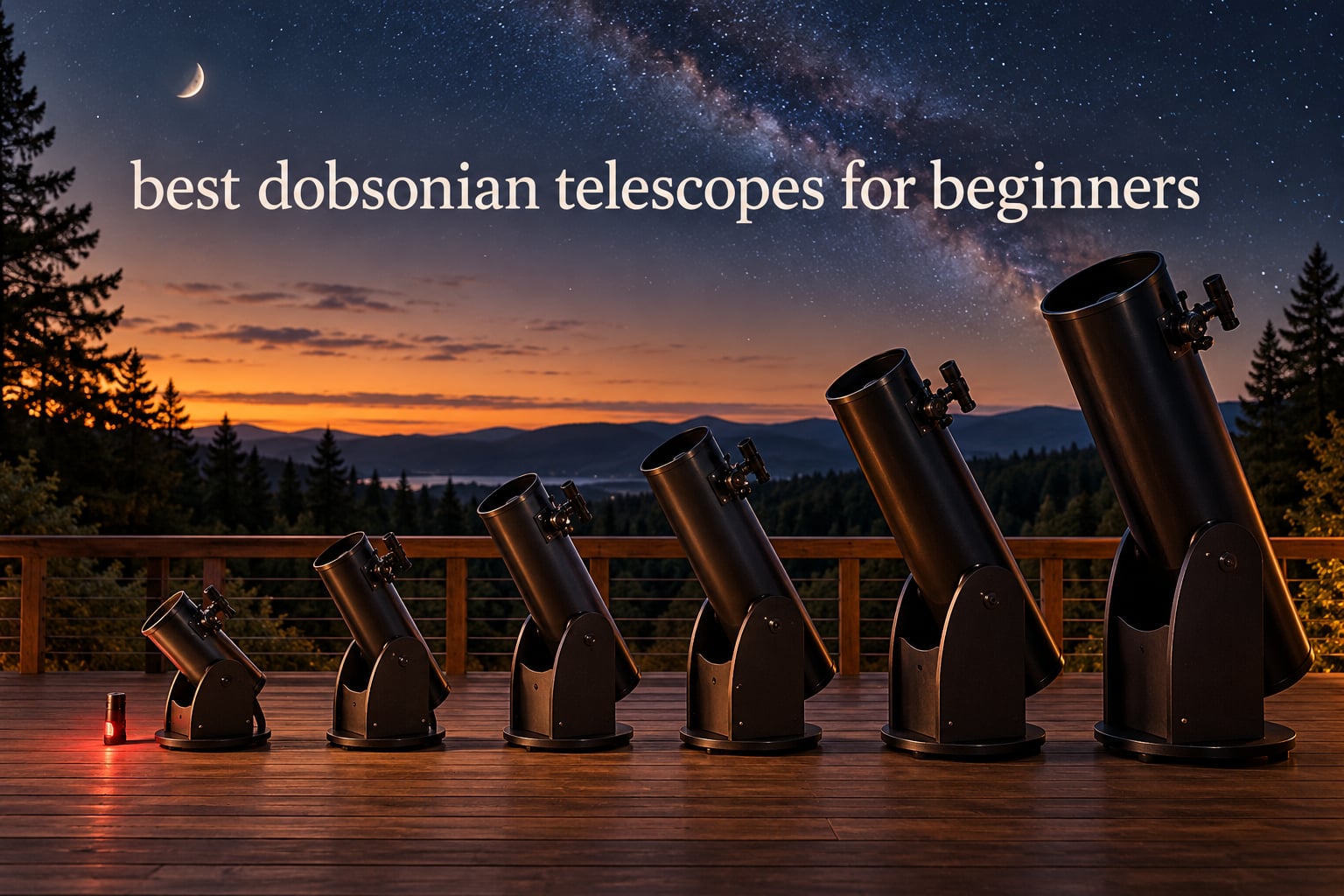
For most beginners, the Celestron FirstScope Signature Series Moon Tabletop Dobsonian is the best entry point in this roundup, because it is the one model here that a new observer can carry out of a closet, set on a kitchen table and use within a minute of opening the box. Its 76mm (3 inch) primary mirror is small by telescope standards, so it will not resolve faint galaxies, but at under five pounds it is genuinely portable, it includes 4mm and 20mm eyepieces, and it has more owner reviews than anything else we cover. The 8-inch Sky-Watcher Classic 200 is the better telescope if you can store and carry one large object, and the Celestron StarSense Explorer 150mm is the better choice if the hardest part of stargazing for you is pointing the thing at the right part of the sky.
A Dobsonian is a Newtonian reflector on a low-to-the-ground alt-azimuth base that you move by hand. That design puts your money into a large mirror instead of into motors, encoders or a plastic SCT shell, which is why a Dobsonian gives you more aperture per dollar than any other telescope design. The whole category is dominated by two names in the US, Sky-Watcher and Celestron, with a handful of smaller brands, and the honest truth is that a well-built 6-inch or 8-inch Dobsonian is a genuinely capable first telescope that many owners keep for decades.
Below we review six beginner-appropriate Dobsonians spanning 76mm to 203mm of aperture, from a four-pound tabletop grab-and-go to a 45-pound full-size classic. We looked at the optical specifications, the mounts, the focusers, the finder solutions, the shipped weight and dimensions, and the patterns that show up in the hundreds of owner reviews behind each listing. We also cover the size decision, the focal ratio question, collimation, and the accessories that actually change what you see on your first night. If you want a different kind of first purchase entirely, our guides to the best aquarium kits for beginners and the best weighted keyboards for beginners cover the setup-friction-first end of the buying spectrum, which is the same instinct that draws some people to a tabletop Dobsonian.
All of the specifications, weights and review patterns below were checked against manufacturer listings in 2026, and we re-check them each time the roundup is updated.
Table of Contents
- The Five Disadvantages Nobody Sells You
- Top 3 Picks for Best Dobsonian Telescopes for Beginners (October 2026)
- Quick Overview: Every Dobsonian in This Roundup in 2026
- 1. Celestron FirstScope Signature Series Moon Tabletop Dobsonian – The One You Will Actually Use
- 2. Sky-Watcher Classic 200 8-Inch Dobsonian – The Biggest Mirror in This Roundup
- 3. Celestron StarSense Explorer 150mm App-Enabled Tabletop Dobsonian – Finding Objects Without a Chart
- 4. Sky-Watcher Heritage 150 Tabletop Dobsonian – The Collapsible Middle Step
- 5. Sky-Watcher Flextube 200 8-Inch Collapsible Dobsonian – The One That Travels
- 6. Celestron NPF FirstScope 76 Tabletop Dobsonian – The Smallest Useful Scope
- What Size Dobsonian Should a Beginner Buy?
- Why Focal Ratio Matters More Than Owners Admit
- Collimation Is a Five-Minute Skill, Not a Chore
- Manual, App-Assisted or GoTo: Which Pointing Style Fits You
- What You Can Actually See From Each Aperture
- Accessories Worth Buying First and What to Skip
- Five Beginner Mistakes That Ruin the First Year
- Frequently Asked Questions
- Final Verdict: Which Dobsonian Should You Buy in 2026?
The Five Disadvantages Nobody Sells You
Every beginner deserves the honest version before spending anything. These are the drawbacks that show up repeatedly in owner conversations, and none of them are fatal, but all of them are real.
No motorised tracking. You point it and you keep it there. At high power on a planet, you will need to nudge the tube every minute or two to follow the sky’s rotation. Almost every owner says this becomes automatic within a few sessions.
Size and weight. A full-size 8-inch Dobsonian is one large, awkward object. The Sky-Watcher Classic 200 in this roundup weighs 45 pounds fully assembled, split as a 20 pound tube and a 25 pound base, and it does not break down any further.
Collimation. The two mirrors need to be lined up with each other and with the focuser. Modern beginner Dobs with slower focal ratios and solid tubes are forgiving, but it is a real maintenance step and a few owners report optics arriving out of alignment.
Object finding is on you. Without electronics, you need a finder and a star chart, or a phone app, to locate anything small. Finding objects, not magnification, is the part beginners underestimate most.
It is not an astrophotography machine. A Dobsonian tracks nothing, so long exposures of deep-sky objects are out of reach without a separate mount and camera setup. Planets and the Moon are the realistic targets, and short video clips through the eyepiece are very achievable.
Top 3 Picks for Best Dobsonian Telescopes for Beginners (October 2026)
Three standouts cover the three ways people actually buy a first Dobsonian: the one you carry outside easily, the one with the biggest mirror, and the one that finds objects for you.

Celestron FirstScope Signature Moon
- 76mm aperture
- 300mm focal length
- 4mm and 20mm eyepieces
- 4.3 lb total

Sky-Watcher Classic 200 Dobsonian
- 203mm aperture
- 1200mm focal length
- 2-inch Crayford focuser
- 45 lb assembled

Celestron StarSense Explorer 150mm
- 150mm aperture
- 650mm focal length
- StarSense app finder
- 25 lb
Quick Overview: Every Dobsonian in This Roundup in 2026
Six models, from a four-pound tabletop grab-and-go to a 45-pound full-size classic. The full spec breakdowns, limitations and one-person carry verdicts are in the individual reviews below.
| Product | Specifications | Action |
|---|---|---|
| Celestron FirstScope Signature Series Moon Tabletop Dobsonian |
|
Check Latest Price |
| Sky-Watcher Classic 200 8-Inch Dobsonian |
|
Check Latest Price |
| Celestron StarSense Explorer 150mm App-Enabled Tabletop Dobsonian |
|
Check Latest Price |
 Sky-Watcher Heritage 150 Tabletop Dobsonian Sky-Watcher Heritage 150 Tabletop Dobsonian |
|
Check Latest Price |
 Sky-Watcher Flextube 200 8-Inch Collapsible Dobsonian Sky-Watcher Flextube 200 8-Inch Collapsible Dobsonian |
|
Check Latest Price |
 Celestron NPF FirstScope 76 Tabletop Dobsonian Celestron NPF FirstScope 76 Tabletop Dobsonian |
|
Check Latest Price |
1. Celestron FirstScope Signature Series Moon Tabletop Dobsonian – The One You Will Actually Use
Celestron FirstScope Signature Series Moon Tabletop Dobsonian Telescope
76mm aperture
300mm focal length
4mm and 20mm eyepieces
4.3 lb total, 9 by 9 by 18 inch
Pros
- Genuinely portable at 4.3 pounds
- you can hold it in your lap
- Excellent Moon views with the included eyepieces
- Good mirror alignment out of the box per owner reports
- Robert Reeves lunar map wrap and eBook included
Cons
- No finder scope included
- Not user-collimatable so alignment cannot be corrected
- Included eyepieces have very little eye relief
- 76mm aperture limits you to the Moon and bright targets
The Celestron FirstScope Signature Series Moon is a 76mm (3 inch) Newtonian reflector on a manual tabletop Dobsonian mount, with 300mm of focal length and a total weight of 4.3 pounds. It is the lightest and smallest telescope in this roundup by a wide margin, and that single fact decides who it suits. If you live in an apartment, if you want to take the telescope to a dark site in the back of a small car, or if your enthusiasm depends on not having to wrestle anything out of a closet, this is the one to buy.
Owner reviews describe it as a charming, well-made starter or gift telescope, and the pattern in the hundreds of reviews behind this listing is consistent. The Moon is the payoff. Multiple owners report spotting Saturn’s rings alongside it, and a good number of reviewers upgraded with a red dot sight or additional eyepieces to make targeting easier once they wanted more than lunar surface detail.
The optical design is a 300mm focal length in a compact tube, which works out to roughly f/4. That is a fast ratio, and it means the 20mm eyepiece gives about 15x magnification for wide, bright views of lunar groups, while the 4mm eyepiece pushes to about 75x for crater detail. The listed field of view is 1.3 degrees, and the rated exit pupil diameter is 3.17mm. Coatings are aluminium with a silicon dioxide overcoat, and the Dawes limit is listed at 1.53 arc seconds.
What is missing matters here. There is no finder scope in the box at all, which means you point by the edge of the Moon and work outward, and finding anything smaller is genuinely tedious. The scope is also not user-collimatable, so if the mirrors are ever knocked out of alignment, there is no adjustment you can make yourself. That is a real limitation for an owner who eventually wants to upgrade, but it is a small one for a gift or a first scope.
Who this scope suits
Buy this if your observing happens on a balcony, a patio or a field within a short walk, and if you want something you can hand to a child without worrying about the weight. It is also the right first telescope for a birthday present for someone who has never used a telescope before, because the Robert Reeves lunar map wrap and the free lunar landscape eBook download give a new observer a way to know what they are looking at on the very first night.
Skip it if the moment you point it at anything fainter than the Moon and go quiet bothers you. At 76mm, deep-sky objects are effectively invisible, and several reviewers mention difficulty locating planets and fainter targets at this aperture. The way to fix that is a red dot finder, and the way not to fix it is to pretend the limitation is not there.
Where the upgrade path goes
The natural next step from a 76mm tabletop scope is a 150mm model, which is exactly the jump both Celestron and Sky-Watcher make in this roundup. The FirstScope’s strengths, portability and simple manual pointing, are exactly what the StarSense Explorer 150mm and the Heritage 150 preserve while roughly quadrupling the light collection. Try the Moon and the craters for a few months first, because most beginners who stick with lunar observing are the ones who buy the larger scope later.
2. Sky-Watcher Classic 200 8-Inch Dobsonian – The Biggest Mirror in This Roundup
Sky-Watcher Classic 200 Dobsonian 8-inch Telescope – Solid-Tube – Simple, Traditional Design – Easy to Use, Perfect for Beginners, White (S11610)
203mm aperture
1200mm focal length
2-inch Crayford-style focuser
45 lb assembled, 49 by 18 by 27 inch
Pros
- 8-inch aperture gives bright high-contrast views
- Patented tension control handles for accurate movement
- Teflon bearings for smooth azimuth rotation
- Comes with 2-inch focuser plus 25mm and 10mm eyepieces and a 9x50 finder
Cons
- Solid tube does not break down for transport or storage
- Heaviest model here at 45 pounds assembled
- Some reviewers report optics arriving out of collimation
The Sky-Watcher Classic 200 is an 8-inch (203mm) solid-tube Dobsonian with 1200mm of focal length, which makes it roughly f/5.9. At 45 pounds fully assembled it splits into a 20 pound tube and a 25 pound base, and the overall footprint is listed at 49 by 18 by 27 inches. This is the telescope in the roundup that shows you what a Dobsonian is actually capable of, and the review consensus is that the views justify the size if you can handle it.
Reviewers consistently praise brightness, contrast and completeness of the accessory package. The included kit is unusually good for a Dobsonian at this level: a 2-inch Crayford-style focuser with a 1.25-inch adapter, 25mm and 10mm super wide-angle eyepieces, and a 9×50 straight-through finder. The mirrors are fully multi-coated borosilicate with reflectivity listed at 94 percent, and the faintest stellar magnitude is rated at 14.2.
On the 1200mm focal length, the 25mm eyepiece gives about 48x magnification and the 10mm gives about 120x. That range covers the Moon’s craters and rilles, Jupiter’s belts and the Galilean moons, and Saturn’s rings with the Cassini Division in good conditions. For globular clusters and bright nebulae, 48x with the wide-field eyepiece is where the aperture really pays off, and a 2-inch diagonal plus a wide-field eyepiece is the most useful single upgrade for this tube.
The mount is the part owners single out most. Sky-Watcher’s patented tension control handles let you move the tube to a target without needing it to be perfectly balanced, and the Teflon bearings make the azimuth rotation smooth and quiet. That combination is what turns a 45-pound object into something a single person can aim rather than wrestle.
Who this scope suits
Buy this if you have a garage, a car, or a ground-level storage spot and you are willing to make the telescope the centre of your observing setup. It is the right answer to the question of which 8-inch Dobsonian is considered the best for a beginner, because the alternative candidates at this aperture are optically and mechanically similar, and this one has the deepest owner-review base of any of them in the category.
Skip it if storage is a genuine problem. The solid tube is the point and the flaw at once: it is rigid, holds collimation well and never needs reassembly, but it also does not break down any further than tube and base. A fourth-floor walk-up with no lift is a poor match, and so is a single small car. The Flextube 200 in slot five exists for exactly that situation.
Where the upgrade path goes
From an 8-inch solid tube, the sensible upgrades are eyepieces rather than hardware. A 2-inch diagonal with a 30mm wide-field eyepiece transforms low-power viewing, and a set of 1.25-inch wide-field, 2x Barlow and a UHC or OIII filter covers faint nebulae from a suburban or moderately light-polluted sky. If your real problem is finding objects rather than seeing them, the fix is a finder or an app-assisted telescope, not more magnification.
3. Celestron StarSense Explorer 150mm App-Enabled Tabletop Dobsonian – Finding Objects Without a Chart
Celestron StarSense Explorer 150mm App-Enabled Tabletop Dobsonian Telescope
150mm aperture
650mm focal length
StarPointer red-dot finder and StarSense app
25 lb, 19 by 19 by 32.5 inch
Pros
- Phone app removes the hardest part of beginner observing
- Patented StarSense star-pattern recognition
- App builds a nightly target list for your location and time
- Simple manual alt-azimuth base that is smooth to point
Cons
- Phone and app needed every session for guided finding
- 25 pounds is bulky for a tabletop model
- App workflow feels less hands-on to some users
The Celestron StarSense Explorer 150mm pairs a 150mm (6 inch) reflector on a tabletop alt-azimuth Dobsonian base with a StarSense dock and a phone app. Its pitch is precise: it removes object finding, which owners and forum regulars alike identify as the real beginner bottleneck, rather than pretending that more magnification solves it. The base is manual, so you still point the telescope yourself, but the phone tells you where to point it.
Reviewers consistently credit the app with clearing the biggest barrier for a first-time owner. The patented StarSense technology uses star-pattern recognition to work out where the telescope is pointing, and the app then lays out on-screen arrows you follow until the target is centred. It also generates a curated list of tonight’s best objects based on your location and time, which is useful because most beginners point at random dark sky and come away disappointed.
Optically it is a 150mm aperture with 650mm of focal length, about f/4.3, with aluminium and silicon dioxide overcoat coatings, a rated Dawes limit of 1.03 arc seconds and a listed field of view of 1.15 degrees. The included eyepieces are 25mm and 10mm Kellner, giving roughly 26x and 65x. Owners report sharp views of the Moon, Jupiter, Saturn, the Orion Nebula and Andromeda, which is a strong showing for a tabletop platform.
The catch is weight and workflow. At 25 pounds with a listed footprint of 19 by 19 by 32.5 inches, this is far bulkier than the small tabletop scopes, and the light-polluted-suburbia-somewhere storage spot is the constraint, not the car. The StarPointer red-dot finder is included alongside the app system, and the box also carries an eyepiece rack, a panning knob and a collimation cap, which tells you the manufacturer expects this to be a working instrument rather than a display piece.
Who this scope suits
Buy this if you have no interest in learning the sky by chart yet, if you want to show a family or a group what a nebula looks like on a first outing, or if you know your session length is the limiting factor rather than your aperture. The app workflow is genuinely effective and the target list removes the trial-and-error that makes many beginners quit in month two.
Skip it if you enjoy the process of learning to navigate the sky. Several users find the app workflow less hands-on than star hopping, and the guided pointing removes the one skill that pays off across every telescope you will own for the rest of your life. It is also the heaviest tabletop model here, at 25 pounds, so it does not solve a small-storage problem.
Where the upgrade path goes
The natural progression is to a full-size 6-inch or 8-inch Dobsonian once you know which objects interest you. Nothing about this platform needs replacing, because the base, the focuser and the collimation cap all carry forward as skills. Treat the app as training wheels you remove after a season, then buy a decent finder and a printed planisphere and start finding things yourself.
4. Sky-Watcher Heritage 150 Tabletop Dobsonian – The Collapsible Middle Step
Sky-Watcher Heritage 150 Tabletop Dobsonian Telescope – Perfect for Beginners, Easy Setup, Portable, and Fun (S11710)
150mm aperture
750mm focal length at f/5
Collapsible tube with RAQ coating
23 lb, 24 by 17 by 17 inch
Pros
- 150mm aperture at a fast f/5 ratio for bright wide fields
- Borosilicate parabolic primary with RAQ coating
- Collapsible tube retains collimation while improving storage
- Tabletop base with rubber feet cuts vibration
- No electronics to learn
Cons
- Collapsed tube is bulkier and more complex to assemble than a solid-tube Dob
- 1.25-inch helical focuser holds less accessory weight than a Crayford
The Sky-Watcher Heritage 150 is a 150mm tabletop Dobsonian with 750mm of focal length, a fast f/5 ratio, weighing 23 pounds in a listed footprint of 24 by 17 by 17 inches. It sits between the small grab-and-go scopes and full-size Dobs, and the review pattern is that owners like the crisp wide-field views from the fast parabolic primary and appreciate the storage benefit of the collapsible tube over a solid one.
The mirror is a borosilicate parabolic primary with Sky-Watcher’s Radiant Aluminum Quartz coating, which is the coating package that most modern value Dobsonians use. The listed field of view is 1.15 degrees, eyepieces are Plossl, and the focuser is a 1.25-inch helical design. That focuser is the main specification you should think hard about, because it limits which accessories you can use later.
On 750mm of focal length, a 25mm eyepiece gives 30x and a 10mm gives 75x, so the working range covers the Moon, the brighter planets and the larger deep-sky objects. The f/5 ratio makes this one of the brighter and widest-field scopes at this aperture, and the rubber feet on the tabletop base reduce vibration, which matters more than most buyers expect when they are trying to focus on Jupiter.
Storage is the argument for this model over a solid 6-inch. The collapsible tube pulls down for storage while retaining collimation, which means the collapsed package fits in a closet or a car boot that a full-length tube will not. The trade is assembly: owners report the collapsed design is bulkier and more complex to put together than a solid-tube Dobsonian, so it rewards someone who will actually use the step-up.
Who this scope suits
Buy this if you want a real 6 inches of aperture but cannot commit to a full-length tube, or if you want one telescope that works for both a balcony and a car trip. It is a strong choice for a family that will use it together, because the wide fields at 30x put several objects in one view, and the fast ratio means dimmer targets are reachable at lower power where tracking and vibration are less of a problem.
Skip it if you will want heavy accessories, a Barlow plus diagonal plus 2-inch eyepiece combination later. A 1.25-inch helical focuser handles a light eyepiece or a small Barlow comfortably, and that constraint shapes every future upgrade. It is also not the telescope to buy if assembly fuss bothers you, because the collapsible design is more steps than a solid tube.
Where the upgrade path goes
The upgrade from here is eyepieces within the 1.25-inch format, or a move up to a full-size 8-inch with a 2-inch focuser if storage ever becomes easier. Resist the temptation to buy a 2-inch diagonal for this scope; the focuser will not take it, and a good 1.25-inch wide-field eyepiece plus a 1.25-inch Barlow will get you most of the way there. The same applies to the StarSense 150mm, which is the app-driven alternative at this aperture.
5. Sky-Watcher Flextube 200 8-Inch Collapsible Dobsonian – The One That Travels
Sky-Watcher Flextube 200 Dobsonian 8-inch Collapsible Large Aperture Telescope – Portable, Easy to Use, Perfect for Beginners (S11700)
203mm aperture
1200mm focal length
Collapsible strut design
40 lb assembled, 29.5 by 20 by 36 inch
Pros
- 8-inch aperture with a tube that collapses for transport
- Strut design keeps collimation through repeated collapse cycles
- Patented tension control handles for easy aiming
- Teflon bearings and 94 percent reflective multi-coated borosilicate mirrors
Cons
- Reassembly needed after every move and collimation shifts if knocked
- Some owners report a difficult initial collimation experience
- Included eyepiece kit has no Barlow lens
- Finder ring set screw can arrive broken
The Sky-Watcher Flextube 200 is the same 203mm aperture and 1200mm focal length as the Classic 200, roughly f/5.9, but the tube collapses down for transport. It weighs 40 pounds fully assembled as a 24 pound tube and a 26 pound base, with a listed footprint of 29.5 by 20 by 36 inches when set up. If you want 8 inches of aperture and you do not have a garage, this is the only way to get both.
Owner reports describe the optics as spectacular once collimation is right, citing the Orion Nebula, Jupiter, Saturn and the Moon as standout targets. The accessory kit is a 2-inch Crayford-style focuser with a 1.25-inch adapter, 25mm and 10mm Plossl eyepieces, and an 8×50 right-angle finder. That finder matters more here than on the Classic 200, because a right-angle finder is far easier to use at the height a collapsed-and-reassembled scope gets set up in awkward rooms.
The friction is the movement. Because the tube collapses, every move means pulling the struts apart and putting them back together, and multiple reviewers note that collimation shifts if the scope is knocked during that process. Several owners also report a difficult first collimation experience specifically on this model, which is worth taking seriously if you have never collimated a telescope before.
The 1200mm focal length gives about 48x with the 25mm and 120x with the 10mm, the same magnification range as the Classic 200 with a slightly different eyepiece design. Magnifications beyond that are available but not useful, because the sky and the mount both give out first. Dobes reward aperture and eyepiece quality, not long focal lengths.
Who this scope suits
Buy this if you will take the telescope to dark sites, if you store it in a flat or a small space, or if you want to hand down a first telescope that a child can carry from a car to a garden without an adult. The collapsible design is widely cited by owners as the reason they chose it over a solid-tube 8-inch, and that is a real, practical reason rather than a preference.
Skip it if you will store it assembled and rarely move it, because the solid-tube Classic 200 does the same job with fewer steps and better collimation stability. The eyepiece kit also lacks a Barlow lens, which owners recommend adding, so budget for that separately. It is also not the model to start on if the idea of a first alignment session sounds daunting.
Where the upgrade path goes
The 2-inch focuser makes this the better long-term platform for eyepieces, and a 2-inch diagonal with a 30mm wide-field eyepiece is the first thing most owners add. A collimation cap and a laser collimator, both cheap, turn the reassembly step into a two-minute check rather than a judgement call. If you decide later that you want powered finding rather than manual pointing, that is a different purchase, not a modification.
6. Celestron NPF FirstScope 76 Tabletop Dobsonian – The Smallest Useful Scope
Celestron NPF FirstScope 76 Tabletop Dobsonian Telescope for Beginners
76mm aperture
300mm focal length
30x from included Plossl
4.3 lb kit in a 13 by 8 by 8 inch footprint
Pros
- Portable and lightweight at 4.3 lb total
- Simple tabletop Dobsonian that needs no setup before use
- 30x magnification gives a clean bright view of the Moon
Cons
- 76mm aperture makes deep-sky objects faint or invisible
- Spherical mirror shows more edge aberration than a parabolic primary
- Only 27 owner reviews
- so long-term reliability is hard to judge
The Celestron NPF FirstScope 76 is a 76mm Newtonian reflector on a tabletop alt-azimuth mount with 300mm of focal length and a 4.3 pound total kit weight, in a listed footprint of 13 by 8 by 8 inches. It is one of the smallest telescopes in the roundup and the least reviewed, with 27 owner ratings, though those ratings carry a 4.3 average with no 1 or 2 star entries at all, which usually means satisfied owners rather than a polarising product.
What owners describe is a grab-and-go Moon instrument. The 10 inch optical tube folds into the base, so the whole thing is one small package that can be carried outside in one hand with no setup before use. At 30x from the included Plossl eyepiece, the Moon fills the field with enough detail for a first look, and that is genuinely the experience the design is built around.
Be realistic about the ceiling. A 76mm aperture collects very little light, so deep-sky objects are faint or effectively invisible, and the spherical mirror produces noticeably more edge aberration than a parabolic primary does. The listed field of view is 1.3 degrees and the rated exit pupil diameter is 11.32mm, which is another way of saying the aperture is the limit rather than the optics. Faintest stellar magnitude is not published for this model, which itself is a clue about the intended use.
Where it beats the Celestron FirstScope Signature Moon is footprint and simplicity. At 13 by 8 by 8 inches it stores anywhere, and the design is as close to set-and-look as a telescope gets. The FirstScope Signature has two eyepieces, a lunar map wrap and a two-year limited warranty, which makes it the better gift; the NPF FirstScope is the cheaper, simpler object.
Who this scope suits
Buy this if the budget is genuinely tight, if the telescope is a loaner or a teaching prop, or if you want something for a child that they can carry themselves without supervision. A 4.3 pound package that needs no assembly is about as low-friction as a first telescope gets, and a bright Moon at 30x will keep a young observer interested longer than a complicated setup would.
Skip it if you expect to see anything beyond the Moon and the brightest planets, or if you want a telescope you will still be using in five years without planning an upgrade. The spherical mirror and the small aperture together cap the ceiling low, and the thin review base makes long-term reliability harder to judge than on the other models here.
Where the upgrade path goes
Treat this as a stepping stone rather than a destination. Its job is teaching you that you like astronomy, and the natural move after that is a 130mm or 150mm tabletop Dobsonian with a parabolic primary and a finder. Nothing you learn here is wasted, because the pointing, focusing and collimation basics transfer straight across. If you want the same portability at a higher ceiling, the Heritage 150 is the same class of instrument done properly.
What Size Dobsonian Should a Beginner Buy?
A 6-inch or 8-inch Dobsonian is the standard answer, and that is where the forum consensus and the manufacturer lineups agree. Below 6 inches you are choosing a Moon instrument; above 8 inches you are buying weight you have to move and store. The two ends of the range are real products for real situations, they are just answering a different question.
Roughly 3 inches of aperture resolves Saturn’s rings as a shape, and 6 inches and up shows the Cassini Division with steady seeing and a suitable eyepiece. That single fact explains most of the size debate, because a 6-inch Dobsonian already crosses the threshold where Saturn stops being a dot.
Light gathering scales with area, not diameter, so doubling the aperture quadruples the light. A 76mm scope is the baseline here. The 150mm models collect roughly four times that, the 203mm models roughly seven times, and that difference is what turns the Orion Nebula from a grey patch into something with visible wings on a decent night.
Weight is the constraint nobody puts in a spec sheet. A 4-pound tabletop scope can be carried in one hand and stored on a shelf. The 23 and 25 pound tabletop models need two hands and a clear table. The 40 and 45 pound full-size models are a two-object problem, a 20-plus pound tube and a 25-plus pound base, that has to be moved as a unit and stored assembled.
Here is the honest version. Buy 8 inches if you have a garage, a car and a partner or strong back. Buy 6 inches if you want most of the capability at half the mass. Buy 3 inches if storage is tight or you want a gift that works the night it is opened. Do not buy 10 or 12 inches for a first telescope unless you already know you will stay in this hobby, because the step up in weight is larger than the step up in view.
Why Focal Ratio Matters More Than Owners Admit
Focal ratio is the focal length of the telescope divided by its aperture, and it is written as f/4, f/5, f/6 or f/8. It controls three things: how wide the field is at a given eyepiece, how much coma you see near the edge, and how much starlight each magnification delivers. It is the single number in a Dobsonian spec list that most beginners ignore and most experienced owners check first.
Slower is better for beginners up to a point. A long f/8 design puts the mirror further from the focal plane, which means the mirrors are far less sensitive to being knocked out of alignment, and the narrower cone of light reduces coma near the edge of the field. The Sky-Watcher Classic 200 at roughly f/5.9 sits in the comfortable middle, and that is part of why a solid tube holds alignment well.
Faster ratios give brighter, wider views per unit of magnification. The Heritage 150 at f/5 and the Celestron StarSense 150mm at roughly f/4.3 both put the same 150mm of aperture into a shorter tube with a wider field, which is why 30x on the Heritage gives a noticeably larger, brighter image than 30x on a long 6-inch f/8. The cost is coma at the edge and a longer tube, and the Heritage’s collapsible design is the direct answer to that length.
The very fast designs in this roundup, around f/4, are compact and bright, which is exactly why they suit small tabletop use. They are not the right choice if you plan to spend time on faint, wide deep-sky objects at high magnification, because the field edges will not be clean.
Collimation Is a Five-Minute Skill, Not a Chore
Collimation means aligning the primary mirror, the secondary mirror and the focuser so the light path runs straight. Every Newtonian needs it eventually, and beginners report it as the most intimidating part of ownership more often than anything else. The good news is that on the beginner-friendly scopes in this roundup, it is genuinely a five-minute job with a cheap plastic cap.
Set the tripod or table in shade, because a laser or bright daylight sky makes it harder to see the reflection. If your scope is a Newtonian, the collimation cap with its hole goes in the focuser where the eyepiece goes, and the collimation screws you are about to turn are the three on the primary mirror cell.
Point the scope at a bright, evenly lit surface such as a sheet of white paper on a wall, a few feet away and above the tube. Look down into the focuser, focus the cap, and centre the reflection of the secondary mirror so it sits inside the outline of the primary mirror reflection. Then look at the three collimation screws in the primary cell and adjust each one by a fraction of a turn until the three reflection dots sit in a straight line, top screw to bottom screw.
Check again with an eyepiece and a bright star. If a star looks like a donut, it is not collimated, and you have a five-minute fix. Owners who report a scope that would not hold collimation, that would bind and then clunk out of focus, are describing a different class of problem, and the cheapest defence is to pick a slower focal ratio and a solid tube. The Sky-Watcher Classic 200 is the most forgiving design here, and the Flextube 200 needs it most often because it gets taken apart.
Manual, App-Assisted or GoTo: Which Pointing Style Fits You
Manual pointing means a finder and a star chart. You centre a bright star in the finder, back off to lower power, and hop to the target. It is the cheapest option and the one that teaches you the sky permanently, and the drawback is real: finding a faint galaxy in a light-polluted backyard is slow work for the first year.
App-assisted pointing, as on the Celestron StarSense Explorer 150mm, uses a phone on a dock and star-pattern recognition to work out where the telescope is aimed. The phone then guides you to targets. It costs you the need to own a phone at the eyepiece and it makes observing less hands-on, and in exchange it removes the single most common reason beginners quit in the first few months.
Motorised GoTo drives the telescope to a target by itself. You pick an object from a catalogue and the motors slew to it, which is the lowest friction of the three and the most expensive, and it also adds a drive base, a power source, a catalogue database and a set of alignment stars to every session. It also adds weight to the base, which matters more than most buyers expect.
For this roundup the practical guidance is simple. Buy manual if you enjoy learning, buy app-assisted if you want results on the first outing, and buy GoTo only if you will use it in a light-polluted city where star hopping is genuinely difficult.
What You Can Actually See From Each Aperture
At 76mm you get a bright, detailed Moon, the phases of Venus, and the brighter moons of Jupiter when the sky is steady. Saturn’s rings are a shape rather than a structure, and deep-sky objects other than the brightest clusters are effectively out of reach. Both 3-inch models here are Moon instruments, and honest expectations are what make them satisfying rather than disappointing.
At 150mm the list opens up. The Moon’s craters and rilles take on real relief, Jupiter shows its belts and the Galilean moons shift visibly over an evening, and Saturn’s rings separate with the Cassini Division appearing under steady seeing. The Orion Nebula shows structure, Andromeda is an oval smudge, and open clusters resolve into individual stars. That is the jump that convinces most beginners the hobby is worth continuing.
At 203mm the same targets get brighter and better resolved, and fainter ones arrive. Multiple globular clusters start to show granular edges rather than looking like fuzzy cotton balls, the Ring and Dumbbell planetary nebulae are reachable from a decent suburban site, and the Orion Nebula grows wings. Under a dark sky, spiral structure in M51 and the wide sweep of the Milky Way start to appear, though steady seeing matters more than raw aperture for planets beyond this point.
Two practical notes. Longer eyepiece focal lengths are your friend at low power because they give a wider field and a brighter image, and astronomy clubs exist because the surface you observe from matters as much as the telescope. Grass beats concrete, and a building or a screen that blocks stray light from a neighbouring window is a free improvement no purchase can match.
Accessories Worth Buying First and What to Skip
A finder is the first thing to buy on any Dobsonian that lacks one, and the Celestron FirstScope Signature Moon is the obvious case here because no finder is included. A right-angle finder that puts the eyepiece at a comfortable angle is worth more than a straight-through one, which is why the 8×50 right-angle finder on the Flextube 200 is a real advantage in awkward rooms.
A second low-power eyepiece is the next best spend. Every scope here ships with something in the 25mm range for wide views, and a 10mm or similar short focal length gives you the power to split Jupiter’s moons and look at lunar craters. A 2-inch diagonal with a 30mm wide-field eyepiece is the single most noticeable upgrade on the two 8-inch models, because it fills more sky at low power than the 1.25-inch route can.
A Moon filter is cheap, clips over the eyepiece, and makes long lunar sessions genuinely more comfortable by cutting brightness. A red light preserves your dark adaptation better than a white torch, and an observing chair matters more than expected, because looking up at a steep angle for an hour is what ends a session early.
What to skip: expensive eyepiece sets sold as upgrades before you know what you need, adapters and diagonals for focusers your telescope does not have, and any bundle that pads the box with a Barlow you will not use. The Heritage 150 and the FirstScope both have 1.25-inch focusers, so 2-inch accessories are wasted money on those. Astrophotography kits, motorised tracking drives and go-to upgrade paths are the three categories where beginners spend the most and benefit the least.
For a completely different kind of beginner setup, our guides to the best snowboards for beginners and the best charcoal grills for beginners cover the same first-purchase decision from different angles.
Five Beginner Mistakes That Ruin the First Year
Believing magnification claims. Department-store scopes advertise 400x or 1000x, and those numbers are meaningless without an aperture and a stable mount to support them. A 76mm scope advertising high magnification simply produces a small, dim, shaky image, and arriving from that background is the most common reason beginners conclude telescopes are bad.
Buying a single-speed focuser. A focuser that only moves fast makes fine focusing on planets impossible. All six models here have manual focusers with reasonable gearing, but check this on any scope outside this list, because it is a genuine deal-breaker for planetary observing.
Settling for a straight-through finder. A straight-through finder forces you to look sideways with your eye. A right-angle finder, or a red-dot finder, is far easier to use and costs very little, so this is a cheap upgrade that pays off on every single session.
Expecting a closed 1.25-inch focuser to accept 2-inch accessories. The Heritage 150 and the 3-inch models cannot take 2-inch diagonals or eyepieces. Buying one anyway is a common and completely avoidable first-year waste.
Observing from concrete under direct light. A hard surface vibrates under every nudge, and a bare light on a patio ruins dark adaptation. Grass, a deck with a screen, or simply putting a hand on your own body to steady yourself all solve this for free.
Frequently Asked Questions
What are the disadvantages of a Dobsonian?
A Dobsonian has no motorised tracking, so you nudge the tube by hand at high power. It is also a large, heavy object that needs storage and transport planning, it needs occasional collimation, finding objects without electronics takes practice, and it cannot do long-exposure astrophotography without a separate mount.
Can you see Saturn with an 8 inch Dobsonian?
Yes, and an 8 inch is where Saturn becomes genuinely rewarding. You will see the rings clearly and, with steady seeing and a suitable eyepiece on a 1200mm focal length, the Cassini Division becomes visible. Titan and the ring shadow are also within reach, and observers report Saturn as one of the standout targets for this aperture.
What is the best Dobsonian telescope to buy?
For a beginner who has to live with the size, the Celestron FirstScope Signature Series Moon is the best Dobsonian to buy, because it is the model in this roundup that works on your first night and asks the least of you in carrying it. If storage and transport are already solved and you want the most aperture, the Sky-Watcher Classic 200 is the stronger telescope.
What size telescope is needed to see Saturn’s rings?
Roughly 3 inches of aperture resolves the rings as a shape. At 6 inches and above you can expect to see the Cassini Division with steady seeing and a high-power eyepiece. That is the main reason 6-inch and 8-inch models dominate beginner recommendations.
Do you have to collimate a Dobsonian telescope?
Periodically, yes. A Newtonian’s primary, secondary and focuser need to be aligned, and the job takes about five minutes with a collimation cap on a beginner-friendly scope. Slower focal ratios and solid tubes are the most forgiving, and models that must be taken apart for transport need checking more often.
Final Verdict: Which Dobsonian Should You Buy in 2026?
The best dobsonian telescopes for beginners come down to storage and honesty about what you will actually carry. Our pick is the Celestron FirstScope Signature Series Moon, the lightest scope here and the one a new observer will still be pointing at a month later. If you can store and move one large object, the Sky-Watcher Classic 200 gives you the most aperture and the most complete eyepiece and focuser package in this roundup. If storage is tight, the Sky-Watcher Heritage 150 keeps real 6-inch aperture in a collapsible tube, and the Sky-Watcher Flextube 200 is the version for anyone who takes the telescope to dark sites.
If you want the first night to produce results rather than a lesson in star hopping, the Celestron StarSense Explorer 150mm removes the hardest part of the hobby and does it well. If the budget is small or the telescope is a gift for someone starting out, the Celestron FirstScope Signature Moon at under five pounds is the easiest first telescope in the roundup, and it is the one most likely to be picked up again next month.
Whichever you choose, start with the Moon, find something you did not expect to see, and buy the finder before you buy the eyepieces. That order works every time.
1 thought on “6 Best Dobsonian Telescopes for Beginners (October 2026) Ultimate Guide”