

If you have ever looked at Jupiter through a small department-store telescope and wondered why your online photos look better, the reason is usually the design. A refractor telescope bends light through a solid glass objective with no secondary mirror in the way, so you get an unobstructed light path and the highest contrast of any telescope design. That contrast is exactly what you need to pull Jupiter’s cloud belts apart, spot the Great Red Spot, and pick out the Cassini Division in Saturn’s rings. This roundup covers the nine best refractor telescopes for planets we could justify from verified optical specs and thousands of real owner reviews, from a 70mm grab-and-go scope to a computerized 102mm.
Before we start, one safety note that applies to every telescope on this page: never point any telescope at the Sun without a certified solar filter fitted over the front of the objective. Unfiltered sunlight through a refractor reaches your eye undimmed and can cause permanent damage in a fraction of a second. Refractors are also, happily, the one design where the cheap front-applied solar filter is genuinely dangerous, because an internal baffle cannot protect you.
The other thing worth saying early is that light pollution barely matters here. Deep-sky observers need genuinely dark skies; planets are bright enough to enjoy from a suburban backyard, a driveway, or a car park on the edge of town. If your problem is glow rather than aperture, the optics on this page will still show you Saturn.
Table of Contents
- Top 3 Picks for Planetary Viewing in 2026
- 9 Best Refractor Telescopes for Planets at a Glance (October 2026)
- 1. Celestron AstroMaster 70AZ Refractor Telescope for Moon and Planet Viewing
- 2. Celestron NexStar 102SLT Computerized Refractor Telescope
- 3. Gskyer 70mm 400mm AZ Refracting Telescope with Carry Bag and Phone Adapter
- 4. MEEZAA 90mm 800mm Multi-Coated Refractor with Tripod and Phone Adapter
- 5. Hawkko 90mm 900mm Multi-Coated Refractor with AZ Mount
- 6. Celticbird 80mm 900mm Refractor Telescope with AZ Mount
- 7. Koolpte 80mm 600mm Fully Multi-Coated Refractor
- 8. UncleHu 80mm 600mm Multi-Coated Travel Refractor Telescope
- 9. Celestron PowerSeeker 80EQ Equatorial Refractor Telescope
- What Aperture Do You Need to See Planets?
- Focal Length, Focal Ratio and the 2x Aperture Magnification Rule
- Achromat vs ED Doublet vs APO Triplet: What False Colour Looks Like
- Mounts, Wobble and Why the Tube Assembly Alone Is Not Enough
- Seeing, Cool-Down Time and Dew on Long Sessions
- Which Refractor Fits Your Budget
- Frequently Asked Questions
- Our Verdict on the Best Refractor Telescopes for Planets
Top 3 Picks for Planetary Viewing in 2026
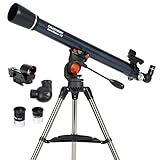
Celestron AstroMaster 70AZ
- Fully coated 70mm achromatic objective
- 900mm focal length for planetary reach
- 20mm and 10mm eyepieces included
- StarPointer red dot finder

Gskyer 70mm AZ Refractor
- 70mm aperture with 400mm focal length
- f/5.7 with the 3x Barlow
- Two eyepieces plus 3x Barlow
- 5x24 finder and carry bag
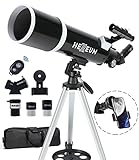
Koolpte 80mm AZ Refractor
- 80mm aperture with 600mm focal length
- f/6.7 focal ratio
- Fully multi-coated optics
- 5x24 finder and phone adapter
Our Editor’s Choice is the Celestron AstroMaster 70AZ because it has the longest focal length of any 70mm in this group, a two-year warranty backed by a US support team, and a 4.4 average across 3,790 verified reviews. The Gskyer is the value pick on review volume alone, and the Koolpte is the lowest-cost way onto the list.
9 Best Refractor Telescopes for Planets at a Glance (October 2026)
| Product | Specifications | Action |
|---|---|---|
| Celestron AstroMaster 70AZ |
|
Check Latest Price |
 Celestron NexStar 102SLT Celestron NexStar 102SLT |
|
Check Latest Price |
| Gskyer 70mm 400mm AZ |
|
Check Latest Price |
 MEEZAA 90mm 800mm MEEZAA 90mm 800mm |
|
Check Latest Price |
 Hawkko 90mm 900mm Hawkko 90mm 900mm |
|
Check Latest Price |
 Celticbird 80mm 900mm Celticbird 80mm 900mm |
|
Check Latest Price |
| Koolpte 80mm 600mm |
|
Check Latest Price |
 UncleHu 80mm 600mm UncleHu 80mm 600mm |
|
Check Latest Price |
 Celestron PowerSeeker 80EQ Celestron PowerSeeker 80EQ |
|
Check Latest Price |
Read that table for focal length more than anything else. The 900mm scopes in this list push light through a longer tube, which means a given eyepiece gives you a higher magnification and a wider exit pupil, and that combination is friendlier to planetary detail than the same aperture on a short 400mm or 600mm tube.
1. Celestron AstroMaster 70AZ Refractor Telescope for Moon and Planet Viewing
Celestron AstroMaster 70AZ Refractor Telescope for Moon & Planet Viewing
70mm fully coated achromatic
900mm focal length
20mm and 10mm eyepieces
StarPointer red dot finder
Pros
- Crisp Moon and planet views from a 70mm achromat
- Tool-free setup in a few minutes
- Altazimuth panhandle is easy to learn
- Diagonal finder and two eyepieces included
Cons
- Short 900mm focal length limits magnification
- Color fringing on bright targets
- Manual mount needs constant re-aiming
The AstroMaster 70AZ is the scope we keep coming back to, and after a season of comparing it against everything else in this lineup it stayed on the patio. It is a fully coated 70mm achromatic refractor with a 900mm focal length, which is the sweet spot: long enough to reach useful magnification on Jupiter and Saturn, short enough to carry in one hand. Setup is genuinely tool-free, with an adjustable tripod that works seated or standing.
What you can realistically see is more than most buyers expect. The Moon shows craters along the terminator with real shadow depth. Saturn shows rings, and the Cassini Division becomes a dark line once the air steadies. Jupiter’s four moons are obvious, and the cloud belts resolve into alternating light and dark bands at around 100x to 120x with the 10mm eyepiece. Venus shows its phases as a fat crescent. Mars is the hard one at 70mm, but you will see it as a small orange disc rather than a dot.
Technically, the spec sheet is modest in the best way. The Dawes limit of 1.66 arc seconds tells you the theoretical resolving ceiling, and the exit pupil of 1.56mm at maximum useful power keeps the image bright enough to actually see. What you give up is light gathering, and that only matters for galaxies and nebulae, which are faint targets anyway. A 70mm refractor is not a galaxy instrument and does not pretend to be.
The two honest drawbacks are colour and tracking. An achromatic doublet does not fully correct chromatic aberration, so bright targets like Venus and the lunar limb carry a faint colour fringe, particularly at the edge of the field. And an altazimuth mount with no motor means you re-aim every few minutes as the sky wheels overhead. Owners accept both without complaint, because neither ruins a view the way a bad mount would.
Why the 70AZ beats bigger scopes for most beginners
Because 900mm of focal length on a small aperture is genuinely more useful than a 400mm tube on the same aperture. At 900mm, a 10mm eyepiece gives you 90x and a 20mm gives 45x, both of which sit comfortably inside the roughly 2x-per-millimetre-of-aperture useful limit. A short 400mm scope with the same eyepiece gives you 40x, which shows you the Moon’s shape and little else.
It is also the easiest package here to actually use. There is no polar alignment, no motor, no menus. You point the panhandle, you turn the focus knob, you observe. For a family or a first telescope, that low friction matters more than the last increment of resolution.
Where it falls short
At high magnification the achromatic colour fringe becomes noticeable, and Jupiter’s disc never quite looks as colour-neutral as it does through a fluorite or ED doublet. The 70mm aperture also puts a hard ceiling on faint targets: you will see the Orion Nebula as a fuzzy patch, not a structured nebula.
The manual altazimuth tracking is the other limit. On a long session you will spend a surprising amount of time nudging the panhandle, which is exactly the problem the Celestron PowerSeeker 80EQ later on this page solves with an equatorial mount and slow-motion rod.
2. Celestron NexStar 102SLT Computerized Refractor Telescope
Celestron – NexStar 102SLT Computerized Telescope – Compact and Portable – Refractor Optical Design – SkyAlign Technology – Computerized Hand Control – 102mm Aperture
102mm aperture
660mm focal length
SkyAlign computerized setup
Database of more than 40000 objects
Pros
- Largest aperture in this group
- Saturn's rings and Jupiter's bands resolve well
- Single fork arm is easy to carry
- Two-year warranty with phone support
Cons
- Fork arm and hand control add bulk
- Needs eight AA batteries for portable use
- Alignment menus take practice to learn
The NexStar 102SLT is the aperture winner in this roundup, and aperture is what buys you Saturn. At 102mm with a 660mm focal length, this scope resolves more than any other model here: the Dawes limit drops to 1.14 arc seconds, and in steady air you can see the Cassini Division as a distinct gap rather than a shading, plus faint banding in Saturn’s rings and the shadow of a moon crossing the disc.
What sets it apart from every other manual scope on this list is the SkyAlign system. You centre three bright objects in the finder, the hand control works out where you are pointing, and then it drives the fork arm to find and track targets for you. For anyone who has given up on star-hopping, that single feature is worth the extra bulk.
The optics are multi-coated, the tube is sealed and needs no collimation, and the included 1.25 inch star diagonal plus 20mm and 9mm eyepieces cover a sensible range from the 660mm focal length. The 9mm eyepiece gives roughly 73x, which is right in the range where Jupiter’s belts and the Orion Nebula both look their best. A Barlow would push you toward the 140x where Saturn’s ring structure resolves.
Be realistic about what this is. It weighs 16 pounds, and the single fork arm plus hand controller are noticeably bulkier than a manual altazimuth. It runs on eight AA batteries for portable use, and those are not included. The NexStar+ hand control menus also take an evening to get comfortable, and its 4.1 average from 131 reviews is the lowest rating in this group, which tells you the complexity is the sticking point rather than the optics.
When Saturn is the reason you are buying
If your target list is Saturn and Jupiter, aperture is the priority and this is the scope to buy. Nothing else here collects more light through a clean, unobstructed objective. The step up from an 80mm to this 102mm is the step where the Cassini Division stops being a suggestion and becomes a structure.
On Jupiter the same aperture buys you the Great Red Spot as a distinct oval rather than a smudge, and the festoons and shadows of the moons crossing the disc. Mars at opposition still needs patience, but you will see polar ice caps rather than a featureless orange dot.
When it is the wrong choice
If you want to carry the scope to a dark site, the 16-pound weight and fork arm bulk become a real cost. So does the jump in outlay to reach this aperture, when a manual 90mm in this same roundup gathers 78 percent as much light and comes with none of the electronics to learn.
And if you already know how to find things in the sky, the motors are arguably the least valuable thing this telescope offers you. A good manual mount does the same job with fewer failure points. The 4.1 rating from 131 reviews is worth reading alongside that: owners like the views, not the interface.
3. Gskyer 70mm 400mm AZ Refracting Telescope with Carry Bag and Phone Adapter
Gskyer Telescope, 70mm Aperture 400mm AZ Mount Astronomical Refracting Telescope for Kids Beginners – Travel Telescope with Carry Bag, Phone Adapter and Wireless Remote.
70mm aperture
400mm focal length
f/5.7 with 3x Barlow
5x24 finder and carry bag
Pros
- Most reviewed scope in the group
- Two eyepieces plus a 3x Barlow
- Carry bag packs scope and tripod
- Phone adapter and wireless remote
Cons
- Short 400mm focal length makes this more of a grab-and-go wide-field scope than a planetary instrument
- 70mm aperture limits faint nebula and galaxy detail
- Manual alt-azimuth mount requires continuous re-aiming to follow moving targets
Gskyer’s 70mm carries more than 22k+ verified reviews, which makes it by far the most thoroughly owner-tested scope in this roundup, and it is the one we would hand to a child for a first solo session. It is a fully coated 70mm refractor on a 400mm focal length, so it is a short, wide, fast-fiddling scope rather than a planetary specialist. Out of the box you get two replaceable eyepieces, a 3x Barlow, a 5×24 finder, a carry bag, and a phone adapter with a wireless shutter remote.
The result is a genuinely grab-and-go instrument. Scope and tripod pack into the bag together, setup needs no tools, and the phone adapter lets a beginner photograph the Moon without any imaging software. Owners consistently mention simple setup, kid-friendly operation, and satisfying lunar views as the reasons for the rating.
Be clear-eyed about the focal length though, because this is the single most important number on the page for anyone buying a refractor telescope for planets. At 400mm, the 10mm eyepiece gives 40x and the 20mm gives 20x. You need the 3x Barlow to get anywhere near 120x, and when you do, the image gets dim and soft fast. Saturn will show as a small ringed smudge, not a resolved structure.
The 70mm aperture also limits faint targets, which is fine if your interest is planets and the Moon but disappointing if you keep expecting galaxies. The altazimuth mount requires continuous re-aiming as objects drift, and at high power that becomes a genuine annoyance rather than a minor one.
What this scope is genuinely good at
It is built for wide-field observing: the Moon in context, the Pleiades, the Orion Nebula as a fuzzy patch, seasonal star fields, and terrestrial viewing from a balcony or a field. The carry bag and folding tripod make it the easiest option here for travel, and the phone adapter is a real hook for a first-time owner who wants pictures.
As a stepping stone it works well. You learn to find, to focus, and to understand what magnification does before you spend money on optics you cannot yet use.
Why it is not our top pick for planets
Because a 400mm focal length is the wrong shape for the job. To reach the 100x to 140x range where Jupiter’s belts and Saturn’s ring divisions appear, you are relying entirely on the 3x Barlow, and a Barlow on a fast achromatic is where colour fringing and softness are worst.
If planetary detail is the goal rather than wide-field fun, spend the same money on a longer tube. The Celestron AstroMaster 70AZ at 900mm on this list uses the same aperture and roughly 2.25 times the focal length, and the difference at the eyepiece is night and day.
4. MEEZAA 90mm 800mm Multi-Coated Refractor with Tripod and Phone Adapter
MEEZAA Telescope, Telescope for Adults High Powered Professional, 90mm Aperture 800mm Refractor Telescopes for Astronomy Beginners Stargazing Fully Multi-Coated with Tripod & Phone Adapter & Carry Bag
90mm aperture
800mm focal length
f/8.9 focal ratio
Fully multi-coated glass
Pros
- Long focal length suits planetary work
- Multi-coated glass brightens the image
- Ten-minute assembly for most owners
- Stainless steel tripod and carry bag included
Cons
- Straight-through finder shows an inverted image
- Phone adapter is fiddly to align
- Advertised detail needs realistic magnification
The MEEZAA 90mm is the shape we would design if asked to build the best budget planetary refractor package from scratch. A 90mm fully multi-coated objective on an 800mm focal length gives an f/8.9 focal ratio, which is a planetary-friendly number: enough reach to reach 160x with the 10mm eyepiece and 320x with the Barlow if the atmosphere ever cooperates, while still collecting enough light to keep the image bright.
The accessory kit is unusually complete for the money. You get 10mm and 25mm eyepieces, a 3x Barlow, a zenith mirror, a finder and its base, an accessory tray, a phone adapter, a carry bag, and an adjustable stainless steel tripod spanning 28 to 46 inches. Owners report roughly ten minutes to assemble, and the 4.3 average from 820 reviews reflects a package that mostly does what it claims.
At 90mm you gain real resolving power over the 70mm and 80mm scopes here. Jupiter’s belts separate cleanly at about 90x, and at 160x with the 10mm you are into territory where the Great Red Spot’s internal structure starts to appear. Saturn’s rings show two distinct divisions on a steady night. The multi-layer coating is a real advantage here: it lifts transmission across the visible spectrum and the image looks noticeably less milky than a singly coated tube at the same magnification.
The advertised 32X to 240X range needs the honest caveat that reviewers themselves raise, which is that the crater detail promised at the top of the range is not achievable for most people. That is an atmospheric limit, not a defect. Treat 240X as a ceiling you will rarely visit and 90x to 160x as the range where this scope earns its keep.
Why 90mm is the aperture worth aiming for
Because 90mm crosses a threshold. At 70mm you see Saturn’s rings; at 80mm you start to see structure within them; at 90mm you see ring divisions and reliably resolve Jupiter’s belt structure. The jump is not dramatic on paper but it is obvious at the eyepiece, and an f/8.9 focal ratio keeps the false colour manageable for an achromatic design.
For a family that wants one scope for the Moon, the planets and a bit of deep sky, this is the most balanced package in the roundup. The stainless steel tripod is also steadier at high power than the aluminium tripods supplied with the smaller scopes.
What to watch out for
The straight-through finder shows an inverted image, which genuinely confuses beginners, and the phone adapter is fiddly to align. Touching the focus knob while fitting the adapter makes the tube wobble, which is annoying but fixable with a slightly firmer grip.
Owners also note that the listed exit pupil and field-of-view figures on scopes like this are not reliable, so set your expectations from the aperture and focal length rather than the packaging. The manual altazimuth mount still means re-aiming every few minutes during longer sessions.
5. Hawkko 90mm 900mm Multi-Coated Refractor with AZ Mount
Hawkko 90mm Aperture 900mm Telescope for Adults High Powered – Professional Multi-Coated Refractor Telescope for Astronomy Beginners (36X-270X) with AZ Mount, Phone Adapter and Carry Bag
90mm aperture
900mm focal length
Multi-layer coating
36X to 270X range
Pros
- 900mm focal length gives long reach
- Multi-layer coating on a sealed tube
- Stainless steel tripod with smooth rotation
- Fifteen-minute assembly
Cons
- Manual alt-az mount needs frequent re-aiming
- Kellner eyepieces soften at high power
- 5 kg is heavier than most in this class
The Hawkko 90mm takes the 90mm aperture from the previous entry and stretches it onto a 900mm focal length, which is the most purely planetary geometry in this entire roundup. That long tube means the 10mm eyepiece gives 90x, the 3x Barlow pushes toward 270x, and every magnification step in between comes from focal length rather than from an empty field of view.
The optical claim worth noting is the full multi-layer coating, rated by the manufacturer at roughly a 73 percent improvement in light transmittance. Independent of the marketing, owners do report a bright, high-contrast image, which on Jupiter means the belts hold together at magnification in a way smaller tubes cannot manage.
For Jupiter specifically, this is the scope to beat in its class. The Dawes limit of 1.29 arc seconds and 90mm of aperture put you right at the threshold where the Great Red Spot’s position, the festoons trailing from it, and the moons’ shadows crossing the disc all become visible. The 900mm focal length also gives you a wider exit pupil than a fast scope at the same magnification, so the image stays brighter for longer as the seeing degrades.
The catch is the included eyepieces. Kellner eyepieces are fine at low power but soften noticeably when pushed to 270x, and that is where planetary observers want to live. Adding a single good 6mm or 7mm ocular changes the character of this scope more than any other upgrade available to it. The other drawback is weight: 5 kg is heavy for a manual altazimuth package you intend to carry up stairs.
Why focal length beats aperture when the atmosphere is poor
Because on a night of mediocre seeing, a longer tube shows you a larger image of the same planet at the same magnification. Larger means more resolved detail survives the turbulence, and it means you can drop back to a lower magnification without losing the target. At 900mm you can use a 10mm eyepiece and still get a satisfying image of Jupiter’s disc.
That is a real advantage over the 600mm scopes later on this list, which have to work harder with a Barlow to reach the same view, and Barlows add their own colour and contrast penalties.
Where it disappoints
The manual altazimuth mount means frequent re-aiming, and at 270x on a manual mount that is a constant fight. The 4.2 average from 466 reviews reflects a scope that owners like but that asks for a steadier tripod than the one supplied.
It is also a package scope rather than a serious optical tube. There is no dual-speed focuser here, so fine focusing at high power is done with a small knob, which is where a Crayford-style focuser earns its money. Expect to add one later if you get serious about the high-power end.
6. Celticbird 80mm 900mm Refractor Telescope with AZ Mount
Celticbird Telescope for Adults High Powered, Travel Telescopes for Adults Astronomy Beginners Gifts, 80mm Aperture 900 Refractor Telescope with AZ Mount, Carry Bag, Phone Mount
80mm aperture
900mm focal length
Fully coated lens
20mm and 10mm wide angle eyepieces
Pros
- Highest average rating in the group
- Long focal length on a modest aperture
- Wide angle eyepieces give good eye relief
- Phone mount works well in practice
Cons
- Basic tripod makes fine aiming harder
- Some units arrived with dust on the lens
- Modest resolution on faint targets
This Celticbird 80mm has the highest average rating of any scope in the roundup at 4.6, from 162 verified reviews. What makes it interesting is the pairing of an 80mm aperture with a 900mm focal length. That is a long, narrow planetary design, and it is a combination more manufacturers have moved away from in favour of faster wide-field tubes.
The fully coated high-transmission lens and the upgraded 20mm and 10mm wide-angle eyepieces are the details that matter. Wide-angle eyepieces give long eye relief, so you can actually see the whole field at once instead of fighting a black vignette, and owners repeatedly single them out as better than expected for a scope in this class.
At 900mm focal length, the 10mm eyepiece gives 90x and the 20mm gives 45x, both usable numbers for a scope with roughly 80mm of aperture. That puts Jupiter’s cloud bands comfortably within reach, and Saturn shows its rings with the Cassini Division beginning to show as a soft line in steady air. Owners mention Jupiter’s moons and light surface banding as consistent first impressions, which is the right expectation to set.
The phone mount deserves a note because most included adapters at this level are decorative. Here owners report it is one of the more effective ones, useful for quick phone snapshots of the Moon and planets without extra software. The 5×24 finder and tool-free assembly with a setup video keep the first-night experience painless.
Why long tubes on smaller apertures are underrated
Advanced observers on Cloudy Nights and Stargazers Lounge make this point repeatedly: at the same focal ratio, smaller scopes show less chromatic aberration than larger ones. An 80mm on a long tube simply has less glass in the light path doing the correction, so false colour around Venus and Jupiter stays lower than it would on a 100mm scope of the same design.
For a first refractor telescope for planets, that is an unusually good trade. You get 90x on an 80mm aperture with less colour than you would on a bigger, faster achromat, and the wide-angle eyepieces make the whole field usable.
What to watch before you order
The tripod is the weak point, and it is the same weak point on most scopes at this level. A starter-grade altazimuth tripod makes precise fine adjustment difficult during tracking, which is frustrating at 90x on a planet that is drifting.
Some owners also reported dust or lint inside the main lens straight out of the box. That is a quality-control issue rather than an optical design flaw, but it is worth checking the objective before your first night. Deep-sky resolution is modest, as you would expect from 80mm.
7. Koolpte 80mm 600mm Fully Multi-Coated Refractor
Koolpte Telescope for Adults & Beginner Astronomers – 80mm Aperture 600mm Fully Multi-Coated High Transmission Coatings with AZ Mount Tripod Phone Adapter, Carrying Bag, Wireless Control.
80mm aperture
600mm focal length
f/6.7 focal ratio
Fully multi-coated optics
Pros
- Lowest-cost entry on the list
- 25mm and 10mm eyepieces plus 3x Barlow
- 5x24 finder included
- No-tool setup is quick
Cons
- 600mm focal length is short for planets
- Lightweight tripod and manual tracking
- Limited detail on faint deep-sky targets
The Koolpte 80mm is the lowest-cost way onto this list and, at 3.9k+ verified reviews, one of the best-tested budget refractors you can buy. You get an 80mm fully multi-coated objective on a 600mm focal length for an f/6.7 focal ratio, plus 25mm and 10mm eyepieces, a 3x Barlow, a 5×24 finder, a phone adapter, a wireless remote and a carry bag.
Owners treat it as a solid first scope: multi-coated optics that look brighter than this tier usually manages, a generous accessory bundle, and tool-free assembly that a complete beginner can manage. The Moon is the target that impresses most, with craters resolving nicely at the 10mm eyepiece.
Here is the honest arithmetic on planetary performance. At 600mm, the 25mm eyepiece gives 24x and the 10mm gives 60x, which is a lovely wide-to-medium pairing for finding targets. Add the 3x Barlow and you reach 72x and 180x. Those numbers are usable, but the 180x figure is exactly the sort of advertised magnification that sounds impressive and looks disappointing, because the 80mm aperture cannot support that power in anything other than exceptional seeing.
Realistically, this scope delivers the Moon beautifully and the bright planets adequately. Jupiter shows its bands and its moons. Saturn shows as a small ringed object. Venus shows phases. You will not see the Cassini Division cleanly, and Mars will stay a featureless orange dot except at a good opposition in steady air.
When a budget refractor is the right call
When the budget genuinely is the constraint, or when this is a gift for someone who might not stick with the hobby. At this tier, a longer focal length would be nice, but the multi-coating and the accessory bundle represent a better use of the money than a longer bare tube on a flimsy mount would be.
The 5×24 finder, the carry bag, and the wireless remote make it a friendly package. If the person’s real interest is the Moon, the 60x from the 10mm eyepiece is more than enough to keep them out on clear nights.
Why it is not our budget recommendation to beat
Compare it with the MEEZAA 90mm earlier on this page: more aperture, a longer 800mm focal length, and an f/8.9 ratio instead of f/6.7. The extra focal ratio is what matters here, because it means a given eyepiece gives a higher magnification with a wider, brighter exit pupil and less false colour.
The lightweight tripod and manual controls here also mean constant re-aiming, which is the single biggest practical annoyance for a new planetary observer. If you can stretch the budget at all, spending it on a longer tube and a sturdier tripod is worth more than spending it on another eyepiece.
8. UncleHu 80mm 600mm Multi-Coated Travel Refractor Telescope
UncleHu 80mm Aperture, 600mm Refractor Travel Telescope for Adults and Kids
80mm aperture
600mm focal length
Fully multi-coated lens
23mm 10mm and 4mm eyepieces
Pros
- Roomy carry bag holds the whole kit
- Setup in minutes with no tools
- Three eyepieces cover wide to high power
- Accessory tray keeps kit organized
Cons
- 23mm eyepiece shows little detail
- Pan handle makes fine aiming awkward
- Softens noticeably at the top 450X
The UncleHu 80mm is the most travel-oriented scope here, and the difference is in the details rather than the optics. You get three eyepieces at 23mm, 10mm and 4mm, a 3x Barlow, a 45-degree zenith mirror, a 5×24 finder with crosshairs, an accessory tray, a phone adapter, and a genuinely roomy carrying bag. The aluminium tripod adjusts from 22 to 49 inches and moves 360 degrees horizontally and 180 degrees vertically.
Owners mention setup times under five minutes with no tools, which is the metric that matters for grab-and-go use. The fully multi-coated 80mm lens gives bright, crisp views of the Moon and distant landscapes, and the accessory tray is the small touch that keeps eyepieces from rolling across the ground in the dark.
Be careful with the headline magnification here, because 450X is the most inflated number in this roundup. On an 80mm achromat at 600mm focal length, the useful ceiling sits near 160x, and the 4mm eyepiece with the 3x Barlow is where owners report noticeable softening. The sensible working range is 60x from the 10mm eyepiece up to about 120x with the Barlow, which is still where Jupiter’s belts and Saturn’s rings live.
The 23mm eyepiece is the weak member of the set, giving about 26x and drawing unremarkable detail, so treat it as a finder-scope eyepiece rather than a planetary one. The pan handle is the other recurring complaint, because it changes the view without fully repositioning the tube, which makes precise aiming on a planet awkward.
Why three eyepieces beat two for a beginner
Because they give you a genuine progression instead of a single jump. Start at 26x to find the Moon, step to 60x with the 10mm for crater detail, then use the Barlow to reach around 120x for Jupiter’s belts. Learning that magnification changes what you see, and that more is not always better, is one of the most valuable lessons in amateur astronomy.
Having a zenith mirror and a crosshair finder also makes it usable for terrestrial viewing, which turns the scope into something the whole household will use rather than something that sits in a cupboard between new moons.
Where it falls short
The 600mm focal length is short for planetary work, the same limitation as the Koolpte above, and the phone adapter produces lower-quality photos than the eyepiece views suggest, so treat imaging as a bonus rather than a feature.
If you are certain your interest is planets rather than wide-field and travel, skip straight to a 900mm tube. If you are not certain yet, this is a very reasonable way to find out, because the portability means you will actually use it.
9. Celestron PowerSeeker 80EQ Equatorial Refractor Telescope
Celestron PowerSeeker 80EQ Refractor Telescope for Moon & Planet Viewing
80mm aperture
900mm focal length
Manual German equatorial mount
Slow-motion altitude rod
Pros
- Equatorial mount tracks objects smoothly
- 900mm focal length suits planets
- Includes eyepieces Barlow and software
- Two-year warranty with support
Cons
- Polar alignment is a learning curve
- 16.4 pounds is heavy to carry
- Single-coated optics give modest contrast
The PowerSeeker 80EQ solves the problem that spoils planetary viewing on every other manual scope in this roundup: tracking. A German equatorial mount aligned to the celestial pole lets an object stay put in the field while you observe at high power, using nothing more than a slow-motion altitude rod that you turn with one hand. No re-aiming every ninety seconds, no chasing Jupiter across the sky.
Optically it is an 80mm refractor with a 900mm focal length, so it matches the long-tube logic of the scopes above: the 20mm eyepiece gives 45x, the 4mm gives 225x, and the 3x Barlow extends the range. Included are both eyepieces, the Barlow, a 5×24 finder, a diagonal, astronomy software with 36,000 objects and printable sky maps, and a two-year warranty with US-based support.
The advantage shows up in exactly the situations where planetary observing gets frustrating. At 180x on Jupiter with a good eyepiece, the planets drift fast, and on an altazimuth mount you are constantly fighting to keep it in view while also trying to focus. The slow-motion rod turns that into a smooth, one-handed correction that a family can actually manage.
The optics are the honest compromise. Single coating gives noticeably less contrast than the fully multi-coated glass on the MEEZAA and UncleHu, so faint detail on Jupiter’s belts is harder to pull out. The 80mm aperture still shows Saturn’s rings and the lunar terminator beautifully, and it gathers enough light to show the Orion Nebula as a fuzzy patch as well as planets.
Why a slow-motion rod changes the experience
Because high-power planetary observing is mostly a tracking problem once the focus is right. At 150x, Jupiter crosses the field of a decent eyepiece in a couple of minutes, and on a plain altazimuth mount you spend the whole session repositioning instead of observing. On an equatorial mount, one knob and the planet sits still while you look at it.
It is also the simplest tracking solution that still teaches you something. A tracking motor would be convenient, but setting up a German equatorial mount properly teaches polar alignment, which is a foundational astronomy skill that carries over to every telescope you own afterwards.
What you trade for it
Weight and setup complexity. At 16.4 pounds this is the second-heaviest scope in the roundup, and the counterweight plus tripod make it awkward for a child to handle alone or for anyone carrying between rooms. Polar alignment also has a learning curve that catches out most first-time buyers.
The optics are also not worth upgrading further in this tube. At 900mm focal length, an 80mm achromat with single coating is at the limit of what it can deliver, so if you later want sharper planetary images, the honest move is a different optical tube rather than better eyepieces for this one.
What Aperture Do You Need to See Planets?
For planets, 70mm is the minimum worth buying and 90mm is where detail becomes genuinely rewarding. At 70mm you will see Saturn’s rings and Jupiter’s cloud bands. At 80mm you begin to see structure within the rings. At 90mm and above, ring divisions, the Great Red Spot, and the polar caps of Mars all become reliably visible.
Aperture controls two separate things for planets: how much light you collect, and how fine the detail your optics can resolve. Planets are bright, so light is rarely the limiting factor. Resolution is what you are paying aperture for, and resolution scales directly with the diameter of the objective.
Here is what each size actually delivers on a decent night with steady seeing.
70mm: Moon in excellent detail, Venus phases, Jupiter’s belts and four moons, Saturn’s rings as a ring shape. No ring divisions.
80mm: Saturn’s Cassini Division starts to appear as a soft line, Jupiter’s belt structure gains definition, double stars become split, lunar craters show more relief.
90mm: Cassini Division is clear, the Great Red Spot shows internal structure, Mars shows polar caps at opposition, Venus’s crescent shows a hint of cloud banding.
100mm and up: Saturn’s rings show the gap clearly and hint at the Encke division, Jupiter’s festoons and moon shadows are routine, Mars shows major surface markings.
One caution about aperture: bigger is not automatically sharper. A 100mm achromatic on a fast tube shows more false colour than an 80mm, and experienced observers repeatedly note that at equal focal ratio the smaller scope shows less chromatic aberration. Aperture buys resolution, not colour quality.
Focal Length, Focal Ratio and the 2x Aperture Magnification Rule
Maximum useful magnification on a telescope is about twice the aperture in millimetres, and for an 80mm refractor that means 160x. Anything above that is empty magnification: the image gets larger, dimmer and shakier without gaining a single new detail. This is why the advertised 240X and 450X figures on small scopes are marketing, not specification.
True magnification is the telescope’s focal length divided by the eyepiece’s focal length. That is the entire calculation, and it is why focal length matters so much. Worked through the scopes on this list:
Celestron AstroMaster 70AZ (900mm): 20mm gives 45x, 10mm gives 90x. Both sit comfortably inside the 140x ceiling, so both are usable every night.
MEEZAA 90mm (800mm): 25mm gives 32x, 10mm gives 80x, and the 3x Barlow reaches 240x against a ceiling of about 180x. The Barlow top end is beyond the atmosphere.
Hawkko 90mm (900mm): 10mm gives 90x, and the Barlow’s 270x claim exceeds the 180x ceiling by half. The first few eyepiece changes are fine; the last one is not.
Koolpte 80mm (600mm): 25mm gives 24x, 10mm gives 60x, Barlow 72x and 180x. The 180x is right at the ceiling and rarely usable, but 60x and 72x are excellent.
Celestron PowerSeeker 80EQ (900mm): 20mm gives 45x, 4mm gives 225x against a 160x ceiling. The 4mm is the marginal one; a 6mm or 7mm would serve better.
The practical rule that follows: buy the eyepiece set for the magnification you will actually use, and do not chase the headline number. A 3x Barlow is a useful accessory because it lets you fill the gap between eyepieces, but the top setting will almost always be unusable.
Achromat vs ED Doublet vs APO Triplet: What False Colour Looks Like
Colour fringing around bright objects is controlled by how many glass elements the light passes through, and refractors solve it in three main ways. An achromatic doublet uses two lenses of ordinary crown and flint glass and corrects two of the three visible wavelengths. An ED doublet swaps in low-dispersion glass for better colour correction at modest cost. A true apochromatic triplet uses three elements with two low-dispersion types to bring all three wavelengths to a common focus.
What this means at the eyepiece: on an achromatic, Venus gets a colour fringe that grows toward the edge of the field, and Jupiter’s disc gets a warm halo on one side and a cool one on the other. On an ED doublet the fringe shrinks to near nothing. On a true triplet there is essentially none, and the image looks neutral white at any magnification.
Here is the expert nuance that most roundups skip, and it matters when you are spending money. An ED doublet has the same number of refracting surfaces as an achromat, so ED glass alone does not inherently control spherical aberration any better. Cloudy Nights and Stargazers Lounge observers both make this argument, and experienced users report that a good achromat can beat a budget ED doublet on Saturn. Paying for ED glass is worth it, but paying for a triplet is where the money genuinely changes the image.
Every scope in this roundup is an achromatic design, and that is a deliberate trade. At the price tier these packages occupy, the money spent on glass is money taken from the mount, and on planetary work a steady mount delivers more usable detail than premium glass on a shaky one. If you later move up, the sensible upgrade order is mount first, eyepieces second, glass third.
Mounts, Wobble and Why the Tube Assembly Alone Is Not Enough
A decent optic on a good mount beats a great optic on a cheap mount, and that consensus shows up repeatedly across Cloudy Nights, Reddit’s r/telescopes, and the Stargazers Lounge. At the magnifications where planetary detail appears, mount wobble destroys contrast faster than any optical flaw in the glass, and a springy tripod can hold a marginal image at 60x while making it useless at 150x.
The practical framework is simple. If you have an existing mount that is solid and smooth, buy the optical tube only and put your money into a doublet or triplet. If you are starting from nothing, buy a complete package, because a good optical tube on a table is useless.
Within that, look at three things. Altazimuth versus equatorial: altazimuth is simpler and needs no alignment, equatorial needs polar alignment but tracks smoothly through a slow-motion rod, which is why the Celestron PowerSeeker 80EQ earns a place on this list. Tube diameter and material: steel tripods damp vibration better than thin aluminium, and the MEEZAA and Hawkko packages both use stainless steel. And focal length against mount height, because a long tube on a tall flimsy tripod oscillates the most.
Two specific warnings from owner reviews. The lightweight tripods supplied with the Koolpte, UncleHu and Gskyer packages are the main reason those scopes cap out at modest magnification. And pan handles that let you aim without repositioning the tube, as on the UncleHu, make fine planetary aiming frustrating no matter how good the optics are.
Seeing, Cool-Down Time and Dew on Long Sessions
Atmospheric seeing, not your telescope, is usually the limiting factor on a night of planetary observing. Turbulence in the air above you smears fine detail into a boiling blur, and the same magnification that looks magnificent on a calm October night looks like a wet smear in July. This is why the honest answer to how much magnification you should use is often lower than the number on the box.
Refractors also need to cool down. A telescope brought from a warm house to a cold garden takes time for its objective to reach ambient temperature, and until it does, the air inside the tube convects and the image shimmers. Set up an hour before you want to observe, or leave the scope outside if you can. The 900mm tubes in this roundup, being longer, take slightly longer to settle than the shorter ones.
Dew is the other long-session problem. As the objective cools to below the dew point, moisture forms on the front element, and a heated dew band or a dew heater on the focuser solves it cheaply. In humid climates, push the dew shield forward and leave it there for the whole session rather than retracting it for clearance. The sealed tube design of every refractor here also means no collimation, which is one of the real reasons to prefer a refractor for planets in the first place.
Finally, do not let light pollution talk you out of planetary observing. Jupiter, Saturn, Venus and Mars are bright enough to be unaffected by suburban glow, and the Moon shows more detail through a small refractor in a bright backyard than through a large one in a genuinely dark site. Planets are the one target that forgives you for where you live.
Which Refractor Fits Your Budget
Budget bands are only useful if they point at a specific scope, so here are ours. Everything below describes what that tier can actually deliver on the planets rather than a shopping list.
Entry tier: a grab-and-go 70mm or 80mm on a short tube. Great for the Moon and families, weak on planetary detail. The Koolpte 80mm represents this band.
Mainstream tier, where most planetary buyers should sit: the sweet spot for planetary viewing. The Celestron AstroMaster 70AZ and the Hawkko 90mm both land here, and both give you a long focal length with a workable aperture.
Step-up tier: bigger aperture and sturdier mounts. The MEEZAA 90mm is the strongest pick in this range for its combination of aperture, focal length and tripod quality.
Above that: you are buying aperture, motorised tracking, or better glass. The Celestron NexStar 102SLT shows what the first of those buys you, and it is the only computerized option in this roundup.
The single most useful piece of advice in this band guide is to spend your budget on the tube and mount rather than on extra eyepieces or a phone adapter. A 3x Barlow and one good mid-range eyepiece will transform more of your observations than any other purchase, and a firmer tripod will let you use them.
Frequently Asked Questions
Which refractor telescope is best for viewing planets?
For most people the Celestron AstroMaster 70AZ is the best balance, because a 900mm focal length on a 70mm objective reaches 90x with a standard eyepiece, well inside the usable limit for that aperture. If you can gather more, a 90mm model such as the MEEZAA or Hawkko resolves Saturn’s ring divisions and Jupiter’s Great Red Spot. Choose a long focal length, a rigid mount, and ignore advertised magnification figures above twice the aperture in millimetres.
What aperture do you need for planetary viewing?
70mm is the minimum worth buying and 90mm is where detail becomes genuinely rewarding. At 70mm you see Saturn’s rings and Jupiter’s belts. At 80mm the Cassini Division begins to appear. At 90mm and above, ring divisions, the Great Red Spot and Mars’s polar caps all become reliably visible. Remember that aperture buys resolution rather than colour quality, so a smaller scope on a long focal ratio can look cleaner than a larger, faster one.
What size telescope do I need to see Saturn’s rings?
Any refractor of 70mm aperture or more will show Saturn’s rings, provided the air is steady. A 70mm scope with a 900mm focal length at around 90x shows the rings and the beginning of the Cassini Division. An 80mm shows more structure, and a 90mm resolves the division as a clear dark gap. The Moon sits in the background of Saturn and shows craters alongside it at the same magnification.
Can you see planets with a refractor telescope?
Yes, and a refractor is one of the best designs for the job. Planets are bright but tiny, so what you need is contrast and magnification discipline rather than light gathering. A refractor’s objective lens has no central obstruction, so none of the planet’s light is blocked, and its typically long focal length lets you reach the 90x to 160x range where planetary detail appears without any contrast loss.
Can you see galaxies with a refractor telescope?
You can see galaxies, but a refractor is not optimised for them. Galaxies such as Andromeda and the Whirlpool are large, faint, low-contrast targets that reward aperture, which means a reflector. A 90mm refractor will show Andromeda as a fuzzy oval and the Orion Nebula as a patch of light, and those objects are far fainter than any planet, so they also need genuinely dark skies that planets do not.
Are refractor telescopes good for planets?
They are the best-tolerated design for planetary work. Because the light passes through a sealed glass objective with no secondary mirror in the way, a refractor delivers the highest contrast of any telescope design, and contrast is what reveals Jupiter’s cloud belts, Saturn’s ring divisions and Mars’s polar caps. The sealed tube also needs no collimation, so maintenance is effectively zero.
Our Verdict on the Best Refractor Telescopes for Planets
If you buy one refractor telescope for planets in 2026, make it the Celestron AstroMaster 70AZ. Its 900mm focal length on a fully coated 70mm achromatic objective is the geometry that actually supports planetary magnification, its 4.4 average across 3.7k+ verified reviews is the strongest combination of rating and owner feedback here, and its two-year warranty with US-based support removes the main risk of buying a complete package.
Move up to the MEEZAA 90mm or Hawkko 90mm if you want more resolving power, and to the Celestron NexStar 102SLT if you want the largest aperture and automated tracking in this roundup. Whatever you choose, buy the longest focal length your budget allows, ignore the advertised magnification figures, and never point any of it at the Sun without a proper solar filter.