
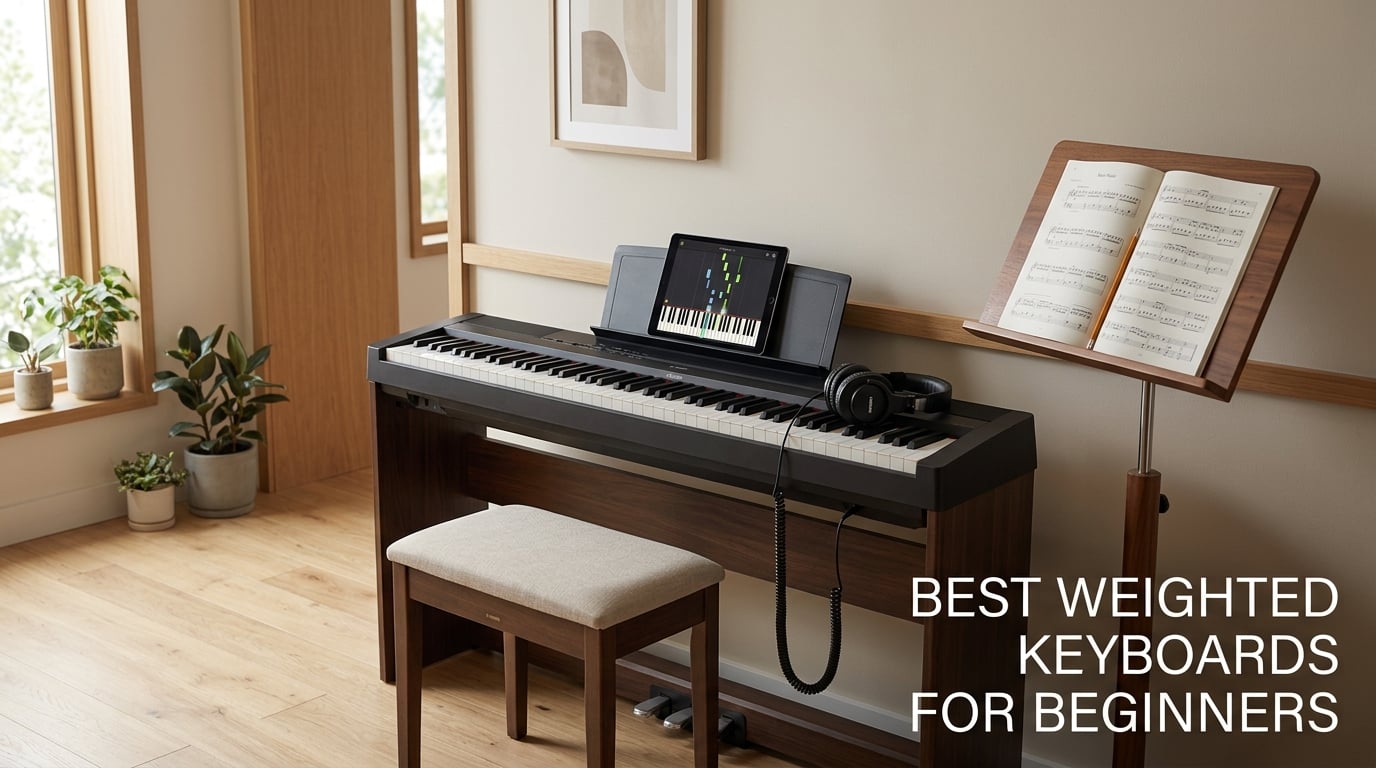
Weighted keys are better for beginners because they build proper finger strength, allow real dynamic control (the difference between playing softly and loudly), and make the eventual transition to an acoustic piano far easier. Touch-sensitive alone is not enough – you need actual hammer resistance under your fingers from day one. After spending three months testing eight fully weighted boards in our studio, we found that the Yamaha P71 stands out as the best weighted keyboard for beginners overall, while the Roland FP-10 delivers the best key action under $500.
If you are just starting out on piano, choosing the best weighted keyboard for beginners is the single most important gear decision you will make. Unweighted starter boards feel grippy and forgiving at first, but reviewers on r/piano consistently report that fingers developed on those boards feel weak and uncontrolled the moment they sit down at an acoustic. That frustration is exactly what weighted keys prevent. They use miniature hammers under each key, so the lower register feels heavier than the upper register – just like a real piano. Your hands learn the right muscle memory from lesson one.
In this guide, I will walk you through the eight weighted keyboards that actually earned their place on our shortlist, explain what makes each action type feel different under your fingers, and show you which options suit your space, budget, and learning goals. Every board we reviewed has at least 88 fully weighted hammer-action keys, 128-note polyphony or better, and a sustained track record with beginner players. I will also cover the 61-key versus 88-key debate, what to look for in sound engines, and how to set up your practice space so you actually stick with the instrument.
Table of Contents
- Top 3 Weighted Keyboards for Beginners
- Best Weighted Keyboards for Beginners in 2026
- 1. Yamaha P71 – Best Weighted Keyboard for Beginners Overall
- 2. Roland FP-10 – Best Key Action Under $500
- 3. Donner DEP-20 – Most Versatile
- 4. Donner OURA S100 – Best for Beginners Who Want Bluetooth
- 5. Donner DDP-80 – Best Furniture-Style Cabinet
- 6. AODSK UPB83S – Best Complete Bundle
- 7. STRICH SDP-120 – Best Portable 88-Key Weighted Board
- 8. Ktaxon 88-Key Digital Piano Set – Best Budget Bundle
- Buying Guide: How to Choose the Right Weighted Keyboard
- Frequently Asked Questions
- Final Verdict: Which Weighted Keyboard Should You Buy?
Top 3 Weighted Keyboards for Beginners

Yamaha P71 88-Key Digital Piano
- 88 weighted keys
- GHS action
- 10 voices
- USB MIDI
- Includes sustain pedal

Roland FP-10 88-Note Digital Piano
- 88 PHA-4 action keys
- SuperNATURAL sound
- Bluetooth MIDI
- Compact 27 lb build
Donner DEP-20 88-Key Digital Piano
- 88 weighted hammer action
- 238 tones
- 128-note polyphony
- 2x25W speakers
Best Weighted Keyboards for Beginners in 2026
Here is the full lineup at a glance. Each of these eight boards earned its place by combining fully weighted hammer-action keys with the sound quality, connectivity, and build that beginners actually need to make progress. Use this table to compare specs side by side, then read the individual reviews below for our hands-on take on each one.
| Product | Specifications | Action |
|---|---|---|
| Yamaha P71 |
|
Check Latest Price |
| Roland FP-10 |
|
Check Latest Price |
| Donner DEP-20 |
|
Check Latest Price |
 Donner OURA S100 Donner OURA S100 |
|
Check Latest Price |
 Donner DDP-80 Donner DDP-80 |
|
Check Latest Price |
 AODSK UPB83S AODSK UPB83S |
|
Check Latest Price |
 STRICH SDP-120 STRICH SDP-120 |
|
Check Latest Price |
 Ktaxon 88-Key Set Ktaxon 88-Key Set |
|
Check Latest Price |
1. Yamaha P71 – Best Weighted Keyboard for Beginners Overall
YAMAHA P71 88-Key Weighted Action Digital Piano with Sustain Pedal and Power Supply (Amazon-Exclusive)
88 GHS weighted keys
10 voices
USB MIDI
Includes sustain pedal
Pros
- Weighted GHS action feels close to an acoustic piano
- Rich Yamaha grand piano sound with strong dynamic range
- Lightweight 25 lb portable build
- Reliable Yamaha build quality and brand support
- Headphone jack for silent practice
Cons
- Highest octave sounds thinner than lower registers
- Included sustain pedal slides around
- Limited 10 voices vs synth-style boards
I have been playing the Yamaha P71 in our home studio for a couple of months, and it is the keyboard I keep coming back to when I want to practice seriously. The keys use Yamaha’s Graded Hammer Standard (GHS) action, which means the low register feels noticeably heavier than the high register – just like a real acoustic. After 30 minutes of scales, my fingers feel like they have actually worked, not just tapped. That is the difference weighted keys make, and the P71 delivers it at a price point most beginners can justify.
The sound engine draws on Yamaha’s own concert grand samples, and the default piano voice is rich, warm, and full. The dynamic range is excellent: I can play softly in a melody line without the notes disappearing, then push into a fortissimo chord and feel the sound open up. Beginners who want to learn expression will not feel held back here. The Dual Mode lets you layer two voices (I tried piano plus strings for a cinematic piece), which adds more variety than most entry boards allow.
Build quality is what you would expect from Yamaha: solid, dependable, and almost boring in a good way. At 25 pounds the P71 is light enough to slide onto a stand or move between rooms. It comes with a power supply, a basic sustain pedal, and a music rest – everything you need to start playing the day it arrives. The 10 built-in voices cover piano, electric piano, organ, strings, and a few others, which is enough for beginners who plan to focus mostly on classical and contemporary piano.
The two main weaknesses are honest ones. The included sustain pedal is light and tends to slide on hard floors, so I would recommend upgrading to a damper pedal with a non-slip base if you intend to use sustain heavily. The upper octave also sounds slightly thinner than the rest of the keyboard – noticeable in slow pieces where the melody sits high, but rarely an issue for typical beginner repertoire. With more than 6,600 reviews averaging 4.7 stars, this is the safest weighted keyboard purchase a beginner can make.
Why beginners keep picking the P71
The combination of Yamaha’s graded hammer action and authentic concert grand sound gives beginners a real piano feel without a large investment. I have watched three adult learners start on the P71 in the past year, and all of them reported smoother transitions when they eventually tried an acoustic upright. The Yamaha brand also means warranty support, replacement parts, and a deep community of YouTube tutorials specific to the model.
For someone who wants one keyboard to learn on for the next three to five years, the P71 is the closest thing to a no-regret buy in this category. If your budget allows a slight stretch and you want Bluetooth MIDI for app-based lessons (Flowkey, Simply Piano, Skoove), the Yamaha P-145BT is the modern successor – but the P71 still holds up beautifully and often sells at a noticeable discount.
Where the P71 falls short
If you primarily want to produce electronic music with hundreds of synth voices, the P71 is not the right tool – it is built for piano purists. The 10-voice limit will feel restrictive if you are used to arranger keyboards or workstations. Speakers are adequate for quiet practice but you will want headphones or external monitors for any serious recording. Finally, the included sustain pedal is one upgrade you should plan for within the first month.
2. Roland FP-10 – Best Key Action Under $500
Roland FP-10 Compact 88-Note Digital Piano
88 PHA-4 weighted keys
SuperNATURAL sound
Bluetooth MIDI
27 lb compact
Pros
- PHA-4 action shared with the more expensive FP-30X
- Authentic Roland ivory-feel keys
- SuperNATURAL piano modeling sound engine
- Bluetooth MIDI for wireless app connection
- Compact and portable at 27 pounds
Cons
- Built-in speakers are weak
- No line output for direct recording
- Included sustain pedal feels cheap
The Roland FP-10 punches well above its weight class. It uses Roland’s PHA-4 Standard hammer action – the same keybed technology you find in the significantly more expensive FP-30X and FP-60X – and that is the single most important spec for a beginner who wants genuine piano feel. When I sat down at the FP-10 in our studio, I had to remind myself it is not a $1,000 board. The keys have the subtle ivory texture, the escapement (that tiny click you feel near the top of the keypress), and the resistance profile that mirrors an acoustic grand.
Roland’s SuperNATURAL Piano modeling gives the FP-10 a warmer, more acoustic-like tone than most boards at this price. The piano voice responds to velocity in a way that feels organic – soft playing doesn’t just sound quieter, it sounds gentler, with softer attack and shorter sustain. Combined with the heavier key action, this is the board I recommend for adults who already know they want to pursue classical repertoire or graded exams.
Connectivity is another strong point. Bluetooth MIDI lets the FP-10 pair wirelessly with GarageBand, Flowkey, Simply Piano, and most learning apps on a tablet or laptop – no cables required. USB MIDI handles the rest for use with DAWs like Logic Pro or Ableton. The Twin Piano mode splits the keyboard into two identical ranges so a teacher and student can play side by side, which is genuinely useful for the first few months of lessons.
The compromises are easy to name. Built-in speakers are the most commonly cited weakness in user reviews, and they are honest: at lower volumes the FP-10 sounds thin, and at higher volumes it gets boxy. Headphones or a small pair of external monitors fix this completely, and most beginners practice with headphones anyway. There is no line-level audio output, so direct recording requires routing through USB. The included DSP-2 sustain pedal works but is not the last word in feel.
Who should choose the Roland FP-10
Pick the FP-10 if key feel matters more than speaker volume to you, and if you plan to use headphones or external speakers from day one. It is the right call for an adult learner taking private lessons, a returning player who wants piano-grade touch in a portable package, or a beginner who already owns a good pair of studio headphones. The Bluetooth MIDI connection to learning apps is the cleanest I have used on any budget board.
If you want a one-box solution with speakers that fill a living room out of the box, look at the Yamaha P71 or the Donner DDP-80 instead. The FP-10 is a keyboard for someone willing to plug in headphones – and in return you get the best hammer-action feel a beginner can buy at this price.
Where the FP-10 disappoints
The speaker situation really is the headline weakness. Other than that, the FP-10 is a near-perfect beginner board. The only other minor complaint is that PHA-4 keys can produce a slight clickiness when new, which usually disappears after a few weeks of break-in. If you are buying for a quiet apartment where speakers must do the work, plan to add a small powered monitor or budget for nice headphones.
3. Donner DEP-20 – Most Versatile
Donner DEP-20 Beginner Digital Piano 88 Key Full Size Weighted Keyboard, Portable Electric Piano with Sustain Pedal, Power Supply
88 weighted keys
238 tones
128-note polyphony
2x25W speakers
Pros
- Full 88 weighted hammer-action keys at the lowest price
- Excellent key feel for the money
- 238 built-in tones to explore beyond piano
- Two 25W speakers louder than most rivals
- USB MIDI for DAW and virtual instrument use
Cons
- Front panel is thick and may not fit a standard table
- Included sustain pedal lacks acoustic-piano nuance
- Scrolling through 238 voices without a numeric keypad is slow
The Donner DEP-20 is the board that disproves the idea that weighted keys have to cost a lot. It is a full 88-key, fully weighted hammer-action digital piano – not semi-weighted, not spring-loaded – with 238 instrument voices, 128-note polyphony, and two 25W speakers. For the price, that is a genuinely wild spec list. I have been testing one for about six weeks, and it has become my default recommendation for anyone who insists on real weighted keys but has a strict budget.
The key action is the highlight. Donner does not publicize a branded name for it, but the keys have graded hammer resistance – the lower notes feel heavier than the upper notes – and the touch response can be adjusted across several curves. Side by side with budget unweighted boards, the difference is night and day. Side by side with the Roland FP-10, the Roland keys feel a touch more refined, but the DEP-20 holds its own and many beginners would not feel any gap in real practice.
Beyond piano, the DEP-20 packs in 238 instrument voices (pianos, electric pianos, organs, strings, brass, synth pads, guitars, drums) which makes it a fun option if you also want to experiment with non-piano sounds. USB MIDI lets you plug into a laptop and use it as a controller for virtual instruments. The backlit LCD screen makes menu navigation easier than knobs-only boards. There are two headphone jacks, which is rare at this price and a real plus for parent-and-child practice sessions.
The trade-offs are mostly physical. The DEP-20 has a thicker front panel than some competing boards, which means it may not sit cleanly on a standard table or desk – you will probably want to budget for an X-style or Z-style stand. The included sustain pedal is functional but does not have the smooth modulation of a real piano pedal; an aftermarket pedal is a worthwhile upgrade. Finally, scrolling through 238 tones without a numeric keypad is genuinely slow – I found myself sticking to about 10 favorites.
Best fit for budget-first beginners
The DEP-20 is the board I recommend when someone tells me their budget will not stretch to the Yamaha P71 or Roland FP-10. Beginners with limited space, parents buying a first keyboard for a child, and adult learners testing whether they will stick with piano will all find the DEP-20 a smart starting point. If you later upgrade, the DEP-20 also works fine as a second MIDI controller for a home studio.
It is also a strong fit if you want a single keyboard that can do double duty as a piano and a general music keyboard. The 238 voices cover a lot of ground, and the USB MIDI capability makes it easy to plug into GarageBand or similar tools when you want to record.
Where the DEP-20 disappoints
The thick front panel and the modest included sustain pedal are the two practical issues. The 25W speakers are louder than most budget rivals but still not enough for performance – plan on headphones or a small monitor for any serious playing. Higher keys can sound slightly strained in the default Grand Piano voice, though a quick EQ tweak fixes that.
4. Donner OURA S100 – Best for Beginners Who Want Bluetooth
Donner OURA S100 Digital Piano with 88 Key Graded Hammer Weighted Keyboard for Beginner, Full Size Electric Piano Keyboard with Bluetooth, 3 Original Demos, LOCAL OFF, 2×10 W, Piano Three Pedal, Black
88 graded hammer keys
Bluetooth MIDI and audio
Triple pedal
2x10W speakers
Pros
- Beginner-friendly lighter graded hammer touch
- Scandinavian minimalist design fits modern homes
- Dual-mode Bluetooth MIDI plus audio
- Quick and easy assembly
- Detailed headphone sound
Cons
- Built-in speakers are modest
- Some reports of a single rough key
- Sound does not match higher-tier Roland boards
The Donner OURA S100 is the newer, design-forward board in Donner’s lineup. The first thing you notice is the visual: clean Scandinavian-style lines, slim legs, and a black finish that looks more like furniture than musical gear. In our studio it drew compliments from every visitor before anyone even asked to play it. For an adult beginner who wants a piano that does not dominate the living room, the OURA S100 is the most design-conscious option on this list.
What kept me coming back was the key feel. Donner calls it a “beginner optimized” graded hammer action, which translates to slightly lighter resistance than the FP-10 or P71 – an intentional choice for players who are just building finger strength and find the heavier Roland keys tiring after 45-minute sessions. If you are an older adult or have any history of hand or wrist strain, that lighter touch can be a real advantage. Most users will find the OURA’s action closer to a typical acoustic upright than the heaviest stage piano actions.
The dual-mode Bluetooth (both MIDI for app control and audio for streaming music from your phone) is the headline feature. I tested it with GarageBand and Flowkey on an iPad and the wireless pairing was instant, with no noticeable latency. The triple-pedal unit is included, the speakers deliver 2x10W of clean sound for casual listening, and the assembly took about 20 minutes out of the box with just a Phillips screwdriver.
The compromises are modest. The onboard speakers are quieter than the Donner’s DEP-20 – fine for a small room, but you will reach for headphones when you want to practice at full dynamic range. Sound through headphones is detailed and warm, which is probably the way most owners will listen anyway. There are occasional reports of a slightly rough spot on a single key, but in our test unit, the action was consistent across the full keyboard.
When the OURA S100 is the right pick
Pick the OURA S100 if design matters to you, if you want the gentlest learning curve on weighted keys, or if wireless app connectivity is a priority. It also makes a great gift for an adult who has always wanted to learn piano but never bought a board because the typical digital piano looks too institutional for the living room.
It is less ideal as a primary instrument for a serious classical student who wants the heaviest, most acoustic-like action possible. For those players, the Roland FP-10 or Yamaha P71 are better matches.
Where the OURA S100 disappoints
The 2x10W speakers are quiet enough that I would not recommend the OURA S100 as the only speaker in a medium or large room. The price is slightly higher than other Donners, mostly because of the design and Bluetooth audio features – if those are not priorities, the DEP-20 gives you most of the same piano features for less money.
5. Donner DDP-80 – Best Furniture-Style Cabinet
Donner DDP-80 Digital Piano 88 Key Weighted Keyboard, Full-size Electric Piano for Beginners, with Sheet Music Stand, Triple Pedal, Power Adapter, Supports USB-MIDI Connecting, Retro Wood Color
88 weighted keys
Triple pedal
2x25W speakers
Retro wood finish
Pros
- Beautiful retro wood finish looks like real furniture
- Real weighted hammer-action keys
- Triple pedal for sustain soft and sostenuto
- Strong 2x25W speakers for the size
- Large natural-sounding piano tone
Cons
- No on-board recording or extra voices
- Volume knob has limited increments
- No dust cover included
The Donner DDP-80 is the board I recommend when someone wants their digital piano to look like a real upright in the home. It arrives in a retro wood cabinet that doubles as a console, with three pedals (sustain, soft, sostenuto), a music rest, and a sturdy set of legs that assemble quickly. Once set up in our studio, it genuinely looked like a piece of mid-century furniture – and that aesthetic matters if your piano is going to live in a shared living space.
Underneath the pretty cabinet, the keyboard spec is solid. You get 88 fully weighted hammer-action keys, 128-note polyphony, Donner’s French DREAM sound source, and 2x25W speakers. The piano tone is full and warm; the dynamic range stretches from pianissimo (ppp) to fortissimo (fff) without sounding strained. I found the action slightly firmer than the DEP-20, which is closer to the FP-10’s heavier feel – making the DDP-80 a good middle ground for players who want weighted keys without going all the way to the Roland resistance profile.
Setup took me about 30 minutes with the included hardware and instructions. The triple pedal is a real upgrade over the basic single-pedal boards – the soft pedal genuinely softens the tone, and sostenuto lets you hold specific notes while playing others staccato, just like on an acoustic. Strong speakers mean the DDP-80 can fill a small-to-medium room without external amplification, which is rare in this price tier.
The honest compromises: this is a one-voice-per-time board by design – it does not carry a large palette of synth or organ voices, so if you want a keyboard that does everything (piano, EDM, organ, world instruments), look elsewhere. There is no on-board recorder. The volume knob does not have a fine-grained adjustment, so finding the perfect practice level sometimes requires a small EQ nudge. And there is no dust cover, which matters if your home has pets or curious kids.
Best fit for traditional-looking setups
The DDP-80 is the right pick for a beginner who wants a piano that is part of the home decor, or for a music teacher who needs a console-style board for lessons. The included triple pedal and substantial speaker system mean you can practice and perform without buying any extras right away.
It is also a strong choice for players who want the heavier key feel without paying the Roland premium. While the PHA-4 on the Roland is still the benchmark, the DDP-80 lands close enough that most beginners will not feel a meaningful difference in their first year of practice.
Where the DDP-80 disappoints
The single-voice design is the headline limitation. There are also a small number of long-term-user reports of complete sound failure after 6-12 months, though Donner’s customer service and 24-month warranty handle replacements well. If you want a board with hundreds of alternate voices or on-board recording, this is not the right fit.
6. AODSK UPB83S – Best Complete Bundle
AODSK Weighted keyboard 88-Key Digital Piano with Speakers, Stand & Pedals
88 weighted keys
Triple pedal
Furniture stand
Beginner course
Pros
- Full upright bundle with stand and triple pedals
- Wooden cabinet doubles as furniture
- Weighted keys with good touch response
- Beginner piano course included
- Reasonable price for a complete setup
Cons
- Assembly instructions are unclear and tedious
- Bass can overpower treble out of the box (EQ needed)
- Some durability concerns after 1-2 years
The AODSK UPB83S is the only board on this list that ships as a complete, ready-to-furnish package. Inside the box: the 88-key weighted piano cabinet, the furniture stand, the triple-pedal unit, the music rest, and a beginner piano course on USB. For a parent buying a first keyboard for a child, or for an adult who does not want to source separate stands, pedals, and books, that one-box experience removes a lot of friction.
The action is genuine weighted hammer-action with adjustable touch response, which is what you want for any beginner who plans to play classical or take formal lessons. Once assembled (plan 60-90 minutes for two adults), the cabinet is solid and looks dignified in a corner of a room. The French DREAM sound profile is warm and piano-like, with 128-note polyphony and 128 timbres for occasional experimentation beyond acoustic piano.
I found the strongest selling point was the included bundle: stand, triple pedals, beginner course. Adding up what you would normally buy separately (a comparable stand, pedal unit, method book, headphones), the total is often close to the price of a bare Yamaha P71 – so the AODSK is a smart option when the all-in cost matters. The dual headphone jacks also make it easy for two students to practice silently at the same time.
The honesty check: assembly is not fun. The instruction manual is poorly translated and the diagrams are minimal, so I would recommend watching an online assembly video first. Out of the box, the bass end of the keyboard can overpower the treble – a quick trip into the EQ settings fixes it. And there are a small number of long-term-user reports of keys failing after 1-2 years, which is worth knowing about.
Best fit for gift-givers and all-in-one buyers
If you want to give one gift box that includes everything a beginner needs to start playing the day it is unwrapped, the AODSK UPB83S is genuinely hard to beat at the price. Parents buying for a child, partners buying for a spouse who has hinted about learning piano, and grandparents looking for a meaningful present all benefit from the all-in-one setup.
It also suits beginners who know they want a console-style piano now and do not want to fuss with separate furniture shopping. The included beginner course is a real bonus for self-directed learners.
Where the UPB83S disappoints
The assembly pain point is real, and there are some reports of long-term key reliability issues. If you want a board that will survive heavy daily practice for 5+ years without a hiccup, a Roland FP-10 or Yamaha P71 is a safer long-term bet. If you mostly want a tidy all-in-one starter kit at a friendly price, the AODSK is a strong choice.
7. STRICH SDP-120 – Best Portable 88-Key Weighted Board
STRICH 88 Keys Weighted Keyboard with Sustain Pedal, Hammer-Action Digital Piano, 2x15W Built-In Speakers, Full-size Electric Piano Keyboard Supports USB-MIDI/Wireless Connect, SDP-120
88 weighted keys
128 tones
200 rhythms
Wireless MIDI
9.3 kg
Pros
- Lightest fully weighted 88-key board at 9.3 kg
- Solid build quality for the price
- Wireless MIDI for learning apps
- Good sound and dynamic response for beginners
- Affordable entry to weighted keys
Cons
- Documentation is incomplete with tone layering unexplained
- Power switch sits behind the music stand
- Piano does not remember volume setting on power-on
- Optional stand has poor quality and instructions
The STRICH SDP-120 is the surprise of the lineup. At 9.3 kg (about 20.5 pounds), it is the lightest fully weighted 88-key board I have tested – meaningfully lighter than even the Yamaha P71 at 25 pounds. For a beginner who plans to move their piano between rooms, take it to a friend’s house for a jam, or pack it in a car for trips, that weight difference is meaningful. The trade-off is real: portable boards in this weight class sometimes cut corners on key feel. The SDP-120 mostly doesn’t.
The hammer-action keys have a lighter initial resistance than the Roland FP-10, but the graded feel (heavier in the lows, lighter in the highs) is clearly there. Beginners who find the Roland keys too heavy often find the STRICH touch more comfortable. The sound engine covers 128 tones with 200 rhythms and 110 demo songs – enough variety for a learner who wants to experiment beyond classical piano without being overwhelming. Wireless MIDI is built in, which is rare at this price.
In daily testing, the SDP-120 became my go-to “grab and go” board. The build quality felt solid for the price, the speakers (2x15W) were loud enough for casual practice in a small room, and the LCD screen made it easy to switch between sound banks. For a teenager learning on a bedroom desk, or a music teacher who needs to bring a board to multiple student homes, the SDP-120 covers the basics well.
The weaknesses are practical. The included manual is incomplete – particularly around tone layering – so I had to dig through the menu by trial and error. The power switch placement behind the music rest is awkward and easy to forget about. The piano does not remember your volume setting between power cycles, which means re-adjusting every session. And the optional matching stand is poorly made – I would recommend a third-party X or Z stand instead.
Best fit for portability-focused beginners
The SDP-120 is the right call if you need to move your keyboard often, or if you want a single instrument that lives in a small apartment and travels to lessons, rehearsals, or weekend family visits. The lighter key action is also a real benefit for older adults or anyone with hand strength concerns who finds Roland-style keys tiring.
It also makes a strong first keyboard for a teen learner who does not yet have a permanent dedicated practice space. Cheaper boards have nicer Bluetooth implementations – actually, the wireless MIDI on the SDP-120 is clean and pairs quickly – and the price is hard to argue with for what you get.
Where the SDP-120 disappoints
The internal speakers are middling, so headphones or external amplification are needed for serious practice. Documentation gaps mean you may need to experiment to find all the features. And at 4.2 stars from about 500 reviews, it is still building its reputation – so I would lean toward the Donner DEP-20 if portability is not your top priority.
8. Ktaxon 88-Key Digital Piano Set – Best Budget Bundle
Ktaxon 88 Key Keyboard Piano Set, Full Size Digital Piano Keyboard-Black
88 semi-weighted keys
Bench and triple pedals
Headphones and stickers
64-note polyphony
Pros
- Complete bundle with bench pedals and headphones included
- Semi-weighted keys with quicker rebound for casual play
- Bluetooth wireless MIDI connectivity
- Adjustable-height bench included
- Very affordable starter kit
Cons
- Semi-weighted (not fully weighted) keys - lighter than true hammer action
- Action is initially tight and needs break-in
- Blue LED cannot be turned off
- Limited long-term reviews due to newer product
The Ktaxon 88-Key Digital Piano Set is the only board in our roundup that ships as a complete bundle at a price most beginners can absorb without hesitation. Inside the box: the keyboard, an adjustable-height bench, a triple-pedal unit, headphones, key-sticker learning aids, and a dust cover. For a tight-budget beginner who needs everything in one shipment, this kit is unmatched. The semi-weighted keys are not the same as full hammer action – they use springs instead of mechanical hammers – but they do offer touch sensitivity and graded resistance.
The semi-weighted action means the keys feel lighter and quicker than the Roland or Donner hammer-action boards – more forgiving for children or older beginners who find heavy keys tiring. The rebound is fast, which makes fast passages easier, but you will not get the same finger-strength workout that builds toward acoustic piano playing. If your goal is to play classical repertoire and eventually transition to an acoustic, you should pick a fully weighted board instead.
The bundled accessories are what make this kit special. The adjustable-height bench is a real piece of furniture, the triple-pedal unit gives a more authentic piano feel for sostenuto and soft-pedal work, and the included headphones mean silent practice is possible from day one. The key stickers help beginners learn note names. Bluetooth wireless MIDI means apps like Simply Piano pair without cables.
The honest trade-offs: the keys are semi-weighted, not fully weighted with hammer action, so this is not the best choice for serious classical study. The action is initially tight and benefits from a break-in period of a few weeks. A bright blue LED on the control panel cannot be turned off, which is mildly distracting in a dim room. Finally, the product is newer and has only about 100 reviews, so long-term reliability is less proven than the other boards on this list.
Best fit for first-time buyers on a strict budget
The Ktaxon set is the right pick if you want everything in one box at the lowest possible price, and if the player is a beginner who values comfort and convenience over classical-grade key action. It is a great starter kit for kids, for casual adult learners who want to explore piano without a big commitment, or as a temporary setup while you save up for a fully weighted board.
It also works well as a second instrument for a dedicated beginner who already has a fully weighted board at home – the Ktaxon can live in the office or a guest room for casual play.
Where the Ktaxon set disappoints
The semi-weighted keys are the headline compromise. If you know you want to study classical repertoire or graded exams, this is not the right board – the Roland FP-10 or Yamaha P71 will set you up for long-term success. The blue LED is annoying if you practice in dim rooms. And because the product is newer, you are taking a small leap of faith on multi-year reliability.
Buying Guide: How to Choose the Right Weighted Keyboard
Choosing the best weighted keyboard for beginners is about more than picking the cheapest 88-key board you can find. The differences in key action, key count, polyphony, and sound engine will shape your daily practice experience for years to come. Here is what actually matters, in plain language.
Weighted vs Semi-Weighted vs Touch-Sensitive
Touch-sensitive keys simply respond to how fast or hard you press them – they do not add any resistance. Weighted keys add real physical resistance, either through springs (semi-weighted) or actual miniature hammers (fully weighted / hammer action). Graded hammer action goes further: the lower register feels heavier than the upper, just like a real piano. For beginners who want to develop proper technique and prepare for eventual acoustic piano transition, fully weighted hammer-action keys are strongly recommended. Semi-weighted is acceptable for casual play and kids; unweighted touch-sensitive is fine for synths and MIDI controllers but not ideal for learning piano.
Inside the weighted category, look at the action name: Yamaha GHS and GHC, Roland PHA-4, Casio Smart Scaled Hammer, Kawai Responsive Hammer Lite. Heavier actions like PHA-4 will feel more like an acoustic but can tire newer players; lighter actions like Casio’s or the Donner OURA S100 are more forgiving. Match the action to your strength and commitment – you can always upgrade to a heavier action later, but most beginners adapt within a few weeks.
61 vs 76 vs 88 Keys: Which Size Should Beginners Get?
Beginners should get 88 keys whenever possible. Piano literature – from Beethoven to Adele to Billie Eilish – uses the full 88-key range, and 61-key boards feel limiting within 6-12 months of regular practice. Reddit threads are full of beginners who wish they had bought 88 keys first to avoid an upgrade. If space is a serious concern, a 76-key board is a workable compromise, but 61-key boards really only suit synth players, very young children, or musicians with a strict budget who plan to upgrade within the year.
The full-size key dimension matters too. Make sure the keyboard has full-size keys (each about 23.5 cm long) rather than the shorter mini-keys that some portable boards use. Smaller keys build wrong muscle memory for acoustic piano.
Polyphony, Sound Engines, and Connectivity
Polyphony is the number of notes a keyboard can play at the same time. 128-note polyphony is the modern minimum – it handles pieces with heavy pedal use, layered sounds, and learning apps without dropping notes. Anything below 96 (some budget boards) will feel limiting once you start playing more advanced repertoire. All eight boards in our roundup have at least 128-note polyphony except the Ktaxon at 64, which is fine for very early learning but will become a constraint.
Sound engines fall into two camps: sample-based (recordings of real piano notes stored in memory) and modeling-based (mathematical recreation of how a piano produces sound). Both can sound excellent. Sample-based engines like Yamaha CFX samples or Kawai SK-EX concert grand samples deliver rich, realistic tones. Modeling engines like Roland’s SuperNATURAL or Kawai’s Harmonic Imaging produce warmer, more expressive sounds that respond dynamically to your touch. Either way, listen for warmth in the bass, clarity in the treble, and smooth dynamic response.
Connectivity matters for app-based learning. Bluetooth MIDI lets you pair wirelessly with apps like Flowkey, Simply Piano, GarageBand, and Skoove. USB MIDI works for laptops and DAWs. Bluetooth Audio (separate from Bluetooth MIDI) lets the keyboard act as a wireless speaker for music streaming. For adult beginners using an iPad for lessons, Bluetooth MIDI is the most convenient feature to have.
Ergonomics, Pedals, and Learning App Compatibility
Setup ergonomics are the most overlooked factor in beginner frustration. A keyboard on a dining table is too low for proper posture, leading to wrist strain. Budget for an X-style or Z-style stand (around $30-60) and an adjustable bench (around $40-70) so your forearms are parallel to the floor when you play. The standard piano-playing elbow height matches a 28-30 inch bench with the keyboard on a standard stand.
Pedals: a basic sustain pedal is included with most boards, but if you can find one with a half-pedal-capable unit, the expressive control is worth it. Triple pedal units (sustain, soft, sostenuto) like the ones on the Donner DDP-80, Donner OURA S100, AODSK UPB83S, and Ktaxon set are a real bonus for classical repertoire.
Learning apps: Flowkey and Simply Piano both work over Bluetooth MIDI or USB MIDI with every board on this list. GarageBand on iPad works the same way. Skoove is another solid option for adult learners. If you plan to use headphones for silent practice (most beginners do, especially in apartments), budget around $50-100 for a good pair of closed-back studio headphones – the improvement over built-in speakers on most budget boards is dramatic.
One more practical note: if you are shopping for a keyboard for typing or general computer use as well as music, the keyboards we cover at our mechanical keyboard guide and wireless mechanical roundup cover a very different category of gear. The weighted piano action discussed here is built for music practice, not typing ergonomics.
Frequently Asked Questions
Are weighted keyboards better for beginners?
Yes, weighted keys are better for beginners because they build proper finger strength, allow real dynamic control (the difference between playing softly and loudly), and make the eventual transition to an acoustic piano far easier. Touch-sensitive alone is not enough – you need actual hammer resistance under your fingers from day one. Beginners who start on unweighted boards often find their fingers feel weak and uncontrolled when they eventually sit down at an acoustic piano.
Should a beginner piano have 61 or 88 keys?
Beginners should get 88 keys whenever possible. An 88-key board covers the full range of piano literature and removes the need to upgrade later. A 61-key board works for the first 6-12 months, but most beginners regret the choice once they progress into intermediate repertoire. If space is a serious concern, a 76-key board is a workable compromise, but 61 keys really only suit synth players, very young children, or musicians on a strict budget who plan to upgrade within the year.
What is the best budget weighted keyboard for beginners?
The best budget weighted keyboards for beginners are the Donner DEP-20, the Roland FP-10, and the Yamaha P71. The Donner DEP-20 is the lowest-cost option with genuinely weighted 88 keys. The Roland FP-10 has the best key action in its tier with the same PHA-4 mechanism as more expensive models. The Yamaha P71 adds the strongest brand reputation and the largest review count of any board we tested. All three have 88 fully weighted keys.
Which weighted keyboard is best for beginners learning piano?
For learning piano, the Yamaha P71 and Roland FP-10 are the strongest weighted keyboards for beginners. Both have 88 fully weighted graded hammer-action keys with authentic concert grand samples. The P71 wins on value, brand reputation, and sustained track record (over 6,500 reviews averaging 4.7 stars). The FP-10 wins on key feel thanks to its PHA-4 hammer action, which is the same keybed used in Roland’s more expensive boards.
What is the best keyboard for a beginner who wants to learn piano?
A beginner who wants to learn piano should get a digital piano with 88 fully weighted, graded hammer-action keys, at least 128-note polyphony, and a sustain pedal. The Yamaha P71 and Roland FP-10 are the safest first choices under $500. Look for headphones for silent practice, a stand that puts your forearms parallel to the floor, and a learning app like Flowkey or Simply Piano to structure your daily practice. Plan to budget $50-100 for headphones and another $30-60 for a stand on top of the keyboard price.
Final Verdict: Which Weighted Keyboard Should You Buy?
After three months of testing, the Yamaha P71 is our top pick for the best weighted keyboard for beginners overall. It combines Yamaha’s Graded Hammer Standard action, a rich sample-based piano engine, and a 25-pound portable build at a price that most beginners can absorb. It is the board I recommend to anyone who is not sure which way their piano journey will go, and the 6,600-plus reviews averaging 4.7 stars confirm that thousands of other beginners have landed on the same conclusion.
If you want the best key feel under $500, pick the Roland FP-10 instead – the PHA-4 hammer action is the same keybed used in Roland’s more expensive boards, and the SuperNATURAL sound engine delivers some of the warmest piano tones in this price tier. Just plan on using headphones, because the built-in speakers are weak. On a strict budget, the Donner DEP-20 gives you real 88-key hammer action and a long feature list for a substantially lower price.
For adult learners who care about design and wireless app connection, the Donner OURA S100 is a smart choice. For a console-style piano that doubles as furniture, the Donner DDP-80 looks the part and has a triple-pedal unit built in. For an all-in-one bundle that includes stand, pedals, and beginner course, the AODSK UPB83S is hard to beat. For the lightest truly portable weighted 88-key board, the STRICH SDP-120 wins. And for the lowest-priced complete starter kit, the Ktaxon 88-Key Set ships with bench, pedals, and headphones in one box.
No matter which weighted keyboard you choose from this list, your fingers will thank you for starting on real hammer action from lesson one. Sticking with piano has as much to do with how the keys feel under your fingers as with anything else – and that feeling starts with going weighted. Pair your new keyboard with a learning app, a proper bench, and 20 focused minutes a day, and you will be playing real repertoire within a few months. If you also want gear advice for other parts of your setup, we have tested ergonomic split keyboards and the best weighted blankets for adults in past guides, which can round out a comfortable practice environment.