
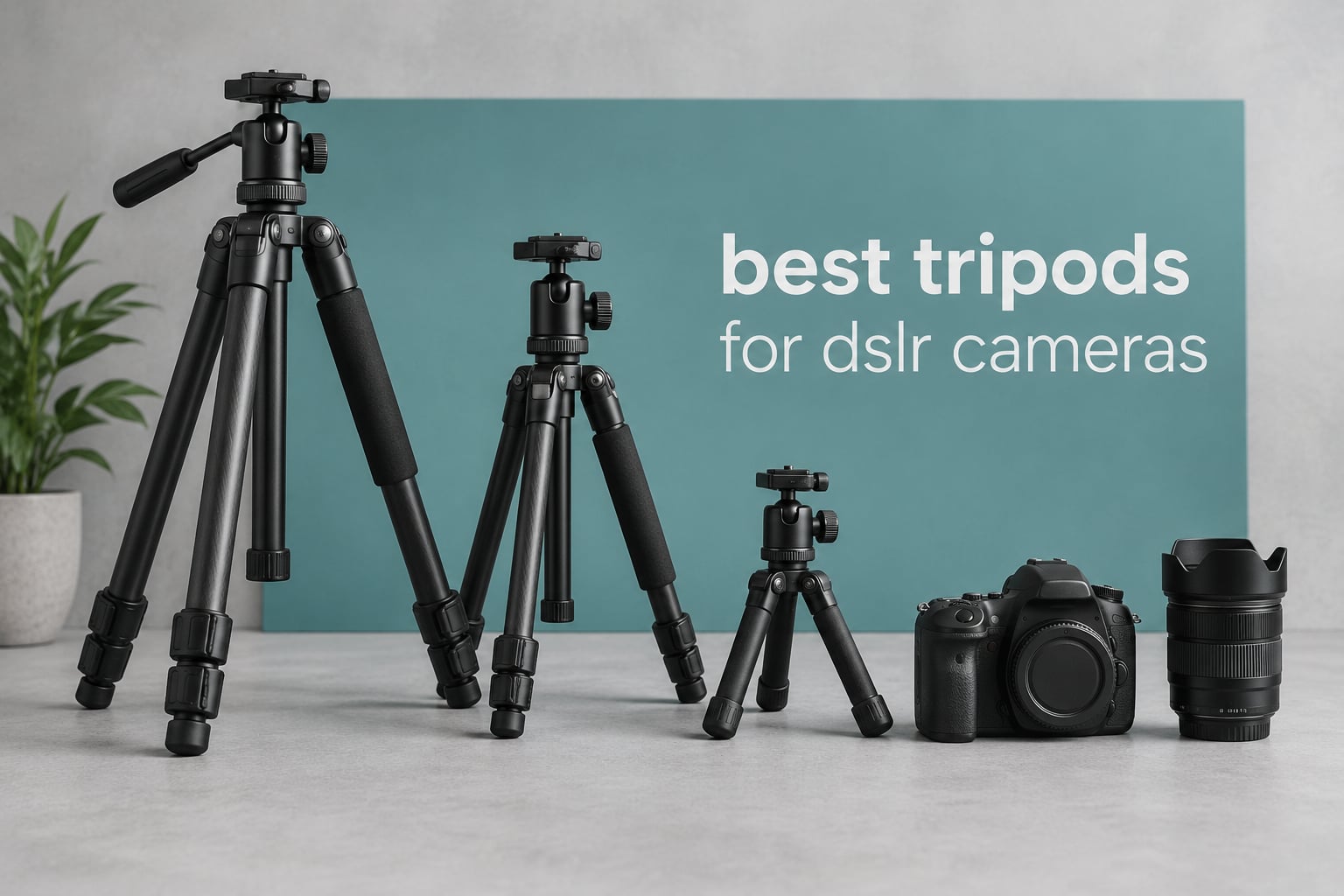
A DSLR with a zoom lens weighs far more than most buyers expect, and that gap between expected and actual weight is where cheap tripods fail. The best tripods for DSLR cameras are not the ones with the biggest printed load number; they are the ones whose head, legs and foot spread stay rigid while you hang a full kit off the top and hold the shutter open. We spent weeks reading owner reviews, checking published specs against each other, and comparing how each of these twelve frames handles a real kit weight. What follows covers budget aluminum through carbon fiber travel rigs, with the load rating and head type called out on every pick.
Two numbers decide the match. The first is load capacity, and the number that matters is the tilted rating, not the vertical one. A tripod quoted at 34 lb vertically often drops to around 11 lb once the head is leaned over to frame a low subject, so a 34 lb frame is not a 34 lb frame. The second is the head type: a ball head reframes in seconds, a three-way pan head is slower but holds a heavy kit in place without creeping, and a fluid drag head is the only one of the three that pans smoothly enough for video.
Before you read further, three things narrow the field fast: your camera body plus heaviest lens plus battery grip weight, whether you are carrying the tripod on your back or loading it into a car, and how much you are willing to spend. Answer those three and half of this list stops being relevant. If you are also building out a wider kit, our picks for dedicated astronomy cameras for beginners cover the sensor side of long-exposure work.
One honest note before the picks: we did not run multi-season durability tests. Nobody does, and any roundup that claims otherwise is guessing. What we could do was cross-check published load ratings against reviewer accounts of sag and drift, compare leg diameters and section counts, and flag the failure modes that show up repeatedly in owner reviews, including twist locks slipping under load and ball heads loosening during long exposures.
Table of Contents
- Quick Picks for Every DSLR Setup
- Top 3 Tripod Picks in 2026
- All 12 Tripods Side by Side in 2026
- 1. Amazon Basics 60-Inch Lightweight DSLR Tripod – the most-reviewed DSLR tripod on the market
- 2. Endurax 60-Inch Travel Tripod – the lightest thing in the group
- 3. UBeesize 74-Inch Tripod – the most flexible frame for overhead work
- 4. K&F Concept 64-Inch Aluminum Travel Tripod – the one that folds shortest
- 5. NEEWER N55C Carbon Fiber Tripod – carbon legs and a monopod in one bag
- 6. NEEWER 72-Inch Center Column Tripod – the strongest studio frame in the roundup
- 7. SIRUI Traveler 7C – carbon fiber with a six-year warranty
- 8. NEEWER 77-Inch TP77 – the tallest and heaviest-rated frame here
- 9. SmallRig CT-10 – extra threaded holes for arms and monitors
- 10. COMAN FF16LS Fluid Head Video Tripod – the video pick
- 11. JOILCAN AH75 – the budget all-rounder with the widest height range
- 12. VICTIV T72 – trips to monopod in about five seconds
- How We Picked These Tripods
- How to Choose a Tripod for Your DSLR
- Match load capacity to your actual kit, and read the tilted rating
- Pick the head type that matches how you move
- Decide between travel and studio by folded length
- Carbon fiber versus aluminum, judged on kit weight
- Arca-Swiss versus a standard 1/4-20 plate
- Stability in wind and on the field
- Used versus new, and what actually fails first
- Frequently Asked Questions
- Final Verdict: Which Tripod Should You Buy?
Quick Picks for Every DSLR Setup
Best overall: Amazon Basics 60-Inch Lightweight DSLR Tripod — the most-reviewed DSLR tripod available, 2.7 lb, and fine for a body with a kit lens as long as you accept a 6.6 lb ceiling.
Best for overhead and tabletop work: UBeesize 74-Inch Tripod — dual handles and a flexible frame that reaches landscape, portrait, overhead and upward positions.
Best carbon value: NEEWER N55C — laminated carbon fiber legs, 26.5 lb rating, converts to a monopod, and ships with an Arca-Swiss plate.
Best for studio and product work: NEEWER 72-Inch Center Column Tripod — 33 lb rating on 28 mm tubes, a multi-angle center column, and the highest owner rating in this group.
Best for telephoto lenses: NEEWER 77-Inch TP77 — 36 mm tubes and a 34 lb vertical rating, the highest number on this list.
Best for video: COMAN FF16LS — a Q6 fluid head with damping and dynamic balancing, on a dual-tube leg set with a 60 mm bowl base.
Best travel pick: K&F Concept 64-Inch Aluminum — folds to 15.5 inches at 2.53 lb, the shortest packed length here.
Best budget pick: Endurax 60-Inch Travel Tripod — 1.4 lb, 17.5 inches folded, and a phone and tablet holder in the box.
Top 3 Tripod Picks in 2026

Amazon Basics 60-Inch DSLR Tripod
- 6.6 lb rated load
- 2.7 lb tripod weight
- 23.2 in folded length
- 3-way head with two bubble levels

NEEWER N55C Carbon Fiber Tripod
- 26.5 lb max load
- Carbon fiber legs
- Converts to monopod
- Arca-Swiss plate included

UBeesize 74-Inch Tripod
- Dual-handle control
- Overhead and 360 degree positions
- Phone holder and 30 ft remote
- Folds to 17.4 inches
All 12 Tripods Side by Side in 2026
| Product | Specifications | Action |
|---|---|---|
| Amazon Basics 60-Inch Lightweight DSLR Tripod |
|
Check Latest Price |
 Endurax 60 Inch Camera Tripod with Remote Endurax 60 Inch Camera Tripod with Remote |
|
Check Latest Price |
| UBeesize 74 Inch Camera Tripod with Phone Holder |
|
Check Latest Price |
 K&F Concept 64 Inch Lightweight Aluminum Travel Tripod K&F Concept 64 Inch Lightweight Aluminum Travel Tripod |
|
Check Latest Price |
| NEEWER 66 Inch N55C Carbon Fiber Tripod |
|
Check Latest Price |
 NEEWER 72 Inch Tripod with Multi-Angle Center Column NEEWER 72 Inch Tripod with Multi-Angle Center Column |
|
Check Latest Price |
 SIRUI Traveler 7C Carbon Fiber Tripod SIRUI Traveler 7C Carbon Fiber Tripod |
|
Check Latest Price |
 NEEWER 77 Inch TP77 Tripod Monopod NEEWER 77 Inch TP77 Tripod Monopod |
|
Check Latest Price |
 SmallRig 71 Inch CT-10 Tripod and Monopod SmallRig 71 Inch CT-10 Tripod and Monopod |
|
Check Latest Price |
 COMAN FF16LS Fluid Head Video Tripod COMAN FF16LS Fluid Head Video Tripod |
|
Check Latest Price |
 JOILCAN 74 Inch AH75 Tripod JOILCAN 74 Inch AH75 Tripod |
|
Check Latest Price |
 VICTIV T72 Camera Tripod Monopod VICTIV T72 Camera Tripod Monopod |
|
Check Latest Price |
1. Amazon Basics 60-Inch Lightweight DSLR Tripod – the most-reviewed DSLR tripod on the market
Amazon Basics 60-inch Lightweight DSLR Tripod with Bag, Black
6.6 lb max load
Aluminum, weighs 2.7 lb
Extends 23.2 to 60 inches
Adjustable 3-way head
Pros
- Lightest full-size option in the group at 2.7 lb
- Quick-release plate for fast camera swaps
- Two built-in bubble levels
- Carrying case included
- 191790 reviews give a clear long-term picture
Cons
- 6.6 lb ceiling rules out big telephoto lenses
- Adjustable head is less precise than a real ball or fluid head
- Column raised adds flex
The number that makes this tripod notable is not its specification sheet, it is the review count. With close to 192000 ratings averaging 4.5 stars, this is the most thoroughly tested budget tripod available, and the pattern in those reviews is remarkably consistent. Owners buy it because it weighs 2.7 lb, sets up in seconds and costs less than a lunch.
What that consistency also reveals is a hard ceiling. The published limit is 6.6 lb, and owners with anything heavier than a body plus a compact kit lens report exactly what you would expect: the legs soften and the head creeps while the exposure runs. Roughly 73% of reviewers hand out five stars, and the most common critical note is always the same load limit.
The head is an adjustable three-way type rather than a ball head, and it handles tilt, swivel, portrait and landscape framing with two built-in bubble levels for horizontal alignment. It is less precise than a dedicated ball head when you are working close to a subject, but for general shooting and low-light work it is more forgiving than it looks on paper.
The folded length is 23.2 inches and the maximum height is 152 centimeters, with a minimum working height of 60.5 centimeters. The build is aluminum, the feet are rubber, and a one-year warranty covers manufacturing defects. Mount compatibility runs well beyond DSLRs to scopes and GoPro devices via adapters.
Will it hold your actual DSLR kit?
It will hold a crop body with a kit lens, or a full-frame body with a lightweight prime, and it will hold them without drama. Add a battery grip and a fast zoom and you are pushing the limit, which is where the 6.6 lb rating stops being a technicality and becomes a problem you will see in your files.
The safe rule is to keep total kit weight at or below half the published rating whenever you can. That puts a comfortable working ceiling around 3 lb here, which comfortably covers a mirrorless body or a small DSLR but leaves nothing spare for a grip.
When to skip it entirely
Skip it if you shoot telephoto, macro, or long exposures at dusk with a full-frame body. The leg diameter and the 6.6 lb rating work together, and neither is enough to stop a heavy glass from introducing vibration into a slow shutter.
Also skip it if you plan to grow into a heavier body soon. The tripod itself will not break, but you will outgrow it, and the budget you save now just moves to later.
2. Endurax 60-Inch Travel Tripod – the lightest thing in the group
Endurax 60” Camera Tripod Camera Stand for Canon Rebel Eos Nikon DSLR, Travel Tripods for Phone Tablet with Remote Black
6.6 lb max load
1.5 lb tripod weight
Folds to 17.7 inches
3-way pan head with bubble level
Pros
- Lightest tripod here at 1.5 lb
- 17.7 inch folded length fits small bags
- Remote shutter and phone holder included
- Three-way head with 360 degree swivel
Cons
- 6.6 lb limit is low for larger DSLR bodies
- Mixed ABS and aluminum build feels less rigid than all metal
- Assembly instructions are unclear
At 1.5 lb with a folded length of 17.7 inches, this is the tripod you can genuinely forget is in your bag. Four leg sections extend from 17.5 to 60 inches, and the whole thing collapses to roughly the length of a large water bottle. Nothing else on this list packs smaller.
It is worth being direct about the ceiling here. The 6.6 lb limit matches the Amazon Basics, and owners say the same thing about both: fine for a phone, a webcam or a lighter camera, and a poor choice for expensive gear with a large lens. Several reviewers explicitly caution against mounting their heavier bodies on it.
The head is a three-way pan type with 360-degree swivel, and the quick-release plate carries its own bubble level. In the box you get the tripod, a phone and tablet holder, the plate, a remote shutter and a carry bag, which is a generous amount of hardware for the money.
Build quality is the trade-off. The legs mix ABS plastic with aluminum, and that combination is why this one feels less rigid under load than a full metal tripod of similar weight. The height range is generous, the locks work, and it will not let you down at the size of kit it is designed for.
Who this actually suits
This is a good carry-everywhere tripod for a traveler shooting a compact body, a phone or a small fixed-lens camera. The 17.7 inch folded length means it fits in a daypack without a dedicated tripod pocket, and the 1.5 lb weight is irrelevant when it lives in your main bag.
The remote shutter and phone holder make it more useful for video and streaming than its price suggests. If your shooting is social, streaming or general travel snapshots, the light weight matters more to your work than stiffness does.
Where it will disappoint
It will disappoint anyone mounting a full-frame body with a fast zoom, or anyone shooting long exposures where any flex at all ruins the frame. The mixed material construction is the reason, and no amount of careful tightening changes it.
It will also disappoint you if you are not comfortable with a slightly fiddly screw assembly. Several owners mention the instructions being unclear, so budget ten minutes and a phone photo of the manual before you are shooting in the field.
3. UBeesize 74-Inch Tripod – the most flexible frame for overhead work
UBeesize 74″ Camera Tripod with Phone Holder and Remote, Heavy Duty Tripod Stand with Portable Bag for Phone and Camera, Compatible with DSLR Cameras, Cell Phones, Spotting Scopes and Binoculars
74 inch max height
Folds to 17.4 inches
Dual-handle design
No published load rating
Pros
- Dual handles give far better framing control
- Handles overhead
- upward and 360 degree panoramic positions
- Phone holder fits 2.8 to 5.7 inch devices
- Wireless remote reaches 30 feet
- Carry bag and hanging hook included
Cons
- No published load rating leaves heavy kits guesswork
- Full-size aluminum frame is bulky to carry
- Not a carbon or aluminum tube design built for long exposure damping
The UBeesize is the odd one out in this roundup, and that is exactly why it earns a place. It does not publish a load rating at all, and it does not need one for the work most people buy it to do. It reaches 74 inches, folds to just 17.4 inches, and the flexible frame swings through landscape, portrait, overhead, upward and panoramic positions without a center column getting in the way.
Two handles, one on the main column and one on the pan head, are the feature that separates it from every other budget tripod here. Most tripods in this class have one handle, and for overhead flat-lay work or overhead video that second handle is the difference between framing a shot and hunting for one.
With about 78% five-star ratings, owners tend to describe it as stable and feature-rich. The compatibility list is genuinely long: Nikon, Fujifilm, Canon, Olympus and Panasonic bodies, plus phones, projectors, webcams, binoculars and spotting scopes. A phone holder covering 2.8 to 5.7 inch devices and a wireless remote with a 30 foot range come in the standard package.
It is also the pick for anyone shooting overhead product photography or top-down video on a modest budget.
What the missing load rating means for you
It means you should treat it as a light-to-medium duty frame and test your specific kit before you rely on it. A small DSLR with a compact lens is well within its comfort zone, and that is the configuration most owners are shooting with.
What you can rely on is the geometry. Reaching overhead or angling up at a subject puts more of the camera’s weight into the leg joints than a level shot does, so if your kit feels marginal, keep the legs wide and lower the center of gravity rather than extending everything to maximum.
Where it falls short
It falls short as a long-exposure tripod. Without a stated load rating, there is no published head specification to compare, and for exposures measured in seconds the tube stiffness matters more than flexibility or reach.
It also falls short as a carry-on travel choice despite the compact fold. The design is a full-size aluminum frame that collapses short, and it is bulkier in the hand than a true travel tripod like the K&F Concept further down this list.
4. K&F Concept 64-Inch Aluminum Travel Tripod – the one that folds shortest
K&F Concept 64 inch/163cm Lightweight Aluminum Travel Camera Tripod
17.6 lb load rating
2.53 lb tripod weight
Folds to 15.5 inches
36 mm 360 degree ball head
Pros
- Shortest folded length in the group at 15.5 inches
- 17.6 lb rating comfortably covers a DSLR with a zoom
- One-handed flip locks deploy fast
- Invertible center column for low angles
- Arca-Swiss compatible standard thread
Cons
- Aluminum is heavier and less rigid than carbon at this tier
- Ball head friction adjustment is basic
- 20.4 inch minimum height is above some competitors
At 15.5 inches folded and 2.53 lb including the 36 mm ball head, this is the shortest packed tripod we tested in this group. Four leg sections run from 20.4 to 64.1 inches, which is a genuinely useful working range for wide scenic shots where you want to get the camera low without digging a mini tripod out of the bag.
The ball head rotates a full 360 degrees and is rated to 17.6 lb, or 8 kg, which is a real step up from the 6.6 lb tripods at the start of this list. That is enough headroom for a full-frame body with a standard zoom, and it is the main reason this one is our travel recommendation.
One-handed quick flip leg locks open and close the sections in seconds, which matters more than it sounds when the wind is picking up. The invertible center column handles low-angle and specialty work, and the standard 1/4 inch thread accepts Arca-Swiss quick release plates, so you are not locked into one plate system.
Does 17.6 lb really cover a DSLR with a lens?
Yes, for most kits. Roughly 79% of buyers give five stars, and the three attributes they name most often are the 15.5 inch packed length, the 2.53 lb weight and the 17.6 lb capacity. That is a tripod you can carry on a plane and still mount a serious lens on.
Where it gets tight is a fast zoom plus a battery grip, particularly with the center column raised. Keep the column down for wide scenic shots and the same rating goes a lot further, which is the technique that matters most on a travel tripod.
What you give up for the packed length
You give up rigidity relative to carbon fiber at the same tier. Aluminum tubes of this diameter flex slightly more under load, and the ball head friction control here is basic compared with premium travel heads, so precise macro framing takes more patience.
You also give up a lower minimum height. At 20.4 inches, this is not a true low-angle or tabletop option, and for insect macro or ground-level work you would be better served by the UBeesize or the SIRUI further down.
5. NEEWER N55C Carbon Fiber Tripod – carbon legs and a monopod in one bag
NEEWER 66″/168cm Carbon Fiber Camera Tripod with 360° Ball Head, N55C
26.5 lb max load
Eight-layer laminated carbon fiber
3.5 lb tripod weight
Folds to 22.6 inches
Pros
- 26.5 lb rating is among the highest here
- Carbon fiber keeps weight down without losing stiffness
- Converts to a monopod by removing one leg
- Arca-Swiss quick release plate included
- 360 degree panning dial and bubble level
Cons
- Ball head friction is effectively on or off
- Heavier than expected in the hand
- Some flex at full extension with heavy video bodies
The N55C is the value standout of this roundup, and the reason is a specific number. Its 26.5 lb, or 12 kg, maximum load sits in the range normally reserved for tripods costing several times as much, and owners routinely compare it favorably to premium ball heads by brand.
The legs are eight-layer high-density laminated carbon fiber put through high-temperature curing, and the result is a 3.5 lb tripod that folds to 22.6 inches and extends to 172 centimeters. For travel, the two-in-one design matters: pull one leg and the whole thing becomes a monopod, which is how you shoot on rough ground without setting three feet.
The ball head has two locks plus a 360 degree panning dial and an included bubble level, and a genuine Arca-Swiss quick release plate is in the box. That plate detail is small but real: it means you are not buying a separate plate to use the head the way it is designed to be used, and the screw-on type fits any Arca-compatible clamp.
Reviewers who shoot stills report solid stability, which is what a 26.5 lb rating on carbon fiber should deliver. The criticisms are consistent too: the head friction is closer to on or off than continuously adjustable, and some owners notice slight wander at full extension with heavier video bodies.
Is it right for a heavy DSLR kit?
Yes, and with room to spare. A full-frame body with a 24-70mm zoom sits comfortably inside a 26.5 lb rating, and carbon fiber means the tripod itself is not the weak link in the system. This is the pick for anyone who wants one tripod that handles both travel and a serious stills kit.
The carbon fiber decision is the quiet advantage here. On aluminum, buying stiffness means buying weight, and 3.5 lb with a 26.5 lb rating is a combination that is difficult to find anywhere at this level.
What to watch before you commit
The all-or-nothing head friction is the first thing to check in person if you can. If you work close to subjects or need fine macro adjustment, a head with continuous friction control, like the E-10 on the SIRUI, will suit you better.
Also factor in the 22.6 inch folded length, which is longer than the K&F Concept or the Endurax. It is a travel tripod, but not a packable mini, and the screw-on plate also gives less tactile confirmation than a lever clamp.
6. NEEWER 72-Inch Center Column Tripod – the strongest studio frame in the roundup
NEEWER 72 Inch Camera Tripod Monopod with Center Column and Ball Head
33 lb max load
28 mm magnesium alloy tubes
Extends to 72.4 inches
3.8 lb tripod weight
Pros
- Highest owner rating in the group at 4.7 with 82 percent five stars
- 33 lb rating on 28 mm tubes
- Multi-angle center column for overhead and horizontal panning
- One leg removes to convert to a monopod
- Arca-type plate and two bubble levels included
Cons
- Bulky and heavy compared with carbon travel tripods
- Ball head can swing to the side when loosened
- Carrying bag is a tight fit without removing head parts
This is the tripod owners describe as feeling premium, and at a 4.7 stars it holds the highest owner rating in the set. The reason is straightforward: magnesium aluminium alloy construction and 28 mm leg tubes carrying a 33 lb, or 15 kg, rating, which is real stiffness rather than a printed claim.
The multi-angle center column is the feature that separates it from a generic ball-head tripod. It works vertically through 0, 22.5, 45, 67.5 and 90 degrees and swings horizontally for 360 degree panning, and the column is reversible for macro and low-angle work. If you shoot overhead product photography, that is the single most useful thing on the whole frame.
It also converts to a monopod by removing one leg, includes a carabiner for hanging a sandbag on the center column hook, and comes with a ball head that has three separate adjustment knobs plus an Arca-type quick release plate and two bubble levels.
Owners upgrading from name-brand tripods frequently report it as more durable, and the metal-where-it-matters construction shows up in comments about stability at longer exposures. Maximum height is 72.4 inches with a minimum of 65 centimeters, and the folded length is 26.4 inches.
The compromises are all about size. At 3.8 lb and 26.4 inches folded, this is a car tripod rather than a pack tripod, and owners who try to squeeze it into a small bag find the supplied case is a tight fit without disassembling the head.
Why the head rating matters more than the leg rating
On a tripod like this the head is usually the weaker link, and the reason to prefer a 33 lb rating here rather than a cheaper 33 lb claim is that the head is built to match. Three adjustment knobs give independent control over pan and tilt, which means a heavy lens does not drag the whole head down when you tilt.
That is what keeps the frame from creeping during a long exposure. A cheap head with one knob couples the axes, so any tension you apply to hold the camera level fights against the other axis, and the head settles a fraction of a degree over the course of a long exposure.
When to choose something lighter instead
Choose something lighter if you are carrying it on your back rather than loading it into a vehicle. At 3.8 lb and 26.4 inches folded, this tripod is not going into a daypack, and carrying it on a hike is where that weight becomes a problem.
Choose something lighter if your kit is a full-frame body with a modest lens. The 33 lb rating is generous headroom, and a lot of that capacity goes unused if you are never hanging a telephoto or a rig on top.
7. SIRUI Traveler 7C – carbon fiber with a six-year warranty
SIRUI Traveler 7C Camera Tripod 65.55 inches Carbon Fiber Arca Tripod with E-10 360° Panorama Ball Head and Arca Swiss Quick Release Plate Load Capacity Up to 17.6lbs, Convertible to Monopod
17.6 lb load rating
3.46 lb tripod weight
Carbon fiber with 1.01 inch legs
Folds to 18.9 inches
Pros
- 3.46 lb carbon fiber body with a 6-year warranty
- Includes an Arca-Swiss plate and the E-10 ball head with two independent knobs
- Four-section twist locks adjust 18.9 to 65.55 inches
- Converts to a monopod with an invertible center column
- 10-year European spare parts availability
Cons
- 17.6 lb rating is modest for heavy pro bodies with long telephotos
- Smaller review base than the value tripods here
The Traveler 7C is the one in this group where the warranty tells you something real. Six years is a long time to cover a tripod, and the company also lists 10-year European spare parts availability, which is a better signal of long-term build quality than any specification on a spec sheet.
At 3.46 lb with 1.01 inch carbon fiber legs, it is heavier than the N55C and heavier than you might expect for a travel tripod, but the stiffness payoff is a frame that holds from 18.9 to 65.55 inches on four twist-lock sections. The legs invert and fold 180 degrees, which is what gets it down to 18.9 inches.
The E-10 ball head pans a full 360 degrees and has two independent control knobs, so pan friction and tilt friction are adjusted separately. That is the refinement the N55C lacks, and on a travel tripod that walks around between locations it is a meaningful difference.
The convertible design works with the center column and a removable leg, giving you a full monopod or a walking stick. The standard 1/4 inch screw plate fits Canon, Nikon, Sony, Olympus, Fujifilm and Pentax bodies, and a portable bag is included.
Owners highlight the low weight, the included Arca-Swiss plate, the smoothness of the 360 degree head and the monopod conversion. The smaller review count, 454 ratings, simply reflects a smaller installed base than the value tripods elsewhere on this list.
Is 17.6 lb enough for a pro body?
For most people, yes. A crop body or a standard full-frame body with a normal zoom sits well inside a 17.6 lb rating, and the four-section carbon legs are stiff enough that the frame is not the limiting factor at that weight.
It becomes marginal with a pro body plus a long telephoto. Canon EOS-1D X class bodies and heavy 70-200mm lenses are where you want the 26.5 lb of the N55C or the 33 lb of the 72-inch NEEWER, not the 17.6 lb here.
What the warranty is worth
On a tripod, warranty length is a proxy for expected service life, because a manufacturer does not offer six years on a frame it expects to fail. Combined with the stated spare parts availability, that is a fair signal this tripod will still be working in five years, and it is a reasonable reason to consider the used market if you find one.
The flip side is that 17.6 lb limits the ceiling, and the 3.46 lb weight is heavy for its category. If your kit is light and you value adjustability and longevity, this is the pick. If your kit is heavy, look at the higher ratings on this list instead.
8. NEEWER 77-Inch TP77 – the tallest and heaviest-rated frame here
NEEWER 77 Inch Camera Tripod Monopod for DSLR & Phone, Aluminum, TP77
34 lb vertical and 11 lb tilted load rating
36 mm leg diameter
Extends to 77 inches
Folds to 19 inches
Pros
- 34 lb vertical rating is the highest on this list
- 36 mm ball head with two independent control knobs
- Two-section center column reaches 77 inches for overhead and crowd work
- Converts to a monopod from 35 to 70 inches
- Three leg opening angles for uneven ground
Cons
- Short pan handle is hard to use with heavy gear
- Ball head friction is high
- so fine adjustment is difficult
- Bundled phone mount feels flimsy
- Bulky when folded
The TP77 has the highest vertical load rating in this roundup at 34 lb, and its 36 mm leg tubes are the thickest outside the video tripod. That combination is the answer to the most common telephoto question on DSLR forums, which is whether a tripod can hold a 70-200mm without the legs visibly bowing.
Here is the number that matters more than the 34: this tripod is rated at 11 lb, or 5 kg, when tilted. That is the honest figure for low-angle wildlife work, ground-level landscapes and overhead angles, and it is exactly the vertical-versus-tilted distinction that trips up most buyers reading a spec sheet for the first time.
The two-section center column is what gets you to 77 inches, and combined with three leg opening angles and an inverted column for macro, this tripod covers more framings than anything else here. Pull one leg and it becomes a monopod with adjustable height from 35 to 70 inches. There is a bubble level and a center-column sandbag hook.
Owners upgrading from name-brand gear report it as more durable, and the 2-axis center column and monopod conversion earn the most praise in reviews. The Arca-type quick release plate is included, so it works with the same plates as the other Arca-compatible tripods on this list.
How to read the 34 lb and 11 lb ratings
Read them as two different tripods. At full level extension with the column down, 34 lb is a real number that comfortably carries a pro body and a telephoto lens. Tilted to 45 degrees, 11 lb is the real ceiling, and that configuration is where most wildlife and low-angle work actually happens.
So if you are shooting straight-out long lenses level, this is the strongest frame here. If you are regularly shooting telephoto from a low angle or from ground level, budget for a rig rated higher in tilt, and keep the column down whenever the angle allows.
What is genuinely awkward about it
The short pan handle is the most-cited drawback, and it matters more with a heavy kit. When a 15 lb setup swings on a short handle, the momentum is hard to control and the frame gets more of your input than a long handle would give you.
Ball head friction here is high, which makes fine adjustments harder than they should be, and the bundled phone mount is the least convincing part of the package. Neither is a dealbreaker, but both are things you will feel while working.
9. SmallRig CT-10 – extra threaded holes for arms and monitors
SmallRig 71″/ 180cm Aluminum Camera Ball Head Tripod & Monopod CT-10
33 lb vertical and 11 lb tilted rating
Magnesium aluminium alloy
16 to 71 inch range
Folds to 16.9 inches
Pros
- 33 lb vertical and 11 lb tilted rating on magnesium alloy
- Three extra 1/4 inch threaded holes for arms
- phones and monitors
- Inverting center column for macro and low angles
- 36 mm metal ball head with firm 360 degree lock
- Tight wobble-free camera mount
Cons
- Lowest rating in the group at 4.4 stars
- Lower leg sections are thin and shake at full extension
- Plastic-feeling adjustment knobs on the head
- Some units arrive with material on the ball socket
At 4.4 stars this has the lowest owner rating of the twelve, and the reviews explain why. The complaints are specific: thin lower legs that shake at full extension, adjustment knobs with a cheaper plastic feel than the legs themselves, and a small number of durability failures within the first few months, including a carrying case zipper and a loose screw during monopod conversion.
What owners do like is the value and the design thinking. The magnesium aluminium alloy build is rated to 33 lb vertical and 11 lb tilted, the 36 mm metal ball head locks firmly, and the camera mount is described as tight and wobble-free compared with cheaper tripods.
The feature that sets it apart is those three extra 1/4 inch threaded holes on the brackets. If you are building a video rig with a magic arm, an external monitor, a phone or a small light, having real threaded points to mount from is worth more than another inch of folded length.
The convertible design gives you a tripod from 16 to 71 inches that folds to 16.9 inches, and pulling one leg turns it into a monopod with an inverting center column for macro work. It accepts 1/4-20 and 3/8-16 mounts, covering DSLRs, mirrorless, action cameras, phones and projectors.
It is the pick here for hybrid shooters who move between stills and rigged video, and for anyone who wants Arca-style mounting with a lower folded length than the 72-inch NEEWER offers.
Who should look past the rating?
Anyone shooting long exposures at dusk, or anything at maximum extension in wind, should look past it. Thin lower sections are exactly the part that transmits vibration, and a 33 lb rating cannot make a 23 mm leg section stiffer than it is.
The 4.4 star average also reflects a higher share of one-star reviews than any other tripod here, and several of those are about early-life failures rather than gripes about performance. If you are comfortable checking lock tension and fasteners on arrival, the risk is manageable.
What it still does better than most
The three threaded holes. No other tripod in this price range gives you mounting points for accessories without an adapter, and for overhead video or a vlogging rig with a monitor that is a practical win rather than a spec-sheet nicety.
The 11 lb tilted rating, the 16.9 inch fold and the metal ball head are also all solid. It is a capable frame that sits slightly outside its comfort zone at full extension, and knowing that in advance is how you buy it well.
10. COMAN FF16LS Fluid Head Video Tripod – the video pick
COMAN FF16LS Heavy Duty Tripod, 74″ Fluid Head Video Tripod Max Load 22 lbs
22 lb max load
Q6 fluid head with damping
Aluminum dual-tube legs
60 mm bowl base
Pros
- Fluid head pans a full 360 degrees and tilts from -75 to +90 degrees
- Dual-tube aluminum legs with a 60 mm bowl base resist collapse
- One-touch quick release plate fits 1/4 inch and 3/8 inch screws
- Works with Manfrotto and DJI RS2 RS3 RS4 gimbals
- Flip locks set up fast without twisting
Cons
- Minimum height of 32.7 inches rules out low-angle work
- Fasteners loosen with use and need periodic retightening
- Carry bag strap is too short for larger users
If you are shooting video on your DSLR, this is the only head on this list built for it. A ball head pans in a way that looks amateur on camera, and a three-way pan head is better but still not smooth. A fluid head has a fixed, calibrated resistance across the whole pan range, which is what separates broadcast-standard movement from handheld-looking video.
The Q6 head pans 360 degrees and tilts from -75 to +90 degrees, with built-in damping and dynamic balancing. Dynamic balancing is the part worth paying for: it means the same drag feels consistent whether the camera is heavy or light, and whether the lens points forward or straight down.
The legs are high-strength aluminum dual-tube construction on a 60 mm bowl base, rated to 22 lb, and the flip locks deploy without twisting. The one-touch quick release plate carries both 1/4 inch and 3/8 inch screws plus a safety release button, and it accepts Manfrotto and DJI RS2, RS3 and RS4 plates.
Owners single out the smoothness of the fluid head and the twin-leg stiffness, particularly with rigged cinema setups, and reviewers comparing it to cheaper tripods report markedly better durability. Mid-level spreaders and adjustable rubber mats add grip on uneven ground, and a foldable L-bracket is included.
Maximum height is 74 inches and the tripod folds to 35 inches, which is a car tripod rather than a pack tripod. The three-section legs and the 60 mm bowl make it stable but not portable.
What you give up for smooth pans
You give up low angles, and that is the headline limitation. A minimum height of 32.7 inches means this tripod cannot get a camera anywhere near ground level, so ground-level video, low macro work and overhead-with-a-boom shots are all off the table.
You also give up the fine positioning control of a ball head. For stills, a fluid head takes longer to set a precise composition because every adjustment is damped. It is a head built for movement, not for framing.
Is a fluid head really necessary?
If you are shooting video with any panning movement, yes. Fluid drag is what removes the stutter from a pan, and no amount of ball head friction adjustment replicates it because the resistance is fixed rather than friction-based.
If you shoot locked-off video, interviews with a static frame, or stills only, a ball head is faster and cheaper for the same job. Several owners also note the fasteners need occasional retightening, so keep a small hex key with the tripod.
11. JOILCAN AH75 – the budget all-rounder with the widest height range
JOILCAN 74″ Tripod for Camera Phone Video Recording Photography
15 lb max load
3.15 lb tripod weight
19 to 74 inch range
3-way pan head
Pros
- Widest height range in the group at 19 to 74 inches
- Two quick release plates and a 360 degree phone mount included
- Thicker tubes improve torsional rigidity
- Four-position leg angle adjustment for uneven ground
- 2-year warranty and stability hook included
Cons
- 15 lb max load is below heavier ratings here
- Pan head offers less precise framing than a ball head
- Bulky at 3.15 lb for a budget tripod
The JOILCAN is the one budget tripod here that does not feel like an apology. At 3.15 lb it adjusts from 19 to 74 inches on four leg sections with trapezoidal flap locks, and the tubes are deliberately thicker than most competitors in this class to resist torsional twist, which is the failure mode that makes cheap tripods feel unstable.
The 3-way pan head has separate head, pan and tilt locks covering 360 degree panoramas, 180 degree tilt and 90 degree portrait framing. A pan handle is included, which is unusual at this level, and so are two quick release plates, a 360 degree phone mount and a stability hook.
With over 6700 reviews at 4.5 stars and 76% five-star ratings, this is one of the best-established budget tripods available. Owners describe it as dependable for events, vlogging and family use rather than for heavy long-lens work, and the two-year warranty is double what several competitors offer.
Where 15 lb lands in practice
Fifteen pounds covers a full-frame body with a standard zoom and leaves a few pounds of headroom. It is enough for events, portraits, wide scenic work and video, and it is enough for most people who will read this page.
It is not enough for a pro body plus a telephoto lens, and a pan head will not rescue you there. If your kit is over 12 lb, spend the extra money on one of the higher-rated frames earlier in this list.
What the extra inches of height buy you
They buy you options. At 74 inches you can shoot over a crowd, get the camera above waist height for downward angles without a riser, and work a low subject without crouching, which is a genuinely useful range for event and family work.
It is worth noting the pan handle can be removed to drop the folded length to 18 inches, and rubber feet plus double sponge pads handle uneven ground and grass better than the bare feet on most tripods here.
12. VICTIV T72 – trips to monopod in about five seconds
Tripod for Camera and Phone, 72″ Tall Camera Tripod Monopod with Remote
3.3 lb aluminum alloy body
21 to 72 inch range
Folds to 17.3 inches
3-way swivel head
Pros
- Thicker-than-average aluminum tubes aid long exposure stability
- Converts from tripod to 55 inch monopod in about five seconds
- Four leg sections spanning 21 to 72 inches
- Extra Arca-Swiss mounting plate included
- Over 5400 reviews at 4.6 stars
Cons
- Load capacity is not published
- Ball and pan head combination is less refined than a dedicated ball head
- Aluminum is heavier than carbon for the same stiffness
The VICTIV T72 is frequently recommended for long exposures, and the reason is tube diameter rather than any spec-sheet number. At 3.3 lb the aluminum alloy legs are thicker than average for this weight class, and tube diameter is what actually damps vibration during a multi-second exposure.
It converts from a tripod to a 55 inch monopod in about five seconds by removing a leg, which is the fastest conversion on this list and genuinely useful when you are moving across rough ground. Four leg sections cover 21 to 72 inches, and the tripod folds to 17.3 inches.
The head is a 3-way swivel type with 360 degree panning and tilting, and an extra Arca-Swiss mounting plate is included beyond the standard fitting. With more than 5400 reviews at 4.6 stars and 78% five-star ratings, it is a well-proven mid-budget pick.
Is an unrated tripod a risk?
It is a gap in the documentation, not necessarily a gap in the frame. Owners routinely use it with mid-size kits and report solid long-exposure results, but the absence of a published rating means you are trusting the reviews rather than a specification.
That is a fair reason to buy it at this weight, and an unfair reason to buy it for a heavy kit. If your camera plus lens approaches 10 lb, choose a tripod with a published vertical and tilted rating, because you will be able to plan around it.
Where it is the right tool
It is the right tool for a photographer who shoots dusk and night scenes with a lightweight body and a normal zoom, and who carries the tripod rather than loading it into a car. The 17.3 inch fold and the five-second monopod conversion suit that life.
The head is the compromise. A combined ball and pan head is less refined than a dedicated ball head on either side of that coin, so fine positioning near a subject takes more work than on the NEEWER or SIRUI heads here.
How We Picked These Tripods
We weighted fit for a real DSLR kit at 40 percent, load rating and leg stiffness at 25 percent, and build and reliability evidence at 20 percent. Packed size and weight made up the remaining 15 percent, weighted higher for the travel picks than for the studio ones.
The load rating and stiffness weighting is the part that separates this from a generic roundup. We compared published vertical and tilted ratings against each other, and we weighted owner reports of sag, head droop and leg flex heavily, because a manufacturer rating is a laboratory maximum and a sagging tripod is a real one.
What we could not test is worth stating plainly. We did not run multi-year durability tests, we did not shoot in sustained wind, salt air or rain, and we did not test any of these with a 70-200mm lens on a pro body over an extended field session. Durability claims here come from owner reports and warranty length, not from our own hours of use. If you are buying for ten years of work, a longer warranty is the best available proxy.
How to Choose a Tripod for Your DSLR
Match load capacity to your actual kit, and read the tilted rating
Add your body, your heaviest lens, your battery grip and any plate or filter, then double the total. That doubled figure is the minimum rating you should look for, and it is the single most useful rule on this page.
Why double it? Because manufacturer ratings are measured at a vertical, static maximum with a fresh tripod, and you will be shooting tilted, with the center column partly extended, in wind, after the locks have loosened a little. Halving the rating leaves you a working margin instead of a paper margin.
Critically, check whether the rating is vertical or tilted. A 34 lb vertical rating that falls to 11 lb tilted, as on the NEEWER TP77, is really an 11 lb tripod for low-angle work. Two of the tripods here publish both numbers, and those are the ones we trust most. Also check the head separately from the legs, because the head is usually the weaker link in any system.
Pick the head type that matches how you move
A ball head reframes a heavy DSLR in seconds by loosening one knob, which is why it dominates travel and landscape tripods. Its weakness is pan smoothness, so it is a poor choice for video movement.
A three-way pan head has separate locks for pan, tilt and rotation. It is slower to operate and much better at holding a heavy kit in position without creeping, which makes it the traditional choice for portraits, events and long lenses.
A fluid drag head fixes the pan resistance across the full 360 degree range, so the same movement feels the same whether the camera is heavy or light. It is the only one of the three that produces smooth video pans, and the COMAN FF16LS is the option here if video movement is part of your work.
Decide between travel and studio by folded length
Folded length decides whether a tripod ever leaves the house, and anything over 20 inches will not fit a normal backpack without strapping it on externally. The K&F Concept folds to 15.5 inches, the VICTIV to 17.3 inches and the Endurax to 17.7 inches; the 72-inch NEEWER at 26.4 inches and the COMAN at 35 inches are car tripods by design.
Watch minimum height as closely as maximum height. The COMAN cannot get below 32.7 inches, which rules out low-angle and macro work entirely, while the SmallRig drops to 16 inches and the SIRUI to 18.9 inches. An invertible or multi-angle center column is the feature that lets a tall tripod reach low angles at all.
Carbon fiber versus aluminum, judged on kit weight
The argument is usually framed around hikers, but for a DSLR owner it is about stiffness per pound. Carbon fiber does not flex more than aluminum at the same diameter, and it does not weigh as much, so a carbon tripod at the same stiffness carries less mass into your kit. NEEWER’s N55C carries a 26.5 lb rating at 3.5 lb; the aluminum 72-inch NEEWER carries 33 lb at 3.8 lb.
Aluminum earns its place when you need the cheapest stiffness per dollar, when you want a tripod that survives being dropped off a roof rack, and when the added weight is irrelevant because it lives in a car. It is also easier to repair, and legs can be replaced individually.
Carbon fiber earns its place when the tripod comes with you, or when you hang a heavy lens on a narrow-diameter travel tripod. SIRUI pairs carbon with a six-year warranty, which is the combination that most reduces the long-term risk.
Arca-Swiss versus a standard 1/4-20 plate
The 1/4-20 thread is universal; every DSLR in this roundup uses it. The plate system on top of it is the decision. Arca-Swiss clamps let you lock a camera on with a lever and release with a button, and a camera already on an Arca plate swaps between tripods in a second without re-threading anything.
Five of the tripods here ship with an Arca-Swiss plate: the N55C, the 72-inch NEEWER, the SIRUI, the VICTIV and the TP77. If you own one Arca plate already, prioritize a tripod that accepts it, and skip paying twice for the same plate format.
Stability in wind and on the field
Three techniques fix most field problems before you buy a heavier tripod. Extend the center column only as far as you need, since every inch of extension multiplies the sway of a heavy head. Set the legs wide and lower the camera, so the center of gravity stays inside the footprint rather than above it.
Hang your bag on the center column hook where one is provided; the 72-inch NEEWER includes a carabiner for exactly this. And use a remote release or the two-second timer, because touching the camera to start an exposure is often the largest single source of shake in a tripod shot.
Leg locks matter more than most buyers think. Twist locks that slip under load are a recurring complaint in owner reviews, and a leg that slips mid-exposure is worse than a slightly less rigid tripod that holds its position. Check lock tension on arrival.
Used versus new, and what actually fails first
On DSLR forums, Gitzo and Manfrotto are the two names that come up most often, and the recurring advice is that a used Gitzo or Manfrotto aluminum tripod with a simple head is genuine value. Those brands build frames that get re-sold rather than discarded, and a well-used one often arrives with less manufacturing variation than a new budget frame.
The failure modes to watch, in order of how often they appear in reviews, are twist locks slipping under load, ball heads loosening over time, head play developing at the mount, and lower leg sections flexing. Flip locks crack less often than twist locks strip, and a tripod that needs lock tension adjusting every shoot is telling you something.
What to check on arrival: set every leg lock and confirm it holds under downward pressure, check for play in the head by racking the camera from side to side, verify the bubble level still reads true with the camera mounted, and confirm the plate clamp engages cleanly. Ten minutes of this on day one prevents a ruined trip later.
Frequently Asked Questions
Which tripod is best for a DSLR camera?
For most DSLR owners, the NEEWER 72-Inch Center Column Tripod is the strongest all-round match, with a 33 lb rating on 28 mm tubes and a multi-angle center column for overhead work. If your budget is tighter, the Amazon Basics 60-Inch carries a body and kit lens reliably, but only up to its 6.6 lb limit. Choose on published load capacity first, then head type, then packed size.
What tripods do professional photographers use?
The names that come up most often among working professionals are Gitzo and Manfrotto, and Canon community regulars describe them as the only tripods they trust. Benro and SIRUI occupy the premium carbon tier, and SIRUI backs its Traveler 7C with a six-year warranty. Lower in the range, NEEWER and K and F Concept are widely used because their rated capacity matches the price.
What is the best brand for camera tripods?
There is no single best brand, but the tiers are clear. Gitzo and Manfrotto lead the professional tier, with Benro and SIRUI covering premium carbon fiber. NEEWER, K and F Concept and Vanguard cover the mid-range with the best rated capacity per dollar, and JOILCAN, VICTIV and Amazon Basics cover the entry level. Match the tier to your kit weight rather than to your aspirations.
Do photographers use tripods?
Almost all of them, and most carry one at all times. A tripod is not optional for long exposures, low light, macro, panoramas, self-portraits or any video work, and a sharp frame is the whole point. DSLR owners also use one for portraits and product work, where even a fast shutter speed cannot replace a rigid camera. The exception is daylight handheld shooting, where the tripod stays in the bag.
How much weight can a DSLR tripod hold?
It depends on the tilt, so read both numbers. A tripod rated 34 lb vertically may only carry 11 lb with the head leaned over, which is the configuration most low-angle and telephoto work uses. As a working rule, add your body, heaviest lens, battery grip and any plate, then double that total and buy a tripod rated at or above the result. The head is usually the weaker link, so check its rating separately.
What tripod head is best for video?
A fluid drag head is best for video, because its pan resistance is fixed across the range rather than friction-based, so pans look smooth whether the camera is heavy or light. A ball head is faster to operate but produces stuttering pans on camera, and a three-way pan head sits between the two. The COMAN FF16LS in this roundup has a Q6 fluid head with damping and dynamic balancing.
Final Verdict: Which Tripod Should You Buy?
Our editor’s choice is the Amazon Basics 60-Inch Lightweight DSLR Tripod, and the reasoning is about evidence rather than specification. With close to 192000 reviews averaging 4.5 stars, it is the most thoroughly documented tripod in this roundup, and at 2.7 lb it is the one that never becomes a burden in a bag. If your kit is a body plus a kit lens, it is the best tripods for DSLR cameras decision you can make without thinking about it.
For heavier kits, the answer changes. The NEEWER 72-Inch Center Column Tripod is the studio and overhead pick at a 33 lb rating with a multi-angle center column, the NEEWER TP77 carries the highest vertical rating here at 34 lb for telephoto work, and the NEEWER N55C is the carbon fiber value pick with a 26.5 lb rating and monopod conversion at 3.5 lb.
The travel pick is the K&F Concept 64-Inch, which folds shortest at 15.5 inches with a 17.6 lb rating. The budget pick is the Endurax 60-Inch at 1.5 lb. The video pick is the COMAN FF16LS, the only fluid head in the group. And the long-term pick is the SIRUI Traveler 7C, where a six-year warranty is the most honest durability signal available on this list.
Whichever one you choose, add your real kit weight, double it, and check the tilted rating before you pay. That one habit prevents almost every disappointment we found in the reviews. If you are outfitting the rest of your setup, our guide to floodlight cameras for backyards covers the other end of the imaging spectrum, and our picks for solar security cameras for barns cover fixed-location coverage where tripod rigidity matters least.