

The pop-up flash on your Canon camera was designed as a rescue light for indoor snapshots, not as a lighting tool. If you have ever shot a portrait near a window and ended up with dark eyes and hard shadows across the nose, you already know what a real flash changes. The best speedlights for Canon cameras add roughly a stop of power over the built-in unit, a head you can bounce off a ceiling, and radio control that lets you put the light behind your subject.
We spent weeks putting ten of the most popular Canon-compatible speedlights through portraits, event sequences and daylight tests, weighing things most roundups ignore: recycle time in real bursts, how the head behaves when bounced, whether the battery pack is replaceable, and what happens when you try to mix brands. That last question matters more than any spec sheet. Canon Speedlite RT units and Godox X units do not talk to each other, and most buyers only discover that after they have bought two flashes.
This guide covers everything from basic TTL fill for a Rebel to a 100Ws round-head unit for a wedding day. We also mapped each pick to the Canon bodies it actually fits, because the multi-function shoe on newer R-series bodies changes what you can use. If you are still choosing a body, our beginner astronomy camera guide covers long-exposure gear on a similar step-up principle: buy for the work you will do, not for the headline number.
Table of Contents
- Top 3 Speedlights for Canon Cameras (2026)
- Best Speedlights for Canon Cameras at a Glance (2026)
- 1. Godox V860III-C – Best Overall Speedlight for Canon Bodies
- 2. Godox V100 C – Best for Weddings and Long Event Sequences
- 3. Canon Speedlite 430EX III-RT – Best Canon-Native Radio Control
- 4. Godox TT685II-C – Best Value TTL Speedlight
- 5. NEEWER Z2PRO-C – Best Round Head for the Money
- 6. NEEWER Z2-C – Best Budget Round Head
- 7. Godox TT600 – Best for Off-Camera Fill and Manual Work
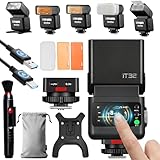
- 8. Godox iT32 with X5C – Best for Travel and APS-C Canon Bodies
- 9. Canon Speedlite EL-10 – Best Compact First-Party Flash for RF
- 10. VOKING VK750II – Budget Pick with Basic TTL
- How to Choose a Speedlight for Canon Cameras
- Frequently Asked Questions
- The Verdict: Which Speedlight Should You Buy for Canon?
Top 3 Speedlights for Canon Cameras (2026)

Godox V860III-C
- 76Ws round head
- 20-200mm zoom
- 2600mAh Li-ion battery
- 480+ full-power flashes

Godox V100 C
- 100Ws output
- replaceable VB30 battery
- 2.3-inch colour touchscreen
- SU-1 sub-flash

Canon Speedlite 430EX III-RT
- Canon RT radio control
- E-TTL II metering
- swivel and tilt head
- mini-stand and diffuser included
Best Speedlights for Canon Cameras at a Glance (2026)
Every flash below fires on a Canon hot shoe and meters correctly with E-TTL II on at least some EOS bodies. The differences are power, battery, and which wireless system it speaks. Here is the full lineup before we go through each one.
| Product | Specifications | Action |
|---|---|---|
| Godox V860III-C |
|
Check Latest Price |
| Godox V100 C |
|
Check Latest Price |
| Canon Speedlite 430EX III-RT |
|
Check Latest Price |
 Godox TT685II-C Godox TT685II-C |
|
Check Latest Price |
 NEEWER Z2PRO-C NEEWER Z2PRO-C |
|
Check Latest Price |
 NEEWER Z2-C NEEWER Z2-C |
|
Check Latest Price |
 Godox TT600 Godox TT600 |
|
Check Latest Price |
 Godox iT32 with X5C Godox iT32 with X5C |
|
Check Latest Price |
 Canon Speedlite EL-10 Canon Speedlite EL-10 |
|
Check Latest Price |
 VOKING VK750II VOKING VK750II |
|
Check Latest Price |
1. Godox V860III-C – Best Overall Speedlight for Canon Bodies
Godox V860III-C Flash for Canon, 76Ws 2.4G TTL 1/8000s HSS Falsh Canon
100m 2.4G X radio
2600mAh Li-ion, 480+ full-power flashes
1.5s recycle, 20-200mm zoom
Pros
- Lithium battery vastly outlasts AA speedlights
- Fast 1.5s recycle suits continuous work
- TTL accuracy reported as spot-on with Canon bodies
- 10-level modeling lamp and 20-200mm zoom
- Master and slave in one unit
Cons
- No battery charge indicator on the pack
- Small and awkward on-off switch
- Menu-driven settings take practice
This is the flash we kept reaching for. The V860III-C does three things well at once: it fires fast enough for a run of reception shots, it runs on a lithium pack that lasts a full day, and it drops into the wider Godox 2.4G ecosystem without an adapter. With a 2600mAh battery you get 480-plus full-power flashes per charge and a recycle time of about 1.5 seconds, which is the difference between catching a whole sequence and watching the buffer stall.
The head swivels 330 degrees and tilts from -7 to 120 degrees, so a plain white ceiling becomes a softbox the size of the room. Zoom coverage runs 20-200mm, wide enough that you can spread the light across a group at full power instead of walking the flash toward the back wall. A 10-level LED modeling lamp is dim, but it is enough to judge placement before you commit to an exposure.
Owners consistently single out the battery as the reason they moved away from AA-based Canon units, and that matches what we saw. Canon RT speedlites are still excellent, but four AA cells warm up, drain, and add bulk to the top of the camera bag. This one packs into the same space as the Canon and weighs less in the hand.
It pairs with the AD200 Pro, V1, AD300Pro and the X1T, XPro, X2T, XProII and X3 triggers, which means a single flash on camera can also serve as the master for a group off camera. The box includes the charger, the lithium battery, a mini stand, a protection case, a USB cable and a cloth.
Who the V860III-C suits
Portrait shooters who work in bars and venues will bounce it off a ceiling and never think about it again. Event photographers get the recycle speed they need for a crowded dance floor, and anyone moving from a Canon RT flash will find the Godox X system more flexible once they own more than one light.
It also works as a stand-alone flash with full E-TTL II on current Canon EOS DSLR and mirrorless bodies, so you are not locked into one body family.
Where it falls short
The battery pack has no numeric charge readout, so you are estimating rather than reading a level. The on-off switch is small and awkward to find without shifting your grip, which matters when you are working blind at a dark reception.
A small number of owners report units that fail to power on until the battery is cycled. The menus are also menu-driven, so budget an evening to set up the buttons you will actually use rather than every feature.
2. Godox V100 C – Best for Weddings and Long Event Sequences
Godox V100 C for Canon 100Ws TTL Camera Flash, 1/8000s HSS, 1.7s Recycle
100Ws in manual mode
Replaceable VB30 battery, ~1.7s recycle
2.3-inch colour touchscreen
Pros
- 100Ws with cooling that handles long bursts
- Replaceable VB30 battery removes the sealed-battery problem
- Detachable SU-1 sub-flash for direct fill
- Colour touchscreen speeds up power and HSS changes
- Native 2.4G X sender and receiver
Cons
- Heaviest unit here at 616 g
- Needs a firmware update before first use
- 2W modeling lamp is a light preview rather than a modeling flash
The V100 C is the newest and most capable unit in this roundup, and the 100Ws output is the reason it earns its place. Manual power runs from 1/1 down to 1/256, and upgraded cooling holds up across 70 to 100 consecutive full-power flashes. For a wedding day that stretches from getting ready to the last dance, that headroom is the whole point.
The battery is the detail we would highlight hardest. The VB30 pack is removable and replaceable, recycling is around 1.7 seconds, and each charge gives you roughly 400 full-power flashes. Most speedlights at this level seal the pack in, which means you carry spares forever or gamble on one cell all day.
Two features separate it from the V860III-C. The 2.3-inch full-colour touchscreen puts power, high-speed sync and TTL or manual switching on one screen, which is much faster than scrolling a small LCD in low light. And the detachable SU-1 sub-flash gives you direct fill while the main head is aimed somewhere else, solving the problem that normally forces you to give up the bounce angle.
It also sends and receives on the Godox 2.4G X system, so it works with the X3 for Canon, the AK-R1, other X-system flashes, and the sub-flash itself. Manual output of 100Ws is the highest figure in this list, and it is what lets you overpower midday sun or lift a subject two stops in bright window light.
Who the V100 C suits
Working photographers who shoot long sequences without breaks. The replaceable battery means you can rotate cells rather than wait for a charge, and the touchscreen means you are not fumbling with dials when the bride is walking back into the room.
It is designed for Canon EOS bodies running E-TTL or E-TTL II from the R5 through to Rebel-series DSLRs, and the cooling is what keeps it honest in a long sequence.
Where it falls short
At 616 g it is noticeably heavier than every other flash here, and on a small APS-C body it is a substantial lump above the lens. If you carry two of them plus a body, your bag changes shape.
Install the firmware update before you rely on it in a paid job, because full X-system compatibility depends on it. The 2W modeling lamp gives you placement preview but will not let you judge exposure accurately the way a modeling flash can.
3. Canon Speedlite 430EX III-RT – Best Canon-Native Radio Control
Canon Flash Speedlite 430EX III RT, 0585C011
Canon RT radio control built in
E-TTL II with Canon bodies
4 AA powered, 0.3 kg
Pros
- Refined electronics and very low battery heat
- Flawless E-TTL sync with Canon bodies
- Compact and light at 0.3 kg
- Swivel and tilt head for bounce
- Includes diffuser
- colour filter
- mini-stand and case
Cons
- Recycle speed lags modern lithium speedlights
- Canon RT radio is closed to other brands
- AA batteries add bulk
If your entire kit is Canon, this flash just works. The 430EX III-RT carries the RT radio system inside the body, so it will group with other Canon RT Speedlites with no trigger on the camera and no menu wrangling. The metering is excellent with Canon bodies, and owners describe the electronics as refined with very little battery heat over a long session.
It is also genuinely small. At 0.3 kg it disappears into a bag next to a compact body, and the tilt and swivel head covers the usual bounce and off-axis angles. The box includes a bounce adapter, a colour filter, a mini-stand and a case, which is more in the box than most rivals at this level.
Effective flash range with an EF 50mm f/1.4 at ISO 100 runs from roughly 0.7 to 23.6 metres in normal flash, and about 0.7 to 13.6 metres in quick flash. That is enough reach for most portrait and small-event work without a separate battery pack.
Who the 430EX III-RT suits
Canon-only shooters who want zero configuration. If you own a 90D, a 5D Mark IV, or an R-series body and you plan to add a second Canon flash later, the RT system links them directly. It is also a safe choice for anyone who has been disappointed by third-party TTL accuracy on Canon.
The bundled diffuser and colour filter make it a friendly first flash for someone learning off-camera light.
Where it falls short
Recycle speed is the weak point. Run it hard in a sequence and it lags the lithium speedlights on this list, which shows up at receptions and indoor sports. Four AA cells also add bulk and drain faster than a lithium pack.
And the radio system is Canon only. A Godox trigger will not group with it, and it will not group with a Godox X speedlight either, so mixing brands means optical triggering or separate remotes.
4. Godox TT685II-C – Best Value TTL Speedlight
GODOX TT685II-C E-TTL Flash for Canon Speedlight Camera Flash,2.4G Wireless
E-TTL II on Canon EOS bodies
20-200mm auto zoom
2.4G X system built in, 0.5 kg
Pros
- Reliable E-TTL II metering across Canon DSLR and mirrorless
- 20-200mm zoom covers wide and long work
- Built-in 2.4G X integrates with other Godox flashes
- TCM key locks exposure and switches to manual in one press
- Quick-release lock for fast on-off changes
Cons
- HSS only when fired off camera via a trigger
- Recycle slower than lithium round-head units
- Tilt and swivel range is modest
The TT685II-C is the workhorse of the Godox range, and for most Canon shooters it is the one to buy. It meters reliably in E-TTL II on a wide list of bodies including the R5 II, R5, R6 II, R8, R7, R10, R50, R100, RP, 90D, 80D, 6D II and 5D Mark IV. That compatibility list is the main reason it has held its value for so long.
Auto and manual zoom covers 20-200mm, so a wide-angle bounce on a small group and a tight head at a ceremony both come from the same head. The quick-release lock means you can move it on and off camera without fumbling, and the TCM key locks your exposure then switches to manual in one press, which is how you build a repeatable setup.
At 0.5 kg it sits between the tiny travel units and the heavy professional ones. It does not have a lithium battery, so it runs on standard cells, but for someone shooting a portrait session or a small event that is rarely the constraint.
It includes a mini stand, a protection case and an instruction manual. There is no modeling lamp on this model, which is the feature you will miss first if you are used to previewing placement.
Who the TT685II-C suits
Anyone who wants dependable TTL on a Canon body without moving outside the Godox ecosystem. It is the natural companion to a V1 or V860III-C, and it groups with them directly.
It also suits photographers who shoot a lot of different Canon bodies and want one flash that meters correctly on all of them.
Where it falls short
High-speed sync only appears when the flash is fired off camera through a trigger. On the hot shoe it is limited to the camera sync speed, so daylight HSS work needs a radio unit in the group.
Recycling is slower than the lithium round-head models, and the tilt and swivel range is more limited than premium units, which restricts how low you can bounce.
5. NEEWER Z2PRO-C – Best Round Head for the Money
NEEWER Z2PRO-C 2.4G TTL Round Head Flash Speedlite Compatible with Canon
76Ws round head, 28-105mm zoom
3000mAh battery, 600 full-power flashes
1/8000s HSS, 1.5s recycle
Pros
- Round Fresnel head renders softer
- more even light
- 600 full-power flashes with 1.5s recycle
- Twin 2W modeling lamps with 10 brightness levels
- One-touch TCM TTL and manual toggle
- Works with the Godox 2.4G X system
Cons
- Q-system transmitters sold separately
- Menu system takes practice
- R50 needs the AD-E1 adapter and RP is excluded
- Firmware update needed for full X-system compatibility
Round heads changed how a small flash looks on a face. The 76Ws circular Fresnel head spreads light more evenly than a rectangular tube, which softens the edge of the pool of light and produces round catchlights in the subject’s eyes. Add the included diffuser and the effect gets closer still.
The numbers here are the part that surprises people: 600 full-power flashes on a 7.2V 3000mAh lithium battery, 1.5 second recycle, and a 2.5 hour USB-C charge. High-speed sync runs to 1/8000s, and manual power steps from 1/1 down to 1/256. For a price tier usually associated with plastic-only budget units, that is a serious specification sheet.
The cooling is optimised for up to 100 consecutive full-power flashes, and the quartz tube is rated to 100,000. That rating matters if you shoot events rather than one portrait session a month.
Wireless is where this flash shows its budget edges. It speaks the Godox 2.4G X system with 32 channels, 99 IDs and 100m of range across four master groups or five slave groups, which is unusually broad. But the NEEWER Q-system transmitters are sold separately, and you update the firmware from the official site before you get full X-system behaviour.
Who the Z2PRO-C suits
Portrait and small-event photographers who want the softer rendering of a round head and the long battery life of a lithium pack without moving up a tier. The twin 2W 3300K modeling lamps give you placement preview, which most budget round heads skip.
Head movement is generous for the class: 330 degrees of swivel and -7 to 120 degrees of tilt, so you can bounce low.
Where it falls short
The menu system is idiosyncratic and takes real practice. Two modeling lamps are bright enough to preview, not bright enough to judge final exposure, so treat them as a placement tool.
Check your body before buying. Canon R50 owners need the AD-E1 adapter, and the RP and R50 are excluded from the native compatibility list on this model.
6. NEEWER Z2-C – Best Budget Round Head
NEEWER Z2-C 2.4G TTL Round Head Flash Speedlite Compatible with Canon Cameras, Compatible with Godox, 76Ws 1/8000s HSS, Diffuser, 2 Modeling Lamps, TTL/M Toggle Key, 3000mAh, 600 Full Power Light
76Ws circular Fresnel head
3000mAh battery, 600 full-power flashes
Magnetic dome diffuser included
Pros
- Round head and dome diffuser give noticeably softer light
- 600 full-power flashes with 1.5s recycle
- TCM key switches TTL and manual almost instantly
- Stroboscopic flash and focus assist at this price
- 2.4G wireless with 4 groups
- 32 channels and 99 IDs
Cons
- Menu system is idiosyncratic and takes practice
- Q-system transmitters sold separately and cannot run at the same time as X
- Some units reported arriving non-functional
- Canon RP and R50 excluded
- Requires a firmware update for full Godox X compatibility
This is the same round-head concept as the model above, trimmed in a few places and cheaper as a result. You still get 76Ws, a 1/8000s high-speed sync, a 3000mAh lithium battery rated at 600 full-power flashes, 1.5 second recycle and a magnetic dome diffuser that stays attached during shooting.
Colour temperature is a stable 5600K plus or minus 200K, which matters when you are mixing it with other flashes on manual power and matching colour by eye. Manual dimming runs 1/1 to 1/256 across a 28-105mm focal range, and you get front and rear curtain sync, flash exposure compensation, focus assist and stroboscopic flash.
Two 2W modeling lamps with ten brightness levels and a head that swivels 0-330 degrees and tilts -7 to 120 degrees complete a feature list that would have been unusual at this level a few years ago.
Who the Z2-C suits
Anyone moving up from a kit-lens pop-up flash who wants modern rendering and battery life rather than the lowest possible number. The dome diffuser alone makes portraits look less harsh than a bare rectangular head.
It also works with NEEWER round flash accessories and the CRM2, M12, CRS6, CRS7, CRB1 and S2 mounts if you build a system over time.
Where it falls short
Owners complain most about the menu system, which takes practice to learn. The Q-system transmitters are extra, and you cannot run the Q and Godox X systems at the same time, so decide which ecosystem you want before you add anything.
A small number of units arrived non-functional, and Canon RP and R50 owners are out of luck because those bodies are excluded from compatibility. Update the firmware from the official site for full Godox X behaviour.
7. Godox TT600 – Best for Off-Camera Fill and Manual Work
Godox TT600 2.4G Wireless Flash Speedlite Master/Slave Flash with Built-in Trigger System Compatible for Canon Nikon Pentax Olympus Fujifilm Panasonic (TT600)
GN60 output
Manual M, S1 and S2 modes
4 AA batteries, about 230 full-power flashes
Pros
- Built-in 2.4G X transmitter with around 100m range
- Entry point into the Godox ecosystem
- Works with most hot shoe camera brands
- Large clear LCD panel
Cons
- No high-speed sync on the hot shoe
- Manual modes only with no TTL metering
- Runs on 4 AA batteries
- GN60 output limits it to fill and moderate power
The TT600 has the largest review count of anything we tested, and the reason is simple: it is a cheap way into the Godox 2.4G system with a transmitter already built in. If you already own an XPro or XProII and want a second light to hang on a stand, this is the body that goes with it.
It runs in M, S1 and S2 modes only, which means there is no TTL metering. That is a genuine disadvantage if you are learning, and an advantage if you have already locked your exposures and want a second light that reproduces the first exactly.
The guide number of 60 and a recycle window of 0.1 to 2.6 seconds put it firmly in fill territory. Around 230 full-power flashes per set of batteries is fine for an evening of event work. Colour temperature is a consistent 5600K plus or minus 200K, which helps when you are balancing it against a daylight-balanced head.
You get 5 groups and 32 channels of control, and it will work with Canon, Nikon, Pentax, Olympus, Fujifilm and Panasonic hot-shoe bodies. The four AA batteries are not included, which is a small annoyance on day one.
Who the TT600 suits
Photographers who already own a Godox radio trigger and want a cheap slave or background light. It is also a sensible first unit for a student learning manual flash off camera, where understanding the numbers teaches more than TTL would.
Because it is brand-agnostic on the hot shoe, it also works as a stand-alone light on non-Canon bodies.
Where it falls short
No TTL, full stop. If you want the camera to meter the flash automatically, look at the TT685II-C or one of the round-head units instead.
High-speed sync only works when the flash is used with a separate TTL wireless trigger, not on the camera hot shoe, and AA power means extra batteries in a bag that already carries a camera.
8. Godox iT32 with X5C – Best for Travel and APS-C Canon Bodies
Godox iT32 TTL Camera Flash with X5C Trigger for Canon R6 Mark II, R7, R8
Hotshoe module doubles as a wireless trigger
TTL and HSS to 1/8000s
169 g, USB-C rechargeable
Pros
- Very small and light while still offering genuine TTL and HSS
- The X5 module turns the same flash into a transmitter
- Touchscreen menu is bright and intuitive
- USB-C recharging with good battery life
- Swappable X5 modules cover multiple camera brands
Cons
- Guide number of 18 makes it a fill light
- Replacement batteries are not sold
- Remote trigger mode does not work on Canon RP in Auto mode
- Multi-function shoe Canon bodies need an adapter
This is the cleverest design in the roundup. The magnetic X5 module clips onto the top and turns the flash into a hot shoe unit; pull it off and the same module becomes a 2.4GHz wireless trigger that controls a whole Godox X group. One piece of gear, two jobs, and no separate trigger to buy or charge.
It still manages TTL and high-speed sync to 1/8000s, manual modes, a swivel head and a modeling light from a body weighing 169 g. On an R50 or an R10 the whole thing is smaller than the pop-up flash assembly on the camera.
The flash reads the attached X5 version on power-up and shows model type, battery and charge status on the screen, so you are not guessing which module is fitted. A magnetic diffuser and 1/1 and 1/2 CTO colour filters are included, and the battery charges over USB-C.
Because the module is magnetic rather than fixed, one flash body serves multiple camera brands. That matters if you split your time between a Canon R7 and an old DSLR, and it also means a lost module is replaceable rather than fatal.
Who the iT32 suits
Travellers, APS-C shooters and anyone who wants fill flash in a small bag. It handles TTL, high-speed sync and off-camera triggering in a package that fits in a jacket pocket with a spare battery.
It is a genuinely good first flash for someone learning off-camera light, because the same unit can sit on camera and then move to a stand.
Where it falls short
A guide number of 18 means it fills shadows rather than lighting a subject at distance. Treat it as a second light or a close-range bounce tool, not as a main flash in a large room.
Spare batteries are not sold, so a long idle period means a recharge before you leave. Canon bodies with the multi-function shoe need an adapter, and remote trigger mode does not engage on the Canon RP when the body is in Auto shooting mode.
9. Canon Speedlite EL-10 – Best Compact First-Party Flash for RF
Canon Speedlite EL-10
Multi-function shoe connector
90 degree tilt, 150 and 180 degree swivel
4 AA batteries, app support
Pros
- Light
- compact and well made for a Canon first-party flash
- Multi-function shoe gives deeper R-series menu integration
- Runs on standard AA rechargeable cells
- Radio control of up to 15 additional Speedlites
- Works as a clean stand-alone flash on R50
- R10
- R8 and R6 Mark II
Cons
- Only works with multi-function shoe Canon bodies
- Some owners report setup confusion and compatibility returns
- Guide number of 82.7 limits it to modest fill
- 1/200s sync is the slowest here
The EL-10 sits where Canon’s portable line sits today, replacing the Speedlite 430EX III-RT. The reason to like it is the multi-function shoe connector, which gives deeper communication with R-series bodies than the older RT foot. It can radio control up to 15 additional compatible Speedlites, which is more group capacity than most first-party flashes offer.
Head movement is good for the size: it tilts 90 degrees up and swivels 150 degrees one way and 180 degrees the other. Custom Flash modes let you register a setup and recall it instantly, which is the feature that saves time at a wedding.
It runs on four AA batteries and is supported by the Canon Camera Connect app for wireless flash settings and shutter release. A soft case and stand are included.
Who the EL-10 suits
Canon R-series owners who want first-party menus, first-party radio control and standard AA cells rather than proprietary lithium packs. If you are moving from an older DSLR, this is a clean step up rather than a whole new system.
It works well as a stand-alone flash on R50, R10, R8 and R6 Mark II bodies for travel and family work.
Where it falls short
It only works with Canon bodies that have the multi-function shoe. Older DSLRs and older R-series models are excluded, and some owners report menu confusion with returns over compatibility, so check your body before you commit.
A guide number of 82.7 limits it to modest fill rather than main-light work, and the 1/200s sync is the slowest in this roundup, which rules out high-speed sync for daylight portraits on this body alone.
10. VOKING VK750II – Budget Pick with Basic TTL
VOKING VK750II TTL Flash Speedlite with LCD Screen for Canon DSLR Camera
Basic TTL for Canon EOS DSLRs
0-90 degree tilt, 0-270 degree swivel
Optical slave triggering only
Pros
- Low cost for a TTL speedlight with an LCD
- Intuitive controls once configured
- Wide rotation range for bounce and indirect light
- Works reliably with older Canon DSLRs
- Listed as dust and water resistant
Cons
- 1/200-1/250s sync is slow by modern standards
- No high-speed sync and no 2.4G radio triggering
- Instruction booklet is of little use
- Some units reported failing to power on
The VK750II is the cheapest way to add TTL to a Canon DSLR, and for an older body it does the job. It is listed for EOS DSLRs including the 5DS and 5DSR, 6D II, 7D, 70D, 77D, 80D and the Rebel T5, T5i, T6, T6i, T6s, SL1 and SL2, and owners confirm it pairs reliably with older Rebels.
Modes cover TTL, manual, multiple, S1 and S2, plus front and rear curtain sync. Head rotation runs 0 to 90 degrees vertically and 0 to 270 degrees horizontally, which is a generous range for bounce work, and it has FEC, AEB, manual and auto zoom, and a PC sync port.
What it does not do is radio triggering. Slave mode here is optical infrared pulse only, so you will be relying on line of sight and a master flash firing in the frame. That is workable indoors in a small room and unreliable at a wedding or a large venue.
There is no high-speed sync, and the 1/200 to 1/250 second sync ceiling means it is a fill and indoor tool rather than a daylight one.
Who the VK750II suits
Anyone holding an older Canon DSLR who wants TTL bounce light indoors and on a budget. At indoor events and family occasions, optical slave triggering is usually enough.
It also works as a second or third light in a room where you can position everything on one stand line of sight.
Where it falls short
The instruction booklet is of little use, and owners report having to research settings online. Slow sync, no high-speed sync and no radio control put it out of contention for outdoor and event work.
A small number of units failed to power on, and one arrived with a cracked LCD screen, so buy from a seller with straightforward returns.
How to Choose a Speedlight for Canon Cameras
What is a speedlight, and is it different from a flash?
A flash is the general word for any light you attach to a camera. A speedlight is the specific term for a portable hot-shoe flash, and Canon calls its own units Speedlites. There is no functional difference between the three words; they describe the same category of gear at different levels of specificity.
What matters is the class of unit. A bare compact flash is manual or TTL-only with optical triggering. A radio speedlight adds a 2.4GHz transmitter, a zoom head, high-speed sync and a lithium battery. A round-head speedlight adds softer light falloff and a wider modifier ecosystem.
Work out the guide number you actually need
Guide number measures flash power at ISO 100 and a stated focal length. The useful relationship is simple: divide the guide number by your subject distance to get the f-number the flash will produce.
So at a 2 metre shooting distance, a GN of 60 gives you roughly f/3 at ISO 100. If you need f/5.6 at 2 metres, you want a guide number of about 11, which tells you immediately that most compact units are fill lights and that a 60-class head is what you buy for main-light work indoors.
Always check the measurement conditions. Guide numbers fall as the zoom widens, so compare figures quoted at the same focal length and ISO.
Decide whether you need TTL at all
TTL measures the flash through the camera and sets the exposure automatically, which is what you want for events, family, and anything where the light changes between frames. Manual power gives repeatable, predictable output, which is what you want in a styled portrait setup or a multi-light group where consistency matters more than speed.
Our advice is to learn manual first and keep TTL for the situations where you would otherwise be guessing. Several units here, including the TT600, are manual-only by design, and photographers using them report a much faster learning curve than automatic metering gives.
Recycle time and battery type decide your shooting day
Recycle time is the gap between shots at full power, and it is what causes buffer stalls in sequences. Lithium packs on the round-head units here recycle at 1.5 to 1.7 seconds and deliver 400 to 600 full-power flashes per charge. AA-based Canon units recycle slower and drain faster, which is the single most common complaint about them in photography forums.
If you shoot events or weddings, prioritise recycle and battery life over features. If you shoot two portraits a month, neither matters much.
Understand the radio systems before you buy a second flash
Canon RT units group with each other and nothing else. Godox 2.4G X units group with each other and with Godox, Neewer and Profoto AirTTL partners, but not with Canon RT. There is no cross-triggering between the two ecosystems, and mixing them means optical slave triggering or two separate remotes.
Pick your ecosystem on the second unit, not the first. Buying one Canon and one Godox because each looked good is the most common expensive mistake.
Check the shoe on your specific Canon body
Newer Canon R-series bodies use the multi-function shoe, which changes compatibility. The EL-10 only works with multi-function shoe bodies, and the Godox iT32 needs an adapter on those bodies. Some Neewer round heads exclude the RP and R50, or require the AD-E1 adapter on the R50.
Older DSLRs have a standard hot shoe and will accept almost anything here. The Godox TT685II-C has the broadest published body list in this roundup, covering current R-series models and DSLRs back to the 5D Mark IV generation.
Budgeting for the whole kit rather than one accessory is the same lesson our beginner astronomy camera guide arrives at: choose gear for the work you will do, then upgrade one layer at a time.
Frequently Asked Questions
Are Godox flashes better than Canon for Canon cameras?
Neither is better at everything. Canon Speedlites such as the 430EX III-RT meter exceptionally well on Canon bodies and radio-control up to 15 Canon units from the camera, but they run on AA cells and recycle slowly in bursts. Godox speedlights run on lithium batteries, recycle in 1.5 to 1.7 seconds, and speak the far more flexible 2.4G X system that also works with Neewer and Profoto AirTTL units. Canon wins for single-brand simplicity; Godox wins for battery life, recycle speed and mixing brands.
Do I really need a TTL flash?
You need TTL if you want the camera to meter the flash automatically, which is the case for events, family gatherings and fast-moving situations. You can skip it if you set manual power and stay with fixed distances, because manual output is repeatable and often more consistent between frames. Our advice is to learn manual flash first so the numbers mean something to you, then keep TTL for the moments when guessing would cost you time.
Will a Canon Speedlite work with a third-party flash?
Physically yes, every speedlight here fits a Canon hot shoe. Electronically, no. Canon RT radio triggering only groups with other Canon RT units, and the Godox 2.4G X system only groups with X-system flashes. The two ecosystems cannot cross-trigger. If you mix brands you can still use optical slave triggering from a master flash firing in frame, though that needs line of sight and is less reliable outdoors.
Is Neewer or Godox better for Canon cameras?
For power and battery life at a mid-range price, the Neewer Z2PRO-C is hard to argue with: 76Ws, a round Fresnel head, 600 full-power flashes, 1/8000s high-speed sync and dual modeling lamps, plus Godox X compatibility. Godox has the broader accessory ecosystem, more established trigger bodies, and units with larger zoom heads and faster recycle. Neewer menus take more practice, and Q-system transmitters are sold separately.
Which Godox speedlight is best for Canon shooting?
The Godox V860III-C is the strongest all-rounder for Canon bodies, with 76Ws, a 2600mAh lithium battery giving 480-plus full-power flashes, 1.5 second recycle and 20-200mm zoom on the 2.4G X system. For long paid event sequences, the V100 C adds 100Ws, a replaceable VB30 battery and a colour touchscreen. For budget, the TT685II-C gives dependable E-TTL II metering across the widest list of Canon EOS bodies.
The Verdict: Which Speedlight Should You Buy for Canon?
For most Canon shooters, the Godox V860III-C is the right first buy. It meters reliably in E-TTL II, recycles fast, runs all day on one lithium charge, and it drops into a wireless system you can grow with instead of one you are locked into. If you shoot long paid sequences, step up to the Godox V100 C for its 100Ws and replaceable battery.
Stay with Canon Speedlites if you are strictly single-brand and want zero configuration, and add the NEEWER Z2PRO-C if softer round-head light matters more than menu simplicity. Whichever you choose, buy the second flash from the same radio ecosystem as the first. That single decision will save you more money than any spec comparison. Explore our other camera buying guides as you build out the rest of the kit.