
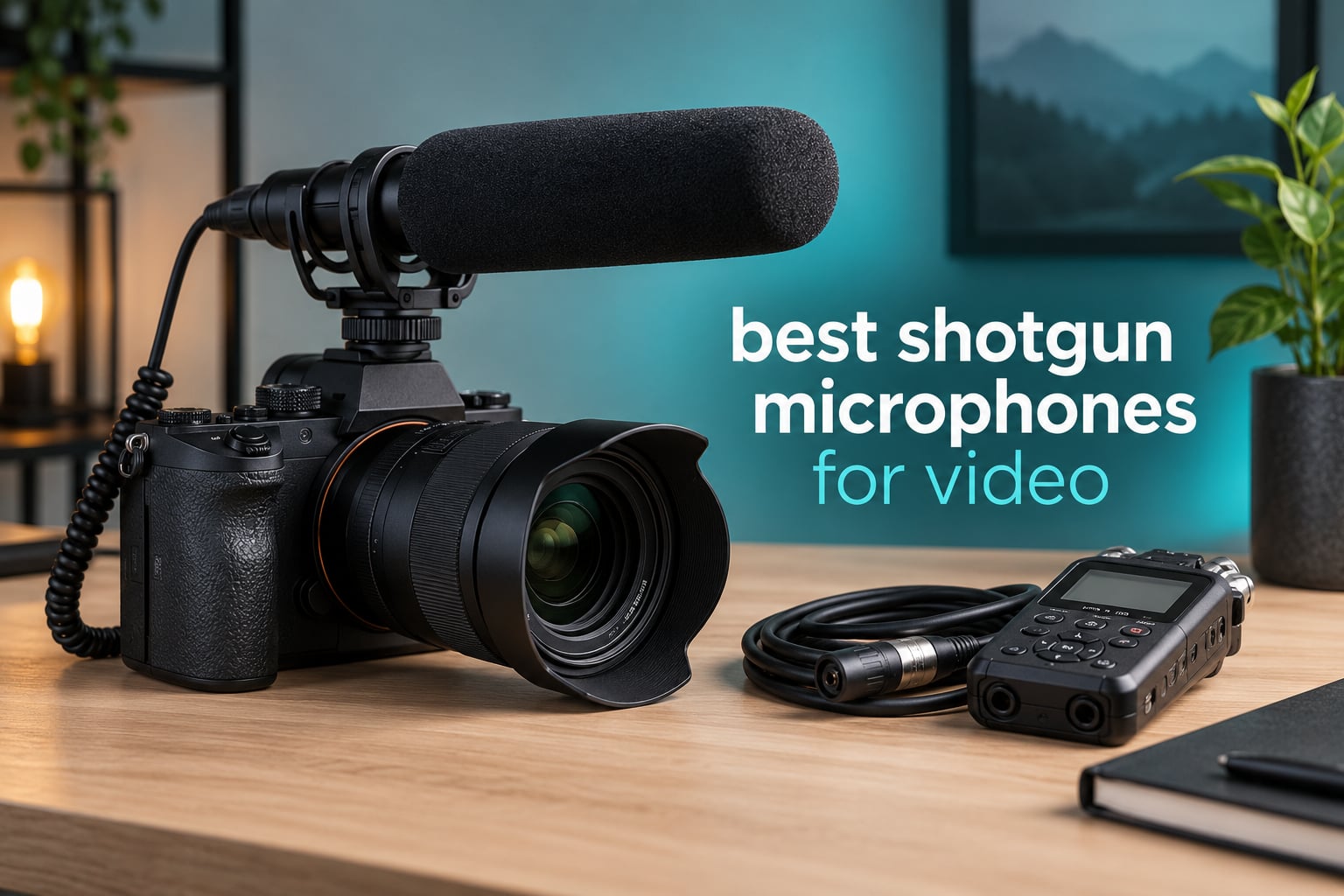
The best shotgun microphones for video turn the thin, distant audio your camera records into dialogue you can actually cut into a finished piece. Our overall pick is the Movo VXR10, a battery-free 3.5mm shotgun with more than 15,000 owner reviews behind it and a full accessory kit in the box.
That said, the shotgun category has split into three very different tiers. Plug-in-power 3.5mm mics cost little and suit a first camera. Battery-powered mics with digital switching give you filters, pads and gain control on the body. XLR condensers like the Audio-Technica AT875R deliver broadcast results but need phantom power and a recorder. Getting the tier right matters more than the badge on the box.
We compared ten current-generation shotgun microphones across polar pattern, power source, self-noise, weight, mounting options and real-world owner feedback, then split them by who should actually buy each one. We also cover the cases where a shotgun mic is the wrong tool entirely, because that is the question running through most of the gear advice on this topic. If you are still building a kit, our XLR microphone picks for streaming cover the other half of the audio chain.
Table of Contents
- Top 3 Best Shotgun Microphones for Video
- All 10 Shotgun Microphone Picks Side by Side in 2026
- 1. Movo VXR10 – Best Overall On-Camera Shotgun Microphone
- 2. COMICA CVM-V30 LITE – Best for Phone and Camera Switching
- 3. Movo VXR10-PRO – Best for Run-and-Gun Shooting
- 4. COMICA CVM-VM10II – Best Kit-and-Cables Value
- 5. Rode VideoMicro II – Best Compact Shotgun for Travel
- 6. Rode VideoMic NTG – Top Rated Hybrid Shotgun Microphone
- 7. Rode VideoMic Pro+ – Best Digital Controls and Sound Quality
- 8. Sennheiser MKE 400 – Best Built-In Filtering and Monitoring
- 9. COMICA VM20 – Best Gain Control on a Budget
- 10. Audio-Technica AT875R – Best XLR Shotgun for Broadcast Work
- How to Choose a Shotgun Microphone for Video
- Frequently Asked Questions
- The Best Shotgun Microphone for Video in 2026
Top 3 Best Shotgun Microphones for Video

Movo VXR10
- 3.5mm plug-in power
- No batteries needed
- Shock mount and windscreen included
- 51 g aluminum body

Rode VideoMic NTG
- 3.5mm auto-sensing plus USB-C
- Digital switches for HPF and pad
- Variable gain control
- 94 g metal body

Rode VideoMicro II
- 80 mm ultra-compact body
- HELIX isolation mount
- 24 g total weight
- TRS and TRRS patch cables included
The Movo VXR10 wins on evidence rather than specification. It carries 15474 owner reviews at a 4.3 rating, more than any other mic in this group, and it arrives with a shock mount, a fuzzy windscreen, a carrying pouch and both TRS and TRRS cables. Plug it into a camera mic input and it works, with no battery to forget.
The Rode VideoMic NTG takes the feature crown with digital switching for a high-pass filter, a -20dB pad, a high-frequency boost and a safety channel, plus infinitely variable gain. The VideoMicro II is the travel answer at 24 g and 80 mm long, small enough to disappear on a compact rig.
All 10 Shotgun Microphone Picks Side by Side in 2026
| Product | Specifications | Action |
|---|---|---|
| Movo VXR10 |
|
Check Latest Price |
 COMICA CVM-V30 LITE COMICA CVM-V30 LITE |
|
Check Latest Price |
 Movo VXR10-PRO Movo VXR10-PRO |
|
Check Latest Price |
 COMICA CVM-VM10II COMICA CVM-VM10II |
|
Check Latest Price |
| Rode VideoMicro II |
|
Check Latest Price |
| Rode VideoMic NTG |
|
Check Latest Price |
 Rode VideoMic Pro+ Rode VideoMic Pro+ |
|
Check Latest Price |
 Sennheiser MKE 400 Sennheiser MKE 400 |
|
Check Latest Price |
 COMICA VM20 COMICA VM20 |
|
Check Latest Price |
 Audio-Technica AT875R Audio-Technica AT875R |
|
Check Latest Price |
1. Movo VXR10 – Best Overall On-Camera Shotgun Microphone
Movo VXR10 Universal Shotgun Mic for Camera
3.5mm jack
No battery required
76 dB SNR
100 Hz to 20 kHz
51 g
Pros
- Works with iPhone and Android as well as DSLRs and camcorders
- Aluminum body with integrated shock mount
- Unidirectional pattern rejects off-axis distraction
- Windscreen and pouch plus TRS and TRRS cables included
Cons
- Needs a separate adapter on newer USB-C and Lightning phones
- Many Canon Rebel T6 and T7 bodies have no external mic input
- Proximity effect distorts when the mic is too close to a mouth
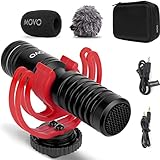
The VXR10 is the mic we keep reaching for when someone asks what to put on a camera this week. It weighs 51 g, runs on plug-in power from whatever device it is plugged into, and comes with a shock mount, a furry windscreen, a carrying pouch and both 3.5mm TRS and TRRS cables. The kit is unusually complete for this price tier.
In use, the unidirectional pattern does what it claims. On a two-person walk-and-talk outdoors, voices from the side drop away and the subject in front stays forward. Buyers consistently mention durability and the accessory value, and the 15474-review count at a 4.3 average tells you this is a mic people keep rather than try once.
Technically it is a modest design: 100 Hz to 20 kHz frequency range, 200 ohm impedance, 76 dB signal-to-noise ratio and a single unidirectional pattern with no switches. There is no gain control, no pad and no low-cut filter on the body, so all level decisions happen at the camera or recorder.
The 100 Hz low end is worth knowing about. It will not capture deep rumble, which is usually a good thing for dialogue, but it also means you get less low-frequency content to shape later. Proximity effect is the other thing to watch: owners report distortion when the mic sits too close to a mouth and a muffled signal when it drifts too far.
Best Used For First Cameras, Phones and Hybrid Rigs
This is the shotgun to buy if your camera has a 3.5mm mic input and you want zero setup friction. It suits talking-head video, product walkthroughs, vlogs and any situation where a visible lavalier is not an option.
Pairing it with a dedicated USB podcast microphone setup is a common split for creators who do both: shotgun for moving shots, USB for the seated desk segments.
Watch Out For Adapter and Body Compatibility
Two compatibility traps account for most of the negative reviews. Newer phones need a USB-C or Lightning to 3.5mm adapter, and several Canon Rebel bodies including the T6 and T7 have no external microphone jack at all. Check your specific body before you buy, not your brand.
2. COMICA CVM-V30 LITE – Best for Phone and Camera Switching
COMICA CVM-V30 LITE Video Microphone,Super-Cardioid Condenser On-Camera Shotgun Microphone for Canon Nikon Sony Panasonic DSLR Cameras,Mic for iPhone Android Smartphone with 3.5mm Jack(Black)
3.5mm jack
Camera and phone mode switch
78 dB SNR
2200 ohm
150 g
Pros
- Camera and phone switch on the mic body removes the need for TRRS adapters
- No batteries needed
- Super-cardioid pattern
- Shock mount plus cold shoe and 1/4 thread included
Cons
- Plastic body feels light next to metal rivals
- Needs a 3.5mm mic input and the external-mic menu enabled on the host device
The CVM-V30 LITE solves a specific and common problem: moving between a camera and a phone without re-cabling. A switch on the body toggles between camera and phone output modes, so the same mic and the same cable work on a mirrorless body and a smartphone with a TRRS jack.
Spec-wise it punches slightly above its tier. The listed polar pattern is super-cardioid, signal-to-noise ratio is 78 dB and sensitivity reads 34 dB, which is a better starting point than most plastic-bodied budget mics. The shock-absorbing mount and the cold shoe with a 1/4 thread underneath cover nearly every mounting case you will hit.
It draws plug-in power from the host device despite the listing also mentioning battery power, so plan on having a battery-free workflow. The 2200 ohm impedance is high, which is normal for this class and means the mic leans on the host preamp for level.
Owners like the straightforward setup and the off-axis rejection for the money. The recurring complaints are the light plastic shell and compatibility, particularly on entry-level DSLRs. Canon Rebel T3, T5, T6 and T7 models and some Nikon D3xxx bodies are called out by name in reviews as having no usable 3.5mm mic input.
Best Used For Creators Who Shoot Phone and Camera
Choose this when your audio workflow crosses devices. Short-form vertical video on a phone, then a longer piece on a mirrorless body, all with one mic and one cable, is exactly what the body switch is for. It is also the cheapest way to cover both devices in one bag without buying two microphones.
Watch Out For Entry-Level DSLR Jacks
Verify your camera has a 3.5mm microphone input and that the external-audio menu is enabled before ordering. The plastic housing also means it is not the choice for a rig that gets knocked around on location.
3. Movo VXR10-PRO – Best for Run-and-Gun Shooting
Movo VXR10-PRO Professional Video Microphone for Camera with Rycote Lyre Shock Mount – Shotgun Mic Compatible with DSLR Cameras and iPhone, Android Smartphones
3.5mm TRS and TRRS
Rycote Lyre mount
Supercardioid
76 dB SNR
2.1 oz
Pros
- Rycote Lyre mount cuts knocks and vibration
- Supercardioid pickup is crisper than a basic directional mic
- No batteries or charging
- Case plus foam and furry windscreens and both cables included
Cons
- Newer phones still need a Lightning or USB-C to 3.5mm adapter
- Some Canon Rebel T6 and T7 bodies lack an external mic jack
The VXR10-PRO is the plain VXR10 with the one upgrade that matters most for movement: a Rycote Lyre suspension instead of a simple rubber mount. Lyre isolates the capsule from the sharp low-frequency thumps that arrive every time a camera body swings on a strap, and owners consistently report a noticeable difference in handling noise.
It also steps up the polar pattern. Where the VXR10 is described simply as unidirectional, the -PRO is a supercardioid with a narrower acceptance angle, which translates to cleaner subject pickup when a second person is standing nearby.
The kit is generous: a hard case, a foam windscreen, a furry windscreen, a 3.5mm TRS cable and a 3.5mm TRRS cable. Power is plug-in only, so there is nothing to charge on a shoot day. The body is metal and plastic at 2.1 ounces, light enough to sit on a small rig without upsetting the balance.
Reviews mention headphone monitoring on smartphones through third-party apps, which is genuinely useful for checking levels when the phone has no built-in meter. As with the VXR10, the same two cautions apply: modern phones need an adapter, and some Canon Rebel bodies have no external mic input at all.
Best Used For Documentary and Travel Work
This is the one for a shooter who moves. Walking interviews, handheld coverage, anything where the rig moves between shots and you cannot afford a low-frequency thud on every reposition. The supercardioid pickup also helps when the subject is not alone in the space.
Watch Out For Adapter Costs on New Phones
Budget a small USB-C or Lightning to 3.5mm adapter if you shoot on a current phone, and confirm your camera body has a mic jack. Neither issue is unusual, but both are avoidable if you check the body first.
4. COMICA CVM-VM10II – Best Kit-and-Cables Value
Camera Microphone,Comica CVM-VM10II Professional Video Microphone with Shock Mount, Deadcat,Compact Shotgun Mic Compatible with iPhone,DSLR Camera,Android Smartphones- Perfect for TikTok YouTube Vlog
3.5mm TRS and TRRS
Rycote Lyre with deadcat
60 Hz to 20 kHz
220 g aluminum
Pros
- Rycote Lyre shock mount keeps handling noise out of recordings
- Aluminum body resists vibration interference
- Battery-free plug-in power setup
- TRS and TRRS cables bundled
Cons
- Long compatibility list for Canon Rebel bodies and some Samsung devices
- Cardioid pickup is wider than a true supercardioid shotgun
The CVM-VM10II is the most complete short-shotgun package in this group, and it is the one that arrives with a deadcat already fitted on a Rycote Lyre shock mount. Most competitors sell the mount and the windshield as extras, so this saves two purchases and a mounting job.
Owners like it for TikTok, YouTube and vlog work, which is the workload its design suits. The aluminum body is a step up from plastic at this tier, and the Lyre mount means it survives being carried rather than needing a desk.
Frequency response runs 60 Hz to 20 kHz, so there is real low-mid content available for editing. Signal-to-noise ratio is listed at 75, and power comes straight from the host device through plug-in power with no battery to manage.
Two honest limits. The pickup pattern is cardioid rather than supercardioid, which is wider and will pick up more from the sides than a true long-barrel shotgun. And the compatibility list is long: Canon Rebel T5, T5i, T6, T7, T7i and the HFR800 are all called out as needing an adapter cable, and some Samsung phones need Samsung’s own Type-C adapter.
Best Used For Social Video With a Complete Kit
Buy this if you want a microphone that works the moment it arrives, with wind protection and isolation already handled. It is a strong match for short-form vertical video, interviews in ordinary rooms, and any setup where the total cost of the kit matters. Nothing else at this tier ships with a deadcat and a Lyre together.
Watch Out For Wider Pickup Than a True Shotgun
Cardioid off-axis rejection is gentler than the supercardioid models in this list, so in a busy space you will hear more background. If the location is noisy, a narrower pattern is a better priority than a fuller accessory kit.
5. Rode VideoMicro II – Best Compact Shotgun for Travel
RØDE VideoMicro II Ultra-Compact On-Camera Shotgun Microphone for
80 mm long, 24 g
3.5mm jack
Battery powered
78 dB SNR
HELIX mount
Pros
- Extremely compact and light at 24 g
- HELIX isolation mount handles knocks
- Highly directional pickup isolates the subject
- Built-in shoe mount with cable management
Cons
- No onboard gain or filter switches
- Plastic shell feels less durable than metal bodies
The VideoMicro II is the smallest mic here, and that is the entire point. At 80 mm long and 24 g it disappears on a compact rig, sits in a small bag without adding bulk, and never crowds the viewfinder on a body with a small sensor. If you shoot on a travel kit, this is the one.
Rode’s HELIX isolation mount is fitted as standard and handles the knocks that come with handheld work. The highly directional pickup isolates the subject well for its size, and the 78 dB signal-to-noise ratio is among the better figures in this roundup.
The box is unusually complete for a Rode mic at this level: the HELIX mount, a foam windshield, a furry WS12 windshield, a SC7 TRS to TRRS patch cable and a SC13 TRS to TRS cable. That is a full cold-shoe kit with wind protection for whatever you shoot on.
What it does not have is control. There are no gain switches, no pad and no low-cut filter, so the camera or recorder handles levels. It is battery powered, and the listing notes a one-year warranty extending to two years after registration. Reviews commonly point to the lack of onboard controls and the plastic shell as the two limitations, along with how much quieter and cleaner it is than built-in camera audio.
Best Used For Handheld and Travel Video
Walk-and-talks, travel vlogs, b-roll with a compact camera, and any kit where every gram and every millimetre counts. It also works well as a backup mic that lives in the camera bag permanently. Among the ten mics here it is the one you are least likely to notice on camera.
Watch Out For No Onboard Controls
If you shoot in wildly changing levels, the absence of a switchable pad and gain control means you manage that in post or with a recorder that offers manual level control. Weigh that against the fact that the mic weighs less than three ounces and stays clear of the viewfinder on a small body.
6. Rode VideoMic NTG – Top Rated Hybrid Shotgun Microphone
Rode VideoMic NTG Camera-mount Shotgun Microphone,Black
3.5mm auto-sensing and USB-C
Digital HPF, pad, HF boost, safety channel
20 Hz to 20 kHz
94 g
Pros
- Natural uncoloured broadcast tone
- Digital switches for high-pass filter and -20 dB pad plus HF boost and safety channel
- Infinitely variable gain for precise level matching
- Doubles as a USB mic with a 3.5mm headphone output
Cons
- Internal self-noise can be noticeable in very quiet rooms
- Needs a battery or USB power
The VideoMic NTG carries the deepest feature set of the on-camera mics here, and it is the one that changes workflow most. It uses an acoustic design derived from the NTG5, which is why owners describe the sound as natural and uncoloured rather than bright or hyped.
Everything is switched digitally on the body: a high-pass filter, a -20 dB pad, a high-frequency boost and a safety channel that records a second, lower track in case the main one clips. Gain is infinitely variable rather than stepped, so you can match levels to a shot instead of picking the nearest switch.
The 3.5mm output auto-senses the connection, switching between a camera input and a mobile TRRS input without a manual change. Plug it into a computer over USB and it becomes a USB microphone with a 3.5mm headphone output for monitoring. Power is a rechargeable battery or USB, and the metal body runs 94 g with a 20 Hz to 20 kHz response range and a 79 dB signal-to-noise ratio.
The honest limitation is self-noise. Several owners note the internal noise becomes audible in a genuinely quiet room after a gain boost, which is the one scenario where a shotgun is the wrong tool anyway. The ten-year warranty is among the longest in the group.
Best Used For Creators Who Want On-Body Control
This suits anyone who currently fixes level problems in post. The safety channel alone removes a whole category of clipped-audio anxiety, and the digital filter and pad cut down on EQ work. It is a strong all-rounder for documentary, wedding and broadcast-style work.
Watch Out For Self-Noise in Dead-Quiet Rooms
In a treated studio or a silent house at night, the internal noise floor can show. That is also where a shotgun earns the least, since a quiet room needs a close microphone rather than a distant one. If you shoot a lot of seated indoor video, review our webcam and video conferencing picks as well.
7. Rode VideoMic Pro+ – Best Digital Controls and Sound Quality
RØDE VideoMic Pro+ Premium On-Camera Shotgun Microphone with High-Pass
3.5mm jack
40 Hz to 20 kHz
Rycote Lyre suspension
LB-1 battery plus AA plus USB
Pros
- Clear and consistent tone owners call a major upgrade over built-in camera audio
- Digital switching cuts post-production work
- Automatic power-off when unplugged
- LB-1 rechargeable battery plus AA and continuous USB
Cons
- Bulky on a compact camera rig
- Picks up more low end than some rivals and needs a touch of EQ
- Multiple adapters needed for smartphone work
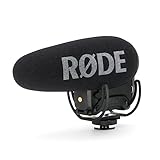
The VideoMic Pro+ shares the highest average rating in this group at 4.6, and the reviews make the reason clear: the sound is consistently described as rich, clear and immediately better than built-in camera audio. It suits interview, event and explainer work where the difference between clean dialogue and thin audio decides whether a clip gets used.
One owner in r/videography put it plainly, saying the battery lasted like 100 hours. That is the practical reality of the power design here, and it is a real advantage over mics that need managing nightly.
The Rycote Lyre suspension is built into the body, and the digital switching covers a high-pass filter, a pad, a high-frequency boost and a safety channel. Power options are unusually broad: the included RØDE LB-1 Li-Ion battery in a built-in door, two AA cells, or continuous micro-USB. The automatic power function switches the mic off when you unplug it, so you do not come back to a flat battery.
Frequency response is 40 Hz to 20 kHz with a 74 dB signal-to-noise rating, and the body is metal at 4.32 ounces, also covered by a ten-year warranty. The main gripes are physical: it is bulky on a small rig, it picks up more low end than some competitors so a little high-pass EQ helps, and smartphone use needs several adapters.
Best Used For Camera-Mounted Work With Real Low End
Choose this for interviews, events and any camera-mounted production where you want a spare level track and filters without opening a menu. The wider low-frequency response makes it a good fit for scenes with body movement and contact sounds rather than desk narration.
Watch Out For Size and Low-End Buildup
On a compact mirrorless body this is a large object hanging off the hot shoe, and the extra low end can turn into rumble on a windy exterior. Plan a high-pass filter in post or use the on-body switch.
8. Sennheiser MKE 400 – Best Built-In Filtering and Monitoring
SENNHEISER Professional MKE 400 Directional On-Camera Shotgun Microphone with 3.5mm TRS and TRRS Connectors for DSLR, Mirrorless & Mobile , Connects with Auxiliary
3.5mm TRS and TRRS
Single AAA battery
Super-cardioid
344 g
2 year warranty
Pros
- Clear directional audio with a low-cut filter and 3-step sensitivity switch
- Interchangeable TRS and TRRS for cameras and phones
- Integrated headphone output with volume adjustment
- Metal body with integrated wind protection
Cons
- Heavier and larger than compact on-camera alternatives
- Needs a single AAA battery
The MKE 400 puts its filtering where you can reach it during a take. The low-cut filter and the three-step sensitivity switch are physical controls on the body, so a rising ambient noise problem gets solved on the shot rather than in the edit. That is the design decision that separates it from the plug-in-power budget tier.
It also carries integrated wind protection and an internal suspension mount, which removes two accessories from the shopping list. Sennheiser includes a two-year manufacturer warranty.
The super-cardioid pattern gives clean, isolated subject audio, and the 3.5mm TRS and TRRS connection is interchangeable, so the same mic covers a camera and a phone. The integrated headphone output with volume adjustment is unusual at this size and lets you monitor without a separate recorder.
At 344 g this is the heaviest mic on the list, and that weight is real on a small rig. It also needs one AAA battery rather than drawing power from the camera, which means one more thing to pack. The trade is a sturdier body with controls you can actually use in the field.
Best Used For Field Recording Where Levels Change Fast
Documentary, event and run-and-gun shooters who cannot pause to open a menu will benefit most from the three-step sensitivity switch. It is also a good match for anyone who wants to hear what they are recording through headphones, which is rare among on-camera shotguns at this level.
Watch Out For Weight on Small Rigs
On a compact body this mic can pull a light rig out of balance. On a full-size camera, a cage or a proper cold shoe, it is unremarkable. Check that your rig can take the size before committing.
9. COMICA VM20 – Best Gain Control on a Budget
COMICA VM20 Shotgun Microphone for Canon Nikon Sony Camera iPhones Androids
3.5mm and USB
3.7V rechargeable battery
10-level gain from -43 dB to -23 dB
OLED display
Pros
- Super-cardioid pattern with a clear and fairly flat response
- 75 Hz and 150 Hz low-cut filters plus 10-level gain
- OLED display shows battery status at a glance
- Up to 60 hours battery with USB-C charge-while-recording
- Rycote shock mount absorbs shake
Cons
- Internal rechargeable battery has failed for some owners within months
- Sound quality drops noticeably beyond about three feet
The VM20 gives you stepped level control in a range most rivals at this tier do not offer. Ten gain steps from -43 dB to -23 dB, plus selectable 75 Hz and 150 Hz low-cut filters, let you shape the capture instead of settling for a single on-off switch. The VideoMic NTG offers finer control, but this is the version with a battery and a display.
The OLED display is a small touch that changes behaviour. Seeing real-time battery status means you are not opening the battery door mid-shoot to check, which is where most battery anxiety comes from.
Power comes from a built-in 3.7V 300mAh rechargeable battery rated for up to 60 hours on standby, and it can charge over USB-C while in use. Connection covers 3.5mm and USB, the body is metal and plastic at 84 g, and the response range is 20 Hz to 20 kHz with a 75 dB signal-to-noise rating. A one-year manufacturer warranty applies.
Two limitations stand out in owner feedback. Some units have had the internal rechargeable battery fail within months, though the manufacturer replaced affected units according to reviews. And sound quality drops noticeably past about three feet, so it is an on-camera mic rather than a distant one. The XLR adapter cable is not included.
Best Used For On-Camera Work Where You Mix Levels Live
This suits interview and explainer work where the subject’s volume swings, or where a low rumble needs cutting before it hits the recorder. It is a comfortable fit for podcasting, streaming and vlogging setups with cameras, and the display keeps levels visible while you shoot.
Watch Out For Battery Reports and Reach
If you are buying this for long stretches, consider the battery feedback seriously and keep a charging cable in the bag. The three-foot reach limit means it belongs on the camera or a short stand, not on a table across the room.
10. Audio-Technica AT875R – Best XLR Shotgun for Broadcast Work
Audio-Technica AT875R Condenser Microphone, 9.5 x 5 x 2.75 inches
XLR output
48V phantom power
Under 7 inches long
2.88 oz
ENG and EFP design
Pros
- Tight lows and a crisp top end without sibilance or hiss
- Very low self-noise and strong off-axis rejection
- Short body suits compact rigs and booms
- Reliable XLR output on a good preamp
Cons
- Needs 48V phantom power plus an XLR preamp or interface
- No onboard low-cut filter or pad or pattern switching
- Rejection is not perfect so loud ambience can still creep in
The AT875R is the professional option here, and it is the one that behaves like a broadcast tool. It was designed for video production and ENG/EFP audio acquisition, with a line plus gradient pattern that has a narrow acceptance angle and excellent rejection of sound from the sides and rear.
Owners describe the sound as tight in the lows with a crisp top end and no sibilance or hiss, and they consistently call it a step-change in quality over entry-level 3.5mm microphones. In a Gearspace thread on value shotgun mics for a video camera, the AT875R is the one named as a compact on-camera pro XLR that will not block a wide lens.
The body is under seven inches long, which is the key practical advantage. It suits a compact rig, it fits on a short boom without becoming a lever arm, and it stays out of a wide-angle frame. Weight is 2.88 ounces.
It is an XLR condenser that needs 48V phantom power, so you also need a field recorder or an audio interface with phantom output, and that is a cost first-time buyers regularly forget to budget for. There is no onboard low-cut filter, no pad and no pattern switching, so EQ happens in post. And while the rejection is excellent, it is not perfect, so a very loud room can still leak in.
Best Used for Boom and ENG Work with a Recorder
Pick this if you already own an XLR recorder or a phantom-power interface, or if you plan to. It is the right tool for documentary interviews, film-set dialogue on a short boom, and any production where you need the mic off the camera and closer to the subject.
Watch Out For the Phantom Power Requirement
This microphone is unusable without 48V phantom power, so budget for a recorder or interface as part of the purchase. If you want a single-cable camera solution, choose from the 3.5mm models above instead.
How to Choose a Shotgun Microphone for Video
Start with the connection your rig actually accepts, because that single choice eliminates half the list. Then decide whether you need on-body control, which separates the middle tier from the budget tier. Finally, consider the environment, because the same mic that handles a documentary exterior will disappoint in an untreated office.
3.5mm, USB-C or XLR: Which Connection Do You Need?
3.5mm is the on-camera standard. Look for a TRS and TRRS combination plus a camera or phone switch on the body, because that covers mirrorless bodies, camcorders and phones with one cable. Check your camera has a real microphone input, as some entry-level Canon Rebel and Nikon bodies do not.
USB-C is for creators who record to a computer, a phone or a modern camera body with a digital input. Mics like the VideoMic NTG and the VM20 output digitally and can record clean without relying on a camera preamp, which removes a layer of gain staging.
XLR is the professional path. It needs 48V phantom power, so it requires a field recorder or an audio interface, and the total cost is higher. In return you get a cleaner signal path, a balanced connection over distance and a mic that works on a boom rather than only on a camera.
One more note on power. Plug-in power means the microphone draws current from the host device, which is why several budget models list no battery. Battery and USB power give you an independent level control and a preamp, which is where the digital switches and gain staging live.
When Not to Use a Shotgun Microphone
Users in r/LocationSound repeatedly warn that shotguns suffer when there is reverb, and they are right. There are four situations where a shotgun is the wrong choice:
1. Untreated rooms with hard surfaces. Glass, bare walls and tile reflect the voice back into the microphone as a hollow, metallic sound. No amount of pattern tightness fixes it, because the mic hears the reflections directly.
2. Two people sitting at the same table. Pointing a shotgun at one speaker puts the other roughly 90 degrees off-axis, where rejection is weakest. Each person needs their own microphone.
3. Close-up work under about one metre. At short distances the interference tube has no useful effect and proximity effect can distort the low end. A cardioid microphone is simpler and clearer.
4. Very quiet indoor narration. A shotgun is built to reject distant sound. For a speaking subject a foot away in a quiet room, it adds internal noise for no benefit.
Untreated Rooms: Shotgun vs Lavalier vs Cardioid Dynamic
If your top-ranking search results led you here from a home-office question, this is the important part. In an untreated room, a lavalier is usually the right answer because it sits close to the mouth and mostly hears the direct sound, not the room. It is small enough to hide and immune to the reflections a shotgun collects.
A cardioid dynamic on a short desk stand is the second option. It rejects the sides and rear, it tolerates a lively room better than a condenser, and it needs no power. It is less forgiving of a quiet voice than a lavalier, but it handles a hard room better than almost anything else at a similar cost.
For a shotgun to work indoors, treat the room first. A heavy duvet behind the subject, moving blankets on the walls behind and beside the camera, and soft furnishings between the mic and the reflective surfaces will do more than any microphone swap. If you want a visual check of the alternative, our video conferencing camera guide covers the seated setup.
Recording Clean Audio in a Noisy Room
Noise is a placement problem before it is a microphone problem. In order of impact:
1. Move the mic closer. A tighter mic-to-subject distance raises the signal over the background by as much as the mic choice ever will.
2. Turn off what you control. Air conditioning, fans, phones on a desk and background music in another room are the first things to silence.
3. Add wind protection outdoors. Most of the hiss people blame on a mic is wind hitting an unprotected grille, and a blimp or deadcat removes it.
4. Engage the low-cut filter. The VideoMic NTG, the VideoMic Pro+, the MKE 400 and the VM20 all have one, which removes low rumble that you would otherwise cut later.
5. Record a safety track. On models with a safety channel or digital pad, a second lower-level recording costs nothing and rescues clipped takes.
The 3:1 Rule and Mic Placement
The 3:1 rule is a mixing principle, not a microphone rule. It states that if one source is 3 dB louder than another, the second only needs to sit three times as far away to sit at the same level. The practical use for a shotgun shoot is simple: get the microphone close.
A subject standing 10 feet from the mic is arriving roughly 14 dB below someone at 2 feet. No amount of gain in post recovers the noise and room tone that come with that distance, which is why shotgun technique is mostly about the shortest workable distance.
Mounting matters as much as distance. A proper boom keeps the microphone out of frame and out of hand, and a shock mount handles the rest. Several mics here include a Rycote Lyre mount or Rode HELIX mount, and that is the cheapest audio improvement available to a run-and-gun shooter.
Frequently Asked Questions
What are the downsides of using a shotgun mic?
Shotgun mics cannot fix the room, only the direction. They collect reflections in untreated spaces, so a hard-surfaced room makes dialogue hollow and metallic. They also reject poorly at the sides, so two people at one table both speaking will spill into the wrong channel. At close range the interference tube does nothing useful and proximity effect can distort, and very quiet indoor narration can expose internal self-noise.
What is a good shotgun microphone for filming?
The Movo VXR10 is the best overall pick for most first cameras, with plug-in power, an aluminum body, a shock mount and both TRS and TRRS cables included. Shooters who want on-body control should look at the Rode VideoMic NTG for digital switching and variable gain, and anyone already running an XLR recorder will get broadcast results from the Audio-Technica AT875R.
How far can a shotgun microphone reach?
Reach depends on the barrel length, the polar pattern and the room. Short bodies like the AT875R and the VideoMicro II are built for on-camera use within a few feet. Longer interference tubes reach further, but reviewers report the COMICA VM20 losing clarity past about three feet. The same mic that holds up outdoors on a boom will struggle across a large room.
Do shotgun microphones need phantom power?
Only XLR shotgun condensers need phantom power. The Audio-Technica AT875R requires 48V phantom power from a field recorder or an audio interface. On-camera 3.5mm models either draw plug-in power from the camera or phone, as the Movo VXR10 does, or run on their own battery, as the VideoMicro II and the Sennheiser MKE 400 do.
What is the 3:1 rule for microphones?
The 3:1 rule says that if one sound source is three times louder than another, the quieter one only needs to sit three times further away to match it in level. For a shotgun shoot it reinforces the same priority: get the microphone as close to the subject as the framing allows, because every doubling of distance costs about 6 dB of level.
The Best Shotgun Microphone for Video in 2026
The best shotgun microphones for video split by rig, not by hype. Buy the Movo VXR10 for a camera or phone that has a 3.5mm input and you want a complete kit with no battery. Buy the Rode VideoMic NTG when you want filters, a pad and a safety track on the mic body, or the Sennheiser MKE 400 when you prefer physical switches and headphone monitoring.
Pick the Rode VideoMicro II for travel and small rigs, the COMICA VM20 for granular gain and filter control, and the Audio-Technica AT875R if you already run an XLR recorder with 48V phantom power. And if the room is untreated and the subject is a metre away, choose a lavalier instead, because no shotgun solves reverb.