

If your kitchen drawer still holds the free knife block that came with a rental apartment, you already know how it feels to cut a tomato and watch it squish instead of slice. That is not your technique. That is a blade ground to a coarse angle from cheap steel, and it is the single most common reason beginners believe they cannot cook.
The best japanese knife sets for beginners are not the biggest sets on the shelf. They are the ones with a proper 8-inch chef’s knife or santoku, a steel hard enough to hold a fine edge, and a handle you can actually grip. Everything else in the box is filler you will ignore for years.
We spent weeks comparing the ten sets below across blade steel, hardness rating, edge angle, tang construction, handle material and what really arrives in the box. You will also find two things no competitor roundup covers: why most beginners should buy a single knife first, and why the block sharpener in your knife set is doing more harm than good. If you want a broader look at the category, our guide to the best Japanese knife sets goes deeper on the premium end.
Every pick below lists its steel type and Rockwell hardness in plain terms, plus who should skip it. We never mention price, because it moves daily and the check button tells you today’s figure.
Table of Contents
- Top 3 Picks for the Best Japanese Knife Sets for Beginners
- Best Japanese Knife Sets for Beginners at a Glance (October 2026)
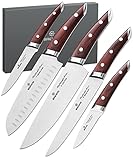
- 1. Brewin Chefilosophi 5-Piece Set – The Best All-Round First Set
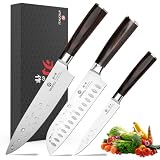
- 2. imarku 3-Piece High Carbon Stainless Set – The Most Reviewed Trio
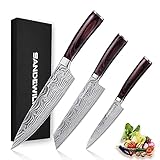
- 3. SANDEWILY 3-Piece Set with Sheaths – The Easiest First Kit
- 4. HOSHANHO 3-Piece Set – The Hardest Steel in the Lineup
- 5. KnifeSaga 15-Piece Block Set – The Full Kitchen Replacement
- 6. YOTSUBA 3-Piece Rosewood Set – The Handle-Led Trio
- 7. Emojoy 3-Piece Damascus Set – The Best-Looking Set
- 8. MOSFiATA 12-Piece Roll-Bag Set – The Portable One
- 9. Shun Classic 3-Piece Set – The One Made in Japan
- 10. XCHIEF PRO 4-Piece Traditional Set – Carbon Steel and Real Japanese Shapes
- Start With One Knife Before You Buy a Set
- How to Choose a Japanese Knife Set
- Work out which knives you actually need
- Choose the steel that matches your habits
- Understand edge angle and hardness together
- Look at tang construction and handle material
- Decide on storage, and check for the built-in sharpener
- Price tiers: what each level buys you
- Know the difference between made in Japan and Japanese style
- Handedness and single bevel, in plain terms
- How to Sharpen a Japanese Knife
- Japanese Knife Care and Maintenance Basics
- Frequently Asked Questions
- How do I choose the right Japanese knife for beginners?
- What are the best entry-level Japanese kitchen knives?
- What are the top 5 Japanese knife brands?
- Is Shun or Miyabi better for a beginner?
- How much should I pay for a Japanese knife?
- What is the difference between a gyuto and a santoku?
- Do Japanese knife sets need a whetstone?
- Conclusion: Where to Start
Top 3 Picks for the Best Japanese Knife Sets for Beginners
Best Japanese Knife Sets for Beginners at a Glance (October 2026)
Every set below lists its steel, hardness and edge angle so you can compare them in one pass. Harder steel holds an edge longer and chips more easily, and a finer edge angle slices cleaner but needs a stone sooner.
| Product | Specifications | Action |
|---|---|---|
| Brewin Chefilosophi 5-Piece |
|
Check Latest Price |
 imarku 3-Piece High Carbon Stainless imarku 3-Piece High Carbon Stainless |
|
Check Latest Price |
 SANDEWILY 3-Piece with Sheaths SANDEWILY 3-Piece with Sheaths |
|
Check Latest Price |
 HOSHANHO 3-Piece Set HOSHANHO 3-Piece Set |
|
Check Latest Price |
 KnifeSaga 15-Piece Block Set KnifeSaga 15-Piece Block Set |
|
Check Latest Price |
 YOTSUBA 3-Piece Rosewood Set YOTSUBA 3-Piece Rosewood Set |
|
Check Latest Price |
 Emojoy 3-Piece Damascus Set Emojoy 3-Piece Damascus Set |
|
Check Latest Price |
 MOSFiATA 12-Piece Roll Bag Set MOSFiATA 12-Piece Roll Bag Set |
|
Check Latest Price |
 Shun Classic 3-Piece Set Shun Classic 3-Piece Set |
|
Check Latest Price |
 XCHIEF PRO 4-Piece Traditional Set XCHIEF PRO 4-Piece Traditional Set |
|
Check Latest Price |
1. Brewin Chefilosophi 5-Piece Set – The Best All-Round First Set
Brewin CHEFILOSOPHI Japanese Chef Knife Set 5 PCS with Elegant Red Pakkawood Handle Ergonomic Design,Professional Ultra Sharp Kitchen Knives for Cooking High Carbon Stainless Steel
5 pieces
1.4116 steel at 56+ HRC
15 degree edge
Full tang pakkawood
Pros
- Sharp from the box and holds for months
- Well balanced full tang grip that does not slip
- Five useful sizes including two 8 inch blades
- Red pakkawood handles that present well as a gift
Cons
- One owner reported a chipped blade after about a year
- Raised metal to simulwood joint can catch the palm
- Support was hard to reach for that buyer
The Brewin Chefilosophi is the set we hand to friends who are serious about cooking for the first time. It gives you an 8-inch chef’s knife, a 7-inch santoku, an 8-inch carving knife, a 5-inch utility knife and a 3.5-inch paring knife, and every one of those five gets used in a normal week.
Blades are 1.4116 German high carbon stainless steel rated at 56+ Rockwell, full tang, ground to 15 degrees per side. That steel is not Japanese and the tang is not wa-handled, but for a first set the combination of a genuine full tang and a 15-degree edge is harder to find than you would expect.
What surprised us was how long the edge lasted. Owners consistently report months between sharpenings, and the pakkawood handles with three reinforced anchor points stay put during long prep sessions. At 2.6 pounds for five knives, the set carries real weight rather than feeling hollow.
What you should know before buying the Chefilosophi
The pakkawood here is a composite, and one reviewer flagged the joint where metal meets the handle material as slightly raised, which can press against your palm during a long chop. It is a small thing, but on a set this size it shows up faster than you would expect.
A second reviewer reported a chip in the chef’s knife after about a year of ordinary use, and could not get a response from the warranty department. That is a single report rather than a pattern, but it is why we would not hand this set to someone who already owns a whetstone and expects to maintain a knife for a decade.
Who the Brewin Chefilosophi suits
It suits the beginner who wants a complete drawer without a block, and who will hand wash everything and dry it straight away. Two 8-inch blades plus a santoku is a genuinely useful lineup for a first apartment kitchen.
Skip it if you are clumsy with a sharp blade and want something forgiving. This is thin steel ground fine, which means it rewards a light hand and punishes force.
2. imarku 3-Piece High Carbon Stainless Set – The Most Reviewed Trio
imarku 3 Pieces Knife Set, Japanese High Carbon Stainless Steel Chef Knives
3 pieces
57 HRC steel
15 degree edge
Pakkawood handles
Pros
- Very sharp from the box at 57 plus HRC
- Balance cuts fatigue during long prep sessions
- Gift box presentation looks premium
- Three knife layout covers most daily tasks
Cons
- Blade profile is narrow for some dicing styles
- Instruction booklet is not available in every language
The imarku 3-piece set is the one with the deepest review history in this roundup, and reading those reviews changes how we think about entry sets. Owners describe sharpness, balance and build quality as consistently better than the money suggests, and many buy it as a backup or to replace a mismatched drawer.
You get an 8-inch chef’s knife, a santoku and a utility knife in Japanese high carbon stainless steel at 57 plus Rockwell, hand polished to 15 degrees per side. The maker states it works for both right- and left-handed cooks, which matters more than it sounds, since many narrow Japanese-style blades are uncomfortable for one hand position.
Two things stand out in practice. First, the balance: the full tang pakkawood handle puts weight forward of the bolster so long prep sessions do not fatigue your grip. Second, the edge, which a few passes on a honing rod keep in working condition between stone sharpenings.
What you should know before buying the imarku trio
The main criticism is blade width. One reviewer wished the blades were wider so the hand can wrap around for dicing, and if you cut large onions or big squash cubes in one motion, a taller blade gives you more room to rock.
The included instruction booklet is not translated into every language, which French buyers in particular noticed. That sounds trivial until you are trying to learn the pinch grip from the insert.
Who the imarku 3-piece set suits
It suits anyone who wants the smallest useful Japanese-style setup and who already knows which three knives do the work. Three knives also means three things to wash and dry, which keeps habit-building easier.
Skip it if you need a paring knife out of the box or want a block. This set arrives bare, so plan on a magnetic strip or a drawer guard. Our notes on countertop knife holders for Japanese knives cover that decision well.
3. SANDEWILY 3-Piece Set with Sheaths – The Easiest First Kit
SANDEWILY Japanese Knife Set, 3 Piece Kitchen Knives with Sheaths
3 pieces with sheaths
58 HRC steel
8 to 12 degree edge
Pakkawood
Pros
- Three knives with matching sheaths for safe storage
- 58 HRC steel ground to a fine 8 to 12 degree edge
- Pakkawood handles with steel cushions at neck and tail
- Gift box included
Cons
- One steel across all three sizes so edge holding varies
- Sheaths add bulk when you want a compact drawer
- Care guidance depends on hand washing to protect the finish
The SANDEWILY set is the one to buy when the main question is where the knives will live. Each blade arrives in its own sheath, so three sharp edges can sit in a drawer, a rucksack or a shared kitchen without anyone reaching into a bare blade.
The steel is German high carbon stainless with 0.5 percent carbon at 58 Rockwell, ground to 8 to 12 degrees per side. That is a finer angle than most Western sets use, which is how you get clean slices from a set this straightforward. Pakkawood handles carry steel cushions at the neck and tail for stability.
Owners rate it as sharp, comfortable and easy to maintain for general prep, and the laminated polish on the blades resists rust and corrosion well for a set at this level. At 1.9 pounds for three knives, it is light enough to move between tasks without fatigue.
What you should know before buying the SANDEWILY set
All three knives share the same steel and the same grind, so edge holding will differ from blade to blade. The thinner a blade is, the sooner it wants a stone, and the 8-degree side of that range is demanding.
Sheaths are a real benefit and a real nuisance. They make the set bulky in a small drawer, and a sheath stored wet is the fastest way to get a spot of corrosion on a blade you never dried properly.
Who the SANDEWILY set suits
It suits first-apartment cooks, shared kitchens and anyone who wants safe storage without buying a block. Three sizes cover cutting, dicing, slicing and chopping without a single useless piece.
Skip it if you already have a whetstone and want to learn sharpening on something forgiving. Fine angles and light steel are a harder introduction to stones than a coarser 15-degree blade.
4. HOSHANHO 3-Piece Set – The Hardest Steel in the Lineup
HOSHANHO 3 Pieces Knife Set, Professional Japanese Kitchen Knife Set
3 pieces
Japanese 10Cr15CoMoV at 60 HRC
15 degree edge
Pakkawood
Pros
- Highest hardness spec here at 60 Rockwell
- 15 degree edges hold through daily mincing
- Pakkawood handles that resist cracking
- Vacuum plus cold nitrogen heat treatment
Cons
- No block or sheaths in the box
- Hard steel chips if you cut bone or frozen food
- Heavier at 900 g than the three knife sheath sets
The HOSHANHO set is the technical answer to this roundup. Blades are Japanese 10Cr15CoMoV high carbon stainless steel at 60 Rockwell, which is the highest hardness rating of any set we reviewed, and they go through high-temperature vacuum treatment followed by low-temperature cold nitrogen treatment before hand polishing at 15 degrees per side.
That process is what separates it from entry sets. Owners describe it as a step up from knife blocks without reaching handmade Japanese pricing, and they single out the steel specification and the grip as the reasons. You get an 8-inch chef’s knife, a 7-inch santoku and a 6-inch utility knife with pakkawood handles shaped to the palm.
Reviewers report that the edges hold up through daily chopping and mincing, which is what you would expect from a steel this hard. The pakkawood is described as rigid and resistant to cracking, a fair upgrade on handles that split after a year.
What you should know before buying the HOSHANHO set
60 Rockwell is a genuine trade-off, not a straight upgrade. Harder steel chips if it meets bone, frozen food or a cutting board joint, and the people who damage these edges are almost always the ones cutting through frozen items.
It arrives in a simple gift box with no block and no sheaths. At 900 g, three knives in a drawer is a chunky load compared with a sheathed three piece kit, so plan your storage before it arrives.
Who the HOSHANHO set suits
It suits a beginner who already cooks regularly, washes by hand, and wants the hardest stainless edge available without moving to carbon steel. It is the sensible middle step between a basic block and a full sharpening setup.
Skip it if your cooking involves frozen meat, big bones or an old glass board. There is no reason to meet your first hard steel edge and your first chip on the same afternoon.
5. KnifeSaga 15-Piece Block Set – The Full Kitchen Replacement
KnifeSaga Japanese Knife Set with Sharpener, Premuim, Razor Sharp, 15 Pcs
15 pieces
10 degree cutting edge
Full tang
Wood block
Pros
- Six non serrated steak knives plus shears and a honing steel
- Edges hold about a year in normal use
- Solid wood block with a non slip base
- Full tang with a protective bolster
- Lifetime assurance and a 100 day return policy
Cons
- Top rivets reported cracking over time
- Handle shapes are not symmetrical
- Dishwasher heat and harsh chemicals discolor the blades
The KnifeSaga set is what you buy when you are clearing out an entire knife drawer rather than upgrading one blade. Fifteen pieces in a solid wood block: an 8-inch chef’s knife, 8-inch bread knife, 6-inch boning knife, 7-inch santoku, 5-inch utility, 3.5-inch paring, six 4.5-inch steak knives, a multi-purpose shear and a sharpening steel.
What stands out is the steak knives. They are non-serrated, which is rare in a set this size, and combined with the included honing steel it is the detail reviewers mention most. Blades use proprietary high carbon stainless at a 10-degree cutting edge, with cryogenic tempering and full tang construction.
Owners frequently describe trading up from a decades-old block, and say the knives arrive sharp and hold their edge about a year. Customer service comes up often too, with replacements and refunds turning negative experiences around.
What you should know before buying the KnifeSaga block
The handle rivets at the top of the bolster are the recurring complaint, with a handful of owners reporting cracking over time. Handle shapes are also not perfectly symmetrical, which some people notice immediately in the hand.
The block makes this the heaviest option on the list, so it is a poor fit for a small kitchen. And the blades must be hand washed; dishwasher heat and harsh chemicals cause both discoloration and handle damage.
Who the KnifeSaga set suits
It suits households replacing a full mismatched drawer, people who cook for a table every week, and anyone who wants steak knives that actually cut instead of tearing. Six matching steak knives is a party-hosting argument, not a cooking one.
Skip it if you live in a studio apartment or cook for one. Four or five blades cover that kitchen, and the rest is dead weight competing for counter space. We cover more in our picks for knife sets that come with blocks.
6. YOTSUBA 3-Piece Rosewood Set – The Handle-Led Trio
YOTSUBA 3 PCS Japanese Kitchen Knife Set with Full Tang Rosewood Handle
3 pieces
14 degree edge
Full tang rosewood
2 year warranty
Pros
- Sharp from the box and holds for months
- Full tang rosewood handle sits well in the palm
- 14 degree edge gives thin slices
- Two year manufacturer warranty
- Gift box included
Cons
- One owner saw the rosewood handle separate from the tang
- Bleed pattern is etched rather than true Damascus
- Thinner review history than the other sets here
The YOTSUBA set is for people who notice handles. Instead of pakkawood it uses full tang rosewood with an ergonomic shape, and at 1.1 pounds for three knives it is the lightest set on this list, which makes it easy to move between prep tasks without wrist fatigue.
Blades are high carbon German stainless steel with a 14-degree edge, which is the second-finest grind here. You get an 8-inch chef’s knife, a 7-inch santoku and a 5-inch utility knife, and the set includes a two year manufacturer warranty, which is uncommon at this level.
Owners report the knives are sharp on arrival and stay sharp for months, and several describe them as good value for a small household. One reviewer specifically noted how easily the blades take to a wet stone, which matters if sharpening is on your list this year.
What you should know before buying the YOTSUBA set
Rosewood is a natural material and it moves. One long-term owner reported the handle separating from the tang and roughening after about a year, which is the single most common complaint on this set.
Also worth knowing: the visible pattern on the blade is a laser-etched decoration rather than true layered Damascus. It looks the part at a glance, but it is not a different steel, and it does not change how the edge behaves.
Who the YOTSUBA set suits
It suits cooks who want a warm wooden handle, a light set they can use all afternoon, and a genuine warranty. Three knives is a clean starter layout with nothing decorative in it.
Skip it if your kitchen is humid or you tend to leave knives near the sink. Natural wood handles and standing moisture are a pairing we would not recommend for a first purchase.
7. Emojoy 3-Piece Damascus Set – The Best-Looking Set
Emojoy 3-Piece Japanese Damascus Steel Knife Set, Olive Wood Handle & Box
3 pieces
67 layer Damascus at 58 HRC
15 degree
Olive wood
Pros
- Visible 67 layer Damascus patterning
- Sharp well balanced blades for everyday prep
- Olive wood handles suit different hand sizes
- Wooden gift box and lifetime warranty
- Second most reviewed set in this roundup
Cons
- Olive wood needs hand drying after washing
- Cladding adds no edge benefit over plain stainless
- No block or sheaths in the box
The Emojoy set is the one people buy as a gift, and it earns that. Blades are 67-layer Damascus cladding with 0.98 percent carbon and 18 percent chromium at 58 Rockwell lead hardness, hand forged and laser sharpened to a 15-degree edge.
You get an 8-inch chef’s knife, a 7-inch santoku and a 3.5-inch paring knife with Calabrian olive wood handles and a half-bolster design so the hand sits forward on the blade. A wooden box and a lifetime warranty come with it.
With more than five thousand reviews behind it, this set has one of the strongest track records in the roundup. Buyers emphasise the visible patterning, the hand-forged feel and the comfortable grips, and describe it as a step-up gift purchase rather than a working tool upgrade.
What you should know before buying the Emojoy set
Damascus cladding is a construction method, not a performance upgrade. The pattern is created by folding layers of steel and nickel, and for edge behaviour the cladding matters far less than the core steel and the grind.
Olive wood handles look wonderful and need the same discipline as any wood handle: hand wash and dry right away. There is also no block or sheath in the box, so storage is on you.
Who the Emojoy set suits
It suits beginners buying for themselves a set that looks like a gift, and anyone who wants Damascus visuals without carbon steel maintenance. A half-bolster design also gives more hand room than a full bolster.
Skip it if you want steel headroom or a harder edge. 58 Rockwell is solid stainless territory, not the 60-plus territory of the HOSHANHO set. Our feature on Damascus steel knife sets goes into the layering question in more detail.
8. MOSFiATA 12-Piece Roll-Bag Set – The Portable One
MOSFiATA Kitchen Knife Set, 12 Pcs Japanese Stainless Steel Knife Sets for Kitchen with Oxford cloth storage bag with Knife Sharpening Rod, Dishwasher Safe, For Outdoor
12 pieces
5CR15MOV at 56+ HRC
13 to 15 degree edge
Dishwasher safe
Pros
- Twelve pieces with a sharpening rod and three finger guards
- Dishwasher safe which is unusual at this steel level
- Roll bag makes it practical for camping and barbecue use
- 13 to 15 degree hand opened edge
Cons
- Dishwasher cycles dull a thin hand opened edge
- Cast stainless handles can feel slick when wet
- No nakiri or gyuto among the shapes included
The MOSFiATA set is built around travel. Twelve pieces including an 8-inch chef’s knife, a 7-inch and 5-inch santoku, an 8-inch bread knife, an 8-inch carving knife, a 5-inch utility, a 3.5-inch paring, an 8-inch sharpening rod, three finger guards and six sheaths, all in an Oxford cloth roll bag with an elastic strap.
Blades are 5CR15MOV high carbon stainless at 56 plus Rockwell with 0.5 to 0.55 percent carbon, hand opened at 13 to 15 degrees on one side. Handles are one-piece cast moulded stainless, shaped with a pattern inspired by ancient armour.
Two things make it unusual. It is dishwasher safe, which is almost unheard of on a set with steel this hard, and the roll bag makes the whole kit genuinely portable for camping and barbecuing rather than just nominally portable.
What you should know before buying the MOSFiATA set
Dishwasher safe does not mean dishwasher friendly for the edge. Heat and detergent will dull a hand-opened 13 to 15 degree edge faster than hand washing, so treat the cycle as a convenience for heavily soiled items rather than a routine.
The cast stainless handles can feel slick when wet, which is exactly the situation you will be in at a campsite sink. And none of the shapes here is a nakiri or a traditional gyuto, so this is a practical set rather than a Japanese-shape set.
Who the MOSFiATA set suits
It suits people who cook away from home, households sharing one knife duty between several people, and anyone who wants sheaths and finger guards as standard. Twelve pieces with a carry bag solves a problem no wooden block solves.
Skip it if your idea of Japanese cooking involves traditional knife shapes and a proper pinch grip practice. You will get sharp, useful blades and none of the shapes that make the style worth learning.
9. Shun Classic 3-Piece Set – The One Made in Japan
Shun Classic 3 Piece Starter Set, Includes 8″ Chef, 3.5″ Paring & 6″ Utility Knives, Handcrafted Japanese Knife Set, VG-MAX Core with Damascus Stainless Steel Cladding, Pakkawood Handle
3 pieces
VG-MAX core with 68 layer cladding
16 degree edge
D shaped pakkawood
Pros
- VG-MAX core steel holds a fine precise edge
- Handcrafted in Japan by Kai
- Free lifetime sharpening and honing service
- D shaped pakkawood handle suits either hand
Cons
- No full tang so the steel does not run through the handle
- Owners report wanting to hone more often than expected
This is the only set on the list handcrafted in Japan. Shun is a line by Kai, and the Classic series is the original Japanese cutlery range the company brought to the United States. Blades use a VG-MAX steel core with 68 layers of Damascus stainless cladding, ground to a 16-degree edge.
You get three knives: an 8-inch chef’s knife, a 6-inch utility and a 3.5-inch paring. The D-shaped pakkawood handle is usable by either hand, and the set includes a lifetime warranty with free sharpening and honing service for as long as you own it.
Owners treat this as a first serious Japanese knife purchase and repeatedly mention the refinement of the cut. The free sharpening service matters more than most people realise, because it removes the main reason beginners hesitate to buy a knife at this level.
What you should know before buying the Shun Classic set
There is no full tang. The steel does not run the length of the handle, which some owners single out, and it is a fair criticism on a set at this level.
The rating is also more mixed than the entry sets here, with a share of buyers saying the edge needs honing more often than they expected. VG-MAX is a hard stainless core and it behaves like one, which means it responds well to a stone and less well to neglect.
Who the Shun Classic set suits
It suits a beginner with a working whetstone, or one who will use the free sharpening service, and anyone who specifically wants a knife manufactured in Japan rather than Japanese style. Three pieces is a restrained, sensible layout with no filler.
Skip it if sharpening is something you plan to avoid. The free sharpening service for life is what makes it defensible as a first serious knife despite sitting at the premium end of every set here.
10. XCHIEF PRO 4-Piece Traditional Set – Carbon Steel and Real Japanese Shapes
Japanese Knife Set with Bag, Hand Forged High Carbon Steel Chef Knives
4 pieces
High carbon steel 15 to 17 degrees
Nakiri and kiritsuke
Wood handles
Pros
- Four distinct Japanese shapes including nakiri and kiritsuke
- Very sharp from the box and retains edge with the included rod
- Hammered finish and coating reduce sticking
- Carry bag poultry shears and honing steel included
Cons
- High carbon steel must be dried immediately or it discolors
- Arrives coated in protective oil that needs washing off
- Coating dulls faster than an exposed steel edge
The XCHIEF PRO set is the only one here with genuine traditional Japanese blade shapes in quantity: an 8-inch kiritsuke, an 8-inch gyutou, a 7-inch santoku and a 7-inch nakiri. If you have read about nakiri knives and want to see one, this is where it is.
Blades are high carbon steel hand polished at 15 to 17 degrees, with a hammered tsuchime finish and a black non-stick coating on both faces. A storage bag, poultry shears and a honing steel come with the set, which makes it a complete kit for cooking away from a kitchen.
Reviewers are impressed by how much shape variety arrives at this level and by how sharp the blades are from the box, often noting that a quick pass on the included rod keeps them working. The handles are wood, light and well balanced.
What you should know before buying the XCHIEF PRO set
This is high carbon steel, so it will spot and rust if you leave it wet. Hand wash and dry immediately, every time, and do not put these through a dishwasher. A few buyers said that requirement should have been clearer before they bought.
They also arrive coated in protective oil to prevent rust during shipping, which you need to wash off before first use. And the non-stick coating dulls faster than an exposed steel edge, so plan on a stone rather than expecting the coating to hold up indefinitely.
Who the XCHIEF PRO set suits
It suits a curious beginner who wants to try a nakiri and a kiritsuke before committing to one shape, and anyone who cooks outdoors and already knows that carbon steel demands care.
Skip it if you have never hand dried a knife in your life. Four carbon steel blades is a lot of surfaces to keep dry, and stainless would be a gentler place to start.
Start With One Knife Before You Buy a Set
The most common piece of advice in knife forums is the one no competitor roundup prints: buy a single knife first. Beginners in r/TrueChefKnives and on kitchenknifeforums describe the buying process as paralyzing, then land on the same conclusion, which is to start with one gyuto or one santoku and add a nakiri later once you can afford it and know what you like.
The reasoning is practical. Every knife in a set is one more blade to wash, dry, sharpen and store correctly, and a 20-piece block with six serrated steak knives is the classic beginner trap. Owners who bought one regularly report that the steak knives and small utility pieces are unusable filler.
There is a second reason. You do not yet know which handle suits your hand, whether you prefer a thin 15-degree edge or a forgiving Western angle, or whether you will actually maintain a knife. A single knife limits the damage when you get it wrong.
If you take this route, buy the best 8-inch chef’s knife you can find and skip the block entirely. Our Brewin pick, the imarku trio and the HOSHANHO set all include a single chef’s knife that stands perfectly well alone, and forum users repeatedly recommend value-oriented Japanese makers over premium names as a first knife.
How to Choose a Japanese Knife Set
Work out which knives you actually need
The gyuto is the Japanese chef’s knife, around 8 inches, with a longer blade and more curve than its Western cousin. It is the most versatile shape in any set and the one you will reach for most.
The santoku is the Japanese all-rounder, usually shorter and taller than a gyuto, prized for chopping, mincing and vegetables. The nakiri is a pure vegetable cleaver with a straight edge, excellent for pushing and rocking through onions, and thin enough that beginners sometimes find it startling at first.
The petty, often sold as a utility knife, handles peeling, trimming and jobs too small for a chef’s knife but too big for a paring knife. A honesuki is a boning knife for joints and fish. Most beginner sets include a gyuto or santoku plus a petty and a paring knife, which is a complete working kit.
Choose the steel that matches your habits
Stainless steel is the right answer for almost every beginner. It resists rust, tolerates a busy kitchen and forgives the occasional wet hour on the counter. Every set on this list except the XCHIEF PRO is stainless, and the HOSHANHO at 60 Rockwell is the hardest of them.
Carbon steel holds a finer edge than stainless and takes a sharper polish, but it spots, stains and rusts if you leave it wet. Forum users do recommend it, with names like Suisun, Konosuke, HADO and Tetsujin coming up often, but usually as a second knife once the habit is built.
Damascus is a cladding pattern rather than a steel category. The Emojoy set uses 67-layer Damascus at 58 Rockwell and looks the part, but edge behaviour comes from the core steel and the grind, not the visible layers.
Understand edge angle and hardness together
HRC, or Rockwell hardness, measures how hard the steel is. Higher is not automatically better. Steel at 60 or above holds an edge for a long time and chips if you hit bone or a frozen core, while steel in the mid-50s is more forgiving and wants sharpening more often.
Edge angle is the other half. A 15-degree angle per side, common across Japanese sets, gives a thin slicing edge that asks almost nothing from your wrist. A 10-degree angle is even finer and needs a stone sooner. Anything at 8 degrees is a stone knife from day one, which is why we would not hand one to a nervous beginner.
Look at tang construction and handle material
A full tang means the steel runs the length of the handle, giving strength and balance. Most sets here use it. The Shun Classic is the exception, and owners notice.
Pakkawood is a resin composite that resists moisture and does not crack easily, which makes it the practical default for a first set. Rosewood, olive wood and plain wood feel better in the hand but need hand drying and can move over time.
Balance matters more than any of it. A knife that feels controlled at the bolster rather than heavy in the tip will keep you cooking longer, and thin Japanese blades are unforgiving of a tight grip. Start with a pinch grip on the blade spine and let the handle rest in your fingers.
Decide on storage, and check for the built-in sharpener
A knife block, a magnetic strip or individual sheaths are the three real options. Blocks protect blades and blunt the point against other knives. Magnetic strips save counter space and are better for a small kitchen. Sheaths are the only safe answer for a shared drawer or a bag.
What to avoid is a block with a built-in pull-through sharpener. Owners who used one report that it dulls edges rather than truly sharpening them, because pull-through devices remove large amounts of metal unevenly and leave the blade rougher than it started.
Price tiers: what each level buys you
At the entry tier you are buying shape and steel labelling, not finesse. Expect mid-50s HRC stainless, a 14 to 15 degree edge, pakkawood or wood handles and full tang on some models. The SANDEWILY, YOTSUBA and Brewin sets live here and they are genuinely usable.
The mid tier buys heat treatment and a harder core. The HOSHANHO at 60 Rockwell, the Emojoy with 67-layer cladding and the MOSFiATA with 5CR15MOV are here. You notice the difference most in edge retention over a long prep session.
The premium tier buys origin and service. The Shun Classic is handcrafted in Japan by Kai and includes lifetime free sharpening. That service is worth more to a beginner than any specification on a listing, because it removes the fear of sharpening from day one.
Know the difference between made in Japan and Japanese style
Japanese style means the knives follow Japanese geometry and steel conventions but were made elsewhere. That is not a criticism; most of the sets on this list are Japanese style, and several are very good. Made in Japan means a Japanese smith, Japanese factory and Japanese finishing.
How to tell: look for a country of origin in the specification block rather than in the title, check whether the manufacturer name matches a Japanese company, and treat words like damascus and VG-10 in a listing description as claims until you see the steel named in the technical details.
Handedness and single bevel, in plain terms
A double bevel has an edge on both sides and works for either hand. A single bevel is ground on one side only, which makes it a specialist tool for a specific hand position rather than a beginner set.
Almost every set here is double bevel, which is why they suit almost every cook. If you are a right-handed cook, the narrow gyuto and santoku profiles on these sets feel natural; a cook whose dominant hand is the other may prefer a wider santoku profile such as the one in the imarku set, which is the reason that set is stated as working for both hands.
How to Sharpen a Japanese Knife
Start by ignoring the sharpener that came with your block. Pull-through devices and electric sharpeners remove far too much metal to keep a 15-degree Japanese edge intact, and owners report they leave blades rougher than before. This is the most repeated technical error in beginner knife handling.
Then learn two separate things: honing and sharpening. Honing straightens an edge that has rolled over, which you do often with a ceramic rod on a whetstone-soft surface. Sharpening removes metal to create a new edge, which you do far less often.
A workable beginner setup is a 1000-grit water stone for shaping and a 3000 to 6000-grit stone for finishing, wet on both sides. Soak the stone, work at roughly 15 degrees per side to match the factory grind, and alternate sides with each stroke rather than grinding one side flat.
On frequency, judge by feel rather than calendar. When the knife starts to need pressure to pass through an onion, it is time to hone. When honing no longer brings the edge back, it is time for the stone.
Forum users are almost unanimous that sharpening is less intimidating than beginners expect, and that the fear of sharpening is a bigger barrier than the actual difficulty. Once you can sharpen any kitchen knife on a stone, a Japanese blade is the easiest thing you will sharpen, because the edge angle is fine and predictable.
Japanese Knife Care and Maintenance Basics
Japanese knives are not dishwasher safe, with the single exception on this list being the MOSFiATA set, which is rated for it. Heat, detergent and the tumbling action will dull a fine edge and can damage handles. Wash by hand with dish soap and dry immediately with a towel, every time.
Your board matters more than your steel. End-grain wood or soft plastic will keep a fine edge, while glass, stone and laminate boards will take it off in weeks. Replace a cheap board before you blame the knife.
Store blades away from each other, either in a block with ventilated slots or on a magnetic strip, and never leave a wet knife in a closed block. If you keep a knife in a household with children, a roll bag or sheaths beat an open block on the counter every time.
One last habit: keep a damp cloth under your cutting hand for stability, and cut with the tip of the blade rather than pressing straight down. That is where a thin gyuto does its best work.
Frequently Asked Questions
How do I choose the right Japanese knife for beginners?
Start with the steel and the size, not the brand. Pick a stainless steel chef’s knife or santoku around 8 inches, ideally full tang with a 15-degree edge, and buy just that one knife first. Add a petty and a paring knife later once you can sharpen and store them properly. Many beginners buy a 20-piece block and never touch half of it.
What are the best entry-level Japanese kitchen knives?
For a complete first set, the Brewin Chefilosophi five-piece leads our roundup with two 8-inch blades, a santoku and smaller knives in 56+ HRC stainless at a 15-degree edge. The SANDEWILY three-piece is the lowest-commitment way in, and the imarku trio is the most reviewed. Each covers a first cook’s full prep range without filler pieces.
What are the top 5 Japanese knife brands?
Only one set here is handcrafted in Japan: the Shun Classic, made by Kai, which also includes free lifetime sharpening. Shun and Miyabi dominate the premium conversation, while Tojiro and Takamura are the names knife forums most often recommend to first-time buyers. The entry-level sets in this roundup are Japanese style rather than Japanese made.
Is Shun or Miyabi better for a beginner?
For a first Japanese knife, neither is the usual recommendation. Forum users consistently point first-time buyers toward value-oriented makers like Tojiro or Takamura because a cheaper blade is easier to learn on. Shun becomes the right choice once you have a whetstone and a steady hand, or once you take advantage of the free lifetime sharpening service that comes with it.
How much should I pay for a Japanese knife?
Spend in the mid range for a first set. Entry-level stainless sets use mid-50s HRC steel and a 15-degree edge, which is plenty sharp for a beginner. Mid-tier money buys heat treatment and a harder core around 60 HRC. Premium money buys Japanese manufacture and free sharpening services, which matter more than any specification.
What is the difference between a gyuto and a santoku?
A gyuto is the Japanese chef’s knife, usually around 8 inches with a longer blade and more curve, and it is the most versatile shape in a set. A santoku is shorter and taller, built for chopping, mincing and vegetables. Both appear in nearly every set we reviewed, and most cooks end up reaching for the gyuto first.
Do Japanese knife sets need a whetstone?
Not on day one, but you will eventually want one. A 1000-grit water stone for shaping and a 3000 to 6000-grit stone for finishing cover almost everything, and they let you match the factory 15-degree edge. What you should avoid is the pull-through sharpener in a knife block, which owners report dulls edges rather than sharpening them.
Conclusion: Where to Start
The best japanese knife sets for beginners are the ones that give you a genuine 8-inch chef’s knife, a steel that resists rust, and an edge fine enough to slice without pushing. Our pick for most first-time cooks is the Brewin Chefilosophi, because five useful blades with a full tang and a 15-degree edge covers every week of cooking without a single filler piece.
If you want fewer knives and more certainty about sharpness, the imarku trio is the most reviewed set here. If you want the hardest steel available, the HOSHANHO runs 60 Rockwell. And if you want the real thing, made in Japan with free lifetime sharpening, the Shun Classic is the only pick on this list that qualifies.
Whatever you choose, buy a board that will not ruin it, wash by hand, dry immediately, and stay away from the pull-through sharpener. Those three habits do more for a Japanese knife than any specification on a listing. For the wider category, our full Japanese knife set guide covers premium makers, and our Japanese dinnerware picks are a natural pairing for the meals you will cook with a sharper edge in 2026.