

A parrot play stand is a freestanding or tabletop perch unit that holds your bird outside the cage, giving it climbing surfaces, perches, feeding bowls and toy attachment points so it can exercise, forage and be trained. Picking the best parrot play stands for training comes down to three things: a perch diameter your bird’s foot can wrap around, a base that will not tip, and a location close enough to you to actually work with.
That last point is the one most shoppers miss. A beautiful stand in the corner of the living room does almost nothing for training. A modest perch on your desk, next to where you work, is where stationing and step-up actually happen. Owners on parrot forums describe the same thing: a bird that ignores an elaborate tree will happily sit on a simple perch it can reach from the chair it is sitting in.
We compared ten stands across the full size range, from a tabletop perch for a parrotlet to a 65 inch rolling gym for a macaw. Every stand here was judged on grip, stability, cleanability, training usefulness and value, using the specifications on the listing and the pattern of what owners report after living with the product. We also flag where the listing photos flatter the product, because a large share of stand listings use stock photography with birds enlarged to show scale.
Table of Contents
- Top 3 Picks for Parrot Training
- Best Parrot Play Stands for Training in 2026
- 1. Prevue Pet Products 5-Foot Parrot Play Stand: the full-size workhorse
- 2. LIMIO Natural Wood Playground: the best entry point for small birds
- 3. Mcage 65.5 Inch Rolling Stand: the tallest frame we tested
- 4. Ibnotuiy 4-Layer Wood Playstand: layered height for cockatiels and conures
- 5. Mcage Wrought Iron Rolling Stand: the stainless tray and bowl upgrade
- 6. FDC Tabletop Steel Stand: dowel grip for medium birds
- 7. KINTOR Tabletop T-Perch: the simplest stand that works
- 8. PawHut 49 Inch Rolling Stand: the room-friendly single perch
- 9. PawHut 63 Inch Three-Ladder Stand: the best layout for large birds
- 10. kathson Tabletop Playstand: the most accessories in a small box
- How to Actually Train a Parrot on a Play Stand
- Parrot Play Stand Buying Guide
- Frequently Asked Questions
- Conclusion
Top 3 Picks for Parrot Training
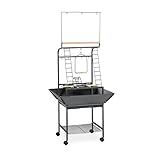
Prevue 5-Foot Parrot Play Stand
- 59 inch tall metal frame
- Stainless steel bowls
- Pull-out debris tray
- Eight toy hoops
- Three ladders
- 17 pounds

LIMIO Natural Wood Playground
- Natural wood build
- 2 pound weighted base
- Removable tray
- Two stainless steel cups
- Includes bell and chew toy

PawHut 63 Inch Three-Ladder Stand
- 63 inch tall frame
- Three textured steel ladders
- Machine washable steel bowls
- Removable tray
- Wheels and toy hook
If you want one recommendation, take the Prevue. It carries the strongest combination of owner rating and review volume in this group, and it is the only stand here that works for a medium bird and a large bird in the same frame.
Best Parrot Play Stands for Training in 2026
| Product | Specifications | Action |
|---|---|---|
| Prevue 5-Foot Parrot Play Stand |
|
Check Latest Price |
| LIMIO Natural Wood Playground |
|
Check Latest Price |
 Mcage 65.5 Inch Rolling Stand Mcage 65.5 Inch Rolling Stand |
|
Check Latest Price |
 Ibnotuiy 4-Layer Wood Playstand Ibnotuiy 4-Layer Wood Playstand |
|
Check Latest Price |
 Mcage Wrought Iron Rolling Stand Mcage Wrought Iron Rolling Stand |
|
Check Latest Price |
 FDC Tabletop Steel Stand FDC Tabletop Steel Stand |
|
Check Latest Price |
 KINTOR Tabletop T-Perch KINTOR Tabletop T-Perch |
|
Check Latest Price |
 PawHut 49 Inch Rolling Stand PawHut 49 Inch Rolling Stand |
|
Check Latest Price |
| PawHut 63 Inch Three-Ladder Stand |
|
Check Latest Price |
 kathson Tabletop Playstand kathson Tabletop Playstand |
|
Check Latest Price |
1. Prevue Pet Products 5-Foot Parrot Play Stand: the full-size workhorse
Prevue Pet Products Parrot Play Stand with Wheels – Black
59 inch tall metal frame
Metal with hammertone finish
Stainless steel bowls
Pull-out debris tray
Pros
- Stays stable when bumped or leaned on
- Multiple perch heights with three ladders
- Seed skirt and pull-out tray speed up cleaning
- Wheels move the whole stand between rooms
- Holds up for macaws cockatoos and African greys
Cons
- Loose screw holes on ladder rungs let small screws fall out
- Minimal instructions and occasionally missing hardware
- Bottom storage shelf will not hold heavy items
- Seed guard gaps at inner corners let seed scatter
Our team spent the most time on this one, and it is still the stand we keep coming back to. The frame is metal with a black hammertone finish, it measures 17.63 by 16.5 by 59 inches, and it weighs 17 pounds, which is exactly what you want under a bird that throws itself sideways mid-play.
Eight toy hoops sit at different points around the upper frame, and there are three ladders, rings and hooks spread across multiple perch heights. Owners report their birds claiming it within days once treats go into the cups, and many wrap smooth metal bars with jute twine to give talons more grip.
The pull-out debris tray with a rounded seed guard is the feature that decides daily life with this stand. You lift it, wipe it, slide it back. It is a genuinely different experience from cleaning under fixed perches, and it is why owners with messy eaters tend to stay with this model for years.
Two refinements recur in owner reports. Several remove the rear bar so droppings do not land on perches the bird uses most, and a number of people swap the small supplied screws for larger ones because the ladder rung holes are a touch loose in some builds.
Size and grip on the 59 inch frame
Multiple perch heights mean multiple foot options, and metal bar plus natural wood perch on the same stand is better for feet than either material alone. For a cockatiel this is a tall perch; for an African grey or a small macaw it is a proper gym.
The toy hoops are the part owners use most. Treats clipped into the hoops turn the stand from a perch into a foraging station in about thirty seconds of assembly, which is the cheapest training win available.
Where owners report problems
Assembly is the weak point. Instructions are minimal, and a share of buyers report arriving screws that are the wrong size or missing entirely, which leaves a rung or hoop feeling loose until you replace the hardware.
The bottom storage shelf is thin pressed material and will bow under a bag of food. Use it for toys and hooks only. Check every bolt with a screwdriver after the first week, because hammertone-finished metal joints do loosen under a bird that leans and swings hard.
2. LIMIO Natural Wood Playground: the best entry point for small birds
LIMIO Natural Wood Bird Toys Playground, Bird Cage Accessories, Bird Perches, with Removable Tray and 2 Stainless Steel Cups
9.5 by 13.5 by 13.5 inch natural wood
2 pound base weight
Removable tray
Two stainless steel cups
Pros
- Compact desktop footprint suits budgies and cockatiels
- Natural wood is safe to chew and smooth for feet
- Removable tray and cups clean up quickly
- 2 pound base resists tipping during active play
- Comes with a bell and corn husk chew toy
Cons
- Small size rules out large parrots and heavy chewers
- Plastic tray is less durable than a metal catch pan
- No ladder or swing for birds that climb
This is the stand we recommend to someone starting out with a cockatiel, lovebird, budgie or parrotlet who wants a real play structure rather than a single perch. It measures 9.5 by 13.5 by 13.5 inches and weighs just over one pound, so it moves between a desk and a kitchen counter without effort.
The construction is natural wood with polished perches, and the base is listed at 2 pounds, which is the detail that matters most on a tabletop unit. A light base lets a startled budgie launch the whole stand across the room, and this one does not do that.
Everything needed is in the box, including a screwdriver, and the unit can be taken apart again for travel. That makes it the stand we would pack for a vet visit or a trip to a friend’s house, where a full-size rolling gym is simply not an option.
Owners frequently place it on top of a cage so the bird can use it during out-of-cage time while a larger stand is being cleaned. The included copper bell and corn husk chew toy mean it is not an empty frame on day one.
Checking the tray and cup sizes
The tray lifts out and wipes down, and the two stainless steel cups come free for a proper wash. Neither part is welded in place, which is the single most common complaint about cheaper stands and the fastest way a play stand becomes unusable.
For a bird that shreds everything, expect the corn husk toy to be gone within a week. That is the toy doing its job, not a defect.
Where the LIMIO playground falls short
Scale is the limit. There is no platform wide enough for a bird to hang upside down, and no ladder, so birds that climb vertically rather than hop between perches will get less out of it than a cockatiel or lovebird will.
The tray is plastic rather than stainless steel, so a determined chewer can work at an edge over time. If your bird is a heavy chewer and you want something that survives ten years of use, spend up on a metal frame instead.
3. Mcage 65.5 Inch Rolling Stand: the tallest frame we tested
65.5 Inch X-Large Parrot Natural Perch Stand Bird Play Ground Training with Strong Climbing Play Ladder Stainless Feeding Bowls Toy Hook Removable Washable Tray Lockable Rolling Wheels
65.5 inch tall wrought iron frame
Four stainless steel bowls
Removable washable tray
Four casters with two lockable
Pros
- Tall height gives birds genuine elevation
- Removable catch pan reduces floor sweeping
- Wheels roll easily between rooms
- Four bowls plus a toy hook make it a full station
- Non-toxic powder coat and steel bowls suit large birds
Cons
- Punched holes can arrive with sharp edges
- Listed height disappoints a few buyers
- Wooden perch is chewed through quickly by large birds
- Instructions are unclear and casters can snap on fitting
Height is the first thing your bird notices. At 65.5 inches, this stand is 25 inches wide and 17 inches deep, and owners of African greys, macaws and cockatoos consistently report that birds choose it in preference to lower perches in the same room.
It is wrought iron with a non-toxic powder coated finish, and the climbing ladder uses half-inch diameter metal rungs, which gives talons something to grip without the smooth, cold-feeling surface of a plain bar.
Four stainless steel feeder bowls with holders, a natural tree branch perch, and a toy hook with two rings make this a full activity station rather than a perch with a tray bolted on. Birds that forage will empty a bowl, drop it, and go looking for it on the tray.
Four push-in heavy duty casters handle the move between rooms, and two of them lock. Locking casters matter more than most listings admit, because a rolling stand with a heavy bird on it will otherwise drift.
Tray capacity and wheel locks
The removable washable bottom tray is the feature owners single out most, and the reason is floor sweeping. A large bird produces a surprising amount of debris in a day, and a lift-out pan is the difference between a two minute clean and a twenty minute one.
Before you buy, check that the two lockable casters actually engage on your floor type. On thick carpet the push-in casters can sit proud of the leg and introduce a wobble that the frame does not have on hard flooring.
Assembly quality and chewed perches
The most detailed owner critique reports sharp punched holes in the square tubing, a stripped cup-holder thread, and sharp corners on a specific unit. That points to manufacturing inconsistency rather than a design flaw, so inspect the frame with a finger along every edge before your bird touches it.
The natural wood perch gets chewed through within a couple of months by large birds. Owners treat this as normal parrot behaviour, and the fix is to fit a replacement branch of similar diameter rather than to downgrade the stand.
4. Ibnotuiy 4-Layer Wood Playstand: layered height for cockatiels and conures
Ibnotuiy 4 Layers Wood Pet Parrot Playstand
18.6 by 12.7 by 37.8 inch pine frame
Four perch levels
Removable stainless steel cups
Screw joints, no glue
Pros
- Four levels create distinct perching and climbing zones
- Polished natural pine is comfortable for feet
- Pre-drilled holes make assembly about 20 minutes
- Removable steel cups simplify feeding and cleaning
- Good value for a stand of this height
Cons
- Drop tray is too small to catch much
- Included swing is undersized for larger birds
- Some pre-drilled holes need redrilling
- Wobbles after months of use
- Toy clip style can injure hook bills
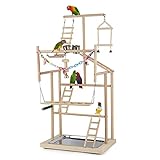
The four-layer pine design is roughly 18.6 by 12.7 by 37.8 inches and weighs 4 pounds, which puts it in the sweet spot between a desktop perch and a rolling floor stand. For cockatiels, ringnecks and small conures it offers more distinct zones than any other stand this size.
Every part is joined with screws rather than glue, which matters for longevity and repair. When a rung works loose you can tighten it; on a glued frame you have no option but to replace the whole piece.
Owners like to personalize this one. Adding extra hooks, wrapping bars with vet tape, and fitting a flat shelf all show up repeatedly in reviews, and several buyers report comfortably holding two birds on separate levels at once.
The removable stainless steel cups are a genuine plus over welded bowls. Take them out, wash them, put them back, and you avoid the biofilm problem that makes fixed bowls the first thing owners replace.
Layer layout and perch feel
Multiple levels mean your bird can choose height, and choosing height is a behaviour, not a preference. A bird that picks the top layer every session is telling you something useful about where it feels safest, and you can use that in stationing.
The pine is polished smooth rather than textured, which suits small and medium feet. If your bird is a strong chewer, expect to sand a rough patch over time and to keep replacement dowel on hand.
Tray size, swing scale and wobble
The drop tray is the weak point. It is too small to function as a catch pan for a bird that likes to eat over the edge, so budget for a separate tray or a splatter mat underneath.
The included swing is sized for smaller birds and is reported as undersized for cockatiels and larger birds once they use it seriously. Also note that a minority of units need redrilling because pre-drilled holes were drilled low or crooked, and that the stand can develop wobble over months even with tight screws.
5. Mcage Wrought Iron Rolling Stand: the stainless tray and bowl upgrade
Elegant and Durable Wrought Iron Parrot Bird Play Perch Sturdy 4-Leg Rolling Stand Perch Gym Ground with Removable No Rust Stainless Steel Tray and Feed Cups Toy Hook
67 inch tall wrought iron frame
Removable stainless steel pan
Two stainless steel feeder bowls
Lockable casters
Pros
- Build quality is often praised for the money
- Stainless pan resists rust and lifts out
- Wheels roll smoothly and lockers hold position
- Sized for medium birds through severe macaws
- Elegant wrought iron look suits a living room
Cons
- Instructions minimal and hardware sometimes missing
- Holes can arrive misaligned and need redrilling
- Not escape-proof since birds climb the lower supports
- Loose ladder and tray can shift
- A twisted top arch arrives on some units
This is the stand we would pick if waste management is the deciding factor. The catch pan is stainless steel rather than plastic, and it lifts out completely for washing, which removes the single complaint we hear most about stands in this category.
The frame measures 19.5 by 18.3 by 67 inches and weighs 10 pounds. Two stainless steel feeder bowls, a natural wooden stand perch and a toy hook come as part of the build.
Owners of umbrella cockatoos, Amazons and severe macaws report that birds claim the stand within minutes of toys going on. Several of those reviews describe the wrought iron look as the reason it does not read like cage furniture in a living room, which matters if the stand lives where you work.
The four-leg base carries heavy duty casters, two of which lock. A wide four-leg footprint is a better answer to tip-over risk than a single narrow pole with a dish at the bottom.
Base footprint and bowl placement
Four legs with a full-width pan support mean a bird hanging off the side has far less leverage than it would on a single centre pole. That is the practical difference between a stand you supervise and one you can leave working while you cook.
The bowls are removable and stainless steel, so they can go in a dishwasher. Check the bowl ring before assembly, because a loose tray or a cup that lifts out too easily is one of the reported issues.
Escape routes and hardware fit
Several reviewers stress that this is not an escape-proof enclosure. The lower supports give a determined bird a direct route to the floor, so treat it as a supervised play station rather than an unattended cage substitute.
Assembly quality varies. There are reports of missing hardware, holes that need redrilling, and one unit arriving dirty with an odd smell. Check every fastener before you introduce the bird, and do not skip the redrilling step.
6. FDC Tabletop Steel Stand: dowel grip for medium birds
Parrot Bird Perch Table Top Stand Metal Wood 2 Steel Cups Play for Medium and Large Breeds 17.5″ x 12.5″ x 11″
17.5 by 12.5 by 11 inch steel frame
Three-quarter inch dowel perch
Slide-out tray fits paper towels
Spring tension steel cups
Pros
- Self-contained steel design is sturdy and portable
- Slide-out tray wipes clean and fits paper towels
- Spring tension cups stop birds flipping food out
- Fixed height suits birds that perch rather than climb
- Toy hanger accepts several toys at once
Cons
- Included ladder is too steep for many birds
- Cups are side-mounted so birds eat sideways
- Screws can be the wrong size
- Some units rock side to side
- Tall toy hook can be climbed like a post
This is a tabletop unit at 17.5 by 12.5 by 11 inches and just over five pounds, listed for African greys, Amazons, small cockatoos, large conures, eclectus and mini-macaws. The fixed height is deliberate: it puts the perch at desk level for hand-taming and stationing.
Perch and ladder rungs are three-quarter inch wooden dowel and are replaceable. That is a larger grip than most small birds want, and for medium birds it sits in a workable range.
Two features make this genuinely practical for a desk. The slide-out plastic dropping tray is sized to take standard paper towels, and the stainless steel cups are held under spring tension so a curious bird cannot flip them out, while still lifting free for cleaning.
For training work this is the sweet spot. The bird is at chest height, close enough for step-up, and small enough that you can carry it to a different room when the bird loses interest.
Dowel grip and desk footprint
Three-quarter inch dowel gives a medium bird a full wrap of the toes, which is what you want for a perch the bird is expected to hold still on. Wrap it with vet tape or jute if your bird slips on it in humid weather.
At 11 inches tall it will not compete with a floor gym for enrichment, so use it for training and short sessions rather than as an all-day play station.
Ladder angle, cup position and rocking
The ladder angle is too steep for many birds to climb down, and several owners simply remove it and add their own perch. The side-mounted cups put the bird in an eating position sideways, which a noticeable number of birds dislike.
There are repeated reports of units that do not sit flat and rock side to side, often from a bent top dowel or an uneven tray. Shim the feet before use rather than hoping the bird ignores it.
7. KINTOR Tabletop T-Perch: the simplest stand that works
Kintor Bird Stand, Natural Wood Tabletop T Perch for Small & Medium Parrots
10.2 by 9 by 6.2 inch natural ash
One piece T design
Hidden screw fixings
1.7 pound weight
Pros
- One piece T design assembles in seconds
- Hard natural wood is safe for birds to chew and grip
- Wide square base keeps the perch upright
- Light enough to carry room to room or keep on a desk
- A natural wood perch at a very low entry cost
Cons
- Very compact
- so only small to medium birds suit it
- No ladder tray hooks or feeding cups
- A single perch offers little variety for an active bird
- Not suitable for large parrots or macaws
Sometimes the best training stand is the one you actually leave out on the desk. This is a natural wood T-perch with a base 26 centimeters long and 23 centimeters wide, and it weighs under two pounds, so it goes from box to work surface in about a minute.
The wood is natural prickly ash, a dense hard wood that is safe to chew, and the fixings are hidden so there is nothing on the stand for a beak to catch on or destroy.
Assembly is a twist of the T bar into the base with the mini wrench in the package. That matters for training work, because a stand you cannot move quickly to where the bird is becomes a stand you stop using.
Owners describe this as a handling and taming station rather than a play gym. When a bird steps onto it, you reward; when it steps off, you wait. Having that surface permanently within arm reach is what makes the habit form.
Wood choice and grip for small feet
Prickly ash has a fine, even grain and takes a smooth finish, which suits small and medium feet better than a rough-barked branch. A bird can grip it confidently without the perch shifting in its foot, which is the starting point for step-up work.
The wide square base is what stops a startled bird tipping it. For a tabletop perch that is the only safety feature that matters, so check the base sits flat on your surface.
No tray, no cups, no variety
There is no tray, no feeding cups and no toy attachment, so this is not an out-of-cage play station. It will not keep a bird occupied for an afternoon on its own.
The footprint suits conures, budgies, parakeets and cockatiels, and it is too small and too light for large parrots and macaws. If you want enrichment rather than training, step up to a multi-layer stand.
8. PawHut 49 Inch Rolling Stand: the room-friendly single perch
Pawhut 49″ Bird Play Stand w/Wheels – Green
22 inch diameter by 49 inch tall
22 inch high-edge catch tray
Two stainless steel bowls
Wheeled base with brake
Pros
- Build quality and finish exceed expectations for the money
- Large 22 inch high-edge tray contains a lot of mess
- Anti-tip cups stop a bird flipping food out
- Wheels roll freely through the house
- Easy to assemble and easy to clean
Cons
- Becomes wobbly over time as bolts loosen
- Perch diameter is too large for small African greys
- Not sturdy enough for large birds such as macaws
- Perch can arrive crooked with the pole
- Base screw can be narrower than the hole
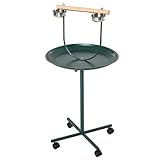
This stand is 22 inches in diameter and 49 inches tall and weighs 12 pounds, which makes it a good fit for apartments and rooms where a 63 or 65 inch frame would dominate the space. It uses stainless steel, powder coated metal and fir wood.
The 22 inch high-edge tray is genuinely large for a stand this compact, and owners credit it with catching a substantial share of what a bird throws down. For someone who has been sweeping around a bare perch for years, that is the feature that changes the routine.
The two anti-tip food and water cups are described as the daily-use feature most owners mention, alongside the wheeled base, which rolls freely and has a brake. Rolling the stand to wherever you are working is what turns it from furniture into a training station.
Long-standing owners describe quality that exceeds expectations at this price point, and most reviews are from people who have had the stand for years rather than weeks.
Tray size and wheel brake
High edges around a wide tray matter more than tray area alone, because a bird perched on the rim drops straight over the edge. The 22 inch diameter here gives you that rim without the footprint of a square stand.
Use the brake whenever a heavy bird is on the perch. Without it, a bird that jumps off while the stand is on a slope can send the whole unit rolling.
Wobble over time and perch diameter
Several reviewers report the stand becoming wobbly after months and needing a daily tighten, which is a fair description of powder coated bolt joints under repeated load. Own the correct wrench and make tightening part of your weekly clean.
Perch diameter is too large for small African greys to grip comfortably, and some buyers swapped in a smaller perch or wrapped the bar. It is also not sturdy or wide enough for macaws, so match it to conures, Amazons and medium birds.
9. PawHut 63 Inch Three-Ladder Stand: the best layout for large birds
PawHut Parrot Stand Large Bird Perch Stand with Toy Hook & 3 Ladders, Parrot Perch with Easy Grip, Bird Wooden Stand, Gray
27.2 by 25.2 by 63 inch frame
Three textured steel ladders
Removable tray and washable bowls
Perch 0.87 inch diameter by 16.7 inch
Pros
- Three ladders give plenty of climbing and exercise options
- Textured powder-coated steel gives a secure talon grip
- Wheels make it easy to bring the stand to the bird
- Removable tray and machine washable steel bowls
- Suited to conures cockatoos Amazons and macaws
Cons
- Three ladders and a 63 inch frame are bulky in a small room
- Assembly required and not always straightforward
- Wheels mean it should not be left out in the rain
- Birds chew natural wood parts over time
The layout is the reason to choose this stand. Three ladders give a bird multiple routes up and down, and owners of conures, Amazon parrots, cockatoos and macaws report that the multiple climbing paths are what keep their birds active on it for long sessions.
The ladders are textured powder-coated steel rather than smooth dowel, which gives talons purchase on the way up and is far more wear resistant than wood under a heavy bird.
It measures 27.2 by 25.2 by 63 inches and weighs 17 pounds, so it wants a dedicated space. The perch is listed at 0.87 inch diameter and 16.7 inches long, which sits at the larger end of a workable grip range for big birds.
The removable tray and machine washable stainless steel food and water bowls make cleaning the least pleasant task considerably easier, and the large hook above the perch gives you somewhere obvious to hang a foraging toy.
Ladder grip and washable bowls
Textured steel is a genuine advantage over smooth metal for climbing birds, and it will not wear through the way a wooden ladder rung does in a macaw or cockatoo household.
Machine washable bowls are worth more than they sound. Washing a stainless bowl takes thirty seconds; scrubbing a welded plastic cup takes ten minutes and never quite finishes.
Footprint, weight and weather
At 27 by 25 inches and 17 pounds, this is furniture-sized. If your play time happens in a small apartment, the PawHut 49 inch is the more sensible purchase.
Wheels let you bring the stand to the bird or out to a sheltered balcony, but powder coated steel and natural wood should not be left in the rain. Bring it back in when the weather turns.
10. kathson Tabletop Playstand: the most accessories in a small box
kathson Parrot Playstand Bird Playground Conures Play Stand Wood Perch Gym Playpen Ladder Parakeets Cage Accessories Exercise Toys with Swings Feeder Cups for Cockatoos Lovebirds
14.96 by 9.44 by 16.53 inch natural wood
Handmade with screw joints
Includes swings bells and chew toys
Screwdriver included
Pros
- Compact size works on a desk or on top of a cage
- Natural wood with polished perches is gentle on feet
- Includes swings ladders bells chew toys and cups
- Easy to put together once you work out the layout
- Several buyers report no strong factory smell
Cons
- Instructions are hard to follow so assembly takes trial and error
- Sturdiness is limited for a conure or Quaker
- Feeder cups are narrow and deep for seed
- Some pieces arrive with holes in the wrong positions
- Bottom perch can spin if screws are not reinforced
When you count what is in the box, this one wins. You get climbing ladders, a tray, wooden swings, chew toys, bells and feeding cups on a 14.96 by 9.44 by 16.53 inch natural wood frame that weighs 2.62 pounds.
Several owners place it on top of a cage so the bird can use it during out-of-cage flying time, and others keep it permanently on a desk for interaction. That dual use is what makes it feel like more than its size suggests.
Construction is handmade natural wood joined with screws rather than glue, and perch surfaces are polished so they are gentle on feet. A screwdriver is included, which matters more than it should.
For budgies, cockatiels, lovebirds, Quaker parrots and small conures, the included swings and bells are reported to hold attention for hours. A bell on a swing is doing more behavioural work than most owners expect.
Accessories included out of the box
Ladders, swings, bells, chew toys and cups in a single purchase removes the most common early frustration with a new stand, which is an empty frame that the bird ignores for a week. There is something on it from minute one.
Check the cup capacity before relying on it for a full day of foraging. Owners describe them as narrow and deep, so they hold a small amount of seed rather than a full portion.
Instructions, hole placement and the spinning perch
Instructions are described as the weakest part of this stand, and attachment posts sometimes arrive too long or drilled in the wrong position. Allow extra time for assembly and check every hole against the drawing rather than forcing parts.
A minority of buyers warn it is not sturdy enough for a conure or a Quaker parrot, and the bottom perch can spin if the screws are not reinforced. Treat it as a small to small-medium bird stand.
How to Actually Train a Parrot on a Play Stand
The best parrot play stands for training are the ones your bird will step onto calmly, because almost every training behaviour starts with the bird standing still in one place. Equipment cannot deliver that on its own, but a stable perch at the right height removes the friction that stops sessions before they begin.
Place the stand where you already spend your time. Parrot forum owners consistently report better results from a stand beside their desk than from a cage in another room, because training depends on you being able to interact with the bird at the perch.
Step 1: measure your bird and set the height
Sit the bird on your hand and note where the feet sit, from the top of the head to the base of the tail. That number is a rough guide to body length, and the perch should sit at or slightly above shoulder height when the bird is standing on it.
Taller is generally better for whether a bird uses the stand at all. Birds that feel exposed stay put longer, and birds that feel low and cornered keep looking for a way down.
Step 2: teach step-up before anything else
Hold a treat at chest height, say one consistent word such as “up”, and wait. When the bird steps onto the perch, mark the behaviour with a clicker and give the treat. Repeat five times, then stop.
Do not chase the bird or lure it repeatedly. A lure with no marker teaches the bird that stepping up ends the conversation, so the marker and the word must come first.
Step 3: station your bird on the stand
Now put the bird on the perch, step back, and mark the moment it stays. Return immediately with a treat. Early on, reward any settling, then any stillness, then any stillness with a relaxed body.
Sessions should be short. Two to five minutes daily beats twenty minutes once a week, and most birds will tell you when they are done by turning away or starting to bite at the perch. Short, frequent sessions are the same principle we use when picking indoor bike trainers for winter training: consistency beats one long effort.
Step 4: add distance and a station cue
Once stationing is reliable, add one verbal cue such as “station” and reward the bird for going to the stand from a short distance in the room. Carry a treat pouch so the reward can be delivered without walking to a kitchen.
This is also the step that fixes the most common owner complaint, a bird that follows you from room to room. Stationing turns your presence into a cue, and eventually the stand itself is enough.
Step 5: move into target training
With stationing solid, introduce a target stick or a finger. Touch the target, mark, reward. Target training turns a bird’s attention into something you can direct, which is the foundation for station-to-mat and step-up on cue without a visible treat.
Rotate toys on the stand every couple of weeks. Owners report birds losing interest in a perch over time even with new toys attached, and changing the perch surface or the toy position brings the interest back.
Parrot Play Stand Buying Guide
Are play stands actually good for parrots? Yes, with conditions. A stand is good for a parrot when the perch diameter matches the bird’s foot, the frame will not tip when the bird leans or hangs off the side, the perch sits at a height the bird chooses willingly, and the stand is close enough to you to work with. A stand that fails any one of those can actually make training harder, because the bird learns that the perch is an unreliable place to be.
Choose the stand type that matches the problem
Tabletop perch. Best for cockatiels, parrotlets, lovebirds and budgies, and best for hand-taming and clicker work at a desk. The KINTOR ash T-perch and the LIMIO wooden playground both sit here. Small footprint, easy to move, limited enrichment on its own. Fitting a tabletop unit into limited floor space follows the same thinking behind our picks for modern play kitchens for small spaces: measure what you actually have.
Rolling metal playstand. Best for conures, caiques, Quakers, Amazons, African greys and cockatoos. Multiple perch heights, ladders, bowls and casters make this the default choice for out-of-cage time. The Prevue and both Mcage stands are in this group.
Multi-layer wood playstand. Best when you want a natural wood perch surface in a freestanding frame at a moderate height. The Ibnotuiy four-layer pine stand is the clearest example.
Cage with a playtop. Convenient because the bird never has to leave the cage footprint, and it is useful as a secondary station rather than a main one. A playtop is too small for hanging play and rarely gives enough height variety for stationing work.
Custom or freestanding gym. Worth considering for a large bird whose feet need wide branch spacing, or for a bird that needs hanging and upside-down play that no stand in this roundup provides. Build quality is high but cost rises sharply, and it is a specialist purchase.
The way people choose larger furniture has the same logic, whether it is an aquarium stand or a wooden play kitchen: pick for the footprint you actually have and the load you actually need, not for the photo.
Match perch diameter to the foot, not the bird’s size
Perch diameter should roughly match the width of the bird’s foot or the sitter’s toe. As a working guide, that is about half an inch for small birds, rising to one inch or one and a half inches for large parrots and macaws.
This single number decides whether a bird uses a stand at all. Forum owners describe birds refusing to engage with a perch because they could not grip it, and the fix was swapping the perch rather than changing anything else. If a listing does not give you a perch diameter, ask before you buy.
Variety matters more than any single material. Natural wood branch perches with different diameters and textures are the community consensus choice, and a stand that combines natural wood with textured steel or dowel gives a bird more than one foot option.
Wood, metal and PVC: what is actually safe
For wood, manzanita and java branches are the most commonly recommended because they are dense, safe to chew and offer irregular diameters. Pine is softer and cheaper but wears faster. Dowel is the weakest option and is a concern only when it is the whole setup, because a stand made entirely of identical dowel gives a bird no variety at all.
For metal, powder coated steel and stainless steel are both workable. Watch the finish rather than the material: sharp punched holes and rough edges are manufacturing problems that show up on budget metal frames, so run a finger along every edge before your bird touches the stand.
For PVC, the honest answer is that it is cheap, light and easy to build, but it is not something we would put under a heavy chewer. It also carries no grip texture and no perch diameter variety. Community DIY builds tend to combine PVC frames with natural wood perches for exactly that reason.
Stability, base weight and tip-over risk
Tip-over risk comes from three things: a light base, a narrow footprint, and a bird hanging off the side. A wide four-leg base with a full-width tray handles side load far better than a single centre pole, which is why the four-leg Mcage design holds up with severe macaws.
Check the listed weight against your bird. A 2 pound base is right for a budgie on a desk and wrong for anything heavier. A 17 pound frame will not be flicked by a cockatoo, but it will dominate a small room and it will not roll easily either.
Locking casters deserve more attention than most listings give them. A rolling stand carrying a heavy bird needs brakes that actually engage on your flooring.
Cleaning burden is the feature owners regret skipping
Cleaning is the most repeated complaint about play stands in owner forums, and it comes down to one question: does the tray lift out?
Stainless steel pans, such as the one on the Mcage wrought iron stand, are the easiest to keep clean. Plastic trays are acceptable and wipe down fine. Integrated ledges, welded bowls and fixed perches are what turn a five minute job into a twenty minute one.
Removable stainless steel bowls are worth as much as the tray in a busy household. A welded bowl develops biofilm at the seam that never fully comes off.
DIY or buy
A simple PVC or wood training perch is a well established community build and can be made for a fraction of the cost of a metal stand. It suits a single purpose: giving a bird one reliable perch at training height.
What DIY does not give you is bowls, casters, a removable tray and engineered joints. For daily out-of-cage use across hours, a manufactured stand is the better purchase, and our own comparison followed the same logic we would apply to a long-term furniture choice.
Spotting misleading listing photos
A large share of stand listings use catalogue photography with the disclaimer that images are not to scale and birds are enhanced to show texture. That means the bird in the picture tells you nothing about the real perch diameter or the real size of the unit.
Ignore the bird. Read the listed dimensions and the listed perch diameter, and check that a customer photo exists. A listing with a beautiful lifestyle image and almost no reviews is a weaker bet than one with real owner photos and a review count in the hundreds.
Frequently Asked Questions
Are bird stands good for parrots?
Yes, as long as four things are right: the perch diameter matches your bird’s foot, the frame will not tip, the perch sits at a height the bird chooses willingly, and the stand sits close enough to you to train with. A stand that fails any one of these teaches your bird that the perch is an unreliable place to be.
What type of wood is best for a parrot stand?
Manzanita and java branches are the most commonly recommended because they are dense, safe to chew and offer irregular diameters. Pine is softer and wears faster. Dowel is the weakest option and only becomes a problem when it is the entire setup, because a bird needs a mix of diameters and textures for healthy feet.
What is the best way to train a parrot?
Positive reinforcement with a marker is the most reliable method. Start with step-up, then stationing at the stand, then target training. Keep sessions to two to five minutes daily, mark the behaviour before delivering the treat, and stop while the bird is still succeeding.
What is the 3-3-3 rule for parrots?
It is a husbandry guideline suggesting roughly three hours of out-of-cage activity, three hours of interaction with people, and three hours of undisturbed sleep each day. It is a starting point rather than a rule, and a good play stand is one of the easiest ways to meet the activity and interaction parts of it.
What are common bird cage mistakes?
The most common mistakes are using only dowel perches, choosing a cage with no playtop or stand nearby, placing perches directly over food and water bowls, and keeping a cage in a room the household does not use. Perch variety and a stand near your workspace fix most of these at once.
What is the best brand of parrot cages?
Prevue Pet Products and Au0026amp;E Cage Co build both cages and stands in the United States and are the two names most often recommended by owners in parrot forums. The brand matters less than fit, so match the bar spacing and perch diameter to your species rather than buying on name alone.
How do I clean a parrot play stand?
Remove the tray or catch pan and wipe it, take the stainless bowls off and wash them, then wipe the perches with a damp cloth. Do this every few days rather than weekly, because dried droppings are much harder to remove once they have set. Replace any perch the bird has chewed down.
Conclusion
For most owners the best parrot play stands for training come down to one honest test: will your bird step onto it and stay there. If your bird is a conure, Amazon, African grey or cockatoo, the Prevue 5-foot stand is the strongest all-round choice, with multiple perch heights, stainless bowls and a pull-out tray that makes cleaning quick.
Desk-bound training work calls for something small instead. Put a tabletop perch beside your chair, keep sessions short, mark every correct behaviour, and let the location do the work for a few weeks before you judge the stand.
Whichever you pick, check the perch diameter against your bird’s foot before you order, and put the stand where you spend your hours. That second decision costs nothing and matters more than any feature on the list.