

Most canister filter roundups are written for freshwater and mention marine in a footnote. This one is built the other way around: every pick below was chosen with a reef or fish-only saltwater system in mind, and each verdict accounts for return height, media volume in a sealed canister, and the fact that a canister does not aerate your water the way a sump does.
We spent weeks running through the specification sheets, owner reviews and marine-specific failure reports for twelve canister filters, then sorted them by what actually matters once salt hits the tank. The result is a list where the top pick is not the biggest, most expensive unit on the page, and several headline flow numbers turn out to be less useful than they look once your return has to climb out of the cabinet.
Last updated for 2026. If you are still choosing hardware, our guide to the best aquariums for modern homes covers cabinet heights and stand clearances, which decide half of the canister decisions on this page.
Table of Contents
- Top 3 Canister Picks for Saltwater Aquariums in 2026
- All 12 Best Canister Filters for Saltwater Tanks in 2026
- 1. Penn-Plax Cascade 1000 – Best Overall Canister for Saltwater Tanks
- 2. Fluval 307 – Best Value Canister Filter for a Reef Tank
- 3. Fluval 207 – Best for Nano and Small Marine Systems
- 4. Fluval 407 – Most Compact for Large Mixed Reef Systems
- 5. Marineland Magniflow 400 – Best for High-Flow Fish-Only Systems
- 6. Marineland Magnum 290 – Most Versatile for Small Marine Systems
- 7. SunSun HW-302 – Best Low-Cost Starter Canister for Marine Tanks
- 8. SunSun HW-304B Pro – Best for UV Clarification on a Mid-Size Reef
- 9. SunSun HW-3000 PRO – Best for Large Mixed Reef and High Turnover
- 10. Aquatop CF-400UV MKII – Best Stacked UV Value
- Aquatop 4-Stage Canister Filter with Vortex Prime, 9W UV, 370GPH Flow Rate, 35W Power, Up to 125 Gal – Including All Filtration Media, Great for Salt & Freshwater Tanks, UV for Crystal Clear Water
- Best for mid-size reefs that want clarification without a sump
- Skip it if UV safety is a concern in your setup
- 11. OASE BioMaster – Best for Large Display Systems
- 12. Flexzion 525 GPH – Best Budget UV Setup for Saltwater Tanks
- Canister vs Sump: Which One Your Marine System Needs
- How to Size a Canister Filter for Saltwater in 2026
- The Nitrate Factory Myth, Explained
- Frequently Asked Questions
- Are canister filters good for saltwater tanks?
- What is the best canister filter for a saltwater aquarium?
- Which is better, Eheim or Fluval, for a marine aquarium?
- What is the best filter media for a saltwater aquarium?
- Are sump filters better than canister filters?
- Can I run two canister filters on one reef tank?
- The Verdict: Which Canister Filter for Saltwater Wins in 2026
Top 3 Canister Picks for Saltwater Aquariums in 2026
These three cover the most common marine builds: a mixed reef up to 100 gallons, a smaller fish-only system, and a larger display that needs real head pressure.
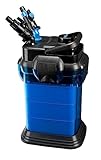
Penn-Plax Cascade 1000
- 265 GPH rated
- Up to 100 gallons
- Fresh and saltwater rated
- Three stackable media baskets


All 12 Best Canister Filters for Saltwater Tanks in 2026
Every pick below is rated by its manufacturer for marine use. Flow figures are rated, not measured at your return height.
| Product | Specifications | Action |
|---|---|---|
| Penn-Plax Cascade 1000 |
|
Check Latest Price |
| Fluval 307 |
|
Check Latest Price |
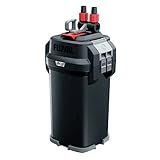 Fluval 207 Fluval 207 |
|
Check Latest Price |
| Fluval 407 |
|
Check Latest Price |
 Marineland Magniflow 400 Marineland Magniflow 400 |
|
Check Latest Price |
 Marineland Magnum 290 Marineland Magnum 290 |
|
Check Latest Price |
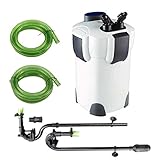 SunSun HW-302 SunSun HW-302 |
|
Check Latest Price |
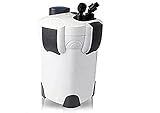 SunSun HW-304B Pro SunSun HW-304B Pro |
|
Check Latest Price |
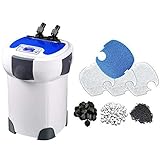 SunSun HW-3000 PRO SunSun HW-3000 PRO |
|
Check Latest Price |
 Aquatop CF-400UV MKII Aquatop CF-400UV MKII |
|
Check Latest Price |
 OASE BioMaster OASE BioMaster |
|
Check Latest Price |
 Flexzion 525 GPH Flexzion 525 GPH |
|
Check Latest Price |
1. Penn-Plax Cascade 1000 – Best Overall Canister for Saltwater Tanks
Penn-Plax Cascade 1000 Canister Filter – 265 GPH Aquarium Filter for Tanks Up to 100 Gallons – 360 Degree Flow Valves, Poly Fiber Pads, Bio-Sponge & Activated Carbon -Fresh & Saltwater -11.5x10x17in
265 GPH rated
Fresh and saltwater
Three stackable baskets
28.5W push-button primer
Pros
- Rated for both freshwater and saltwater up to 100 gallons
- Three large stackable baskets with handles
- Push-button primer and 360-degree rotating valve taps
- Complete media package included with floss bio-sponge carbon and spray bar
- Tip-proof base for tight cabinet floors
Cons
- Included media must be replaced on a recurring schedule
- Plastic valve taps can be fiddly to aim precisely
- Spray bar only circulates at the surface with no directional nozzle
This is the canister we keep coming back to for a mixed reef, and the reason is simple: it has more owner history in the marine hobby than anything else on this list, with 10,000+ reviews averaging 4.3 stars. Owners running reef and mixed systems single out strong circulation and a reliable seal as the recurring wins, which is exactly what you need from a filter living in a salt cabinet.
Three stackable baskets with built-in handles is a genuinely useful amount of media volume for a marine layout. You can run a floss pad and sponge in the top basket, ceramic rings in the middle and carbon in the bottom without cutting anything to fit, and the handles mean you are not fishing wet media out of a canister by the edge.
One spec deserves a hard look before you commit. The product details list a maximum supported water TDS level of 1000 ppm, which is a freshwater figure, while the marketing copy states the unit works for freshwater and saltwater. Plenty of reefers run it in salt regardless, and the review base suggests the seals hold, but if your TDS meter reads well above that figure this is a question to raise with the manufacturer rather than assume.
The 28.5W draw on 110V is easy to hide on a standby strip, and at 12 pounds with an 11.42 x 9.84 x 16.93in body it fits the cabinet footprint most stands provide. Flow is 265 GPH rated, which works out to modest turnover on a 100-gallon display, so if your system is stocked heavily for coral you will want to plan on a second unit or a much higher-flow model.
Best for mixed reef systems under 100 gallons
This is the pick for a fish-only or lightly stocked mixed reef where mechanical filtration matters more than raw flow. The basket layout gives you room for a proper marine stack and the review history means parts, gaskets and baskets are easy to source down the road. Long-term owners on forums describe it as the unit they set and largely stop thinking about.
Pair it with an external protein skimmer. Canisters do not provide the gas exchange a skimmer needs, and several hobbyists on Reef2Reef describe the skimmer as the marine-specific requirement a canister cannot meet on its own. Cleaning cadence on a reef is more frequent than on freshwater, typically every two to three weeks rather than monthly.
Skip it if you need serious head pressure
At 265 GPH rated, the Cascade 1000 loses a meaningful share of that figure pushing water to a return three or four feet up. High-flow systems with demanding coral want a unit with more head pressure and a directional outlet, and reviewers also note the spray bar only circulates at the surface with no directional nozzle included.
The other soft spot is consumables. Around 10 percent of one-star reviews cluster on media replacement cost, and the plastic 360-degree valve taps are widely described as fiddly to aim precisely in a cramped cabinet.
2. Fluval 307 – Best Value Canister Filter for a Reef Tank
Fluval 307 Perfomance Canister Filter for Aquariums up to 70 Gallons
Rated up to 70 gallons
eTEC pump
EZ-Lift center-handle baskets
9.45 x 7.09 x 16.54in
Pros
- Near-silent eTEC pump that is inaudible in most living spaces
- Steady flow and pressure that clears water quickly
- EZ-Lift center-handle baskets make servicing fast
- Simple forgiving startup and priming
- Clean-looking cabinet installation
Cons
- Media bags are smaller than older Fluval generations
- Included carbon pouches feel thin next to genuine Fluval media
- Can produce microbubbles and a faint hum at higher settings
- No built-in UV stage
The Fluval 307 is the mainstream answer to what is the best canister filter for a saltwater aquarium under 70 gallons. It carries 10,000+ reviews at 4.4 stars, and the marine-specific feedback is consistently positive: strong circulation and reliable sealing, with no reports of salt-related gasket or housing problems.
Fluval’s eTEC pump is stated to run up to 25 percent quieter than the previous generation, and the power draw is described as equivalent to an LED light bulb. In practice that means you can run it in a living room without thinking about it, which matters more for a canister than for any other filter type since it sits next to where you sit.
The EZ-Lift baskets with a centre handle are the detail reefers notice most. The whole media stack lifts out with one finger, which on a marine system matters more than on freshwater because you will be doing it more often. At 6 pounds the unit is also light enough to lift in and out of a cabinet without a two-person job.
There is a trade-off on consumables. Owners report the Fluval-branded media bags are smaller than those from older generations, so the ongoing media cost adds up faster than the unit’s sticker presence suggests. There is no UV stage either, so parasites and green water have to be handled by other means.
Best for quiet reef setups and easy maintenance
If your stand is next to a living space, this is the one to shortlist. Owners running it on reef or marine tanks cite near-silent operation, clear water within days and straightforward maintenance as the top three reasons it works for them. The 9.45 x 7.09 x 16.54in body fits shallow stands that will not take a sump.
It is also a strong second filter. If you are running a 100 to 150 gallon system and want a cheap, serviceable backup alongside a larger unit, a 307 is a common choice. Users caution against undersizing to exact tank volume, and going one size up here is the same advice in miniature.
Skip it if media budget matters more than silence
The recurring criticism across the line is media sizing and cost, plus isolated reports of microbubbles or a faint hum at the highest flow settings. If you run carbon heavy, the smaller bags add up faster than on larger baskets, and running the unit at full tilt can introduce microbubbles into the return.
At 70 gallons rated it is also a step down for anyone with a 100-gallon display. Pick the 407 instead if your tank is larger, or run a paired setup if you want redundancy.
3. Fluval 207 – Best for Nano and Small Marine Systems
Fluval 207 Perfomance Canister Filter for Aquariums up to 45 Gallons
Rated up to 45 gallons
eTEC pump
7.09 x 7.48 x 16.54in
3.3 pounds
Pros
- Compact 45-gallon footprint that fits under most stands
- Markedly quieter than older Fluval canisters
- EZ-Lift centre-handle baskets simplify media swaps
- Lightweight at roughly 3.3 pounds
- Consistent flow that clears water quickly
Cons
- Modest flow for high-turnover reef systems
- Media consumables add recurring cost
- Some owners report faint humming at higher flow settings
- Included media pouches are smaller than legacy Fluval refills
For a nano reef or a small fish-only marine system the Fluval 207 is hard to argue with. It shares the Performance line review data at 4.4 stars across 10,000+ ratings, and the feedback pattern is consistent: near-silent running, easy maintenance and a clean-looking cabinet installation.
At 3.3 pounds it is by far the easiest unit on this list to lift into a stand, and at 7.09 x 7.48 x 16.54in it will fit cabinetry that refuses anything bulkier. If your stand space is genuinely tight, that footprint alone can decide the purchase.
Where the 207 differs from its larger siblings is turnover. It is rated for tanks up to 45 gallons, and reviewers on the Performance line flag limited turnover compared with larger canisters as the most common caveat. For a lightly stocked nano that is a non-issue; for a mixed reef pushing high flow, owners suggest a second unit rather than one bigger one.
It shares the same consumable criticism as the rest of the line. The included pouches are smaller than legacy Fluval refills, and owners note the ongoing cost of Fluval-branded filter media as a recurring theme in the reviews.
Best for quarantine, hospital and nano reef tanks
Quarantine and hospital setups reward exactly what the 207 offers: a small footprint, low noise and a media basket that comes out with one hand. Because these systems are small and often temporary, the modest rated flow is a benefit rather than a limitation. It also works well as a second filter on a system where you want a redundant mechanical stage.
Fish-only tanks in the same volume range are the other natural fit. A 45 gallon marine display with a moderate stocking level is well within what this unit was built for.
Skip it if you need reef-scale turnover
The model number sits low in the range on purpose, and the flow figure is not one of the higher ones on this list. If your coral placement depends on strong directional flow, or you are stocking a heavily populated system, you will outgrow it faster than the price difference suggests.
Some owners also report a faint hum at the higher flow settings, so if the system is in a bedroom, listen to a demonstration before committing.
4. Fluval 407 – Most Compact for Large Mixed Reef Systems
Fluval 407 Performance Canister Filter – For Aquariums Up To 100 Gallons
Rated up to 100 gallons
eTEC pump
Adjustable spray bar
7.09 x 9.45 x 19.29in
Pros
- Strong flow for 100 gallon systems
- Near-silent eTEC pump and clean cabinet appearance
- EZ-Lift baskets make media changes one-handed
- Straightforward setup and clear instructions
- Users report crystal-clear water within hours
Cons
- Documented impeller cover failure mode under pressure
- Repeated motor head durability complaints
- Costly replacement motor heads and kits
- Included media pouches smaller than expected
- Faint hum audible at top flow in very quiet rooms
The 407 tops the Performance line and is the right Fluval when a mixed reef needs more than the 307 can push. Reviewers rate the pump performance and installation experience highly, with clear water reported within hours in properly sized systems, and the adjustable spray bar gives you the directional control a mixed reef layout benefits from.
It is also the tallest unit in the Fluval range here at 19.29in, so measure your cabinet clearance before you order. At 9.7 pounds it is manageable, but it is a two-handed lift rather than a one-handed one.
There is one long-horizon caveat we will not paper over. A notable minority of reviews concentrate on the 407’s impeller cover disengaging under pressure, which silently stops filtration, along with repeated motor head durability complaints and what owners describe as poor responsiveness from the manufacturer. That is a real risk on this specific model, not a general Fluval problem, and it is why the 307 is our value pick rather than this one.
Replacement motor heads and maintenance kits are also a costly add-on purchase, which matters more in a salt cabinet where a surprise failure means an emergency water change.
Best for 90 to 100 gallon mixed reef builds
Pick the 407 when your system is large enough that turnover matters, you want the adjustable spray bar for circulation pattern control, and you are comfortable keeping spare parts on hand. Long-term owners on forums cite Eheim units running 10 to 20-plus years and Fluval as the mainstream reliable name, and the 407 is the strongest of the Fluval options here on flow.
It is a good second unit too. A 407 paired with a smaller canister gives you redundancy and extra flow on a system that cannot yet justify a full sump.
Skip it if reliability history is the deciding factor
Buy a different model if you cannot service it quickly when something fails. The impeller cover and motor head reports are specific enough that we would not put this unit on a display tank where a filtration failure is expensive. The 307 or 207 avoid the reported issue, and the 207 in particular shares the same line but sits well below the failure cluster.
Also expect a faint hum at top flow in a very quiet room, and budget for genuine Fluval media because the supplied pouches run smaller than expected.
5. Marineland Magniflow 400 – Best for High-Flow Fish-Only Systems
Marineland Magniflow 400 GPH Canister Aquarium Filter
400 GPH rated
Up to 100 gallons
Stack N Flo forced-flow trays
Quick prime button
Pros
- 400 GPH rated for tanks up to 100 gallons in fresh or salt water
- Stack N Flo trays create forced-flow paths through all media layers
- Generous included media set with foam carbon bags bio-balls and ceramic rings
- Quick prime button and lift-off watertight lid
- Owners report dramatic clarity improvements
Cons
- Included plastic hose clamps are weak and a common leak source
- Lid gasket often not supplied which causes immediate leaking
- Rigid tubing is hard to route and suction cups can be inadequate
- Short intake tube for deep tanks
- A nonstop rattle can develop from the priming button assembly
The Magniflow 400 is rated for freshwater and saltwater aquariums up to 100 gallons and moves 400 GPH, which makes it a strong fit for fish-only marine systems that want more circulation than a reef-focused canister gives you. It holds a 4.1 average across 4,100+ reviews, and reviewers consistently credit strong filtration results and quiet running once it is set up.
The Stack N Flo trays force water through the media layers in a defined path rather than letting it find the easy way round, which is a real advantage when you are layering floss, carbon and bio-media. The included media set is unusually generous: foam, carbon bags, bio-filter balls, ceramic rings and polishing pads all ship in the box.
Setup is straightforward, with a quick prime button for self-priming and a watertight lift-off lid for media access. Compatibility with Marineland Rite-Size T media means the consumables supply is easy to keep coming.
The recurring complaint cluster is mechanical rather than filtration-related, and you can plan around all of it. Included plastic hose clamps are weak and a common source of leaks, so fit metal clamps instead. The lid gasket is often not supplied with the unit, which causes immediate leaking on first setup. Rigid tubing is hard to route, the intake and outlet suction cups can be inadequate, and the intake tube is short for deep tanks.
Best for fish-only marine tanks that want circulation
A fish-only marine display with tangs, a triggerfish or a large predatory species cares more about flow than about media layering, and this is where 400 GPH rated flow earns its place. Owners report dramatic clarity improvements in previously cloudy tanks, and the media set gives you a working configuration before you buy a single bag of anything.
It is also a good choice as a second canister on a large system, where a 400-rated unit paired with a larger main filter adds flow and redundancy without a full sump build.
Skip it if fittings and gaskets are not your thing
Every one-star review in this product’s history tends to trace back to leaking, and the leaking traces back to the plastic clamps or the missing lid gasket. Budget five minutes and a pack of metal clamps, and check the gasket before first fill, and most of the risk disappears.
At 19.27 pounds and 11 x 11 x 18in it is also the second heaviest unit here, and some owners report a non-stop rattling noise developing from the priming button assembly. Deep tanks need an intake extension that is not in the box.
6. Marineland Magnum 290 – Most Versatile for Small Marine Systems
Marineland Magnum 290 GPH Polishing Canister Aquarium Filter
290 GPH rated
Up to 97 gallons
Submerged motor
Two refillable chambers
Pros
- 290 GPH throughput in a compact lightweight body
- Submerged motor means no separate pump head and instant startup
- Two refillable chambers run carbon and mechanical media together
- Included micron cartridge gives noticeably clearer water
- Fits cabinet spaces too shallow for a full-size external unit
Cons
- Small chamber volume limits media carried compared with full-size canisters
- Internal canister format differs from standard external plumbing
- Lightweight plastic housing feels less premium
- Refillable cartridges add recurring consumable cost
- Less suited to high-biomass reef stocking
The Magnum 290 delivers 290 GPH for tanks up to 97 gallons in a body that weighs 2.91 pounds and measures 7.5 x 3.5 x 9.88in. That combination is the whole argument for it, and it holds a 4.1 average across 3,400+ reviews with 63 percent five-star ratings.
Buyers highlight clear water improvement, quick installation and an unusually low entry point for that much rated flow. The submerged motor design means no separate pump head and instant startup, which removes the priming step that trips up several competitors.
Be clear-eyed about the format, though. This is an internal canister, not an external hang-on-style unit, and its mounting and tubing layout differ from standard return plumbing. If you are planning a conventional in-cabinet external install, this is not a drop-in substitute for the rest of this list.
Two refillable media chambers let you run carbon and mechanical media together, and the included micron cartridge gives a visible clarity step. Chamber volume is the limiting factor, and it is why reviewers describe it as less suited to high-biomass reef stocking than the higher-flow external models.
Best for low-biomass marine tanks and hospital setups
Small fish-only marine tanks, quarantine systems and hospital tanks are where the 290 makes complete sense. You get 290 GPH of filtration and a micron polish step in something you can carry with one hand, install without siphoning, and hide in a stand with almost no room.
For a nano reef under 30 gallons it is also more than adequate, and refillable cartridges are a predictable, easily sourced consumable.
Skip it for a stocked reef display
The small chamber volume is the whole limitation, and it shows up as detritus storage rather than as a flow problem. A heavily stocked reef needs more media volume than two small chambers can hold, which is exactly the complaint the review data clusters on.
Also factor in the recurring refillable cartridge cost and the fact that the housing does not give you the premium feel or the plumbing flexibility of an external unit. If you want a canister you can grow with, this is the wrong shape of product.
7. SunSun HW-302 – Best Low-Cost Starter Canister for Marine Tanks
SunSun HW-302 3-Stage External Canister Aquarium Filter 264GPH
264 GPH rated
Fresh and saltwater
Three media trays
Self-priming pump
Pros
- 264 GPH of flow at an entry-level outlay
- Explicitly rated for both freshwater and saltwater
- Self-priming pump removes the manual siphon step
- Three configurable media trays allow custom media stacks
- Adjustable spray bar helps tune surface agitation
Cons
- Included spray bar and plastic fittings can crack or warp
- No UV stage so green water control depends on media alone
- Basic tubing and valve quality versus premium brands
- Can develop small air leaks at the hose connections
- Noisier than Fluval and OASE at equivalent flow
The HW-302 is the budget entry point for a first marine build, and at 264 GPH it sits right alongside the Cascade 1000 on flow. It holds a 4.1 average over 1,200+ reviews with 66 percent five-star, and reviewers consistently highlight strong flow for the money and easy self-priming.
It is explicitly rated for fresh and saltwater aquariums, which is the box most budget buyers actually care about. Three media trays let you build a custom stack, and the adjustable spray bar helps you tune surface agitation and circulation pattern in a tank that will not take a directional nozzle.
It is also the one on this list reviewers most often describe as useful as a sump or double-filtration add-on, running it alongside a powered filter to push more water through a second media stack. That makes it a cheap way to add mechanical capacity to a system you already own.
The durability notes are consistent and worth planning for. The included spray bar and plastic fittings can crack or warp under sustained pressure, tubing and valve quality are basic against premium brands, and some units are prone to small air leaks at the hose connections. There is no UV stage, so green water and algae control depend on media alone.
Best for a first reef build on a budget
If this is your first marine system and the plan is to grow slowly, the HW-302 is a sensible place to start. It gives you real external canister plumbing, three configurable trays and a self-priming pump, which is most of the functional benefit of a bigger unit at a fraction of the outlay.
It also works as a secondary canister on a larger system where you want more media volume without adding another major piece of equipment. Just check fittings whenever you service the hoses.
Skip it if you need quiet or long-term fittings
Reviewers note it is slightly noisier than Fluval and OASE units at equivalent flow, and in a living room next to the tank that difference is audible. Fittings that crack or warp under sustained pressure are a longer-term concern in a marine cabinet where corrosion already works against you.
With 1,243 reviews the long-horizon data is thinner than the Fluval and Marineland entries here. If you want a unit you will still own in a decade, spend up for a model with a deeper parts supply.
8. SunSun HW-304B Pro – Best for UV Clarification on a Mid-Size Reef
Sunsun Hw304B 525GPH Pro Canister Filter Kit with 9-watt UV Sterilizer
525 GPH rated
Up to 150 gallons
9 watt UV sterilizer
Four media baskets
Pros
- 525 GPH rated for tanks up to 150 gallons
- Integrated 9 watt UV sterilizer helps with green water
- Four media baskets give generous media capacity
- Kit ships with 1 lb each of filter carbon and ceramic rings plus bio balls
- High flow per unit among UV-equipped canisters
Cons
- UV bulb and quartz sleeve are consumables
- Bulb ballast and electronics are the most failure-prone parts
- Basic plastic intake tubing and head fittings can leak
- 17 lb weight makes cabinet installation awkward
- Priming is fiddly if hoses are not fully filled first
The HW-304B Pro pairs 525 GPH rated flow with an integrated 9 watt UV sterilizer and four media baskets, rated for tanks up to 150 gallons. It averages 4.1 stars from 1,000+ reviews with 67 percent five-star, and owners consistently value having high flow, four baskets and a built-in UV stage in one unit.
Four baskets is the number that matters most in a marine canister. It is enough room to run a floss pad and sponge, ceramic rings, and carbon as separate stages, which is more usable media capacity than most competitors of similar flow offer.
The kit ships with a substantial starting media load: 1 lb of premium filter carbon, 1 lb of ceramic rings and a set of bio balls, alongside 4 white filter pads and 1 blue coarse pad. For a first reef build that removes almost all of the up-front media shopping.
Plan for the UV hardware. The bulb and quartz sleeve are consumables that eventually need replacement, and the ballast and electronics are the most failure-prone components according to owner reports. The intake tubing and head fittings are basic plastic and can leak at the connections, and the startup sequence needs the hoses completely filled before you prime or you will be doing it more than once.
Best for clear water on a reef up to 150 gallons
The UV stage is what separates this from the plain HW-302. It handles green water and suspended fine particles that mechanical filtration alone will not clear, and on a display where water clarity is the visible goal, that is a real difference you can see within days.
At 525 GPH rated it also gives you head pressure to lift water to a return sitting high in the tank, which is the specific problem so many reef owners run into with entry-level canisters.
Skip it if you are not comfortable with electronics
The UV circuit is the weak point. Bulb and sleeve replacement is a recurring cost, the ballast is the component that most often fails, and there is no carry handle on a 17 pound body that already has to go into and out of a cabinet.
If you would rather own a plain mechanical canister and handle clarity through media changes, the Fluval 407 or the Cascade 1000 is a cleaner fit for a long-term install.
9. SunSun HW-3000 PRO – Best for Large Mixed Reef and High Turnover
SunSun HW-3000 UV 9W 5-Stage External Canister Filter w/Media, 793gph, White, HW-3000 PRO
Adjustable 396 to 793 GPH
Five stages
9 watt UV with timer
No priming needed
Pros
- Flow adjustable up to 793 GPH
- Digital display for exact flow setting and UV scheduling
- Huge media capacity with sponges polisher and biostimulant media
- Double O-ring connectors reported leak-free
- Runs extremely quiet at low and mid power settings
- No priming button required
Cons
- Very tall canister may need to be laid nearly horizontal under a low cabinet
- Laying the unit on its side can cause seepage at the main seal
- Priming after a media clean is difficult with the wide-bore hoses
- Control panel and electronics are the main failure points
- Display backlight is bright and does not dim
- No built-in carry handle
The HW-3000 PRO is the flow leader in this roundup, with adjustable output from 396 to 793 GPH and a five-stage layout with a 9 watt UV sterilizer. It holds a 4.0 average across 559 reviews with 61 percent five-star, and enthusiasts praise the adjustment range, media capacity and UV scheduling.
What makes it interesting for marine work is the LCD control panel. You can dial an exact flow speed and schedule the UV runtime, which on a reef gives you the turnover control that a fixed-output canister simply does not offer. Several long-term owners report running multiple units in place of Fluval, Marineland and Eheim filters.
It is also rated for freshwater and saltwater, requires no priming, and owners report double O-ring connectors that stayed leak-free. The media capacity is large enough that owners routinely load sponges, polisher and biostimulant media together rather than choosing between them.
The cabinet fit is the real caveat. At 19.49 x 15.51 x 12.6in and 22.05 pounds it is the largest, heaviest unit on this page, and it is tall enough that some cabinets require laying it nearly horizontal. Laying it on its side can cause slight seepage at the main seal, which is a poor trade in a salt cabinet.
Best for large displays that need dialed-in turnover
Pick this when your system needs more flow than any fixed-output canister on the list can deliver, and you want the ability to reduce that flow as coral placement demands. The scheduled UV is genuinely useful on a reef with a known nuisance algae or bacterial problem, and the no-priming design saves you the mess on restart.
It is also the natural choice for the two-canister pattern people use on 100-plus gallon systems when a single unit is not enough. Running a pair of these gives you both flow and redundancy.
Skip it if your cabinet is shallow
Measure first. The height and weight are real constraints, and the workaround of laying it nearly horizontal introduces a seal seepage risk in a saltwater cabinet. There is no carry handle, and at 22.05 pounds that is a two-person lift in a tight space.
Priming after a media clean is genuinely difficult because of the wide-bore hoses, and the control panel screen and internal electronics are the main failure points. The display backlight is also bright and does not dim, which matters if the canister is in a room you use after dark.
10. Aquatop CF-400UV MKII – Best Stacked UV Value
Aquatop 4-Stage Canister Filter with Vortex Prime, 9W UV, 370GPH Flow Rate, 35W Power, Up to 125 Gal – Including All Filtration Media, Great for Salt & Freshwater Tanks, UV for Crystal Clear Water
370 GPH rated
Up to 125 gallons
3 plus 1 stages
9 watt UV sterilizer
Pros
- 370 GPH rated for tanks up to 125 gallons in salt or fresh water
- Four large media baskets hold a full stack of custom media
- Vortex prime button fills the canister on the first push
- UV stage cleared green water within a couple of days
- Adjustable directional spray bar works well in larger tanks
- Long-running owners report more than 16 months of continuous duty
Cons
- UV bulb and quartz sleeve eventually fail and the bulb is hard to source
- No carry handle so a full canister needs both hands
- Instructions are vague and omit the siphon connection feature
- In-tank fittings can fit loosely
- A cracked UV bulb sleeve can put the water column at risk of electrical shock
The Aquatop CF-400UV MKII runs 370 GPH at 35W, is rated up to 125 gallons, and is designed for both freshwater and saltwater tanks with a 3 plus 1 stage layout and a 9 watt UV. It averages 4.1 stars across 441 reviews with 63 percent five-star, and reviewers praise the large media baskets, quick prime button and effective UV clarification.
Four large baskets is the highlight for a marine install. That is enough capacity to run a real marine stack, with floss and mechanical media separated from the biological and chemical stages rather than crushed into two small chambers.
Two details are genuinely useful in a cabinet. The Vortex prime button fills the canister on the first push, and the adjustable directional spray bar gives you circulation pattern control on a tank large enough to need it. The intake tube also accepts a siphon hose connection, so you can use the same unit for gravel vacuuming, though the instructions omit that feature and you may have to work it out yourself.
The UV bulb and quartz sleeve are the recurring concern. They eventually fail and the replacement bulb is hard to source, which is a genuine long-term ownership issue rather than a minor one. There is also no carry handle, so a full canister needs both hands, and in-tank fittings can fit loosely in some units.
Best for mid-size reefs that want clarification without a sump
This is the pick when your tank is in the 75 to 125 gallon range and you want a directional return and a UV stage without building a sump. Long-running owners report 16-plus months of continuous duty with a watertight seal, which is a reasonable durability signal for the class.
It is also a sensible quarantine and hospital companion, where the siphon-connection intake makes water changes and vacuuming simpler on a smaller system.
Skip it if UV safety is a concern in your setup
One detailed review documents an electrical shock risk after a cracked bulb sleeve filled with water, and reviewers note that some media baskets and hose clips degrade after a couple of years under UV exposure. If you run this in a shared room or above a wooden stand, inspect the sleeve periodically and keep the canister where a leak cannot reach a socket.
Hard to source bulbs and vague instructions are the other two reasons we rank it below the SunSun UV units, which are easier to keep running.
11. OASE BioMaster – Best for Large Display Systems
OASE BioMaster External Filter for Aquariums up to 225 gallons, Multi-Stage Filtration, Easy Maintenance Prefilter, Quiet Canister Filter, German Engineering
Up to 225 gallons
Sound dampened housing
Easy-maintenance prefilter
Made in Italy
Pros
- Highest rated capacity on this list at up to 225 gallons
- Fresh and marine water compatible for large reef systems
- Sound-dampened housing keeps pump noise very low
- Easy maintenance prefilter keeps the pump intake clear
- Optional built-in heater integration for all-in-one setups
- Premium European build quality
Cons
- Highest cost per unit among these picks
- Large 13 x 16 x 25in body needs a deep cabinet
- OASE specific media and parts are costly and hard to source
- Small review base so long-term data is limited
- Heater integration requires buying a separate HeatUp unit
The OASE BioMaster is rated for aquariums up to 225 gallons and is compatible with both freshwater and marine water, which makes it the capacity leader here. It carries a 4.3 average from 79 reviews, with 75 percent five-star, and experienced reef keepers describe the BioMaster design as a standout with premium components.
The sound-dampened housing is the feature you will notice most day to day. Combined with the easy-maintenance prefilter that keeps the pump intake clear, it addresses the two things that make a canister annoying in a living space: noise, and a service routine that turns into a mess.
There is also heater integration capability built in. If you want an all-in-one cabinet setup, an OASE HeatUp adjustable heater can be integrated into the canister, though the heater itself is a separate purchase. The unit is made in Italy and backed by German engineering.
The constraint is physical. At 13 x 16 x 25in and 17.6 pounds it needs a genuinely deep cabinet, and it is the tallest canister on this page by a wide margin. OASE-specific media and parts are costly and not widely stocked, which is a real consideration in a salt cabinet where you cannot always substitute a generic basket.
Best for large reef displays that value noise and build quality
Pick the BioMaster when the system is big enough to need 225 gallons of rated capacity, the cabinet has real depth, and quiet operation in an open-plan living space is a priority. The marine and freshwater compatibility is stated by the manufacturer, and the multi-stage filtration with an easy-maintenance prefilter is a well-considered marine layout.
It is also a strong second unit. Pairing a BioMaster with a smaller canister on a large system gives you the head pressure of the big unit plus the redundancy of a second motor, which is the pattern experienced reef keepers use on 100-plus gallon systems.
Skip it if your cabinet is shallow or your parts supply is thin
The 25 inch height is the dealbreaker for many stands, and OASE-specific replacement media and parts are both costly and not widely stocked, so a failed component is a bigger problem than it would be with a Fluval or Marineland unit where spares are everywhere.
Also weigh the small review base. With 79 reviews there is very little long-horizon data on this unit from owners, so nobody outside our team has watched it age, and heater integration adds a separate purchase if you want it.
12. Flexzion 525 GPH – Best Budget UV Setup for Saltwater Tanks
Flexzion Aquarium Canister Filter with 525GPH Flow Rate, UV-C Lamp, Spray Bar, & 3-Stage Media Filtration for up to 100 Gallon Fish Tanks – Ultra-Quiet External Canister Filters for Aquarium
525 GPH rated
Fresh and saltwater
Three-stage media
9 watt UV-C lamp
Pros
- 525 GPH flow at a mid-range outlay
- 9 watt UV-C lamp adds clarity and helps with nuisance organisms
- Three-stage media layout with bio-spheres and ceramic rings
- Spray bar improves oxygenation and even distribution
- Primer pump and single-valve disconnect for quick setup
Cons
- UV-C bulb is a consumable that eventually needs replacing
- Small review base so long-term reliability is thin
- Heavier 17 lb body is awkward in shallow cabinets
- Some owners report replacing included fittings and tubing
- Listing copy is inconsistent on rated tank size
The Flexzion puts 525 GPH of flow, a 9 watt UV-C lamp and three-stage media filtration in one external canister rated for freshwater and saltwater. It holds a 4.0 average from 78 reviews with 61 percent five-star, and reviewers highlight strong flow, a genuinely useful UV-C stage and quiet operation relative to the class.
The three-stage layout includes bio-spheres and ceramic rings for biological filtration, and the optimized spray bar is pointed at even distribution and oxygenation. For a fish-only marine system that wants a visible clarity improvement, that combination covers the main reasons people upgrade filtration.
Setup is simple, with a primer pump and single-valve disconnect for maintenance. At 17.18 pounds and 18 x 12 x 15in it is not a small unit, so check cabinet depth before you order.
The UV-C bulb is a consumable that eventually needs replacing, and some owners report having to replace the included fittings and tubing after a period of use. At 78 reviews the long-term reliability data is thin, which is the main reason this sits at the bottom of the list despite the strong spec sheet.
Best for fish-only tanks wanting a UV stage
If your marine system is fish-only and the goal is a clearer water column without building a sump, the Flexzion is a straightforward fit. The 525 GPH rating gives you enough flow for circulation and enough head pressure to lift water to a high return, and the UV-C lamp handles the fine particulates mechanical stages will not.
It also works as an add-on canister alongside an existing system, where the extra flow and media capacity are useful without needing a second major purchase.
Skip it if you need verified long-term reliability
With 78 reviews, there is not enough owner history to tell you how the pump and the UV electronics hold up over years. Forum consensus in the marine hobby puts Eheim and Fluval at the top for longevity, and those are the models with a documented decade-plus track record.
The listing copy is also inconsistent on rated tank size, with different figures in the title and the description, so verify the actual rating with the manufacturer. Heavier bodies like this are awkward in shallow cabinets, and expect to swap fittings at some point.
Canister vs Sump: Which One Your Marine System Needs
Are sump filters better than canister filters? In a reef, usually. In a small or shallow-stand marine system, often not. The difference is not filtration quality, it is gas exchange and interface, and a canister simply does not have either.
A sump exposes water to air across a wide surface, which drives off carbon dioxide and allows oxygen in. That is what a protein skimmer needs to work. A canister is a sealed pressure vessel, so the water moving through it sees no air, which means no skimmer interface and no meaningful gas exchange. On a fish-only system with light stocking, that rarely matters. On a stocked reef where oxygen and carbon dioxide balance directly affect coral health, it does.
Choose a canister when your stand is too shallow for a sump, when you want the system to be quiet in a living space, when the tank is small enough that turnover is not the limiting factor, or when you want a cheap, serviceable backup filter. Choose a sump when you are running a protein skimmer, when you have high bioload, or when you have the cabinet depth and want the gas exchange and the grow-out space.
The honest middle path, and the one most marine hobbyists on Reef2Reef and r/ReefTank describe, is a canister plus an external skimmer. The canister handles mechanical and biological filtration, the external skimmer handles gas exchange and nutrient export, and you accept a more frequent cleaning routine in exchange for a much simpler install.
If you have not settled the tank itself yet, our guide to the best aquariums for modern homes covers stand clearances and cabinet depth, which is the factor that decides this question before any brand does.
How to Size a Canister Filter for Saltwater in 2026
Most sizing mistakes come from treating the box GPH as the number that matters. It is not, and on a marine install the gap between the two is where people get disappointed. Here is how to size properly, in the order that actually matters.
Work out your real flow at return height, not the box number
Rated flow is measured at zero head pressure. Your return sits three to four feet above the canister in a typical cabinet, and flow at that height is meaningfully lower. Treat the printed GPH as an upper bound and pick a unit with enough rated flow that you still have turnover after the loss. A fish-only system can absorb the loss; a reef built around high flow cannot.
If your return is mounted high on the back wall, that is the worst case for head pressure. Mounting it low and directing flow across the tank with a spray bar or powerhead reduces the height your filter has to lift and gives you back some of the lost flow.
Match media capacity to your bioload, not your tank size
Baskets are the scarce resource in a canister. Count usable chambers, then subtract the space your prefilter takes. As a working rule, a fish-only marine system can run a canister alone; a mixed reef benefits from a second unit or a larger basket count; a heavily stocked reef should be on a sump, because that is where the media volume lives.
Media replacement is a recurring cost, and the smaller the bags and baskets, the faster that cost accumulates. Two picks on this list draw specific criticism for undersized consumable media, so check the replacement media dimensions before you commit rather than after.
Know what belongs in each chamber of a marine media stack
Order matters in a canister, and this is the marine-specific sequence we use. From the intake side toward the return:
Floss or pad. Coarse mechanical first, catching detritus before it reaches anything else. This is the layer that keeps the rest of the stack from clogging.
Sponge or floss second stage. A second mechanical stage or an egg-crate style sponge for finer particles and more surface area for nitrifying bacteria.
Biological media. Ceramic rings or equivalent, the largest basket on the list, running with the flow direction you want oxygen to reach it.
Chemical media. Activated carbon for clarity or odour control, or a phosphate remover if that is your current water-quality goal.
Polishing or UV stage last. A micron pad or the UV chamber, placed where it sees the cleanest water.
Do not fill every basket solid. Media needs water moving through it, and an over-packed canister becomes a detritus trap, which is the mechanism behind the nitrate complaint below.
Check the salt-safety checklist before you buy
Marine installs fail at the plumbing and gasket level long before they fail at the pump level. Before buying, confirm the manufacturer states freshwater and saltwater use, and check the fittings and housing material, the availability of replacement gaskets and impellers, and whether the included hose clamps are plastic or metal. Budget for metal clamps on the budget models, as several picks here ship plastic ones that leak.
Also consider your return plumbing. Canister hoses running over the rim of the display look unfinished next to a herbie or BeanAnimal setup, and siphon break on restart is a real risk. A check valve and an anti-siphon loop cost almost nothing and remove most of that risk. If your fish are being pushed by a strong return, aim it along the back glass or into a spray bar rather than across the open water.
Eheim vs Fluval for saltwater, head to head
Which is better, Eheim or Fluval? For a saltwater aquarium, Fluval is the safer recommendation on evidence, and the reason is parts and history rather than performance. Long-term owners repeatedly cite Eheim units running 10 to 20-plus years and Fluval as the mainstream reliable name in the freshwater-to-marine crossover.
Fluval wins on consumables availability. EZ-Lift baskets and genuine Fluval media are easy to source, and the Performance line carries review volumes above 10,000 per model, which means you will find other owners describing the same failure modes before you hit them. Eheim wins on build longevity reputation, though none of the Eheim models carried enough review volume in our research to place them here.
Is Fluval the best canister filter brand? For a first marine canister, it is the most defensible answer, with the caveat that within the line you should skip the 407’s reported impeller cover issue and choose the 307 or 207. Which company makes the best canister filters overall depends on your cabinet and your tank size more than on the logo, which is what the next section works through.
The Nitrate Factory Myth, Explained
The most repeated objection to canisters on a reef is that they are a nitrate factory, and it is worth dealing with directly because it is why so many marine hobbyists default to a sump without questioning the choice.
Here is the actual mechanism. A canister is a sealed, dark, low-oxygen environment. Nitrifying bacteria need oxygen to process nitrite into nitrate, and in a canister media stack much of the media sits in water that has already given up its oxygen by the time it reaches the biological chamber. Media sitting in low-oxygen, nitrogen-loaded water becomes a detritus trap, anaerobic bacteria produce hydrogen sulfide, and the accumulated organics feed a nitrite spike when the filter is cleaned or restarted. That is the nitrate factory effect, and it is real.
It is also entirely a function of how the canister is run, not of the canister itself. The fix is unglamorous: clean the mechanical stages on a short reef schedule, typically every two to three weeks rather than monthly, keep the pre-filter floss from ever loading up, and do not over-pack the biological basket so the media starves of flow. A canister with a clean floss pad, a properly sized bio basket and an external skimmer running alongside it does not produce nitrates that a correctly run sump would not.
The difference between a good canister install and a bad one is that the sump gives you gas exchange you do not have to think about. That is the whole of the argument, and it is an argument about maintenance habits, not about salt.
Frequently Asked Questions
Are canister filters good for saltwater tanks?
Yes. Canister filters are rated for marine use by most major brands and deliver strong mechanical filtration and large media capacity without taking up display space. The trade-off is that a sealed canister provides no gas exchange, so it needs more frequent cleaning and usually an external protein skimmer alongside it.
What is the best canister filter for a saltwater aquarium?
For a mixed reef up to 100 gallons, the Penn-Plax Cascade 1000 is our top pick: 265 GPH rated, three stackable media baskets, a push-button primer and the largest owner review base in the category at more than 10,000 ratings. For larger systems needing more head pressure, the Fluval 407 or a SunSun UV-equipped canister suit better.
Which is better, Eheim or Fluval, for a marine aquarium?
Fluval is the safer choice on evidence, mainly because consumable media and spare parts are widely stocked and each Performance model carries more than 10,000 reviews. Eheim has a strong reputation for build longevity, with owners reporting units running 10 to 20-plus years. Within the Fluval line, the 307 and 207 avoid the impeller cover issue reported on the 407.
What is the best filter media for a saltwater aquarium?
Run a coarse floss pad nearest the intake, then a sponge or finer floss stage, then the largest basket to ceramic rings, then activated carbon or a phosphate remover, and finish with a polishing pad or UV stage. Leave space in each basket so water still moves through the media, and replace the mechanical stages every two to three weeks on a reef.
Are sump filters better than canister filters?
On a stocked reef, yes, because a sump provides gas exchange and the interface a protein skimmer needs. A canister is the better call when the stand is too shallow for a sump, when quiet operation in a living space matters, or when the tank is small enough that turnover is not the limiting factor. Many marine hobbyists run a canister paired with an external skimmer as a middle path.
Can I run two canister filters on one reef tank?
Yes, and it is a common pattern on 100-plus gallon systems. Two canisters give you more total flow, more combined media capacity and redundancy if one unit fails. Size each one to roughly half the turnover your system needs, and clean both on the same short reef schedule so neither accumulates detritus.
The Verdict: Which Canister Filter for Saltwater Wins in 2026
For most marine systems, the best canister filters for saltwater aquariums start with the Penn-Plax Cascade 1000. It carries the deepest owner history in the category, three genuinely usable media baskets, and a simple push-button primer that makes a two-to-three-week cleaning routine realistic. If your stand is quiet-sensitive, the Fluval 307 is the pick, and if your tank is small, the Fluval 207 covers it in a smaller footprint.
Beyond 100 gallons, the decision shifts from filtration to flow and head pressure. The SunSun HW-3000 PRO leads on adjustable output and scheduled UV, the HW-304B Pro gives 525 GPH with four baskets and a UV stage, and the OASE BioMaster is the choice when cabinet depth allows it and quiet operation in an open room matters most.
Whichever you pick, size it for your return height, keep the mechanical stages on a short reef cleaning schedule, and pair it with an external skimmer. That is the whole difference between a canister that works in salt and the nitrate factory people warn about. If you still need a starting point for the hardware itself, start with the 10 best canister vacuums tested and reviewed and then come back to sizing once your tank is chosen.