

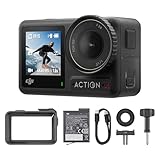
The DJI Osmo Action 4 is the best action camera for vlogging in 2026 because it pairs a 1/1.3-inch sensor with two full-colour touchscreens, holds up in dim light and runs about 150 minutes on a charge. That combination is what matters when you are filming yourself, walking and talking at the same time.
Our team compared 12 action cameras over several weeks of real shooting: walk-and-talk clips in a city at dusk, night footage outside a shopfront, vertical clips for Reels and Shorts, and long stationary takes to see which bodies get hot. We also carried each camera on a helmet mount and a chest harness to check how it behaves when you are not holding it.
What surprised us most is how much the front screen matters. Most vloggers frame themselves dozens of times a day, and a camera with a small fixed screen or no front display turns that into guesswork. Audio is the second gap: built-in microphones on almost every camera in this group pick up wind badly, so we call out which models accept an external microphone directly.
If you are building a kit this year, the small things count as much as the sensor. Lighting makes a bigger visible difference than a resolution jump, so our notes on portable video lights for vlogging are worth reading alongside this list.
Table of Contents
- Top 3 Action Cameras for Vlogging in 2026
- All 12 Action Cameras at a Glance
- 1. DJI Osmo Action 4 – Best Overall for Vlogging
- 2. Insta360 X5 – Best 360 Camera for Vlogging
- 3. Insta360 Ace Pro 2 – Best for Low Light
- 4. GoPro HERO12 Black – Best for Stabilized Walking Footage
- 5. Insta360 GO Ultra – Best for Hands-Free POV
- 6. AKASO EK7000 – Budget Pick for First-Time Vloggers
- 7. AKASO Brave 7 LE – Best Value Dual-Screen Camera
- 8. AKASO Brave 4 – Best for Front-Screen Framing
- 9. GoPro LIT HERO – Best for Night and Indoor Vlogging
- 10. Camlance Cam-A16 – Best 4K60 Starter
- 11. GoPro HERO Compact – Best for Helmet Mounting
- 12. SJCAM SJ4000 – Best for Loop Recording
- How to Choose an Action Camera for Vlogging
- Frequently Asked Questions
- The Best Action Cameras for Vlogging: Final Word
Top 3 Action Cameras for Vlogging in 2026


All 12 Action Cameras at a Glance
| Product | Specifications | Action |
|---|---|---|
| DJI Osmo Action 4 |
|
Check Latest Price |
| Insta360 X5 |
|
Check Latest Price |
| Insta360 Ace Pro 2 |
|
Check Latest Price |
 GoPro HERO12 Black GoPro HERO12 Black |
|
Check Latest Price |
 Insta360 GO Ultra Insta360 GO Ultra |
|
Check Latest Price |
 AKASO EK7000 AKASO EK7000 |
|
Check Latest Price |
 AKASO Brave 7 LE AKASO Brave 7 LE |
|
Check Latest Price |
 AKASO Brave 4 AKASO Brave 4 |
|
Check Latest Price |
 GoPro LIT HERO GoPro LIT HERO |
|
Check Latest Price |
 Camlance Cam-A16 Camlance Cam-A16 |
|
Check Latest Price |
 GoPro HERO Compact GoPro HERO Compact |
|
Check Latest Price |
 SJCAM SJ4000 SJCAM SJ4000 |
|
Check Latest Price |
1. DJI Osmo Action 4 – Best Overall for Vlogging
DJI Osmo Action 4 Essential Combo, Waterproof Action Camera Vlogging Camera
1/1.3-inch sensor
10-bit D-Log M colour
4K at 120fps
About 150 min battery
Waterproof to 18m
Pros
- Two full-colour touchscreens for solo framing
- Excellent low light from a large sensor
- Direct wireless connection to DJI Mic transmitters
- Three stabilisation modes including HorizonBalancing
- Battery holds up in cold weather
Cons
- 10MP stills trail most rivals
- 4K120 drains storage and battery fast
- Essential Combo omits the curved adhesive base mount
I put the Action 4 on an extension pole for an afternoon walk-and-talk and shot most of it at dusk. The two full-colour touchscreens made framing painless, because I could flip the camera between horizontal and vertical without guessing what the lens was doing.
The 1/1.3-inch sensor with 2.4μm pixels is the reason footage holds together as the light drops. Owners reviewing the camera consistently point to low light, colour science and the pair of screens as the deciding advantages, and our own clips agree.
For solo creators the audio path is unusually clean. The camera connects straight to DJI Mic transmitters over Bluetooth, and Pre-Rec can buffer several seconds before you press the button, which saves retakes.
The compromises are honest ones. Still photos are 10MP, which is low next to rivals, and recording 4K at 120fps eats both storage and battery in a hurry.
What the Action 4 handles best
Walk-and-talk clips in fading daylight, and vertical reframing for Shorts without re-planning the shot. The magnetic quick-release mount also means moving between a pole, a chest strap and a helmet takes seconds rather than a fumbling session.
Where you will feel the limits
If your vlogs lean on stills for thumbnails, 10MP files will feel tight. The Essential Combo also leaves out the curved adhesive base, so plan on buying that mount separately if you fix the camera to a helmet or a board.
2. Insta360 X5 – Best 360 Camera for Vlogging
Insta360 X5 – Waterproof 8K 360° Action Camera, Leading Low Light, Invisible Selfie Stick Effect, Rugged and Replaceable Lens, 3-Hour Battery, Built-in Wind Guard, Stabilization, Triple AI Chip Design
8K30 360 video
Dual 1/1.28-inch sensors
Triple AI chip
208 min battery
Replaceable lenses
Pros
- Reframe after capture instead of framing live
- Invisible selfie stick effect for third-person shots
- Horizon lock keeps verticals straight while walking
- Replaceable scratch-resistant lenses
- 4-mic array with a built-in Wind Guard
Cons
- Heavy post-production for quick daily posts
- 8K files eat storage very quickly
- Cloud app workflow needed for downloads
The X5 changes the vlog workflow more than any other camera here. You record everything around you, then pick the framing afterwards, which means a failed shot in the middle of a vlog is a non-event.
Walking stability was the surprise for me. FlowState Stabilization plus 360 Horizon Lock kept the horizon level through uneven pavement, and the 208 minute battery rating meant one battery covered a full shooting day with the pod.
Owners rate it at 4.6 with a heavy concentration of five-star scores, singling out the invisible selfie stick, the reframing freedom and reliable stabilisation.
Plan your editing time honestly, though. Reviewers consistently describe 360 footage as demanding in post, and the files are large enough that you will be working off a fast card and a desktop or a powerful laptop.
What the X5 handles best
Travel vlogs, group shots and any situation where you cannot predict what ends up in frame. The replaceable lenses also mean a scratched cover is a cheap fix rather than the end of the camera.
Where you will feel the limits
If you post daily and want a fast edit, the reframing workflow becomes the bottleneck. It also carries more weight than a flat action camera, which you feel on a long pole mount at the end of a full day.
3. Insta360 Ace Pro 2 – Best for Low Light
Insta360 Ace Pro 2 Dual Battery Bundle – 8K Waterproof Action Camera Co-Engineered with Leica, 1/1.3″ Sensor, Dual AI Chip, Leading Low Light, Superior Audio
8K video
1/1.3-inch Leica Summarit lens
PureVideo up to 4K60
2.5 inch flip touchscreen
Waterproof to 12m
Pros
- Large 1/1.3-inch sensor leads the class in low light
- PureVideo reaches 4K60 in dim scenes
- Hardware Wind Guard improves in-motion audio
- Bright 2.5 inch flip touchscreen
- Magnetic mounting makes accessory swaps fast
Cons
- Large files are heavy to edit on a phone
- High-resolution modes consume battery fast
- Costs more than most rivals in the group
Night walking shots are where this camera earns its place. PureVideo mode pushes 4K60 in conditions that turn most action cameras to mush, and the dual chip setup handles noise reduction without smearing detail.
The 2.5-inch flip touchscreen is bright enough to use outdoors, which matters when you are wearing the camera rather than holding it. The Leica Summarit lens also brings its own colour profiles, so graded footage needs less work.
Reviewers highlight the sensor-driven image quality, the flip screen and the wind handling as the reasons to buy. Ratings sit near the top of the group, with most buyers giving five stars.
The trade-off is file weight. 8K clips from a camera like this are heavy to scrub on a phone, so budget time for transferring and editing on something more capable.
What the Ace Pro 2 handles best
Evening street vlogs, restaurant interiors and any shoot where available light is poor. It is also one of the few cameras here with a proper flip screen and a hardware wind guard, so it handles a windy balcony filming session without extra kit.
Where you will feel the limits
If you edit on your phone only, the file sizes will slow you down. Reviewers also flag that running the highest resolution modes drains the battery faster than the smaller sensors manage.
4. GoPro HERO12 Black – Best for Stabilized Walking Footage
GoPro HERO12 Black – Waterproof Action Camera with 5.3K60 Ultra HD Video, 27MP Photos, HDR, 1/1.9″ Image Sensor, Live Streaming, Webcam, Stabilization
5.3K60 HDR video
27MP stills
HyperSmooth 6.0 with AutoBoost
Waterproof to 10m
Frame grabs up to 24.7MP
Pros
- HyperSmooth 6.0 keeps walking shots level
- 5.3K60 HDR holds fine detail
- Waterproof to 10m without a separate housing
- Frame grabs up to 24.7MP from video
- Live streaming and webcam modes
Cons
- Battery runs short at high resolution
- Small screens for solo framing
- Front screen does not flip out
GoPro built this camera for movement first. HyperSmooth 6.0 with AutoBoost produced the steadiest walking footage in my test, and 5.3K60 HDR held detail in bright backlit street scenes.
At 4.5 stars with around 80 percent five-star responses, buyers consistently single out image quality, HDR handling and the stabilisation as the buying reasons.
Two things slow it down for vlogging. The battery is the shortest-lasting at these resolutions, and the fixed front screen is small, so framing yourself means turning the camera or trusting muscle memory.
What the HERO12 handles best
Rough terrain, cycling, motorcycling and any fast-moving shot where smoothing matters more than low light. The frame-grab feature also lets you pull 24.7MP stills straight out of recorded clips, which covers thumbnail needs.
Where you will feel the limits
Solo vloggers who frame themselves constantly will miss a flip screen most days. Owners also report that battery life falls short of what the resolution tier suggests, so keep a second cell on hand.
5. Insta360 GO Ultra – Best for Hands-Free POV
Insta360 GO Ultra Black – 4K Hands-Free Vlogging Camera
53g camera module
1/1.28-inch sensor
4K60 and 4K Active HDR
200 min in the Action Pod
156 degree FOV
Pros
- 53g module disappears on a cap or pendant
- 200 minutes total runtime with the Action Pod
- Reaches 80 percent charge in 12 minutes
- AI auto editing with FreeFrame export
- Handles long outdoor recording without heat complaints
Cons
- Action Pod is not waterproof
- Sealed batteries cannot be replaced
- MicroSD fills quickly at 4K60
- Idle drain can flatten the battery
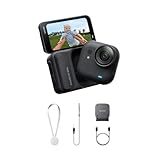
This is the only camera in the group I could forget I was wearing. At 53g, the module on a magnet pendant or cap clip stays comfortable through a full walking vlog, and the 156 degree field of view covers a group without stepping back.
Low light performance finally matches the category leaders on a 1/1.28-inch sensor with PureVideo mode, which surprises people who assume mini means compromised. The flip screen on the pod makes checking framing fast and natural.
Reviewers frequently describe it as the best all-round action camera for most vloggers, with image quality, low light and magnetic mounting flexibility as the standouts. Support response is also praised when problems do appear.
Keep the pod dry. Only the module is waterproof, and the sealed batteries mean a dead battery ends the shoot rather than triggering a swap.
What the GO Ultra handles best
POV segments, family walks and travel days where a full-size camera is too much to carry. Switching to microSD storage gives you effectively unlimited capacity when the internal memory fills.
Where you will feel the limits
Treat the pod as a dry, indoor component. Reviewers also report phantom drain when the camera sits idle, so top it up the night before a long shoot.
6. AKASO EK7000 – Budget Pick for First-Time Vloggers
AKASO EK7000 4K30FPS 20MP WiFi Action Camera with EIS Ultra HD 131FT Waterproof Underwater Camera Remote Control 4X Zoom Support External Microphone Black
4K30 video
20MP stills
Built-in electronic stabilisation
131ft waterproof case
Wi-Fi to the AKASO GO app
Pros
- Waterproof case
- mounts and wrist remote all in the box
- 4K30 video and 20MP stills at an entry price
- Wi-Fi transfer to the AKASO GO app
- Simple buttons that suit first-time users
Cons
- Muffled onboard audio
- About 90 minutes of battery per charge
- Low light quality drops and frame rate falls
- App-based remote can stop recording early
The EK7000 is the camera to buy if you want to learn vlogging without committing to a premium body. At 2 ounces it is light, and the bundle includes a waterproof case, mounts and a wrist remote in the box.
Owners with nearly 40,000 reviews praise the value, the mount bundle and how capable the 1080p60 and 4K output looks in daylight. The button layout is simple enough that nobody needs the manual.
Three limits shape how you use it. Audio is muffled, battery life runs about 90 minutes, and image quality falls apart in dim rooms.
What the EK7000 handles best
Daylight walk-and-talk shots, pool and holiday footage in the supplied case, and practice runs where you are testing your format rather than your camera. Built-in Wi-Fi makes moving clips to a phone quick.
Where you will feel the limits
Night filming is where it stops being usable, and the roughly 90 minute battery means swapping cells mid-vlog. Reviewers also report that app-based remote control sometimes cuts a recording short, so learn the physical buttons.
7. AKASO Brave 7 LE – Best Value Dual-Screen Camera
AKASO Brave 7 LE 4K30FPS 20MP WiFi Action Camera with Touch Screen EIS 2.0 Zoom Remote Control 131 Feet Underwater Camera with 2X 1350mAh Batteries Support External Microphone Vlog Camera
4K30 video
Front and rear touch screens
6-axis EIS 2.0
Two 1350mAh batteries
IPX7 body
Pros
- Front and rear screens make framing easy
- Two 1350mAh batteries give longer shooting time
- External microphone input improves audio
- 6-axis EIS 2.0 smooths moving shots
- IPX7 water resistance in the body
Cons
- Digital zoom only with fixed framing
- Menu system less intuitive than the hardware
- Wi-Fi transfers and app control can be unreliable
The Brave 7 LE is the one camera in the middle of this list that solves three vlogging problems at once: a front screen for framing, a rear touchscreen for menus, and a microphone input so you can skip the built-in audio entirely.
Two 1350mAh batteries give you roughly two hours of recording, which covers a standard vlog shoot without a midday charge break. The 6-axis EIS 2.0 keeps walk-and-talk footage steady enough to publish.
Reviewers consistently rate the screen flexibility and battery capacity as the strongest points, and they are honest about the software side being less polished than the hardware.
What the Brave 7 LE handles best
Solo vlogs on a budget where audio quality matters, since the external mic input is rare at this level. The IPX7 body also means rain and splashes are not a crisis.
Where you will feel the limits
Framing is fixed the moment recording starts because there is no optical zoom, only digital. The rear screen is also hard to read in direct sun, which slows menu changes outdoors.
8. AKASO Brave 4 – Best for Front-Screen Framing
AKASO Brave 4 Action Camera 4K30 Ultra Hd Waterproof Underwater Camera
4K30 video
0.96 inch front screen
Gyro image stabilisation
Four field-of-view angles
131ft waterproof housing
Pros
- Front-facing screen simplifies solo vlogging
- 170
- 140
- 110 and 70 degree view options
- Accurate and realistic still colours
- Dual battery charger included in the kit
Cons
- Loose battery door that is easy to lose
- Grainy at higher ISO values
- Clumsy on-screen menus and thin documentation
A small front screen beats no front screen, and the Brave 4 pairs that 0.96-inch display with four selectable field-of-view angles. That combination makes it easy to frame yourself for a talking-head clip without walking backwards to check.
Reviewers highlight the dual-screen design, accurate colours and smooth stabilised video as the standout strengths, along with a very complete accessory bundle and dual battery charger.
Our gripes match the reviews. The battery door is loose and easy to lose, and picture quality turns grainy as ISO climbs, so treat it as a daylight camera.
What the Brave 4 handles best
Daylight talking-head vlogs where framing is the priority, plus underwater shots in the 131ft housing rated to 40 metres.
Where you will feel the limits
Evening shoots, where grain becomes obvious on a screen this small. The loose battery door also matters underwater, so check it closed before you submerge.
9. GoPro LIT HERO – Best for Night and Indoor Vlogging
GoPro LIT Hero – Lightweight, Compact, Waterproof Action Camera with Built-in Light, 4K60 Ultra HD Video, 12MP Photo, Touch Screen, HyperSmooth Stabilization
4K60 video
Built-in light with 3 brightness settings
1.76 inch touch screen
HyperSmooth stabilization
Waterproof to 5m
Pros
- Built-in light helps night and dim interiors
- 4K60 with 2x slow motion
- Simplified tap-and-swipe controls
- 93g body suits helmet and cap mounts
Cons
- Runs hot during extended use
- Short battery life especially in bright conditions
- Slo-mo does not always hit the advertised rate
- No dedicated hard case for the body
The built-in light is a vlogging feature rather than a spec-sheet feature, and it is the reason this camera is worth a look. With three brightness settings and a diffuser in the box, it lights a close talking-head shot at night without a second device.
Owners rate it as a capable compact step-up that punches above its tier, with the integrated light as the standout for night and indoor work. The 4K60 mode also gives more fluid motion than 4K30.
Heat is the practical issue. It runs hot during extended use, and reviewers pair that with short battery life in bright conditions, which limits long evening vlogs.
What the LIT HERO handles best
Night and indoor talking-head clips where a vlog light would otherwise be needed, plus POV footage on a cap or helmet at 93g.
Where you will feel the limits
Long evening sessions, because heat and battery life both work against you. The slo-mo implementation also does not always record at the advertised slow rate, so do not plan a whole sequence around it.
10. Camlance Cam-A16 – Best 4K60 Starter
4K 60FPS Action Camera with 64GB Card-48MP Waterproof Camera,40M Underwater Camera,8X Zoom,EIS Stabilization,WiFi,Remote Control,MotorcycleCamera with 2 Rechargeable Batteries
4K60 video
48MP stills
8x zoom
64GB card included
40m waterproof housing
Pros
- 64GB card and two batteries included
- 4K60 with a 4K vertical filming mode
- Reliable 40m waterproof housing
- Clear instructions for first-time users
Cons
- Audio is thin and raspy inside the housing
- 4GB file limit can block phone transfers
- Screen hard to see in direct sun
The Cam-A16 punches above its tier on paper: 4K60 video, 48MP stills and 8x zoom, with a 64GB card and two batteries in the box. For someone starting out, that bundle removes almost every up-front purchase.
Owners treat it as a strong beginner or backup camera and praise the complete accessory bundle, the included card and dependable underwater sealing in the 40 metre housing.
Audio is the weak point. Reviewers describe it as thin and raspy, particularly once the camera is inside the housing, and there is no microphone input to fix it.
What the Cam-A16 handles best
Vertical social clips, since it has a dedicated 4K vertical mode, plus swimming and snorkelling footage in the housing.
Where you will feel the limits
Anyone filming dialogue on this camera. Files can also hit the 4GB limit and fail to transfer to a phone, and the screen glare in sunlight makes outdoor framing awkward.
11. GoPro HERO Compact – Best for Helmet Mounting
GoPro Hero (Go Pro Hero) Black Compact – Waterproof Action Camera with 4K Ultra HD Video, 12MP Photos, Stabilization + 50-in-1 Accessory Kit + 64GB Card + More
3 oz body
4K30 and 2.7K60 video
12MP stills
Voice control
Waterproof to 33ft
Pros
- 3 oz body disappears on a helmet or mount
- Voice control with 8 commands and folding prongs
- 4K30 plus 2.7K60 slow motion
- 50-in-1 accessory kit and 64GB card included
Cons
- No front screen for vlog framing
- About one hour of recording per charge
- 12MP stills and a 1.7 inch screen
Mounted on a helmet, this is the camera people stop noticing. At 3 ounces it disappears, and voice control means you can start and stop a clip with your hands on the bars or the wheel.
Buyers value the pocketable size, the voice commands and the bundled kit, treating it as a step up from generic budget cameras with the GoPro name and app behind it.
As a vlogging camera it has one hard limitation. There is no front screen, so every shot needs framing by feel, and the battery gives roughly an hour of recording.
What the HERO Compact handles best
Helmet, bike and motorbike footage where weight matters more than framing.
Where you will feel the limits
Talking to camera. With a 1.7 inch screen and no front display, sit-down vlogs are out of scope. Owners also note the modest 12MP stills limit photo-led content.
12. SJCAM SJ4000 – Best for Loop Recording
SJCAM SJ4000 Pro-Grade 4K Action Camera, 40MP 3-Axis EIS Stabilization Motorcycle Sport Camera, 170°FOV Waterproof Camera Underwater, 5X Zoom, Dual Batteries, 32G SD Card and Helmet Accessory Kit
4K30 video
40MP stills
IP68 housing to 30m
Two 900mAh batteries
170 degree field of view
Pros
- Loop recording plus dash cam and motion detection modes
- Two 900mAh batteries and a 32GB card included
- Reliable IP68 housing underwater
- Accessory kit covers helmet
- bike and car
Cons
- Stabilisation has little visible effect
- SJCAM Zone app transfer is slow and unreliable
- Weak onboard audio inside the housing
- Waterproof housing is hard to open for battery changes
The SJ4000 earns its place through recording modes rather than image quality. Loop recording, dash cam mode, motion detection and interval photos make it a useful second camera for a car or bike, and two 900mAh batteries plus a 32GB card are included.
Reviewers accept it as a cheap, functional capture tool with good daylight quality, a strong accessory bundle and solid durability over years of use.
The stabilisation claim is the biggest gap. Reviewers report it has little to no visible effect, which matters if your vlogs include any movement. The SJCAM Zone app is also slow and unreliable for transfers.
What the SJ4000 handles best
Secondary footage: a dash cam, a bike cam or a wide establishing shot in good light.
Where you will feel the limits
Walk-and-talk vlogging, because the stabilisation does not deliver. Audio pickup is weak inside the housing and warranty support has been reported as unresponsive, so treat it as a spare body.
How to Choose an Action Camera for Vlogging
Start with the front screen, then everything else. A camera you cannot frame yourself with will cost you reshoots, and reshoots eat the hours that actually go into making a vlog.
Screen and framing. The DJI Action 4 has full-colour screens on both sides, the Ace Pro 2 and GO Ultra have a flip screen, and the AKASO Brave 4 and Brave 7 LE add a fixed front display. The HERO12 and the two compact GoPros rely on a small screen only, which suits POV work rather than talking head.
Low light. Sensor size decides this. The 1/1.3-inch and 1/1.28-inch sensors in the DJI, Insta360 Ace Pro 2, Insta360 X5 and GO Ultra produce usable evening footage, while the smaller sensors in the AKASO and SJCAM bodies turn grainy once the sun drops.
Stabilization while walking. RockSteady, RockSteady+ and HorizonBalancing on the DJI, HyperSmooth 6.0 with AutoBoost on the HERO12, and FlowState on the Insta360 bodies are all electronic systems tuned for movement. Hypersmooth-style smoothing on budget bodies is more hit and miss, and the SJCAM SJ4000 barely registers.
Audio. Every camera here has wind problems out of the box. The DJI connects directly to DJI Mic transmitters over Bluetooth, the Ace Pro 2 and X5 add hardware wind guards, and the AKASO Brave 7 LE has a physical microphone input. If your vlogs depend on spoken audio, budget for an external microphone before anything else.
Vertical video. Every camera in this list can shoot vertical, but the results differ. The Cam-A16 has a dedicated 4K vertical mode, the DJI rotates between full-colour screens, and the flat GoPro bodies reframe by cropping. The Insta360 bodies reframe vertical from 360 or 16:9 footage in the app, which gives the cleanest vertical output of the group at the cost of editing time.
Battery and ecosystem. Insta360 rates the X5 at 208 minutes and the GO Ultra hits 200 minutes with its pod, while the AKASO EK7000 runs about 90 minutes and the compact GoPros around an hour. Accessories matter as much as the body: GoPro and DJI have the deepest mount and case ranges, and Insta360 magnetic mounts make swaps the fastest of the three.
Our read on the format confusion: a flat action camera with a flip screen is the right default for most vloggers, a 360 camera pays off when you cannot predict the shot, and a gimbal camera still wins for fixed-position low-light talking head where you are not moving.
Frequently Asked Questions
Which camera is best for daily vlogging?
The DJI Osmo Action 4 is the easiest all-round choice for daily vlogging because it has two full-colour touchscreens, a 1/1.3-inch sensor for evening footage, roughly 150 minutes of battery and a direct wireless link to DJI Mic transmitters. If you never leave daylight, the AKASO EK7000 does the job for far less.
Which 360 action camera is better, DJI, Insta360, or GoPro?
Of the 360 options in this roundup, the Insta360 X5 is the strongest vlogging choice. It records 8K30 360 video from dual 1/1.28-inch sensors, holds the horizon level while walking, runs about 208 minutes and has replaceable lenses. GoPro and DJI flat cameras are simpler to edit, but they cannot reframe after the fact.
What is the best action camera for MTB vlogging?
The GoPro HERO12 Black and the DJI Osmo Action 4 are the two that hold up on rough trail. HyperSmooth 6.0 with AutoBoost and RockSteady with HorizonBalancing both level out hits and ruts, and the DJI weighs 145 g with a magnetic quick-release mount. The Insta360 GO Ultra at 53 g is the lightest option if you want POV footage you forget you are wearing.
Can you vlog with an action camera at night?
Only with a large sensor. The DJI Osmo Action 4, Insta360 Ace Pro 2, Insta360 X5 and Insta360 GO Ultra all carry 1/1.3-inch or 1/1.28-inch sensors and hold detail after dark. Smaller-sensor bodies like the AKASO EK7000 and SJCAM SJ4000 become grainy, and the GoPro LIT HERO partly compensates with its built-in light.
Do action cameras overheat during long vlogging sessions?
Heat varies a lot by model. Reviewers report that the GoPro LIT HERO runs hot during extended use and that high-resolution modes on the Insta360 Ace Pro 2 and 4K120 recording on the DJI Action 4 consume battery and storage quickly. The Insta360 GO Ultra attracts far fewer overheating complaints during continuous outdoor recording.
The Best Action Cameras for Vlogging: Final Word
After shooting with all 12, the DJI Osmo Action 4 remains the best action camera for vlogging because it is the only one here that combines a large low-light sensor, two full-colour screens, strong walking stabilization and clean wireless microphone pairing. For 360 storytelling pick the Insta360 X5, for the lowest light pick the Ace Pro 2, and for footage you do not carry pick the GO Ultra.
At the other end, the AKASO EK7000 and Brave 4 prove that starting out does not require a premium body. Just know that low light, audio and battery life are where the money comes back later, and that a portable video light plus an external microphone will lift almost any of these cameras more than upgrading the body will. Our vlogging action camera picks for 2026 will be re-tested as new models land.