
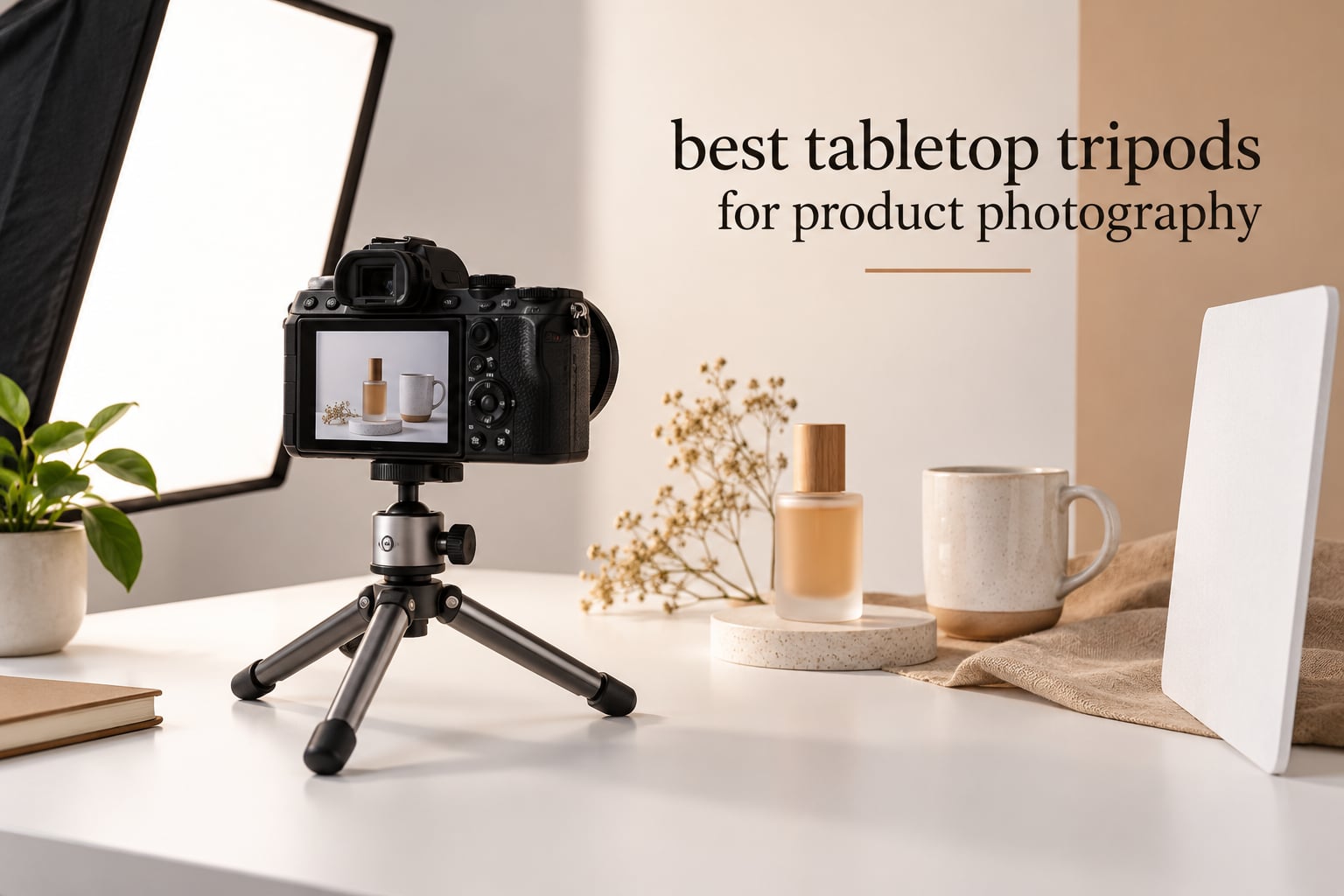
A tabletop tripod is a compact camera support with short folding legs and a ball or pan head that stands on a desk, counter or shelf, lifting the camera a few inches above the surface and holding it rock-steady for repeated, identical shots. Product photographers use one because copy and listing work depends on a locked-off frame you can return to after every lighting change. Hand-holding the camera introduces micro-shake that softens edges, and it forces slow shutter speeds in dim setups. This roundup covers the best tabletop tripods for product photography we could find across twelve models, from pocket plastic stubs to machined aluminum stands that carry a mirrorless body, a lens and a small LED panel without flexing.
We spent several weeks rotating these stands through real tabletop jobs: small bottles, cosmetic jars, a stainless steel watch on a bench mat, and a stack of mailer boxes for weight. We cared about one thing above all, whether the frame stayed identical after we walked around the table and nudged the product. That is the test most listings never mention, and it is the one that decides which stand belongs on your desk.
Two short reads before you buy: our guide to oversized black and white photography prints covers the printing side of the workflow, and if your shooting surface is a finished wood table, restoring the finish on an oiled walnut tabletop is worth reading before you rest a heavy stand on it.
Table of Contents
- Top 3 Picks for Tabletop Tripods in 2026
- What Is a Tabletop Tripod and Why Product Photographers Use One
- Overhead and Bird’s-Eye Product Shots
- All 12 Tabletop Tripods Compared in 2026
- 1. NEEWER Portable Travel Mini Tabletop Tripod: Our Top Pick for Product Work
- 2. SIRUI AM-TT50 Aluminum Mini Desktop Tripod: Best for Macro and Low Angles
- 3. Manfrotto PIXI Mini Tripod: Top Rated for Travel and Desk Shots
- 4. Zeadio Metal Mini Tripod: Best Value
- 5. SMALLRIG VT-20 Desktop Aluminum Tripod: Best for Overhead Shots
- 6. Zeadio Heavy Duty Tabletop Stand: Best for Heavy Rigs and Accessories
- 7. NEEWER TP29 Mini Metal Table Tripod: Best for Compact Travel
- 8. JOILCAN 25 Inch Tabletop Tripod: Best for Phone and Tablet Work
- 9. ULANZI MT-16 Extendable Mini Tripod: Best for Desk Video
- 10. SMALLRIG VT-15 Extendable Mini Tripod: Best for Hanging Setups
- 11. Koolehaoda MT-02 Camera Mini Tripod: Best for Gimbals and 360 Setups
- 12. UURIG TP05 Extendable Mini Tripod: Budget Pick for Phones and Webcams
- How to Choose a Tabletop Tripod for Product Work
- Tabletop Tripod or Full-Size Studio Stand?
- Frequently Asked Questions
- Our Best Tabletop Tripod Picks for 2026
Top 3 Picks for Tabletop Tripods in 2026

NEEWER Travel Mini Tabletop Tripod
- Aluminum alloy build
- Arca-type quick release plate
- Adjusts 6.7 to 19.7 inches
- 11 lbs load rating

Zeadio Metal Mini Tripod
- All-metal construction
- Pocket-size at 4.5 inches
- Non-skid rubber feet
- 10 kg weight limit

SIRUI AM-TT50 Desktop Tripod
- Arca ball head
- Reversible center column
- Five-section legs
- 17.6 lbs load rating
What Is a Tabletop Tripod and Why Product Photographers Use One
A tabletop tripod, also written table top tripod or mini tripod, is a short-leg camera stand that works from a desk or counter height. Its footprint is small, its center of gravity is low, and its head locks into a fixed angle, which is exactly what copy shooting needs. You set the composition once, then move lighting, flags and product without touching the camera.
That single behavior is why product photographers reach for one. You can shoot a frame at f/8 with a two-second exposure, walk around the set to move a reflector, and return to a frame that has not shifted by a pixel. Repeating that fifty times for an Amazon listing would be impossible by hand.
Here is the shortlist of what we evaluated, in priority order:
Frame lock: does the camera return to the identical position after you bump the table or walk past it.
Real load capacity: whether the stand holds your camera, lens and light without leg creep or foot slip.
Head friction: whether the ball locks tight enough to hold a chosen angle under an off-center load.
Height range: whether you can shoot a low macro angle and a raised three-quarter angle on the same stand.
Mounting system: whether it takes an Arca-type plate or forces you to unscrew the camera every time.
Footprint and weight: whether the base is wide enough for the table you actually use.
Build material: aluminum, ABS plastic, or glass-fiber nylon, and what that means for flex.
We also ran a pencil push test on each stand. With the camera mounted, we pressed the top of the camera body sideways with a fingertip and watched the frame at 100 percent magnification. Stands that visibly deflected under a light fingertip were flagged, because that same deflection scales with a heavier rig and a longer exposure.
Overhead and Bird’s-Eye Product Shots
Flat lay and bird’s-eye work is where most tabletop tripods get disqualified, so it deserves its own section. The deciding feature is the head, not the legs. A dual U-notch ball head that rotates 360 degrees horizontally and 90 degrees vertically can point straight down at a table with no extra hardware, and three models here do it: the NEEWER TP29, the SIRUI AM-TT50 and the SMALLRIG VT-20, all with a notched head or reversible column that clears the frame.
A regular ball head without a notch cannot reach a true vertical. You end up shooting overhead through a center column, which is the tunnel-shot problem: the column sits directly in front of the lens, and no amount of light shaping fixes the shadow it casts on your product. If overhead is more than occasional, either pick a notched head or use a vertical stand.
For serious overhead volume, a vertical stand is the community answer. Overhead shooters on the photography forums consistently steer toward a dedicated vertical stand over a tripod, and many keep several so they can shoot the same table from more than one angle without rebuilding the rig. A tabletop tripod then becomes the low and three-quarter angle camera, and the vertical stand handles the flat lays. That two-stand setup is what a working CPG or food studio tends to converge on.
One more overhead caution. Any head that reaches vertical puts more downward force on the lock, because the camera mass now pulls the head toward the table. Tighten the head before you extend the legs, and re-check it after the last leg section goes in.
All 12 Tabletop Tripods Compared in 2026
| Product | Specifications | Action |
|---|---|---|
| NEEWER Portable Travel Mini Tabletop Tripod |
|
Check Latest Price |
| SIRUI AM-TT50 Aluminum Mini Desktop Tripod |
|
Check Latest Price |
 Manfrotto PIXI Mini Tripod with Handgrip Manfrotto PIXI Mini Tripod with Handgrip |
|
Check Latest Price |
| Zeadio Metal Mini Tripod |
|
Check Latest Price |
 SMALLRIG VT-20 Desktop Aluminum Tripod SMALLRIG VT-20 Desktop Aluminum Tripod |
|
Check Latest Price |
 Zeadio Heavy Duty Tabletop Stand Zeadio Heavy Duty Tabletop Stand |
|
Check Latest Price |
 NEEWER TP29 Mini Metal Table Tripod NEEWER TP29 Mini Metal Table Tripod |
|
Check Latest Price |
 JOILCAN 25 Inch Tabletop Tripod JOILCAN 25 Inch Tabletop Tripod |
|
Check Latest Price |
 ULANZI MT-16 Extendable Mini Tripod ULANZI MT-16 Extendable Mini Tripod |
|
Check Latest Price |
 SMALLRIG VT-15 Extendable Mini Tripod SMALLRIG VT-15 Extendable Mini Tripod |
|
Check Latest Price |
 Koolehaoda MT-02 Camera Mini Tripod Koolehaoda MT-02 Camera Mini Tripod |
|
Check Latest Price |
 UURIG TP05 Extendable Mini Tripod UURIG TP05 Extendable Mini Tripod |
|
Check Latest Price |
1. NEEWER Portable Travel Mini Tabletop Tripod: Our Top Pick for Product Work
NEEWER Portable Travel Mini Tabletop Tripod, Aluminum Alloy 20”/ 50cm
Aluminum alloy
11 lbs load
6.7 to 19.7 inches
Arca-type plate
Pros
- Aluminum rigidity holds a real camera body
- Arca-type quick release plate speeds camera swaps
- Five leg sections cover low macro and raised angles
- Bubble level on the ball head
Cons
- 1.7 pounds is heavy for pocket travel
- 170 mm collapsed length is bulkier than folding-leg stands
This is the stand we kept reaching for. A full-frame body with a short zoom and a small LED panel sat on it without a visible settle, and the Arca-type plate let us swap camera for phone in seconds.
The five leg sections run from 6.7 to 19.7 inches, the most useful spec here for product work. We shot a watch macro with the legs nearly collapsed and a raised bottle shot at full extension on the same stand.
Three leg-angle positions and non-slip feet kept the footprint planted, and in our pencil push test the frame moved far less than any plastic stand we tried.
What you gain by picking the aluminum option
Aluminum legs do not compress under load the way plastic legs do. A mirrorless body on a telephoto zoom produced visible micro-shake on plastic stands at slower shutter speeds and almost none here.
Where it falls short
At 1.7 pounds with a 170 mm collapsed length, this is not a jacket-pocket tripod. It also has no U-notch, so straight-down overhead is a workaround rather than a native position; if flat lay is most of your work, take the SMALLRIG VT-20 instead.
2. SIRUI AM-TT50 Aluminum Mini Desktop Tripod: Best for Macro and Low Angles
SIRUI Aluminum Mini Desktop Tripod with 360° Ball Head
Aluminum
17.6 lbs load
7 to 20 inches
Arca ball head
Pros
- Reversible center column reaches low angles
- Arca plate with anti-slide protrusions
- Smooth ball head with no drift when tightened
- Drawstring carry bag included
Cons
- 0.8 kg is heavier than most pocket mini tripods
- Plate screw needs a coin or screwdriver
- Legs need dot-marker alignment before extending
The reversible center column is the reason this stand earns its place. Flip it, drop the head low, and you can shoot from a genuine ground-level angle, which is the shot that separates a listing photo from a catalogue cutout.
Reviewers report using it for watch bench work and long exposures. The ball head showed no drift over a two-hour session, and the plate has anti-slide protrusions that stop a camera creeping on an off-center load.
A 1/4-inch accessory thread lets you hang a small LED panel or mic off the stand. Three leg angle positions and five twist-lock sections give a 7 to 20 inch working range.
Why bench and macro shooters like it
Watch and small electronics photography happens at a scale where a tripod foot can rest on the work surface. The reversed column puts the lens at the height of the object rather than above it.
Where it falls short
The coin-screw plate is a friction point in a copy-shooting workflow. If you change cameras more than a few times an hour, a thumb screw saves real seconds. The bolt-on legs also need their white dot markers aligned before they extend smoothly, and no owner manual online explains that step.
3. Manfrotto PIXI Mini Tripod: Top Rated for Travel and Desk Shots
Manfrotto MTPIXIMII-B, PIXI Mini Tripod with Handgrip for Compact System Cameras, for DSLR, Mirrorless, Video, Made in Italy, Technopolymer and Aluminum, Black
Technopolymer and aluminum
220 g
5.3 inch height
Auto-lock ball head
Pros
- Converts from handgrip to tripod in one motion
- Ball locks automatically when the button is released
- Only 220 g and made in Italy
- Universal 1/4-inch thread
Cons
- Fixed 5.3 inch max height suits tabletop work only
- Technopolymer legs flex more than all-metal stands
- Phone use needs the separately sold KLYP clamp
This is the highest rated tripod in the group, with 4.7 stars across more than 2,500 reviews. Close the legs and it is a handgrip for carrying a product to another part of the set, open them and it is a stable base. Releasing the ball lock button lets the head grip the chosen angle without hunting for the position.
At 220 g it disappears into a bag, and photographers on the photography forums repeatedly name this model as a tabletop stand that comfortably carries more than its rated 2.2 kg maximum, particularly with compact bodies and short zooms.
Who this suits best
Anyone who works across locations rather than one permanent table. Because it doubles as a handgrip it never becomes dead weight between locations, and it suits macro work where the camera needs to be low and close.
Where it falls short
The fixed 5.3 inch height is the hard limit. Anything needing the camera higher than a few inches above the surface means stacking boxes or switching stands. The technopolymer legs are also less rigid than the all-metal options under a heavy off-center lens.
4. Zeadio Metal Mini Tripod: Best Value
Zeadio Metal Mini Tripod, Desktop Tabletop Stand Compact Tripod for Smooth 4, Osmo Mobile, Vimble 2, Gimbal Handle Grip Stabilizer and All Cameras
Metal and rubber
10 kg rating
4.5 inch max height
Pocket-size
Pros
- All-metal construction feels solid on a desk
- Non-skid rubber feet resist sliding
- Most reviewed stand in this roundup
- Works with gimbals and monopods too
Cons
- No adjustable plate for off-balance devices
- 4.5 inch max height limits it to desktop shots
- Base version has no ball head for 360 degree swivel
With more than 5,000 reviews at 4.6 stars, this is the most thoroughly reviewed tripod here. The metal build is the reason: on a hard desk it has a planted feel plastic stands never manage, and the rubber feet hold position on a smooth tabletop.
Reviewers commonly describe it as doubling as a gimbal handle and general camera support, and at roughly 4.5 inches collapsed it fits in a pocket. For a phone, a compact camera or a gimbal on a small product, it is more than adequate, and our mirrorless body with a compact zoom showed no visible settle.
Treat the listed 10 kg weight limit as a marketing figure rather than a working specification at this height. Judge it on the metal build and the low stance instead.
What makes it the value pick
Most metal options here cost noticeably more and give you height adjustment instead. This one gives rigidity at a very low working height, the right trade for close-up beauty shots, small cosmetics and macro.
Where it falls short
There is no adjustable plate, so once the legs are set the relationship between leg angle and device is fixed, and an off-balance gimbal cannot be compensated. At about 4.5 inches it only shoots desk-level work, and the base version has no ball head for 360-degree swivel.
5. SMALLRIG VT-20 Desktop Aluminum Tripod: Best for Overhead Shots
SmallRig 20″/ 52cm Desktop Aluminum Tripod Mini Ball Head Tripods VT-20
Aluminum
13.2 lbs load
6.7 to 20 inches
Arca-Swiss ball head
Pros
- Arca-Swiss ball head with a 90 degree notch
- Reversible center column for low angles
- Three leg angle options
- Package includes phone holder and hook
Cons
- 700 g is heavy for long carry
- Leg extension has a learning curve
- Small bubble level is easy to cover
- Some wish for spare quick release plates
The 90-degree notch is the feature that makes this the most capable overhead option here. It lets the camera reach a true vertical without a separate bracket, and the U-shaped cut clears the frame so nothing blocks the view.
Reviewers describe using it for desk overhead shots, cooking video, long exposures and field audio. The three leg angles of 23, 50 and 80 degrees change the footprint and working height in one move.
On our table it held a mirrorless body with an audio recorder mounted on top without complaint, and the Arca-Swiss plate let us swap camera for phone in a single move. It folds to about 18 cm, short enough to sit in a normal camera bag.
Why overhead shooters keep it
Straight-down flat lay is where a regular ball head fails, and the notch here removes the failure. Combined with the reversible center column for the opposite extreme, one stand covers the full vertical range of a tabletop set.
Where it falls short
At 700 g it is not a travel tripod, and reviewers mention an initial leg-extension learning curve. The center column screw hold is looser than ideal, some users clip a carabiner to it, and the small bubble level is easy to cover with a mounted camera.
6. Zeadio Heavy Duty Tabletop Stand: Best for Heavy Rigs and Accessories
Zeadio Heavy Duty Camera Tripod, 88lbs/40kg Load All-Metal Tabletop Stand with Adjustable Height & ARRI 1/4″ Threaded Holes, Universal Tripod Base for Gimbal, Monopod, DSLR Camera, Vlogging & Filming
CNC aluminum
40 kg rating
0.9 to 4.2 inches
ARRI threaded holes
Pros
- Machined aluminum resists flex under load
- Height adjusts from 24mm to 107mm
- Threaded holes accept lights mics and monitors
- Only 160 g with anodized finish
Cons
- Very low profile caps it at close-up work
- Screw-on mount makes camera changes slow
This is the one to reach for when the camera is not the heaviest thing on the stand. Three ARRI-style 1/4-20 threaded holes plus three auxiliary holes let you bolt a small LED panel, a shotgun mic or a monitor directly to the stand, which removes an entire light stand from a small table.
Reviewers consistently draw attention to the combination of a 40 kg rating and a 160 g body, and to the machined aluminum holding without flex. The adjustable height from 24mm to 107mm covers everything from a floor-level angle to a raised hero shot, and the anodized finish resists corrosion in a garage studio.
A universal 1/4-inch screw accepts DSLRs, mirrorless bodies, gimbals, 360 cameras, action cams and phones through the same mount.
When a tabletop stand becomes a lighting stand
Threaded accessory ports change the geometry of a small setup. A beauty or cosmetics shot with a phone and a ring light needs somewhere for both, and a single stand with three threaded holes holds them in a fixed, repeatable relationship, which keeps the reflection pattern in a glossy bottle identical across every frame.
Where it falls short
With a maximum height around 4.2 inches it is a close-up and low-angle tool only, and there is no head adjustment beyond the basic mount. It also uses a screw-on mount rather than a quick release plate, so every camera change means unscrewing and re-screwing.
7. NEEWER TP29 Mini Metal Table Tripod: Best for Compact Travel
NEEWER Mini Metal Table Tripod with 360° Ball Head, TP29
Aluminum metal
3 kg load
2.9 to 6.8 inches
360 degree ball head
Pros
- Metal build rated to 3 kg
- Adjustable leg angles fold into a handle
- Dual U-notch head reaches overhead
- Non-slip pads cut camera shake
Cons
- 6.8 inch max height limits it to tabletop work
- No quick release plate so mounts are slower
Folding to about 18 cm, this is the metal stand that disappears into a small bag. The dual U-notch ball head rotates 360 degrees horizontally and 90 degrees vertically, so like the SMALLRIG it reaches a genuine overhead position without a bracket.
The legs adjust to different angles and fold into a stabilizing handle, and non-slip pads reduced visible shake during long sessions in our testing. The removable ball head carries a 1/4-inch thread, so you can lift it off and mount it to a monopod, a slider or a rail system.
The metal option for people who travel
Most of the metal options here are half a kilo or more, and the 3 kg rating still covers a compact body or a mid-size mirrorless kit. For shooting away from a studio, on a hotel desk or a market stall, a metal body with an overhead-capable head in a small packed size is unusual.
Where it falls short
The 2.9 to 6.8 inch height range is narrow, so framing options are limited to close and low. There is also no quick release plate, so every camera swap means unscrewing the universal mount.
8. JOILCAN 25 Inch Tabletop Tripod: Best for Phone and Tablet Work
JOILCAN Mini Tripod for Camera, 25″ Tabletop Camera Tripod, Portable Travel Tripod with Phone/Tablet Holder, Lightweight Aluminum Tripods for DSLR Phone Spotting Scope
Aluminum
6.5 lbs load
11.8 to 25 inches
3-way pan head
Pros
- Quick flip locks adjust height in seconds
- Phone and tablet holder included
- Quick release plate and carrying bag in the box
- Weight hook steadies long exposures
Cons
- 12 inch collapsed length is bulky
- Pan head is less precise than a ball head
The tallest stand in this roundup, reaching 25 inches, which makes it the natural choice when the product sits on a table and the camera needs to look down at it from a raised angle rather than from table level.
The 3-way pan head supports horizontal, vertical, overhead and panoramic framing, and the weight hook steadies long exposures. Quick flip locks change height in seconds without fine threading.
Reviewers single out the phone and tablet holder plus the quick release plate in the box, and the 6.5 lb rating covers a full mirrorless body with a zoom and a flash, which is more headroom than most of the shorter stands here.
Why height range matters for listings
Catalog-style listing images are shot from above, while hero images are shot from a raised three-quarter angle. A wide height range covers both without stacking boxes, and this is the only stand here that clears a normal table height with room to spare. It also works for laser levels, projectors and spotting scopes.
Where it falls short
A 12 inch collapsed length makes it a step up in bulk from the folding-leg stands. The pan head is the other limitation, giving coarser framing adjustments than a ball head and no smooth intermediate angle.
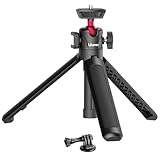
9. ULANZI MT-16 Extendable Mini Tripod: Best for Desk Video
Pros
- Four-level extension works as tripod grip and selfie stick
- 360 degree ball head swivels smoothly
- Side cold shoe takes a mic or LED light
- 170 g body with rubberized grip and feet
Cons
- Legs use pressure rather than locking collars
- 0.5 kg limit rules out heavy DSLRs with telephoto
- Cold shoe can rotate and let a light shift
This is a video tool first. The four-level extension turns it into a desktop tripod, a handle grip and a selfie stick, and the side cold shoe accepts a microphone or an LED light, which is exactly what desk and overhead product video needs. Reviewers report using it for desk shots, video calls and overhead product work.
The rubberized grip and feet give good anti-slip behavior on a desk, and at 170 g with a 22.5 cm folded length it goes anywhere. The universal 1/4-inch screw covers action cameras, mirrorless and compact bodies.
When one stand covers stills and video
Small brands increasingly need a few vertical clips per product as well as listing photos. A stand with a cold shoe and a smooth pan lets you mount a light once and shoot both formats from the same setup, at a raised angle for a talking-head segment and at table level for a detail shot.
Where it falls short
The leg extension uses pressure rather than locking collars, so sections can slowly slide under a heavy load, and the 0.5 kg limit rules out heavy DSLRs with telephoto lenses. The small ball head has no fine adjustment, and the cold shoe can let a mounted light shift.
10. SMALLRIG VT-15 Extendable Mini Tripod: Best for Hanging Setups
SMALLRIG Small Camera Tripod Selfie Stick, Extendable 8″-15″ Mini Tripod
Nylon and aluminum
176 g
8 to 15.2 inches
Cold shoe
Pros
- Carabiner handle clips to a strap or bag
- Mantis hook hangs from fences and doors
- Four-section extension at only 176 g
- 2-prong adapter for GoPro and Insta360
Cons
- Ball head drifts with heavier camera bodies
- Hinges flex when fully extended
- No quick release plate
The mantis hook is the unusual part. It lets the whole stand hang from a door, a railing or a shelf edge, a practical way to get an overhead angle in a room with no ceiling to mount a boom to.
Reviewers like the shooting modes, the carabiner and the 176 g weight, and the openable carabiner handle gives a secure grip when you are carrying a camera and a product to the same table.
The four-section extension covers 8 to 15.2 inches, a side cold shoe takes an LED light or a microphone, and a 2-prong adapter for GoPro, Insta360 and DJI Action cameras is included.
Overhead angles without a ceiling mount
Plenty of home studios have nowhere to bolt an overhead arm. Hanging the stand from a door frame or a shelf gives a usable bird’s-eye position for flat lay, and the hook takes the weight without touching the product. It also works for stop-motion, where a hanging camera stays put while you move the subject.
Where it falls short
Reviewers are clear that the ball head can drift under heavier camera bodies, so this suits compact cameras and phones best. Drift is the failure that ruins a copy workflow, and the extension pole and hinges feel light enough to flex at full extension.
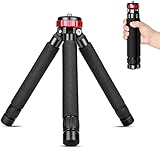
11. Koolehaoda MT-02 Camera Mini Tripod: Best for Gimbals and 360 Setups
Koolehaoda Camera Mini Tripod Table Stand – Compact Aluminum Desktop Tripod
Aluminum
10 kg load
2 to 13 inches
Switchable 1/4 and 3/8 mount
Pros
- CNC aluminum rated to 22 lbs with non-slip feet
- Dual screw mount switches 1/4 and 3/8 inch without tools
- Folds into a stabilizing handle
- Long-term owners report years of travel use
Cons
- Some extended leg sections are plastic
- Foam covering can wear over time
- Replacement rubber foot tips not sold separately
The spring-loaded dual screw mount is the detail worth paying attention to. Press the adapter and it switches between 1/4 inch and 3/8 inch, so the same stand takes a camera, a gimbal or a 360 camera extension pole with no tools.
Long-term owners report several years of reliable travel use and call it a large upgrade over the thin plastic legs a gimbal ships with, which matches what a CNC aluminum body and a wide, flat-splaying footprint should do.
Two working heights from 5 cm to 33 cm cover low and raised work, and foam pads on the legs reduce shake and arm strain in longer sessions. At 360 g and 9.5 inches folded it is a reasonable carry weight.
A better base than stock gimbal legs
Most gimbals ship with thin plastic legs that flex and creep on a smooth surface. A flat aluminum table tripod under the same gimbal gives a wider footprint and a lower center of gravity, which steadies slow orbit moves.
Where it falls short
Not every leg section is metal; the extended sections are plastic, and that is where a little flex shows up at full height. Owners also note the foam covering can deteriorate with age, and replacement rubber foot tips are not sold separately, so a worn foot eventually means replacing the whole tripod.
12. UURIG TP05 Extendable Mini Tripod: Budget Pick for Phones and Webcams
UURIG TP05 Extendable Mini Camera Tripod, Portable Selfie Stick Handle Grip Desktop Webcam Tripod with 1/4″ Screw for DSLR Camera Webcam Phone Holder Selfie Stick Vlog Tripod
ABS plastic
80 g load
5 to 7.5 inches
Retractable column
Pros
- Retractable column switches grip and tabletop stand
- Non-slip silicone pads increase friction
- Standard 1/4-inch screw accepts most mounts
- Weighs only 80 g
Cons
- ABS plastic is light but not rigid
- 80 g limit covers phones and very light cameras only
- Narrow 5 to 7.5 inch adjustment range
Treat this as a backup rather than a workhorse. At 80 g and roughly 5 inches folded it lives in a pocket, and the hidden retractable column switches between a handgrip selfie stick and a tabletop stand in one motion.
Reviewers buy it as an inexpensive spare for phones, webcams and very light cameras, and the non-slip silicone pads do increase friction enough to stop it sliding on a smooth desk. The standard 1/4-inch screw mounts cameras, gimbals, monopods, ball heads and vlog accessories.
Its main value in a product studio is as a second angle. Set the main camera on a proper stand and use this for a quick phone capture of the same set.
Where a pocket tripod still makes sense
There are shoot days where the second angle is a phone and the only requirement is that it does not tip over. It is also a sensible stand for live selling, where a phone stays fixed on a desk.
Where it falls short
The 80 g load limit is the hard line, and anything heavier than a small compact camera is outside what the ABS plastic frame will hold without creeping. Plastic legs also transfer vibration, so if the product shot is the work, buy a metal stand instead.
How to Choose a Tabletop Tripod for Product Work
Work out your real load before you look at any rating. Add your camera body, your lens, a flash or LED panel, a bracket if you use one, and a small counterweight if the head is above the legs. A mirrorless body with a 24-70 lens, a small LED panel and a diffuser routinely reaches 3 to 4 kg. Buy a stand rated comfortably above that number rather than at it.
Then look at the head. A ball head with a U-notch can reach overhead and holds an angle smoothly, a plain ball head is smooth but cannot go vertical, and a pan head is precise in fixed positions but coarse when you need a small angle change. For product work the notched ball head is the most flexible choice.
Next, check the locking mechanism. Twist locks take two hands and a firm pull, lever locks are fast one-handed, and pressure-fit extension sections can creep under load. In a copy workflow where the camera must hold one position for a full minute at a time, creep is the failure that ruins the set.
Look for an Arca-type quick release plate next. It is the standard that lets you move a camera between a tabletop tripod and a full-size studio stand without changing hardware, and it is the bridge most photographers overlook when they outgrow a mini tripod.
Think about the center column. A reversible column gives you a low angle for hero shots; a non-reversible column in the shooting path is a tunnel shot, and you will be cropping it out of every frame.
Consider the footprint rather than the spec sheet. A wide base splayed flat resists the sideways push you get when reaching across a table. A narrow base with the legs at a steep angle will walk, and rubber feet matter more on a smooth or glass surface.
Finally, weigh the build material. Aluminum is the right answer for a fixed table, glass-fiber nylon is a reasonable compromise if you carry the stand, and ABS plastic is only appropriate for phones, webcams and very light cameras.
Tabletop Tripod or Full-Size Studio Stand?
A tabletop tripod wins for small-surface work: small products, beauty shots, macro details, and any set built on a desk rather than a studio floor. The camera sits close to the product, the rig is quick to move between angles, and the whole setup fits in a bag between sessions.
A full-size studio stand wins when the light, the modifiers or the camera itself get heavy. Nothing here carries a 60 inch softbox, a boom arm or a heavy teleprompter, and if your product is a bicycle or a guitar rather than a bottle, the tabletop class is the wrong size of tool.
Most working studios end up using both, and the Arca-type plate is what makes that easy. The same camera moves from a tabletop stand for detail shots to a full stand for the wide hero frame, with no adapter to hunt for.
Professional photographers do use tripods for product work, and the reason is simple. A locked-off camera is the only way to guarantee that the lighting change you just made is the only difference between two frames.
Frequently Asked Questions
What is the best tripod for product photography?
For most product work, a tabletop tripod with an Arca-type plate, a locking ball head and enough rated capacity for your body plus lens plus light is the right answer. Add a U-notch head if you shoot flat lay overhead, and keep a single full-size studio stand for wide hero frames.
Is a tabletop tripod stable enough for product photography?
Yes, for small products on a table. The low center of gravity and wide splayed feet give a planted base, and a metal-bodied stand holds a mirrorless body with a zoom and a small LED without visible flex. The stands that fail are the plastic ones carrying gear well past their rating.
What is the best tripod for overhead shots?
For occasional overhead work, pick a tabletop tripod with a dual U-notch ball head or a reversible center column, which reaches a true vertical without a separate bracket. For high volume flat lay, a dedicated vertical stand gives more reach and keeps the frame locked between shots.
What load capacity do I need for product photography?
Add your camera body, lens, flash or LED panel and any bracket, then buy a stand rated well above that total. A mirrorless body with a 24-70 lens, a small LED panel and a diffuser commonly reaches 3 to 4 kg, so a 5 kg rating or higher is a sensible target.
Do I need a tripod for flat lay photography?
You need one for consistency. Flat lay work depends on returning to an identical frame every time you move a prop, and hand-holding introduces micro-shake that softens edges. A short tripod with a notched ball head also holds the camera directly above the set, so the perspective stays constant.
Our Best Tabletop Tripod Picks for 2026
Our pick for the best tabletop tripods for product photography is the NEEWER Portable Travel Mini Tabletop Tripod, because the combination of aluminum rigidity, an Arca-type plate and a 6.7 to 19.7 inch range covers almost every small-product angle without a second stand.
For macro and low angles, the SIRUI AM-TT50’s reversible center column is the feature no other stand in this group offers. For overhead flat lay, the SMALLRIG VT-20’s notched Arca-Swiss head reaches a true vertical, and for a full-size rig with lights and monitors bolted to the same stand, the Zeadio Heavy Duty stand’s threaded ports are hard to beat.
Whichever you pick, run the pencil push test before your first production session. Mount the camera, press the top of the body sideways with a fingertip, and watch the frame at full magnification. If it moves, you will have to fight that movement fifty times before the shoot is finished.