
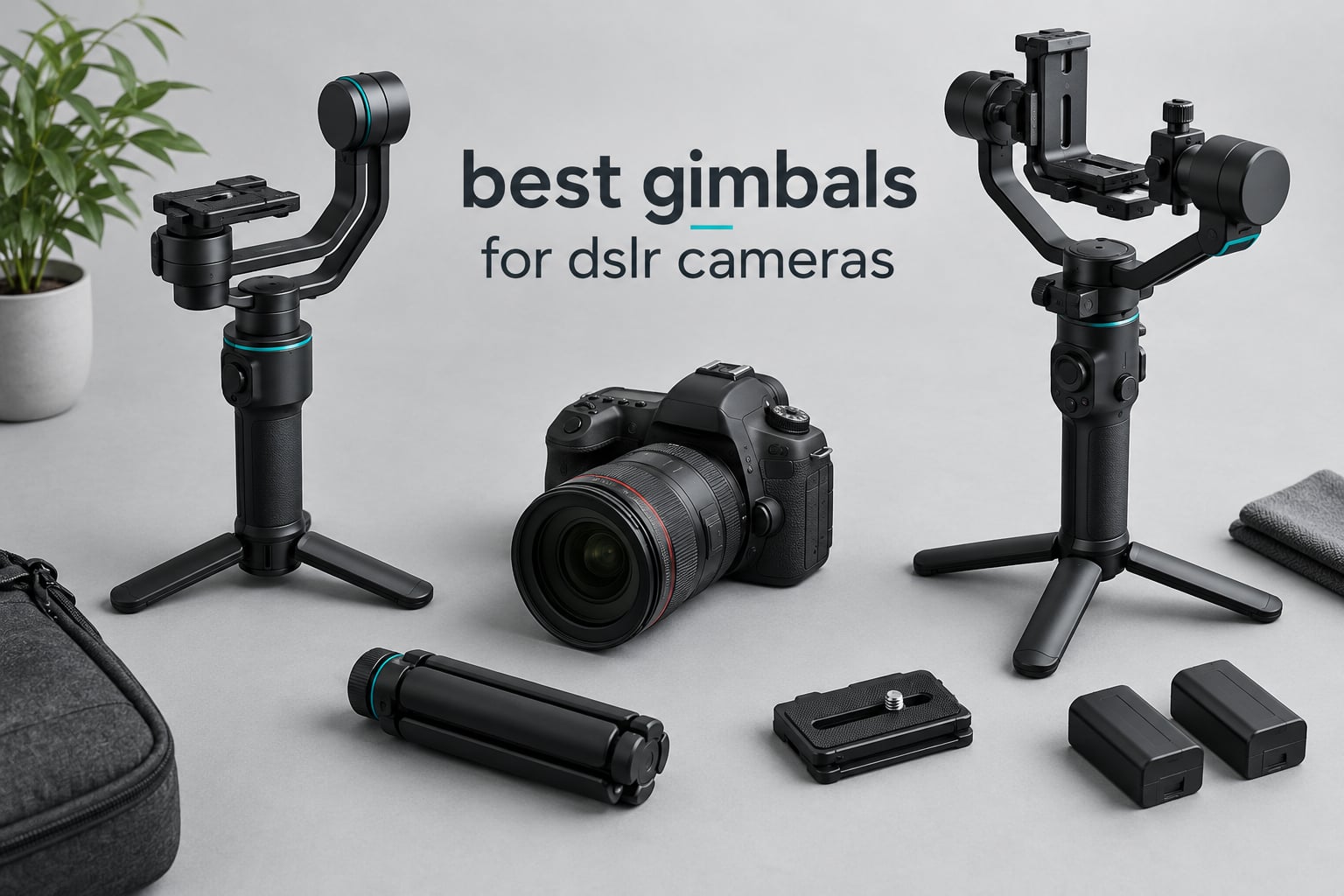
A DSLR does not smooth out your footsteps while you shoot video. Mirrorless bodies have gained in-body stabilization over the years, but a full-frame DSLR with a fast zoom still shakes visibly every time you pan or walk. A three-axis gimbal fixes that with brushless motors that read the camera’s motion thousands of times per second and cancel it out, and picking the best gimbals for DSLR cameras is really a question of payload headroom, battery strategy and how quickly you can rebalance when the lens changes.
We spent weeks putting twelve gimbals through the same routine: mount a DSLR body, add a zoom, check the balance, run the motors at a walking pace, then switch to vertical. The list below covers everything from a sub-kilogram travel gimbal rated for 2.5 kg up to a professional rig built for long cinema lenses, and every product here has enough owner feedback behind it to judge honestly rather than guess.
Two things separate a good DSLR gimbal from a disappointing one. The first is payload headroom, because the rating assumes an evenly balanced rig and a heavy telephoto shifts the centre of gravity forward. The second is battery strategy, because a gimbal with a cell built into the handle means your shoot day ends when that cell ends, no matter how many spares you own.
If you are still choosing the rest of your kit, our guides to dedicated astronomy cameras for beginners and video doorbell cameras for front doors cover other corners of the camera market.
Table of Contents
- Top 3 DSLR Gimbals in 2026
- All 12 DSLR Gimbals Compared in 2026
- 1. DJI RS 4 Pro – 4.5 kg of Payload with LiDAR Focus
- 2. DJI RS 3 Combo – 3 kg Tested Payload with Automated Axis Locks
- 3. DJI RSC 2 Pro Combo – Folding Travel Gimbal with Transmitter Bundle
- 4. DJI RS 2 Combo – Carbon Fiber Arms and 10 lb of Tested Payload
- 5. DJI RS 3 Pro – 4.5 kg Payload with O3 Pro Transmission
- 6. Zhiyun Weebill S – The Lightest Body Here with 14-Hour Battery
- 7. FeiyuTech SCORP-C – Built-In Handle and Stand at 2.5 kg
- 8. Zhiyun Weebill 3E – 3 kg at 990 g with Native Vertical Shooting
- 9. Zhiyun Crane 4 – Extended Arms with Balance Indicator Lights
- 10. FeiyuTech SCORP 2 – Built-In AI Tracking at 2.5 kg
- 11. Zhiyun Weebill 3S – 3 kg with a 1000-Lux Fill Light
- 12. Zhiyun Crane 4E – Wave Wheel Controls and Servo Focus Ports
- How to Choose a Gimbal for Your DSLR Rig in 2026
- Frequently Asked Questions
- Which DSLR Gimbal Should You Buy?
Top 3 DSLR Gimbals in 2026

DJI RS 4 Pro
- 4.5 kg payload
- 20% more motor torque
- LiDAR focus with 76800 points to 20m
- Second-gen native vertical shooting

DJI RS 3 Combo
- 3 kg tested payload
- Automated axis locks
- 1.8-inch OLED touchscreen
- Third-gen RS stabilization algorithm

DJI RS 2 Combo
- 10 lb tested payload
- Monocoque carbon fiber axis arms
- Dual-layer Manfrotto and Arca-Swiss plate
- Combo includes focus motor and transmitter
The RS 4 Pro is the most capable DSLR gimbal we tested and the one we would hand to a full-time operator. The RS 3 Combo is the sensible middle ground, with the largest review base in this group. The RS 2 Combo holds the highest average rating of the twelve and remains an outstanding buy for anyone who values a low weight-to-payload ratio.
All 12 DSLR Gimbals Compared in 2026
| Product | Specifications | Action |
|---|---|---|
| DJI RS 4 Pro |
|
Check Latest Price |
| DJI RS 3 Combo |
|
Check Latest Price |
 DJI RSC 2 Pro Combo DJI RSC 2 Pro Combo |
|
Check Latest Price |
| DJI RS 2 Combo |
|
Check Latest Price |
 DJI RS 3 Pro DJI RS 3 Pro |
|
Check Latest Price |
 Zhiyun Weebill S Zhiyun Weebill S |
|
Check Latest Price |
 FeiyuTech SCORP-C FeiyuTech SCORP-C |
|
Check Latest Price |
 Zhiyun Weebill 3E Zhiyun Weebill 3E |
|
Check Latest Price |
 Zhiyun Crane 4 Zhiyun Crane 4 |
|
Check Latest Price |
 FeiyuTech SCORP 2 FeiyuTech SCORP 2 |
|
Check Latest Price |
 Zhiyun Weebill 3S Zhiyun Weebill 3S |
|
Check Latest Price |
 Zhiyun Crane 4E Zhiyun Crane 4E |
|
Check Latest Price |
Two numbers decide most of these purchases. Payload sets the ceiling on what you can mount, and unit weight tells you how long you can hold it before your arms give up. Everything else on this list is refinement.
1. DJI RS 4 Pro – 4.5 kg of Payload with LiDAR Focus
DJI RS 4 Pro, Gimbal Stabilizer for DSLR & Cinema Cameras
Payload: 4.5 kg
Weight: 1.84 kg
LiDAR focus: 76800 points to 20m
Battery: 29 hr with BG70 grip
Pros
- 4.5 kg payload with 20% more motor torque
- Second-generation native vertical shooting
- LiDAR focusing with 76800 ranging points
- Automated axis lock and unlock
- Carbon fiber axis arms
Cons
- Bulky to hold over a long shooting day
- Steep learning curve for balancing and the feature set
- A few reports of tilt-axis faults on units received new
We balanced a full-frame body with a 24-70mm zoom on this one and never felt the motors working hard. That headroom is the reason it ranks first here: you can add a follow focus motor, a monitor or a top handle and still sit comfortably inside the rating.
The second-generation native vertical shooting is the feature we used most. You release the plate from the horizontal position, secure it to the vertical arm and keep shooting without a fresh balance. That alone saves several minutes on a social-content day.
LiDAR focusing puts 76,800 ranging points inside a 20 metre range to a paired focus motor. On a walking interview the focus pulls stayed smooth and repeatable rather than hunting, which is the usual failure mode with cheaper motors.
The runtime figure of 29 hours comes with the DJI RS BG70 high-capacity battery grip, which is sold separately. Without that grip the picture is more ordinary, and you should factor the extra cost into the decision if you shoot long days.
Who should buy the RS 4 Pro
Anyone who carries a heavy rig, changes lenses often or works solo on documentary and event coverage will get the most out of this gimbal. The RSA communication port and SDK support also open the door to vehicle, jib and slider integration later.
If you mostly shoot mirrorless with a small lens and you travel light, the weight and bulk are working against you. Several owners report that the included briefcase handle feels less robust than third-party alternatives.
Who should look elsewhere
First-time gimbal buyers on a tight budget will find the feature set overwhelming, and the learning curve is real. If your rig stays under 2 kg and rarely changes, a lighter model handles the same work with far less fatigue.
2. DJI RS 3 Combo – 3 kg Tested Payload with Automated Axis Locks
DJI RS 3 Combo, 3-Axis Gimbal Stabilizer for DSLR and Mirrorless Camera for Canon/Sony/Panasonic/Nikon/Fujifilm, 3 kg (6.6 lbs) Payload, Automated Axis Locks, 1.8″ OLED Touchscreen, Camera Gimbal
Payload: 3 kg
Weight: 1.94 kg
Screen: 1.8-inch OLED
Battery grip: BG21
Pros
- 3 kg tested payload in a 1.94 kg body
- Automated axis locks on all three axes
- Third-generation RS algorithm with 20% better anti-shake
- 1.8-inch OLED touchscreen
- Bluetooth shutter control
Cons
- 3 kg ceiling is tight for full-frame bodies with telephoto lenses
- Bundled accessories add weight
- Balancing still needs care on unusual rigs
With more than 1,900 owner reviews on record, the RS 3 Combo has the widest evidence base in this roundup, and the feedback is consistent. Smooth stabilization and quick axis locks are the two things nearly everyone mentions first.
Automated axis locks are triggered from the power button, which sounds minor until you pack down between locations. Instead of folding each arm by hand you lock the axes and the gimbal goes into the case in a single motion.
The 1.8-inch OLED touchscreen puts most Ronin app settings one tap away, which cuts the phone out of the loop on quick setups. Bluetooth shutter control starts and stops recording without a cable hanging off the camera.
The 3 kg rating is the compromise that matters most. A large DSLR body plus a telephoto zoom plus a follow focus motor can approach that ceiling, and once you are close the motors start to work harder and the stabilization tightens up.
Who should buy the RS 3 Combo
This is the gimbal we would put in the hands of a working wedding videographer who changes lenses a few times a day and shoots long hours. The BG21 grip, briefcase handle and carrying case in the bundle cover most of what a first pro rig needs.
Run-and-gun shooters benefit from the axis locks because packing and unpacking happen fast. If you already own a strong pro body and routinely exceed 3 kg, step up a class instead.
Who should look elsewhere
Some users find the bundled accessories unnecessary for their workflow and simply leave them in the box, which is sensible if you prefer your own handles. Balance calibration on heavy or unusually shaped rigs still needs deliberate attention.
3. DJI RSC 2 Pro Combo – Folding Travel Gimbal with Transmitter Bundle
DJI RSC 2 Pro Combo – 3-Axis Gimbal Stabilizer for DSLR and Mirrorless Camera, Nikon Sony Panasonic Canon Fujifilm, Ronin SC, 3kg Payload, Image Transmission, Focus Motor – Black
Payload: 3 kg
Folded: 260 x 210 x 75 mm
Screen: 1-inch OLED
Battery: 14 hr
Pros
- Folds smaller than a sheet of A5 paper
- Titan algorithm with SuperSmooth mode
- 14-hour battery runtime
- Bundle includes image transmitter and focus motor
- Built-in 1-inch OLED screen
Cons
- 3 kg payload is below what large DSLR builds demand
- Battery built into the handle
- Older Ronin-era hardware and app
Folding down to 260 by 210 by 75 mm, this is the smallest gimbal in the group by a clear margin. It fits into a normal camera bag, which changes how often you are willing to bring a stabilizer along at all.
The Titan stabilization algorithm with SuperSmooth mode is tuned for micromovement rather than large swings. Owners shooting with 100mm zoom lenses report noticeably calmer results than they get from entry-level three-axis kits.
The combo package is unusually complete. You get an image transmitter, a focus motor, a focus rod mount kit, a focus gear strip, a camera riser and multi-camera control cables in one box, which is where most of the value sits.
The dual-layer Manfrotto and Arca plate supports one-tap portrait switching, and the 1-inch OLED lets you adjust settings without reaching for a phone. Battery runtime is listed at 14 hours, enough for a long day without a spare handle.
Who should buy the RSC 2 Pro Combo
Travel shooters, documentary crews working from small bags and anyone who needs a second stabilizer for a second operator will appreciate the folded footprint more than any spec sheet number. The bundled transmitter also removes a separate purchase.
A fast-focus lens on a mid-size body sits comfortably inside the rating. DSLR owners using sub-70mm zooms can work with this gimbal all day.
Who should look elsewhere
Large DSLR bodies with heavy accessories will push past 3 kg, and the battery sits inside the handle rather than being user-replaceable, which complicates back-to-back multi-day work. The hardware and app are also a generation behind the current RS range.
4. DJI RS 2 Combo – Carbon Fiber Arms and 10 lb of Tested Payload
DJI RS 2 Combo – 3-Axis Gimbal Stabilizer for DSLR and Mirrorless Cameras, Nikon, Sony, Panasonic, Canon, Fuji, 10lbs Tested Payload, 1.4” Full-Color Touchscreen, Carbon Fiber Construction, Black
Payload: 4.5 kg
Unit weight: 2.3 lb
Monocoque carbon fiber arms
Plate: Manfrotto and Arca
Pros
- 10 lb tested payload at 2.3 lb unit weight
- Highest average rating in this group
- Monocoque carbon fiber axis arms
- Dual-layer Manfrotto and Arca-Swiss plate with fine-tune knob
- Combo bundles focus motor and image transmitter
Cons
- Serious learning curve before it feels natural
- Battery integrated into the grip
- Rubber grip can flex under very heavy payloads
The RS 2 Combo carries the highest average rating of the twelve gimbals we reviewed, at 4.6 across 577 reviews. The carbon fiber monocoque arms are the reason: they deliver 4.5 kg of tested payload from a 2.3 lb body.
Owners repeatedly mention that it will not work without investment. Balancing takes practice, the control layout rewards memorisation, and the payoff is a stabilizer that stays rock-solid once you know it.
The 1.4-inch full-colour touchscreen gives access to ActiveTrack 3.0, and the dual-layer plate with a fine-tune balancing knob makes fine adjustment after a lens change fast. Professional mounting options exist for car, jib and slider integration with remote control.
A Canon 1DX-style body with a 24-70mm is well within limits and does not strain the motors. The combo adds a BG30 grip, briefcase handle, focus motor, image transmitter, phone holder and multi-camera control cables.
Who should buy the RS 2 Combo
Operators who carry a heavy pro DSLR plus fast zooms and want minimum weight for the payload will find the ratio hard to beat. It also suits long-term owners who already use DJI accessories and will not need the newest app features.
If you plan to use professional mounting hardware or third-party quick release plates, test the combination early. Some plate setups cause configuration problems for owners.
Who should look elsewhere
The battery lives inside the grip, so multi-day projects mean carrying extra handles. Holding the rig upright for long stretches is tiring, and the rubber grip on the battery chassis can flex under very heavy payloads.
5. DJI RS 3 Pro – 4.5 kg Payload with O3 Pro Transmission
DJI RS 3 Pro, 3-Axis Gimbal for DSLR and Cameras Canon/Sony/Panasonic/Nikon/Fujifilm/BMPCC, Automated Axis Locks, 4.5 kg (10lbs) Payload, LiDAR Focus Camera Stabilizer
Payload: 4.5 kg
Weight: 1.74 kg
Transmission: O3 Pro to 6km
Focus: LiDAR
Pros
- 4.5 kg payload from a 1.74 kg body
- Extended carbon fiber arms ease balancing large bodies
- Automated axis locks on all three axes
- O3 Pro transmission with ultra-low latency
- LiDAR focus motor for repeatable pulls
Cons
- Accessory ecosystem adds real cost
- Balancing heavy rigs takes practice
- Bundled briefcase handle adds bulk
The extended carbon fiber axis arms are the quiet advantage here. Extra levelling space means big bodies such as the Sony FX6 or the Canon C70 with a 24-70mm f/2.8 sit closer to level, which means less fine-tune work after every setup.
O3 Pro video transmission reaches up to 6 km with ultra-low latency, so a second operator can monitor from a distance during an event. For a single operator it is a luxury, but for crew work it changes the shot list.
The LiDAR focus motor paired with the focus motor gives repeatable pulls even as the subject moves toward or away from the lens. Automated axis locks handle the packing and unpacking routine in a single press.
A 4.5 kg payload from a 1.74 kg body puts this near the top of the power-to-weight field in the group. The SDK protocol opens ports for vehicle mounts, jibs and Steadicam-style integration.
Who should buy the RS 3 Pro
Crew shooters who need on-set monitoring, operators working with cinema bodies and anyone who wants a full pro kit without moving to a heavier platform will find a good match here. The extended arms reduce balance time with large rigs.
Anyone building toward vehicle or jib mounting will find the documented ports and SDK support valuable. It also works well as a second body for a growing rental package.
Who should look elsewhere
The accessory ecosystem carries a meaningful cost if you want the focus motor and image transmitter to complete the kit. Balancing and calibration still demand practice on heavier professional setups, and the briefcase handle is dead weight for travel shooters.
6. Zhiyun Weebill S – The Lightest Body Here with 14-Hour Battery
Zhiyun Weebill S [Official] 3-Axis Gimbal Stabilizer for Mirrorless and DSLR Cameras
Payload: 2.5 kg
Weight: 926 g
Battery: 14 hr
Mode: sling underslung
Pros
- Lightest body in this group at 926 g
- 14-hour battery covers full shooting days
- Sling mode eases low-angle and underslung work
- Broad DSLR and mirrorless body compatibility
- Trajectory and timelapse modes with phone sync
Cons
- 2.5 kg payload shrinks with heavy telephoto lenses
- Small screen with no printed manual
- App and Bluetooth connection issues on some bodies
At 926 g this is the lightest gimbal in our roundup, and after a full shooting day the difference is obvious. Nothing else we tested stayed as comfortable in the hand for as long.
The compatibility list is genuinely broad, covering Sony a9 and a7R IV, Canon 5D III and IV plus R5 and R6, Nikon D850, Z6 and Z7, Panasonic GH5, S1 and S5, Fujifilm X-T3 and X-T4, and Blackmagic bodies.
Sling mode is the sleeper feature. It rotates the handle so low-angle and underslung shots sit closer to your body, and owners with sling motor clearance report it takes pressure off the wrist during long takes.
The optional TransMount image transmission module sends 1080p at 30fps up to 100 metres with up to three receivers, and a phone gyroscope sync mode is available through the companion app.
Who should buy the Weebill S
Videographers on long days who carry a light rig will get the most from this gimbal. Travel shooters and anyone working without a support rig appreciate the low weight, and the 14-hour runtime removes mid-day charging entirely.
Interview and event shooters who use sling mode for low angles will find the wrist rest genuinely useful. Any owner with a mainstream body under about 2 kg will never feel the payload ceiling.
Who should look elsewhere
The 2.5 kg limit is the tightest here and shrinks further with heavy telephoto lenses. Full camera shutter and focus control needs a separately sold USB cable matched to your brand, the small LCD and button layout are awkward, and some owners report horizon tilt or sleep-mode faults.
7. FeiyuTech SCORP-C – Built-In Handle and Stand at 2.5 kg
FeiyuTech SCORP-C Gimbal Stabilizer for Cameras DSLR and Mirrorless Camera
Payload: 2.5 kg
Weight: 1200 g
Battery: 2500 mAh, 10-13 hr
Arca quick release plate
Pros
- Integrated hanging handle doubles as a grip
- Folding aileron bracket works as a built-in stand
- Five-way centre-of-gravity adjustment with COG memory
- 2500 mAh battery with 18W fast charging
- AB trajectory memory and flash mode
Cons
- 2.5 kg payload limits larger DSLR and cinema builds
- Modest output at the top of its payload range
- App features less polished than the hardware
Most entry-level gimbals make you buy a tripod and a separate handle. The SCORP-C integrates both: the folding aileron bracket doubles as a tabletop stand and the hanging handle gives you lens control in upright or underslung configurations.
Five-way centre-of-gravity adjustment plus a centre-of-gravity memory slider means the second setup of the day takes minutes rather than a fresh balancing session. The three-axis motor locks add a second layer of convenience.
The 2500 mAh battery runs 10 to 13 hours at maximum, and 18W fast charging adds roughly 30 minutes of runtime in five minutes. That top-up speed is genuinely useful between ceremony setups.
AB trajectory memory and flash mode let you replay a complex move exactly as it worked the first time. Compatibility covers mainstream Sony, Canon, Nikon, Panasonic, Fujifilm and Sigma bodies on an Arca quick release plate.
Who should buy the SCORP-C
Newcomers who struggle with balancing will like the motor locks and centre-of-gravity memory, because both reduce the number of ways a setup can go wrong. Shooters working with a body and lens under 2 kg get full performance from it.
Anyone who wants one box instead of a gimbal plus tripod plus grip will find the integrated design pays for itself immediately. Battery runtime covers a standard shoot day without a spare.
Who should look elsewhere
The 2.5 kg rating excludes large DSLR and cinema builds, and output drops off near the top of that range compared with 4.5 kg class gimbals. The app-driven features are less polished than the hardware, so do not buy it for its software.
8. Zhiyun Weebill 3E – 3 kg at 990 g with Native Vertical Shooting
ZHIYUN CINEPEER Weebill 3E, 3-Axis Lightweight Gimbal Stabilizer for DSLR & Mirrorless Camera Canon/Sony/Panasonic/Nikon, 3KG Payload, Native Vertical Shooting, Bluetooth Shutter Control
Payload: 3 kg
Weight: 990 g
Folded: 12 x 8 x 2.8 in
Battery: up to 16 hr
Pros
- 3 kg payload at only 990 g
- A4-paper-sized folded footprint
- Up to 16 hours of battery life
- Native vertical shooting without extra accessories
- Bluetooth shutter control with auto-pairing
Cons
- Canon and Sony control cables sold separately
- Sling grip and wrist rest are optional extras
- No built-in touchscreen
Getting 3 kg of rated payload out of a 990 g body is the standout number here. The wide-axis arm cradles bodies of different sizes, and the listed lens pairings include 24-70mm f/2.8, FE 24-105mm F4G, Z 24-70mm F4S and XF 16-55mm f/2.8.
Native vertical shooting works by mounting the quick release plate to the vertical arm, with no extra accessory or disassembly. For creators cutting vertical clips alongside landscape footage, that removes the most annoying part of orientation changes.
Battery runtime reaches up to 16 hours, and 14W PD fast charging reaches a full charge in about two hours and 46 minutes. Bluetooth shutter control pairs once and then reconnects on its own, which removes a cable from the camera.
The folded package is roughly A4-paper-sized at 12 by 8 by 2.8 inches. The ergonomic handle was shaped to reduce fatigue on long shoots, and that shows in a full day of handheld work.
Who should buy the Weebill 3E
Solo creators shooting both landscape and vertical will get the most from the native vertical mount and the long runtime. It also suits anyone moving between locations on a budget who values a small folded package.
If your rig includes a fast standard zoom on a mid-size body, the payload rating gives you headroom that lighter gimbals cannot. Bluetooth shutter control is convenient for solo operators with no assistant.
Who should look elsewhere
Only the Panasonic control cable is included, so Canon and Sony users need to buy cables separately. Sling Mode 2.5 requires a separately purchased sling grip and wrist rest, and there is no built-in touchscreen for on-unit adjustment.
9. Zhiyun Crane 4 – Extended Arms with Balance Indicator Lights
ZHIYUN Crane 4, 3-Axis Gimbal Stabilizer for DSLR and Mirrorless Camera, Nikon Sony Panasonic Canon Fujifilm BMPCC 6K, Fill Light, PD Fast Charge
Payload: heavy-rig class
Weight: 1500 g
Fill light: 10W, 3200 lux
Battery: 12 hr, PD fast charge
Pros
- Longer arms and stronger motors for full-frame and compact cinema bodies
- Motor balance indicator LEDs cut setup guesswork
- Built-in 10W fill light with CRI 95+ and 2700K-5500K
- Native horizontal and vertical switching
- Full charge in about 1 hour 50 minutes
Cons
- Heavy and tiring without a support rig
- Battery is not user-replaceable
- Right-handed grip is awkward for left-handed operators
The longer arm length and stronger motors are what set this apart for heavy rigs. Owners mount bodies such as the BMPCC 6K Pro in a cage and report smooth results on full-frame DSLRs like the Sony A7 IV.
Motor balance indicator lights are a small idea with a real effect on workflow. Instead of nudging the plate until the motor stops fighting, you watch the LEDs and adjust until they settle.
The built-in 10W fill light delivers up to 3200 lux with CRI 95+ across a 2700K to 5500K range, which is unusual at this level and saves carrying a separate light for interviews. A 1.22-inch colour touchscreen and Bluetooth shutter control round out the controls.
The quick-release module integrates horizontal and vertical lock structures, so orientation switching is native rather than an accessory trick. PD fast charging reaches full in about 1 hour 50 minutes with up to 12 hours of runtime, and a built-in motion timelapse function is included.
Who should buy the Crane 4
Cinematographers running cages, top handles and matte boxes will appreciate the arm length and motor strength. Solo interview shooters gain a genuinely usable on-board fill light, and balance indicators make heavy setups faster to dial in.
If you work in low light or run a camera cage as standard, this is one of the few gimbals in the roundup that handles both needs without extra purchases.
Who should look elsewhere
At 1.5 kg the body tires your arms quickly without a support rig, and the battery is not user-replaceable. The right-handed design is awkward for left-handed operators, vertical-mode calibration can be fiddly, and a small number of units arrive with faulty batteries.
10. FeiyuTech SCORP 2 – Built-In AI Tracking at 2.5 kg
FeiyuTech SCORP 2 Gimbal Stabilizer for DSLR and Mirrorless Camera, Integrated Al Tracking Sensor, 3-Axis Camera Stabilizer for Sony Canon Panasonic Nikon, 2.5kg Payload Touch Screen Vertical Shooting
Payload: 2.5 kg
Weight: 1070 g
Screen: 1.3 inch touchscreen
Tracking: AI module
Pros
- Built-in AI tracking with gesture control
- Instant vertical shooting via L-shaped plate
- 1.3-inch touchscreen with multifunction knob
- Seven camera control cables in the box
- Light 1070 g body
Cons
- 2.5 kg payload restricts larger DSLR and cinema builds
- Bundled tripod is minimal for a moving shoot
- Tracking and app features less refined than dedicated systems
Subject tracking normally means buying a separate module. The SCORP 2 builds an AI tracking module into the body, so gesture-based tracking works out of the box with no extra purchase and no app dependency for the basic gesture commands.
The new-generation L-shaped mounting plates with an anti-off quick release slider make vertical shooting instant. You slide the camera to the vertical position instead of rebuilding the rig, and the anti-off design resists accidental loosening.
A 1.3-inch touchscreen shows filming status and parameters, and the multifunction knob handles per-axis rotation or electronic zoom. Camera control works over cable or Bluetooth, with a light shutter press triggering focus.
The box is unusually complete, with seven camera control cables, a tripod, fixed plate, quick release plate, slider, backing base, lens holder and USB-C cable. The Feiyu app adds somatosensory remote control using the phone’s gravity sensor.
Who should buy the SCORP 2
Solo content creators who want automatic subject tracking without extra accessories will find this the least complicated route. Mixed-brand kits benefit from the seven included control cables, and vertical-first workflows suit the instant L-shaped plate switch.
Anyone who needs a touchscreen at an entry-level price will appreciate the 1.3-inch display. Its 1070 g body also stays comfortable for long handheld sessions.
Who should look elsewhere
The 2.5 kg rating keeps larger DSLR and cinema builds out of range, and the bundled tripod is minimal for a gimbal used on the move. Tracking and app features are less refined than dedicated tracking systems, and there is no fill light or long-range transmission in the base package.
11. Zhiyun Weebill 3S – 3 kg with a 1000-Lux Fill Light
ZHIYUN Weebill 3S [Official] 3KG Payload Gimbal Stabilizer with Fill Light
Payload: 3 kg
Weight: 1100 g
Fill light: 1000 lux, 2600K-5500K
Battery: dual 2600 mAh, 11.5 hr
Pros
- 3 kg payload at a 1100 g body
- Built-in 1000-lux fill light with adjustable colour temperature
- Native orientation switching in about 3 seconds
- Dual 2600 mAh batteries give 11.5 hours
- 10th-generation honeycomb stabilization algorithm
Cons
- 0.96-inch screen limits on-unit control
- 3 kg ceiling is modest for large full-frame builds
- Balancing takes a deliberate setup for each rig
The 1000-lux fill light with adjustable colour temperature from 2600K to 5500K is equivalent to a 6W pocket light, and having it built into the gimbal means one less cable and one less accessory in the bag on indoor shoots.
The 10th-generation honeycomb stabilization algorithm re-tunes follow and smoothing curves for specific shooting scenarios. In practice it means the gimbal is more forgiving of imperfect balancing and less aggressive panning than older models.
Native horizontal and vertical switching through the integrated design takes about three seconds. Dual 2600 mAh batteries deliver 11.5 hours of runtime with roughly a two-hour PD fast charge, and Bluetooth shutter control auto-pairs with mainstream mirrorless models.
At 3 kg payload the motors handle full-frame mirrorless and DSLR rigs plus 24-70mm f/2.8 lenses. A tripod and three camera cables are included, and the compatibility list covers Sony FX3, ZV-1 and ZV-E10 camcorder bodies.
Who should buy the Weebill 3S
Documentary and interview shooters who need a light source on the rig will value the fill light more than most spec sheets suggest. Novices will also find the re-tuned smoothing curves easier to work with.
If your camera and lens sit under 3 kg, the motors have comfortable headroom. The included cables and tripod cover the basics without extra purchases.
Who should look elsewhere
The 0.96-inch status screen is very small for adjusting parameters on the move, and the 3 kg ceiling is modest for large full-frame bodies with accessories. Balancing still needs a deliberate setup for each rig, and ratings cluster lower than other Weebill models with a larger share of mixed reviews.
12. Zhiyun Crane 4E – Wave Wheel Controls and Servo Focus Ports
ZHIYUN Crane 4E 3-Axis Camera Stabilizer for DSLR and Mirrorless Cameras
Payload: 2.4 kg listed
Weight: 1.63 kg
Runtime: 12 hr
Controls: built-in wave wheel
Pros
- Strong motors that handle heavy camera and lens combinations
- Built-in wave wheel for shutter aperture and ISO
- 12-hour runtime with charge-while-operating support
- All-in-one plate for native horizontal and vertical mounting
- Supports two servo focusers for follow focus and zoom
Cons
- Listed 2.4 kg payload is the lowest in this roundup
- No carrying case included
- English menus and instructions are weak
The built-in wave wheel is unusual at this tier. It gives quick access to shutter, aperture and ISO without opening menus, which is exactly the control a documentary camera operator reaches for mid-take.
It also supports two servo focusers, so you can add follow focus and zoom control later without changing the platform. Reserved image transmission and control interfaces, plus focus and zoom interfaces, leave room for expansion.
Battery life is a strength. The built-in 2600 mAh cell with up to 25W PD charging reaches full in about two hours, runs 12 hours and supports charging while operating, so the gimbal does not stop when the battery dips.
Owners report strong, predictable motors and good build quality for the tier, and one reviewer came away from a studio day with roughly half the charge remaining. Bluetooth shutter control works without a cable after pairing.
Who should buy the Crane 4E
Operators planning to add servo focusers later will find two mounting positions and the expansion interfaces worth having from day one. The wave wheel suits anyone who changes exposure settings constantly while filming.
Charge-while-operating support makes long days easier to plan. Compatibility covers Canon, Nikon and Sony bodies, and the tripod is included.
Who should look elsewhere
The listed 2.4 kg payload is the lowest in this roundup despite the Crane branding, which is a real limit with DSLR bodies. No carrying case is included, the English instructions and menus are weak, vertical mounting can be unstable with some bodies and tracking can be confused easily.
How to Choose a Gimbal for Your DSLR Rig in 2026
Most wrong turns happen before the gimbal is ever mounted. Work through these six checks in order and the choice becomes arithmetic rather than guesswork.
1. Add up your rig, then leave headroom
Add the camera body, the lens, a top handle, a follow focus motor and any monitor or battery plate. That total is your rig weight, and you want it comfortably under the rated payload rather than at it.
Leave 20 to 30 percent headroom. A payload rating assumes an even centre of gravity, and a front-heavy lens pushes the balance point forward, which makes the motors work harder and the stabilization less clean near the limit.
One more DSLR-specific note: a swinging DSLR mirror can introduce small vertical vibration at some shutter speeds. Most operators see it as a faint flicker rather than a defect, and it is not something the gimbal can correct.
2. Decide how your battery day ends
Fixed batteries mean your shoot day ends when that cell ends. The DJI grips on the RS 2, RS 3 and RS 4 Pro series hold their cells in the handle, and the RSC 2 Pro is built the same way.
The Weebill S, Weebill 3E, Weebill 3S, SCORP-C, SCORP 2 and Crane 4E integrate their batteries instead, which keeps weight down but removes the quick swap. The Crane 4’s battery is also not user-replaceable. If you shoot double days, plan for spare handles or a charging break.
3. Budget for balancing, not just the gimbal
Balancing is the single biggest frustration new owners report, and most gimbals get easier after a few setups rather than harder. Features that genuinely shorten that stage are worth real money.
Automated axis locks on the DJI RS 3, RS 3 Pro and RS 4 Pro cut packing time. Centre-of-gravity memory on the SCORP-C remembers your last position. Balance indicator lights on the Crane 4 turn a guess into a process.
A quick routine: power on, unlock the axes, level the camera, slide the plate until the motor stops correcting, then tighten the fine-tune knob. Five minutes, and the same order every time.
4. Check the mounting system you already own
The dual-layer Manfrotto and Arca-Swiss plates on the RSC 2 Pro and RS 2 let you move between stands, sliders and clamps without changing hardware. The SCORP-C and SCORP 2 use Arca-style plates, which match a lot of existing gear.
Native vertical matters more than most spec sheets suggest. The RS 4 Pro, Weebill 3E, Weebill 3S, Crane 4, Crane 4E and SCORP 2 all switch orientation without rebuilding the rig.
5. Add the accessories you will actually use
Focus control and monitoring are the two add-ons that change the footage. The RSC 2 Pro Combo and RS 2 Combo bundle a focus motor and image transmitter, while the RS 3 Pro pairs a LiDAR focus motor with O3 Pro transmission.
The Crane 4E takes two servo focusers. The Weebill S accepts an optional TransMount transmission module. Conversely, no model in this roundup includes a fill light except the Crane 4 and the Weebill 3S.
6. Match the gimbal to the body you actually own
Light rig under 1.5 kg, body often changing: a sub-kilogram gimbal such as the Weebill S or Weebill 3E keeps fatigue down and packs small.
Mid-size DSLR with a fast zoom around 2 to 3 kg: the DJI RS 3 Combo, RSC 2 Pro or the Weebill 3E give real headroom at a fraction of the weight of a pro body.
Full-frame DSLR with a telephoto, or a rigged cinema body: the RS 4 Pro, RS 3 Pro and RS 2 Combo give you 4.5 kg of tested payload, and the Crane 4 has the longest arms in the group for caged builds.
Vertical-first social work: the RS 4 Pro, Weebill 3E, SCORP 2 and Crane 4E switch orientation natively. Crew work needing on-set monitoring: the RS 3 Pro, RS 2 Combo and RSC 2 Pro cover that with bundled or supported transmitters.
Fixing a camera in one spot rather than moving it is a different problem entirely. Our guides to floodlight cameras for driveways and solar security cameras for barns cover those setups if that is what you need.
Frequently Asked Questions
Do gimbals work with all DSLR cameras?
Almost, but payload decides. A gimbal works with any DSLR that fits within its rated weight and its mounting plate, and every model here lists Canon, Nikon, Sony, Panasonic, Fujifilm and Blackmagic bodies as supported. If your body and lens exceed the rating the motors will struggle to balance it, so check the payload number against your rig weight before buying.
Do photographers use gimbals?
Yes, mainly for video. A gimbal smooths motion across tilt, roll and pan axes, so it helps when you are walking, panning or moving with a DSLR that has no video stabilization of its own. For still photography a tripod is usually the better tool, though gimbals are popular for time-lapse work.
What is the best budget gimbal for DSLR cameras?
For most DSLR shooters the FeiyuTech SCORP-C is the strongest budget pick because the integrated handle, built-in stand and centre-of-gravity memory reduce setup frustration. The FeiyuTech SCORP 2 is the alternative when you want a touchscreen and built-in AI tracking, and the Zhiyun Weebill S is the pick if light weight and long battery life matter most.
What’s the difference between a gimbal and a stabilizer?
A gimbal is one type of stabilizer: it uses brushless motors and motion sensors to actively cancel camera movement on three axes. Stabilizers are the broader category and include passive and mechanical options such as tripods, monopods, shoulder rigs and steadicam arms, which reduce shake by geometry and operator technique rather than by powered correction.
How much payload do I need for my DSLR?
Add your body, lens, top handle, follow focus motor and any monitor, then aim for a gimbal rated 20 to 30 percent above that total. A typical full-frame body with a fast standard zoom lands near 2 kg, a telephoto setup pushes past 3 kg, and a rigged cinema build can approach 4 kg.
Which DSLR Gimbal Should You Buy?
The DJI RS 4 Pro is our pick as the best gimbal for DSLR cameras overall. Its 4.5 kg payload, second-generation native vertical shooting and LiDAR focus handle the widest range of real rigs without straining, which is exactly what a full-time operator needs.
If your rig stays under 3 kg, the DJI RS 3 Combo is the smarter purchase, and the RS 2 Combo remains the best rated gimbal here for anyone who values low weight per unit of payload. For the lightest carry and the longest single-cell runtime, the Zhiyun Weebill S is hard to argue with, while the FeiyuTech SCORP-C is the one to beat on setup frustration at the entry level.
Work out your total rig weight first, then pick from the comparison table above. We keep this roundup current through 2026, so check the latest details for any model that made your shortlist and confirm the payload comfortably covers what you are carrying.