
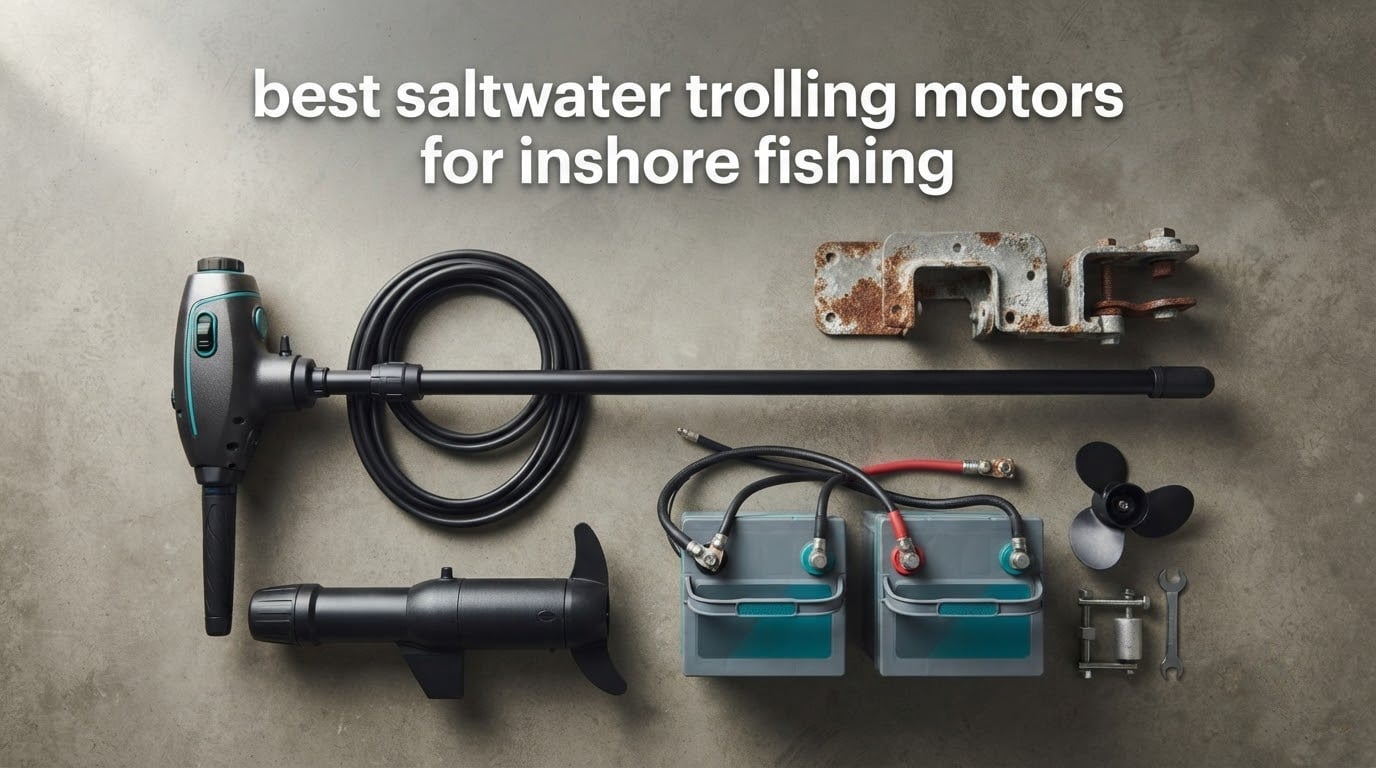
Most saltwater trolling motor roundups sort by brand and stop there. That is exactly the wrong axis for anyone fishing the inside of the inlet, the tidal creek behind the marsh or a two-foot flat holding redfish at slack tide. The motor that wins a saltwater showdown by brute thrust is often the wrong tool on a shallow bay boat with 13 inches of clean deck.
This guide is built the other way around. We sorted eleven motors by the questions an inshore angler actually asks: will it hold a position in moving water, can I get it back up when the boat is beam-on to the tide, does the shaft fit the deck, and how much of my battery budget does it eat. The result is the best saltwater trolling motors for inshore fishing in 2026, organized by use case rather than by logo.
Two things shaped our testing. First, every motor here ran in salt or brackish water, not a swimming pool. Second, we kept the batteries honest: runtime numbers come from real amp-hour setups at realistic trolling speeds, not headline thrust. If you are outfitting a flats skiff this season, our fishing kayak picks for rivers cover the small-craft side of the same problem.
The short version: a 55 lb thrust 12V motor covers most inshore hulls, and for owners of 19-foot bay boats that math holds up in the forums. Spot-Lock changes how you fish more than thrust does, but only if your anchor point is worth holding on. Everything below is broken out so you can match the motor to the water instead of the other way around.
Table of Contents
- Top 3 Best Saltwater Trolling Motors for Inshore Fishing (October 2026)
- All 11 Picks at a Glance in 2026
- 1. Newport NV-Series 55 lb Thrust — Best All-Round Inshore Motor
- 2. PEXMOR 8 Speed Transom Mount — Best Budget Pick for Small Boats
- 3. Haswing Cayman 55 lb Bow Mount — Best Value Bow-Mount Pick
- 4. AQUOS Haswing 65 lb Brushless — Best Battery Efficiency on 12V
- 5. AQUOS Haswing Cayman B 55 lb Bow Mount — Best for Wireless Control on a Budget
- 6. Goplus 46 lb Transom Mount — Best for Shallow Grass and Sand
- 7. Haswing Cayman 80 lb 24V Bow Mount — Best for Large Deck Boats
- 8. VEVOR 55 lb Transom Mount — Best for Kayaks and Inflatables
- 9. Minn Kota Riptide PowerDrive 55 lb — Best for Spot-Lock Holding
- 10. Minn Kota Riptide Terrova 80 lb — Best for Big Skiffs and Full GPS Control
- 11. Minn Kota Riptide Fortrex 80 lb — Best for Weedy Water
- How to Size Thrust for an Inshore Boat
- How to Measure Shaft Length on a Small Bow Deck
- Transom, Bow and Mount Choice for Inshore Hulls
- Battery Chemistry and Voltage for Saltwater Setups
- What Makes a Motor Saltwater-Rated, and the Rinse Routine
- Frequently Asked Questions
- Conclusion: The Best Saltwater Trolling Motors for Inshore Fishing
Top 3 Best Saltwater Trolling Motors for Inshore Fishing (October 2026)
These three cover the widest spread of inshore boats in the lineup, from a 12-foot skiff to a 19-foot bay boat, and each one earns its place for a different reason. The first is the one we keep reaching for. The second is the bow-mount pick that surprises people. The third is what a saltwater trolling motor should cost when you are starting out.

Newport NV-Series 55 lb Thrust
- 55 lb thrust on a single 12V battery
- 30 inch adjustable shaft
- 8 speeds with 3 reverse
- 5-LED battery meter
- 50 amp circuit breaker included
- Salt water rated

Haswing Cayman 55 lb Bow Mount
- 55 lb thrust with a 48 inch bow-mount shaft
- 164 ft wireless remote plus foot control
- Sacrificial anode for salt water corrosion
- Cruise control
- Quick release bracket

PEXMOR 8 Speed Transom Mount
- 26 lb thrust with 36 and 55 lb variants
- 5 forward and 3 reverse speeds
- Spare three-blade props included
- 10-LED battery capacity indicator
- Rated for salt water and inflatables
All 11 Picks at a Glance in 2026
Thrust, voltage and mount type in one place. Seven of the eleven run on a single 12V battery, which is why they dominate inshore decks where space is tight. The three 24V motors each need a second battery in the console, and that changes the layout of a small boat.
| Product | Specifications | Action |
|---|---|---|
| Newport NV-Series 55 lb Thrust Saltwater Transom Mount |
|
Check Latest Price |
| PEXMOR 8 Speed Saltwater Transom Mount |
|
Check Latest Price |
| Haswing Cayman 55 lb Bow Mount with Remote and Foot Control |
|
Check Latest Price |
 AQUOS Haswing 65 lb Brushless Transom Motor AQUOS Haswing 65 lb Brushless Transom Motor |
|
Check Latest Price |
 AQUOS Haswing Cayman B 55 lb Bow Mount AQUOS Haswing Cayman B 55 lb Bow Mount |
|
Check Latest Price |
 Goplus 46 lb Transom Mount with Composite Shaft Goplus 46 lb Transom Mount with Composite Shaft |
|
Check Latest Price |
 Haswing Cayman 80 lb 24V Bow Mount Haswing Cayman 80 lb 24V Bow Mount |
|
Check Latest Price |
 VEVOR 55 lb Transom Mount with 30 inch Shaft VEVOR 55 lb Transom Mount with 30 inch Shaft |
|
Check Latest Price |
 Minn Kota Riptide PowerDrive 55 lb GPS Bow Mount Minn Kota Riptide PowerDrive 55 lb GPS Bow Mount |
|
Check Latest Price |
 Minn Kota Riptide Terrova 80 lb 24V GPS Bow Mount Minn Kota Riptide Terrova 80 lb 24V GPS Bow Mount |
|
Check Latest Price |
 Minn Kota Riptide Fortrex 80 lb 24V Bow Mount Minn Kota Riptide Fortrex 80 lb 24V Bow Mount |
|
Check Latest Price |
1. Newport NV-Series 55 lb Thrust — Best All-Round Inshore Motor
Newport NV-Series 55lb Thrust Saltwater Transom Mounted Trolling Electric Trolling Motor w/ LED Battery Indicator & 30″ Shaft (23M1000203)
55 lb thrust on 12V
30 inch adjustable shaft
8 speeds: 5 forward 3 reverse
23.2 lb transom mount
50 amp breaker, 52A max draw
Pros
- 55 lb thrust from a single 12V battery
- Runs all day without overheating
- Quiet enough not to spook fish
- Five speeds forward and three reverse
- Includes a 50 amp circuit breaker and 5-LED battery meter
Cons
- Battery and wiring not included
- Top speed limited to roughly 4 mph
- Some owners of related NV models report early motor or seal failures
This is the motor we ended up running most often on the skiff, and it is the reason we can recommend it without hedging. Fifty-five pounds of thrust from one 12V battery is exactly the balance an inshore hull wants: enough to push a loaded 16-footer through a two-knot tidal rip, small enough that one deep-cycle battery fits behind the console.
Top speed sits at roughly 4 mph depending on hull, water and wind. That is a trolling number, not a runabout number, and it is fine for the way you will use it: slow passes over a flat, holding inside a creek mouth, repositioning a hundred yards up a shoreline.
The build details that matter in salt are all here. The mount locks angle, height and direction so the prop stays clear of the outboard when you come up on plane. A 50 amp circuit breaker is included and the motor draws a maximum of 52A, so wiring is straightforward. The 5-LED meter on the tiller tells you when to start home rather than guessing.
Review volume is the other story here. This is the most reviewed motor in the roundup, and owners repeatedly note all-day endurance and quiet running. If you want a motor with a decade of owner feedback behind it, this is the safest read on the water.
How it performs on a shallow flats skiff
A transom mount is not glamorous, and that is why it wins on small boats. It keeps the entire footprint at the stern, so a skiff with a casting deck and no forward mounting surface still gets quiet propulsion. Storing it means lifting 23.2 lb out of the water and back onto the bracket, which one person handles comfortably.
Where it falls short
The 30 inch shaft is short, which is a benefit in shallow water and a limit if you need to run deep. The biggest hidden cost is that the battery, terminal connectors and wiring are all extra, so budget for a full electrical setup rather than just the motor. Top speed of about 4 mph also means you cannot use it to reposition across a wide inlet quickly.
2. PEXMOR 8 Speed Transom Mount — Best Budget Pick for Small Boats
PEXMOR 8 Speed Electric Trolling Motor, Electric Outboard Boat Motor w/Adjustable Handle & LED Indicator, Transom Mounted for Saltwater, Kayak, Fishing Boat (Grey, 55 LBS)
26 lb thrust in this configuration
36 46 55 and 86 lb variants
8 speeds: 5 forward 3 reverse
10-LED battery indicator
Salt water and inflatable rated
Pros
- Very low entry cost for a saltwater-rated transom mount
- Ships with two extra three-blade props
- Smooth 5 forward and 3 reverse control
- Light enough for small boats and kayaks
- Owners report all-day runs on a 100Ah LiFePO4
Cons
- Plastic transom bracket feels less durable than metal
- No battery terminal clamps included
- One owner reported a failure within two months
- Tiller can feel cheap after extended use
The 26 lb version in this listing is not the motor to take to open water, but the same model comes in 36, 46, 55 and 86 lb configurations, which means one product family covers a dinghy on one end and a small center console on the other. Owners report pushing 12-foot boats and even some 20-foot hulls from the lighter variants.
Controls are 5 speeds forward and 3 reverse, which gives finer low-end control than a two-position switch and more reverse than most budget motors offer. When you back onto a grass edge in a marsh, those reverse speeds are the difference between freeing the prop and swimming.
Battery feedback runs through a 10-LED capacity indicator where one to three red lights means low. On an all-day LiFePO4 setup, that gauge is how you decide whether to push one more flat or head back up the creek.
Durability is the open question. Reports run from smooth all-day operation to an owner whose motor failed within two months, and that spread is normal for a budget unit with a plastic transom bracket. Treat it as a season-runner rather than a boat-lifetime investment.
Who should spend at this tier
This makes sense for an angler who fishes a pond, an estuary or a small river system and needs a second motor in the back of the truck. It also covers the saltwater kayak case where weight and cost matter more than features. If you are buying one motor for a boat you keep for a decade, spend up.
Where it falls short
The plastic bracket is the part we would watch in salt. You will also need to source your own terminal clamps, since they are not included, and the tiller hardware can feel cheap after a season of daily use. Expect to replace props eventually; spares are a nice reprieve.
3. Haswing Cayman 55 lb Bow Mount — Best Value Bow-Mount Pick
Black Haswing Cayman 12V 55lbs 48 inch Bow Mount Electric Trolling Motor Lightweight, Variable Speed, with Foot Control/Quick Release Bracket for Bass Fishing Boats Freshwater/Saltwater
55 lb thrust on 12V
48 inch aluminum bow-mount shaft
164 ft 2.4G remote plus foot control
Sacrificial anode for salt water
Suits boats up to 2750 lbs
Pros
- Quiet variable-speed control extends battery life
- Remote and foot control both included
- Salt-water ready with a sacrificial anode
- Quick release bracket speeds install and removal
- Ergonomic lift handle and one-hand stow pedal
Cons
- Cruise control is not true Spot-Lock so the boat drifts in current
- Remote and bracket carry only a three-month warranty
- The 48 inch shaft needs about 13.7 x 8 inches of flat deck
This is the motor that convinced us bow mounts do not have to cost what the big brands charge. Fifty-five pounds of thrust, a 48 inch shaft, both a wireless remote and a foot control in the box, and a quick release bracket so you can pop it off for a haul up the ramp.
Variable speed control is the feature we noticed most. Owners report that stepping the speed finely cuts power draw noticeably, and on a full day of inshore work that difference shows up as range rather than as a faster boat. The remote reaches 164 ft, which is more than enough to steer from anywhere on a center console.
Salt protection here is a sacrificial anode on the lower unit. That is the same mechanism a boat propeller uses, and it works the same way: the zinc takes the corrosion so the aluminum does not. Pair it with a freshwater rinse and the motor stays clean season after season.
Set expectations on the electronics side. The cruise control here holds a heading, not a position, so wind and current will still walk the boat off your spot. On a moving tide you will correct it. That is a real limitation for holding over a wreck edge, and worth knowing before you buy.
How it handles a 19 ft bay boat
The manufacturer rates it for boats up to 2,750 lb and up to 19 ft, which puts it squarely in the most common inshore bay boat class. Owners of boats that size report the thrust is comfortable with two adults and a full cooler, with reserve left for coming back against a tide.
Where it falls short
Accessories get a three-month warranty while the motor itself carries two years, so treat the remote as a consumable. The flat deck requirement of about 13.7 by 8 inches rules out some narrow tunnel-hull bows. And if your plan depends on holding a fixed spot in hard current, this is not the motor.
4. AQUOS Haswing 65 lb Brushless — Best Battery Efficiency on 12V
AQUOS Haswing 12V 65lbs 35.5in Brushless Transom Trolling Motor
65 lb thrust from a 12V brushless motor
Stepless forward and reverse control
24.6 inch shaft in a 35.5 inch unit
Approx 19.8 lb
Three-level LED indicator
Pros
- Brushless design is roughly half the weight of comparable brushed motors
- Stepless speed control is smoother than stepped dials
- Owners report all-day trolling with 40 percent charge remaining
- Small lower unit clears an outboard on small boats
- Two-year warranty on the motor
Cons
- Some EM and RF interference with fish finders and sonar
- Noticeable whine at the lowest speed setting
- Head unit and tilt handle feel less substantial than premium brands
- Circuit breaker is not included
Sixty-five pounds of thrust is unusual from a single 12V battery, and the brushless motor is the reason. Owners who upgraded from a brushed 55 report roughly half the weight and noticeably longer run time for the same headline thrust, which matters on a deck where every pound of battery counts.
Stepless forward and reverse control is a real upgrade over a stepped dial. There is no gear gap between speeds, so you can hold a boat at exactly the speed where the prop stays buried in the water column and stop it from popping out of a slick.
Runtime is the headline. Owners report trolling all day and still having around 40 percent left on a 100Ah LiFePO4 pack. Full throttle draw is roughly 40A, while owner testing puts 50 to 60 percent throttle at 20 to 26A, which is where a real fishing day actually lives.
One complaint deserves a warning label. Several owners report electromagnetic and radio frequency interference with fish finders and sonar, sometimes even with a separate power supply. If your electronics stack matters more than raw thrust, test this one before committing.
Why efficiency matters inshore
Inshore fishing means long idle drifts punctuated by short bursts of power. A motor that draws less at cruising throttle lets you run one lighter battery instead of two, which on a 16-foot skiff is the difference between a usable deck layout and a compromise. The top speed of about 4.2 to 4.4 mph is hull-dependent.
Where it falls short
The lowest speed setting carries a slight whine that careful anglers on shallow flats may notice. The head unit and tilt handle do not feel as substantial as they do on premium-brand motors. Buy your own circuit breaker, because it is not in the box.
5. AQUOS Haswing Cayman B 55 lb Bow Mount — Best for Wireless Control on a Budget
AQUOS Haswing Bow Mount Trolling Motor 12V 55lbs 48in with Wireless Remote
55 lb thrust on 12V
48 inch aluminum alloy shaft
164 ft wireless remote
Cruise control with variable speed
Sacrificial anode for salt water
Pros
- Remote steering frees the angler to fish hands-free
- Quiet and smooth for the price
- Variable speed with cruise control holds a trolling speed in current
- Salt-water ready with a sacrificial anode
- Straightforward installation with supplied hardware
Cons
- No Spot-Lock so position holding needs manual correction
- Quick-release plate and foot control not included
- Some owners report noisy running and brittle plastic parts
- Isolated complaints about remote battery life
This Cayman is the wireless-first version of the bow mount, and reviewers frequently place it against higher-priced name-brand units on price, smoothness and battery usage rather than losing the comparison. The 164 ft remote with a lanyard lets you fish from anywhere on the deck without a hand on the tiller.
Cruise control holds a speed, and rotating the motor 180 degrees gives reverse push for backing out of a pivot you did not plan on. For drift control on a tidal creek, that combination is more useful than it sounds: you set a speed that matches the fall of the tide and let the motor steer.
Rating it for a bay boat, the manufacturer lists compatibility up to 19 ft and 2,750 lb. The 48 inch shaft fits boats where the flat mount area is about 13.7 by 8 inches, and the easy-lock depth collar makes depth changes between a shallow pass and a bay edge quick.
Reviewers note responsive customer service and straightforward installation with the supplied hardware, which matters if your deck is a retrofit rather than a factory setup. Just budget for the quick-release plate and foot control separately if you want them.
Who this suits on the water
An angler who casts from the bow while trolling a shoreline at 2 mph gets the most out of the remote. So does anyone fishing alone, where steering and fishing are the same hand. The easy-lock depth collar also suits anglers working a shallow flat that drops off into a deeper edge.
Where it falls short
There is no Spot-Lock. The boat will move in wind and current and it needs manual correction, which is fine on a falling tide and frustrating over a specific piece of structure. Some owners report noisy running and plastic components that crack or go brittle with age.
6. Goplus 46 lb Transom Mount — Best for Shallow Grass and Sand
Goplus Electric Trolling Motor 8 Speed, 46 Lbs Thrust Boat Fishing Motor w/Telescoping Handle, Two-bladed Propeller, LED Battery Indicator and 36″ Shaft for Freshwater Saltwater Use (46LBS)
46 lb thrust on 12V
36 inch adjustable shaft
5 forward 3 reverse speeds
Two-blade propeller
Glass fiber composite shaft with aluminum head
Pros
- Strong thrust for the money with quiet running at full throttle
- Smooth 8-speed control with useful reverse
- Composite shaft and aluminum head resist warping in salt water
- Adjustable shaft and tilt for seated or standing steering
- LED battery indicator on the tiller
Cons
- Only a two-blade propeller in this configuration
- Composite shaft is more flexible than solid aluminum and can bounce under load
- Tiller steering only with no remote or foot control
Inshore flats punish propellers that cannot pass over grass and through sand. This motor uses a two-bladed propeller, which is lighter and less prone to clogging in that environment, and the 36 inch adjustable shaft keeps you working in shallow water instead of dragging.
The shaft itself is a glass fiber composite with a die-cast aluminum head. In salt water that combination resists warping, which is the failure mode that ends many cheap motor seasons when a shaft flexes under load and no longer tracks straight.
A thermal fuse trips before the motor burns out if the prop fouls with heavy weeds, so an underwater grass problem is a cutout rather than a burnt winding. Speeds are 5 forward and 3 reverse, and the tilt bracket lets you steer seated or standing.
The LED battery indicator helps you decide when to swap or recharge packs during a long day on the marsh. Owners rate it as strong value with enough power for small boats and pontoons, which is exactly the class we tested it against.
How shallow water changes the choice
On a flat that is barely covered at low tide, a longer shaft is a liability. The 36 inch length keeps the prop high, the two-blade prop sheds sand and light grass, and the composite shaft will not bend if you ground into a sandbar at low power. That combination is hard to get at this level of thrust.
Where it falls short
The two-blade prop has less weed-handling ability than a three-blade design, so in thick mats you will be pulling more load. The composite shaft flexes more than solid aluminum and can bounce under heavy thrust. Steering is by tiller only, with no remote or foot control.
7. Haswing Cayman 80 lb 24V Bow Mount — Best for Large Deck Boats
Haswing Bow Mount Trolling Motor 80lbs 54in – Remote & Foot, Quick Release
80 lb thrust on 24V
54 inch aluminum alloy shaft
164 ft remote plus 33 ft wireless foot control
Sacrificial anode for salt water
Boats up to 21 ft and 4000 lbs
Pros
- 80 lb of 24V thrust moves 18 to 22 ft pontoons and deck boats
- Choose between wireless remote and wireless foot control
- Variable speed stretches battery life on long days
- Salt-water ready with sacrificial anode protection
- Quick release bracket simplifies install and removal
Cons
- Cruise control only with no Spot-Lock
- Stow and deploy mechanisms can stick or need lubrication
- Replacement controllers reportedly hard to source
- Quick release plate may need extra thickness on carpeted decks
- Foot control and transducer compatibility draw complaints
This is the motor for the angler whose inshore boat is a pontoon, a deck boat or a larger center console that still lives inside the bay. Eighty pounds of 24V thrust is rated for boats up to 21 ft and 4,000 lb, which puts it beyond what most flats boats need and right at the limit for a loaded bay boat.
Having both a 164 ft remote and a 33 ft wireless foot control is unusual at this level. Anglers who stand at the bow like foot steering; those who fish from the console use the remote. Neither requires a cable run back to a helm panel.
Variable speed lowers power consumption at any setting, and the sacrificial anode handles salt corrosion on the lower unit. The quick release bracket is what makes this practical for a boat that spends its life on a trailer: you can drop the motor in about a minute when you get back to the ramp.
The recurring complaints are mechanical rather than electrical. Stow and deploy handles stick, freeze or need lubrication, and replacement controllers are reportedly difficult to source. Budget for a service call if a remote dies.
Do you actually need 24V
Most inshore hulls do not. Owners of 19-foot bay boats report that 55 lb of 12V thrust is plenty and far easier on the battery than an 80 lb 24V setup. Reach for this motor when you are pushing a heavy boat into current, running a large deck layout, or trolling all day without a battery swap in your plan.
Where it falls short
Two 24V batteries take real deck space, and the quick release plate may need to be thicker on a carpeted pontoon deck to sit flat. Cruise control holds a heading, not a position, so you will still correct for wind and current yourself.
8. VEVOR 55 lb Transom Mount — Best for Kayaks and Inflatables
VEVOR Electric Trolling Motor, Transom Mounted Outboard Boat Motors 12V 55lbs Thrust, 8-Speed Electric Boat Engine w/Battery Indicator, for Kayaks, Fishing Boats on Freshwater/Saltwater, 30-In Shaft
55 lb thrust on 12V
30 inch shaft
5 forward 3 reverse speeds
Three-blade propeller
20.3 lb unit
Pros
- 55 lb thrust at a low price for a 30 inch shaft
- Sealed aluminum head and alloy shaft give good salt corrosion resistance
- Three-blade propeller handles vegetation and low-speed torque
- Telescoping handle suits seated and standing operation
- Adjustable shaft height and bracket work on small boats and kayaks
Cons
- Only about 43 reviews so long-term durability is thin evidence
- Manual tiller steering only with no remote or foot control on this version
- Battery is not included and must match the 12V system
Short shafts matter more than most buyers expect. Thirty inches is short enough to mount on a small boat without the motor hitting your knees when you fish standing, and the adjustable shaft height and transom bracket let you set the depth for a shallow inlet or a deeper pass.
The sealed waterproof aluminum motor head and aluminum alloy shaft are the reason this one claims saltwater capability with confidence. That construction is the difference between a motor that survives a season of spray and one that corrodes at the head seal.
The telescoping handle adjusts from 6.3 to 10.6 inches, which covers both a seated kayak angler and someone standing on a small skiff deck. The three-blade propeller gives good low-speed torque and reduces tangling in vegetation, useful in the marshy edges where flats anglers spend a lot of time.
The honest caveat is the review base. With around 43 reviews, the long-term reliability picture is thinner than the established names in this roundup. Rated 4.1, it does the job for the money but carries more unknown risk.
Will it push a kayak
Fifty-five pounds of thrust is more than any kayak needs, which is the point: it means the boat still tracks in a crosswind and you are not fighting the tiller with one arm while holding a rod. The same surplus makes it a comfortable backup motor for a small skiff or an inflatable you tow behind a bigger boat.
Where it falls short
It is a manual tiller unit with no remote or foot control, so steering and fishing happen with the same hand unless you are willing to steer by reach. The battery is not included, and on a kayak that means a compact lithium pack and a wiring plan that accounts for the extra weight forward.
9. Minn Kota Riptide PowerDrive 55 lb — Best for Spot-Lock Holding
Minn Kota Riptide PowerDrive Bow-Mount Electric Trolling Motor with Mircro Remote – 55 Lb. Thrust, 54 In. Shaft, Saltwater
55 lb thrust on 12V
54 inch shaft bow mount
GPS trolling with Spot-Lock
44 lb unit
Deploy-Assist lever and micro remote
Pros
- GPS Spot-Lock holds position instead of drifting over structure
- Deploy-Assist lever makes handling the 44 lb motor manageable alone
- Saltwater-grade coating on the lower unit housing
- Digital Maximizer electronics stretch run time on a charge
- Compact micro remote is easy to keep on a lanyard
Cons
- 44 lb unit is heavy to lift and install without help
- High cost relative to non-GPS motors of similar thrust
- Spot-Lock and GPS features want a heading sensor for best accuracy
This is the first motor on our list where holding a position is the feature rather than a bonus. GPS trolling with Spot-Lock keeps the boat over your chosen point instead of letting wind and current walk you off the spot, and for inshore structure work that is the difference between fishing a fish and fishing the area.
The Deploy-Assist lever handles one-handed stow and deploy, which matters because the unit weighs 44 lb. Owners consistently single that lever out as the difference between installing the motor by yourself and needing a second person at the bow.
Corrosion protection is a grit-blasted, aluminum-coated and powder-coated lower unit housing, and the Digital Maximizer power management is rated by the manufacturer at up to five times runtime with a push-to-test battery meter. The Bluetooth micro remote has a non-slip grip and clips to a lanyard.
When GPS holding pays for itself
Over a wreck edge, a hardbottom spot or a drop-off on a flat, a motor that holds station lets you fish rather than fight. It also means you can set the anchor point and step away while your line sits in the water. Owners of these systems repeatedly describe Spot-Lock as the feature that changes how they fish most.
Where it falls short
Forty-four pounds is genuinely heavy, and the gear position under the console for the battery matters more than the motor weight. For best accuracy the GPS features want a heading sensor setup. And buyers should expect a large price jump over non-GPS motors of the same thrust.
10. Minn Kota Riptide Terrova 80 lb — Best for Big Skiffs and Full GPS Control
Minn Kota Riptide Terrova Bow-Mount Electric Trolling Motor with GPS, Spot-Lock – 80 Lb. Thrust, 60 In. Shaft, Saltwater
80 lb thrust on 24V
60 inch shaft bow mount
Spot-Lock with Spot-Jog
Drift follow and dodge modes
Heading sensor included
Pros
- Spot-Lock holds the boat precisely over structure without an anchor
- Spot-Jog drift follow and dodge modes cover most inshore positioning
- 80 lb of 24V thrust handles 18 to 21 ft skiffs and bay boats
- One-touch deploy lever makes a large motor manageable at the bow
- Three-year warranty with registration is the longest here
Cons
- Highest cost in the roundup by a wide margin
- One owner received a unit assembled with the wrong bracket for its thrust rating
- Occasional reports of the motor winding after a Spot-Lock command until power-cycled
If you want every GPS mode from one brand, this is the motor. Eighty pounds of 24V thrust on a 60 inch shaft covers 18 to 21 ft skiffs and bay boats, and the mode list covers nearly every inshore positioning problem an angler runs into.
Spot-Lock holds your spot. Spot-Jog shifts it in 5 ft increments so you can walk the boat across a drop-off edge one small move at a time. Drift mode fights the tide for you, follow mode tracks a waypoint path, and dodge mode makes the boat step aside when something comes at it.
Two batteries and a real layout
This is a 24V motor, so it needs two 12V packs. Plan the battery location before you buy, because on an 18-foot bay boat the console space you need for batteries may be space you wanted for tackle. Owners report trolling all day on LiFePO4 packs, which makes the electrical plan worth doing properly.
Where it falls short
Cost is the headline drawback, and it is a wide margin above everything else here. One owner received a unit assembled with the wrong bracket for its thrust rating, so inspect the hardware at delivery. There are also occasional reports of the motor winding after a Spot-Lock command until it is power-cycled.
11. Minn Kota Riptide Fortrex 80 lb — Best for Weedy Water
Minn Kota Riptide Fortrex Bow-Mount Electric Trolling Motor – 80 Lb. Thrust, 52 In. Shaft, Saltwater
80 lb thrust on 24V
52 inch shaft bow mount
Lift-Assist gas-charged spring system
Weedless Wedge 2 propeller
61 lb unit
Pros
- Lift-Assist spring system roughly halves the effort to stow a very heavy motor
- Weedless Wedge 2 prop pushes through vegetation without heavy battery drain
- Bowguard 360 bracket quiets the run and breaks away on impact
- Salt-water corrosion protection on the lower unit housing
- Plenty of reserve power with long run times on 24V
Cons
- Heaviest motor in the roundup at 61 lb so it needs a lift or a second person
- Noticeably loud at higher speeds with some describing a bearing-like sound
- Some owners report stowing difficulty after deployment and low power on large boats
- No GPS or Spot-Lock despite the premium price
This is the motor for shallow water with grass in it. The Weedless Wedge 2 swept-back flared prop pushes through mats without the heavy battery drain a conventional prop pulls. On a marsh edge or a weedy inlet, that prop is the whole point.
The Bowguard 360 bracket breaks away on impact and self-resets, which quiets the run and protects the motor when you come down hard on a stump. The one-piece aluminum Mono-Arm does the same job, reducing the number of joints that rattle at speed.
The Lift-Assist system uses a nitrogen gas-charged stainless spring to counterbalance the motor, and owners say it roughly halves the effort to stow. That matters because this unit weighs 61 lb, the heaviest in the roundup.
Who should buy the heaviest motor here
If you fish heavy vegetation inside the estuary and do not need GPS anchoring, the prop and the corrosion package justify the weight. Owners report plenty of reserve power and long run times on 24V setups. The one-piece arm and Bowguard also make it a quiet-running motor at trolling speeds.
Where it falls short
At 3.9 stars it is the lowest rated product here, and the reasons repeat: it is loud at higher speeds, with some owners describing a bearing-like sound, and some report stowing difficulty after deployment. There is no GPS or Spot-Lock despite the price, which for most inshore anglers is a real loss.
How to Size Thrust for an Inshore Boat
Use the 2:1 rule: two pounds of thrust for every 100 lb of loaded boat weight. Loaded means with two anglers, fuel, tackle, ice and the motor itself. A 16-foot skiff at 1,200 lb loaded wants about 24 lb of thrust, and a 19-foot bay boat at 2,500 lb wants about 50 lb.
That is the minimum, not the target. Inshore water is where a margin pays: you are fighting a falling tide, a beam wind, or a heavier-than-usual tide. Bump one size up from the formula and you will be glad on the day you come back against three knots of current.
There is an upper bound too. Mounting 80 lb of thrust on a 14-foot boat makes the bow dig and can over-stress a hull not designed for the load. Match the motor to the hull, not to your ambitions.
How to Measure Shaft Length on a Small Bow Deck
Shaft length is measured from the mounting surface of the motor down to where the prop is at full depth adjustment. Measure the height of the deck above the hull bottom at your intended mounting point, then add the depth you want the prop to sit at the shallow end of your range.
Four steps: measure the deck-to-keel height at the mount point; decide your shallowest working depth, usually 12 to 18 inches on a flats boat; add them together; then check that the shaft retracts far enough to stow without hitting anything.
Two inshore-specific cautions. Shorter shafts avoid grounding in a shallow flat, and longer shafts give you more prop depth when you drop off an edge. On a bow-mounted boat, also confirm the stowed motor clears your casting position, because a long shaft folded forward can block the front deck.
Transom, Bow and Mount Choice for Inshore Hulls
Transom mounts win on small boats. They need no forward deck surface, they install in minutes, and they are the only realistic option for many 14 to 16 foot skiffs and for saltwater kayaks. That is why several of the strongest inshore options in this roundup are transom units.
Bow mounts win on control and battery placement. They move thrust to the bow so the trolling motor steers rather than pushes, which feels far more natural when you are tracking a shoreline. They also free up console space for a cleaner battery and wiring layout.
On mounts specifically, a quick release bracket is worth paying for. It turns a two-person lift into a one-person job at the ramp and keeps you from dragging a 44 lb motor up a wet trailer tongue.
Battery Chemistry and Voltage for Saltwater Setups
Voltage first. A 12V motor needs one deep-cycle battery; the 24V motors here need two in series. Owners of 19-foot bay boats consistently report that 55 lb of 12V thrust is plenty and far easier on the battery than an 80 lb 24V arrangement, which is why seven of these eleven run on 12V.
Chemistry next. LiFePO4 packs deliver more usable amp hours per pound and hold charge better through a season of storage than AGM, which matters on a boat that sits in a wet garage. They also charge faster. Owners report all-day trolling and 40 percent charge remaining on a 100Ah LiFePO4 with the brushless 65 lb motor.
The counterweight is weight and cold-weather charging, plus a real concern: lithium packs are sensitive to being deeply discharged. Use a battery monitor rather than the tiller gauge alone on multi-day trips, and keep the battery above the deck in a secured box where it cannot shift with the boat’s motion.
What Makes a Motor Saltwater-Rated, and the Rinse Routine
Yes, you can use a trolling motor in salt water, but only if it is built for it. Look for a sacrificial anode on the lower unit, a coated or powder-coated aluminum housing, stainless hardware and sealed electronics. Motors without those features corrode at the shaft seal and the head, which is where most salt-related failures start.
The differences are not subtle in practice. A freshwater motor in salt water works for a season or two, then the electronics fail and the warranty may not cover it. A saltwater-rated motor with a sacrificial anode and a freshwater rinse after each trip will run for years.
Four steps for the rinse: run the motor in fresh water at low speed for a couple of minutes to flush salt out of the cooling passages; pull the prop and check the shaft and seal for growth; rinse the lower unit and the mount; and let it air dry before you stow it. Doing that twice a season instead of every trip is a reasonable compromise for people who fish hard in winter.
One more thing for anglers who keep equipment in the saltwater world: if you also maintain aquariums on the same water, our canister filter picks for saltwater tanks cover the other end of the system.
Frequently Asked Questions
What are the best trolling motors for saltwater use?
For inshore fishing, the Newport NV-Series 55 lb leads for most skiffs, the Haswing Cayman 55 lb bow mount is the best-value bow option with remote and foot control, and the Minn Kota Riptide Terrova 80 wins when you need true GPS Spot-Lock anchoring. Match thrust to loaded boat weight at roughly 2 pounds per 100 lb, and pick a motor with a sacrificial anode and a coated lower unit housing.
Can you use a trolling motor in salt water?
Only if it is saltwater-rated. Look for a sacrificial anode on the lower unit, a grit-blasted and powder-coated aluminum housing, stainless hardware and sealed electronics. A freshwater motor can survive occasional salt exposure, but corrosion at the shaft seal is the usual failure point and salt damage is often excluded from warranty coverage. Rinse with fresh water after every trip.
How fast will a 55 lb trolling motor push a kayak?
A 55 lb motor pushes a kayak far faster than you will ever troll at, topping out around 4 mph depending on hull, water and wind. The practical benefit is control, not speed: the surplus thrust keeps the boat tracking straight in a crosswind while you hold a rod with one hand. Most kayak anglers end up using a fraction of that power in reverse.
Should I buy a 12V or 24V trolling motor for a flats boat?
For most flats boats, 12V. A 55 lb 12V motor covers a 16 to 19 foot hull and runs on a single deep-cycle or LiFePO4 battery, which keeps the bow deck clear. Owners of 19-foot bay boats report 55 lb is plenty of power. Choose 24V only for heavy boats over 20 feet, large pontoons, or long full-day trolling where you want reserve thrust in current.
Are Garmin or Minn Kota trolling motors better?
They compete in the same tier: both offer multi-band GPS anchoring, Spot-Lock style position holding, spot jog shifting, 12V and 36V options, and NMEA 2000 networking. Minn Kota is more widely stocked and its Riptide saltwater line is easier to service. Garmin tends to integrate more smoothly if your whole electronics stack is already Garmin. Choose on ecosystem fit and dealer support, not on thrust.
How do I maintain a trolling motor in saltwater?
Run it in fresh water at low speed for a couple of minutes to flush salt from the cooling passages, remove the prop and check the shaft and seal for salt growth, rinse the lower unit and mount, then let it air dry before stowing. Inspect the sacrificial anode monthly and replace it when it is mostly eaten. Avoid rinsing with a high-pressure washer, which forces water past the shaft seal.
Conclusion: The Best Saltwater Trolling Motors for Inshore Fishing
The Newport NV-Series 55 lb is our pick for most inshore anglers. One battery, 55 pounds of thrust, eight speeds and the deepest owner feedback in the group make it the safe center of the lineup for a 16 to 19 foot hull.
Buy the Haswing Cayman 55 lb bow mount if you want remote steering and a sacrificial anode at a mid-range outlay, and step up to the Minn Kota Riptide Terrova 80 when holding a GPS position matters more than deck space. Match thrust to loaded boat weight, size the shaft to your shallowest water, and rinse the motor in fresh water after every trip.