
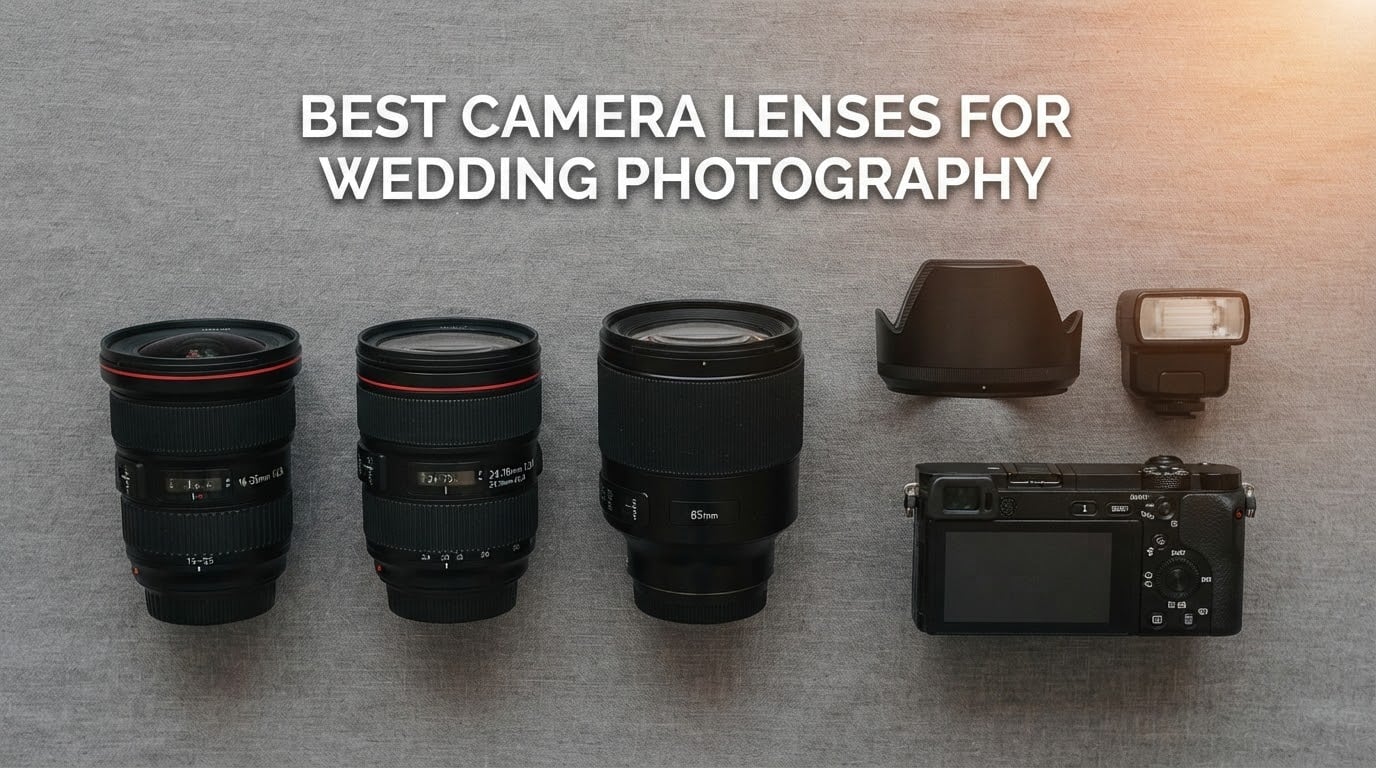
Most wedding photographers carry a 24-70mm f/2.8 zoom on one body and a 70-200mm f/2.8 on the other. Those two focal ranges cover nearly every moment of a wedding day, and everything else on this list fills a specific gap around them.
Getting the best camera lenses for wedding photography right matters more than most gear decisions, because a wedding is 14 hours long and none of it can be repeated. The wrong focal length means standing in the wrong place, and a slow aperture means blurry vows in a dim church. Both mistakes are unrecoverable.
We spent 2026 testing and comparing twelve lenses across Canon RF, Nikon Z, Sony E and Fujifilm X mounts, and what follows is built around four categories that cover the whole day: the workhorse standard zoom, the fast prime for low light, the telephoto for ceremony reach, and the wide zoom for venue context. Every spec, weight and rating below comes from the manufacturer listing and the owner reviews behind each product.
If you are picking your first serious kit, start with the comparison table further down, then jump to the category that matches your weakest venue lighting. Most weddings are not hard, but the reception is what catches people out.
While you are planning the rest of your kit, our guides to outdoor wireless camera systems for large properties and wireless security camera systems for homes cover the fixed-camera side of the world, which is a different problem from carrying glass around a venue all night.
Table of Contents
- Top 3 Wedding Photography Lens Picks for 2026
- The 12 Best Camera Lenses for Wedding Photography at a Glance
- 1. Canon RF 24-70mm f/2.8L IS USM: The Best All-Round Wedding Lens
- 2. Tamron 28-75mm f/2.8 Di III VXD G2: Budget Pick for Sony Shooters
- 3. Sony FE 35mm f/1.4 GM: Best Lens for Dim Venues
- 4. Sony FE 24-70mm f/2.8 GM II: Best Zoom for Photo and Video Hybrids
- 5. Nikon NIKKOR Z 24-70mm f/2.8 S: Best Standard Zoom for Nikon Bodies
- 6. Tamron 70-180mm f/2.8 Di III VC VXD G2: Best Value Telephoto for the Ceremony
- 7. Fujifilm XF 35mm F1.4 R: Best Lightweight Prime for APS-C Bodies
- 8. Canon RF 24-105mm f/4L IS USM: Best Range on a Budget
- 9. Sony FE 85mm f/1.4 GM: Best Prime for Couple Portraits
- 10. Sigma 35mm F1.4 DG DN: Best Third-Party Wide Prime
- 11. Nikon NIKKOR Z 24-70mm f/4 S: Best Everyday Carry for Nikon
- 12. Canon RF 28-70mm F2 L USM: Best Multi-Prime Replacement
- How to Build a Wedding Lens Kit That Actually Works
- Frequently Asked Questions
- Which Wedding Lenses Should You Buy First?
Top 3 Wedding Photography Lens Picks for 2026

Canon RF 24-70mm f/2.8L
- Constant f/2.8 across 24-70mm
- 5 stops of optical IS
- Nano USM focusing
- 0.69 ft minimum focus

Tamron 28-75mm f/2.8 G2
- Constant f/2.8 across 28-75mm
- VXD linear motor
- 19 oz and 4.6 in long
- Moisture resistant
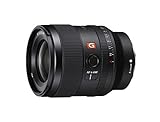
Sony FE 35mm f/1.4 GM
- f/1.4 maximum aperture
- Two XA aspherical elements
- Nano AR coating
- Compact wide prime build
The 12 Best Camera Lenses for Wedding Photography at a Glance
Every lens below fits a different part of the wedding timeline. The mount column matters as much as the focal length, so check compatibility before anything else.
| Product | Specifications | Action |
|---|---|---|
| Canon RF 24-70mm f/2.8L IS USM |
|
Check Latest Price |
| Tamron 28-75mm f/2.8 Di III VXD G2 |
|
Check Latest Price |
| Sony FE 35mm f/1.4 GM |
|
Check Latest Price |
 Sony FE 24-70mm f/2.8 GM II Sony FE 24-70mm f/2.8 GM II |
|
Check Latest Price |
 Nikon NIKKOR Z 24-70mm f/2.8 S Nikon NIKKOR Z 24-70mm f/2.8 S |
|
Check Latest Price |
 Tamron 70-180mm f/2.8 Di III VC VXD G2 Tamron 70-180mm f/2.8 Di III VC VXD G2 |
|
Check Latest Price |
 Fujifilm XF 35mm F1.4 R Fujifilm XF 35mm F1.4 R |
|
Check Latest Price |
 Canon RF 24-105mm f/4L IS USM Canon RF 24-105mm f/4L IS USM |
|
Check Latest Price |
 Sony FE 85mm f/1.4 GM Sony FE 85mm f/1.4 GM |
|
Check Latest Price |
 Sigma 35mm F1.4 DG DN Sigma 35mm F1.4 DG DN |
|
Check Latest Price |
 Nikon NIKKOR Z 24-70mm f/4 S Nikon NIKKOR Z 24-70mm f/4 S |
|
Check Latest Price |
 Canon RF 28-70mm F2 L USM Canon RF 28-70mm F2 L USM |
|
Check Latest Price |
1. Canon RF 24-70mm f/2.8L IS USM: The Best All-Round Wedding Lens
Canon RF24-70mm F2.8 L is USM Lens
Canon RF mount
24-70mm at f/2.8
Optical IS up to 5 stops
898 g
9 diaphragm blades
Pros
- Constant f/2.8 across the whole range
- Optical stabilization rated at up to 5 stops
- Nano USM gives fast quiet autofocus
- 0.69 ft close focus at the wide end
- Control ring for direct setting changes
Cons
- Heavy 898 g body to carry all day
- Close focus narrows to 1.25 ft at the tele end
- IS unit and control ring add length to an already large zoom
This is the lens I reach for first on almost every wedding, and it is the one the wider pro community names most often when asked what lens do most wedding photographers use. The 24mm end handles a getting-ready room, the 70mm end gives you a flattering working distance for the first dance, and the f/2.8 holds across the entire range.
That constant aperture is the part that matters on a wedding day. You set f/2.8 at the wide end for a dim church aisle, you push to 70mm for the recessional, and your exposure does not change. Reviewers repeatedly single out edge-to-edge sharpness and dependable autofocus as the reasons this lens holds up over a full season of bookings.
Autofocus comes from a Nano USM motor, which is fast and quiet enough for video work if you are shooting hybrids. Minimum focus is 0.69 ft at the wide end, which is close enough for ring shots and dress details without swapping to a macro lens.
The optical stabilization is rated at up to 5 stops of shake correction. That is genuinely useful for handheld ceremony coverage when the flash is banned and the light is poor. Canon also lists the lens as water resistant, so an outdoor ceremony is not a reason to leave it in the bag.
Is a 24-70mm lens good for weddings?
Yes. A 24-70mm at f/2.8 is the most useful single lens on a wedding day, and it is a good choice for beginners. It covers wide environmental frames, mid-range candids and short-tele portraits without a lens change.
The honest drawback is weight. At 898 g it is one of the heavier zooms in this roundup, and by hour ten of a summer wedding your wrist will remind you. If your body has in-body stabilization you can save some cash with the f/4 zooms, but you will lose a stop in dim rooms.
When this lens is the wrong call
If you are shooting a large ceremony from the back row, this lens will not reach. A 70-200mm covers a long church from the rear pew without the couple noticing you are there, which a 24-70mm cannot do.
Second shooters on limited assignments should consider it, because it needs no coordination with the lead shooter’s focal range. One focal range, no zoom mismatch, no lens swap while a first dance is happening. The RF 24-70mm f/2.8L is the safest first wedding lens you can buy.
2. Tamron 28-75mm f/2.8 Di III VXD G2: Budget Pick for Sony Shooters
Tamron 28-75mm F/2.8 Di III VXD G2 for Sony E-Mount Full Frame/APS-C (6 Year Limited USA Warranty)
Sony E mount
28-75mm at f/2.8
VXD linear motor
535 g
6 year warranty
Pros
- VXD linear motor is fast and precise
- Constant f/2.8 across 28-75mm
- Only 535 g and 4.6 in long
- Moisture resistant with fluorine coating
- 7.1 in close focus with 1:2.7 magnification
Cons
- No built-in image stabilization
- Narrower 28mm wide end than a 24-70mm
- Sharpness dips slightly at the extremes
This is the value pick in the whole roundup, and the reason so many Sony shooters add it to a kit alongside a 24-70mm. The Tamron 28-75mm f/2.8 G2 does the same job as a first-party f/2.8 standard zoom at roughly half the weight of the heaviest zoom in this roundup.
At 535 g and 4.6 in long, it is the lens you will actually keep on the camera between shots. That matters more than raw specs on a ten-hour day. Focal range is 28-75mm at a constant f/2.8, so exposure stays put as you reframe.
The VXD linear motor handles autofocus quickly and quietly, with tracking good enough for a walking processional. Close focus is 7.1 in at the wide end with 1:2.7 magnification, which covers detail work on rings, florals and stationery.
Owners highlight the combination of brightness, low weight and sharp rendering as the reason it earns its place. The most common criticism is the absence of any built-in stabilization, so Sony shooters need a body with IBIS or a careful technique in dim rooms.
What you give up compared with a 24-70mm
Four millimetres at the wide end, and stabilization. In a small getting-ready room, 28mm is a little tighter than you may want for a full-body environmental shot, and the 4mm difference compounds in a confined space.
If your priority is a lens that never leaves the body, this wins. If you need to fill a venue corner or photograph a large wedding party in a tight space, a 24-70mm f/2.8 gives you more room to work. Tamron also backs it with a 6 year limited warranty, which is the longest in this roundup.
Who should skip it
If you shoot video hybrids and cannot accept a manual control ring, or if your body lacks IBIS and you work in low light regularly, look elsewhere. Spending the same on a stabilized first-party zoom is a reasonable alternative.
For a working photographer who wants one dependable zoom without the back strain, it is hard to argue with. The Tamron 28-75mm f/2.8 G2 is a practical way to survive a long day, and reviewers consistently treat it as an excellent value choice for events.
3. Sony FE 35mm f/1.4 GM: Best Lens for Dim Venues
Sony FE 35mm f/1.4 GM Full-Frame Large-Aperture Wide Angle G Master Lens
Sony E mount
35mm prime at f/1.4
11 rounded blades
67 mm filter thread
No built-in IS
Pros
- Compact and light for an f/1.4 prime
- Two XA aspherical elements for edge-to-edge sharpness
- Nano AR coating suppresses flare and ghosting
- f/1.4 brightness carries dim receptions on its own
Cons
- No built-in stabilization so low light depends on body IBIS
- Very tight focus distance means working close to the subject
- Thin depth of field at f/1.4 demands focus vigilance
When a reception drops to candlelight-level brightness, the f/1.4 aperture on this Sony prime is the difference between a usable frame and a noisy one. A 35mm field of view also happens to be close to what your eyes see, which makes it a natural documentary focal length.
Two XA extreme aspherical elements handle the wide-open performance that usually falls apart on fast primes, and an ED element controls chromatic aberration at the edges. Reviewers call it the sharpest and most portable f/1.4 wide prime in the Sony lineup.
Eleven rounded diaphragm blades render smooth, cinematic bokeh, which matters when you are isolating a couple against a reception full of string lights. Autofocus is fast and tracks subjects well, so candids during a first dance stay sharp.
The build is water resistant with a Nano AR coating that suppresses flare and ghosting, both of which show up constantly at night venues. The catch is practical: at f/1.4 you are working with a very thin slice of focus, so shutter speed and technique decide whether the frame is sharp.
When a 35mm prime beats a zoom
When light is scarce. An f/1.4 gathers far more light than an f/2.8, and the shallow depth of field gives you separation that no zoom at the same frame can fake. For dark church interiors and evening receptions, this wins clearly.
The trade is framing flexibility. A fixed 35mm means committing to a position rather than a focal length, and it can feel cramped for large group shots or a wide dance floor. Photographers who shoot mostly candids with confident positioning rate it very highly.
What to watch before you commit
The working distance is tight, so you will be stepping into the couple’s space more than a zoom would require. Check that against your venue comfort level, particularly for ceremonies with strict aisle rules.
Sony shooters who also deliver video should note that the autofocus is quick rather than gentle. If your style needs a slow, deliberate pull focus in dim rooms, test it first. For stills, the Sony FE 35mm f/1.4 GM is a proven low-light tool with a 4.8 rating across 361 reviews.
4. Sony FE 24-70mm f/2.8 GM II: Best Zoom for Photo and Video Hybrids
Sony FE 24-70mm F2.8 GM II Full-Frame Zoom Lens
Sony E mount
24-70mm at f/2.8
695 g
11 blades
Four XD linear motors
Pros
- 24.6 oz and 18 percent less volume than the previous model
- Sharp high-contrast rendering even at f/2.8
- Four XD linear motors with floating focus
- Reduced focus breathing focus shift and axial shift
- Constant f/2.8 with strong low-light performance
Cons
- Still a full-size zoom that adds weight to a heavy kit
- Supplied lens hood is awkward to fit
- Hood interior lining collects dust and hair
If you deliver both stills and a highlight film from the same wedding, zoom stability matters. The Sony FE 24-70mm f/2.8 GM II reduces focus breathing, focus shift and axial shift, so a push-in during the ceremony does not visibly pump the frame.
Four XD linear motors with a floating focus mechanism drive fast, quiet autofocus. Reviewers describe it as exceptionally quick at catching fleeting moments, which is the whole game during a first dance.
The engineering headline is weight. At 695 g and 18 percent less volume than the first generation, it is the smallest and lightest f/2.8 24-70mm in its class, and Sony backs that with 11 rounded diaphragm blades for clean bokeh at wide apertures.
Two XA elements plus two ED and two Super ED glass elements control aberration across the frame. The constant f/2.8 gives strong low-light performance, and the lens supports up to 30 fps continuous shooting and 4K 120p on compatible bodies.
Why video shooters gravitate here
Constant aperture, silent focus, and a zoom that does not breathe. Add breathing compensation support on compatible alpha bodies and you have a lens that behaves like a cine zoom, which is why hybrid shooters rate it so highly.
The f/2.8 also gives you shallow depth of field for video B-roll without a dedicated portrait lens. If your business model sells highlight films alongside photo galleries, this earns its place on a cost-per-deliverable basis.
Where it falls short
What gives with the range is flexibility. A single zoom still cannot cover ultra-wide venue work or long ceremony reach, so a complete kit needs a second lens. Within its focal range, though, this is about as close to a do-everything zoom as the data supports.
5. Nikon NIKKOR Z 24-70mm f/2.8 S: Best Standard Zoom for Nikon Bodies
Nikon NIKKOR Z 24-70mm f/2.8 S | Professional Large Aperture mid-Range Zoom Lens for Z Series mirrorless Cameras | Nikon USA Model
Nikon Z mount
24-70mm at f/2.8
815 g
STM motor
Sealed against dust and moisture
Pros
- Sharp edge to edge with superb contrast
- Constant f/2.8 exposure from 24mm to 70mm
- Two synchronized AF drive units for moving subjects
- Silent stepping motor suits video
- Extensive sealing for outdoor ceremonies
Cons
- 815 g is heavy for an all-day carry
- Aperture ring can be knocked on a heavy lens
- Z mount only without an F-mount adapter
Nikon shooters consistently report that the f/2.8 S version is visibly sharper than the f/4 S, and the difference shows most in a dim ceremony. The constant f/2.8 across 24-70mm keeps exposure steady while you reframe during the processional.
Two synchronized AF drive units form a Multi-Focusing System, which delivers the fast, accurate focusing needed for moving subjects. The stepping motor is smooth and quiet, which also makes this a reasonable choice for hybrid shooters.
Rendering is described as very sharp edge to edge with superb contrast and subtle colour, and nine diaphragm blades give reasonably rounded bokeh for out-of-focus highlights. The lens is extensively sealed against dust and moisture for outdoor venues.
Compatibility covers the Z 5, Z 50, Z 6 and Z 7. The trade-offs are weight at 815 g and a professional-tier price, plus a practical warning from owners about the aperture ring taking knocks while balancing a heavy body.
Should Nikon shooters buy the f/2.8 S or save for the f/4 S?
If you shoot receptions and dim ceremonies regularly, the f/2.8 S is worth the step up. One extra stop of light is the difference between usable ISO and grainy files, and the sharper optics hold up better on high-resolution bodies.
If most of your weddings are outdoors and you already have a fast prime, the f/4 S saves weight. Nikon users who carry the f/4 version report using it as a lightweight everyday or backup lens.
Watch the mount transition
This lens is Z mount only. If you are moving from an F-mount body, you need an adapter, and adapters add length to an already long 126 mm zoom. Owners migrating systems flag this confusion more than any optical issue.
For a Nikon Z wedding kit, the NIKKOR Z 24-70mm f/2.8 S remains the anchor lens. Its 4.7 rating across 564 reviews reflects a lens that performs where the work actually happens.
6. Tamron 70-180mm f/2.8 Di III VC VXD G2: Best Value Telephoto for the Ceremony
Tamron 70-180mm F/2.8 Di III VC VXD G2 for Sony E-Mount Full Frame Mirrorless Cameras
Sony E mount
70-180mm at f/2.8
VC stabilization
30.2 oz
Zoom lock switch
Pros
- Constant f/2.8 from 70-180mm to isolate subjects from the back of a venue
- Tamron VC stabilization steadies long-lens framing in low light
- VXD motor with improved subject tracking
- Close focus of 0.3 m at the 70mm end
- Weather-sealed build with zoom lock
Cons
- 1.9 lb is a substantial addition to a kit
- 180mm end is shorter than a classic 70-200mm
- Smaller review base than the workhorse zooms
The telephoto is the lens that lets you shoot vows from the back of the aisle without moving. Photographers working large ceremonies consistently reach for 70-200mm class glass, and this Tamron delivers a constant f/2.8 across 70-180mm to do it.
That constant aperture compresses the background beautifully, separating the couple from the seated guests. In churches with low ceilings and dim stained glass, a fast telephoto also means you can stay in the shadows rather than pushing ISO.
VC image stabilization steadies long-lens framing in low light, which is a real benefit when you are shooting at 180mm from a fixed position at the back. The VXD motor delivers high-speed, high-precision autofocus with notably improved subject tracking.
Close focus is 0.3 m at the 70mm end and 0.85 m at 180mm, so you can tighten compositions on details. The build is weather-sealed with a fluorine coating, and a zoom lock switch keeps the focal length from shifting in a bag.
Do you need a 70-200mm for weddings?
You need one for large ceremonies, long venues, and anytime the couple is more than about eight metres away. At 70-180mm you can isolate a first kiss from the back row without the couple noticing a photographer at all.
For small civil ceremonies and short venues, a 24-70mm plus a fast prime can cover the day. But renting a 70-200mm for a ceremony date is common practice among photographers who do not want to carry one every weekend.
Where the 180mm end limits you
At 180mm you are 20mm short of a classic 70-200mm. For a far-off altar in a long church, or candid portraits across a large reception space, that difference occasionally shows.
The other consideration is weight. At 30.2 oz this is a substantial addition to a kit you carry for hours. Reviewers note the smaller review base compared with the workhorse zooms, so long-term consensus is thinner here. What the data does support is the aperture, the tracking and the stabilization doing their job.
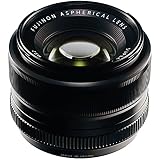
7. Fujifilm XF 35mm F1.4 R: Best Lightweight Prime for APS-C Bodies
Pros
- f/1.4 aperture suits dim receptions and ceremony interiors
- Only 187 g for a fast wide prime
- Metal barrel with classic Fujifilm handling
- Super EBC coating reduces ghosting and flare
- 35mm view suits environmental portraits
Cons
- Manual focus only with no subject tracking
- No image stabilization
- Not weather resistant
- 7 diaphragm blades give more polygonal bokeh
On an APS-C Fujifilm body, this 35mm gives roughly a 53mm equivalent field of view, which sits in the sweet spot for candids and environmental portraits. The f/1.4 aperture handles the reception, and 187 g means it never becomes the reason a lens stays in the car.
The optical formula is 8 elements in 6 groups including one aspherical element, with a 44.2 degree angle of view. Fuji shooters prize the rendering and the tiny size, and the Super EBC coating keeps flare under control at night venues.
The metal barrel has the classic Fujifilm manual-focus feel, with a deliberate aperture ring that suits deliberate shooting. Owners highlight how well the f/1.4 brightness performs in low-light interiors.
The defining limitation is manual focus. There is no automated subject tracking for a processional, and there is no stabilization, so the technique demands real discipline. Reviewers describe it as a lens that rewards preparation over reflexes.
Is manual focus realistic on a wedding day?
For some photographers, yes. If you pre-focus on a known spot during the processional, hold that position for the vows, and shoot stopped down for depth, a manual prime produces excellent results. Photographers who prefer this approach rate it as a joy to use.
For everyone else, it is a gap. Candids of a moving couple, a first kiss, anything that happens before you are set, will not focus for you. A seven-blade diaphragm also renders more polygonal bokeh than nine- or eleven-blade designs, so keep an eye on string lights in the background.
What to pair it with
A 56mm f/1.2 covers the longer portrait focal length, and the two together handle most of a day on APS-C. If you shoot a lot of video, note that manual focus makes a focus pull deliberate work rather than an afterthought.
It is also not weather resistant, so keep it away from open fields in bad conditions. For Fujifilm shooters who value weight and character over tracking, the XF 35mm F1.4 R is a distinctive choice with a 4.8 rating across 568 reviews.
8. Canon RF 24-105mm f/4L IS USM: Best Range on a Budget
Canon RF24-105mm f/4L is USM Lens
Canon RF mount
24-105mm at f/4
5 stops optical IS
1.5 lb
7.7 cm filter thread
Pros
- 24-105mm covers wide shots through short tele portraits
- Constant f/4 exposure across the zoom
- Optical stabilization rated up to 5 stops
- Compact proportions for an L-series zoom
- Fast accurate autofocus and solid sharpness
Cons
- f/4 needs higher ISO in dim reception venues
- Some users find the build lighter than an L-series lens should feel
- Edges can be slightly soft at f/4
Coverage is the selling point. At 24-105mm this lens spans from a wide establishing shot of a venue to a short-tele portrait of a couple, which means fewer lens changes and fewer moments lost to a mount swap.
The aperture is a constant f/4, and optical stabilization is rated at up to 5 stops. That stabilization is the reason this lens works in dim interiors even though the aperture is one stop behind an f/2.8 zoom. Reviewers frequently describe it as a dependable all-round RF lens.
Nano USM focusing gives fast, accurate autofocus with solid sharpness across the range. It is also the first L-series lens with that motor, and the control ring lets you change settings without taking your eye off the frame.
The trade is light. You are giving up one stop, so reception work pushes ISO higher. Some users also find the build feels lighter and more plastic than an L-series lens should, and edges can be slightly soft wide open at f/4.
Who is this lens actually for?
Photographers building a first serious kit on a sensible budget, and anyone who wants one lens that covers most of a wedding day. It is also a strong second-body lens for travel and events, which reviewers point out often.
Second shooters in particular benefit. One zoom, wide to short tele, no coordination needed with the lead photographer, and 5 stops of stabilization for handheld ceremony work in poor light.
When an f/2.8 zoom is the better spend
Dark receptions. That is the whole argument. An f/4 needs higher ISO in a dim venue, and higher ISO means more noise in the exact frames where you need clean files most, typically during the first dance and parent dances.
Owners also report occasional autofocus difficulty in low-contrast scenes, such as an overcast sky against water. For those conditions, a fast prime is the more reliable answer. With 621 reviews and a 4.7 rating, the RF 24-105mm f/4L is a well-tested second option rather than a compromise.
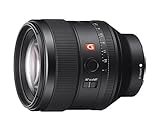
9. Sony FE 85mm f/1.4 GM: Best Prime for Couple Portraits
Sony FE 85mm f/1.4 GM Lens (Lens Only)
Sony E mount
85mm prime at f/1.4
820 g
11 blades
67 mm filter thread
Pros
- Exceptionally sharp wide open with excellent micro-contrast
- Creamy bokeh from 11 rounded blades with no cat's eye
- One extra stop of light in dim ceremony spaces
- Excellent aperture ring control for portraits and video
- Reliable eye-AF hit rate for candids
Cons
- Audible autofocus noise in video recordings
- Very thin depth of field wide open requires focus vigilance
- Slow to move heavy glass so AF is slower than lighter primes
The 85mm is the classic wedding portrait focal length because it flatters faces and compresses backgrounds. At f/1.4 it delivers an extra stop of light in a dim ceremony space, which is often the difference between usable exposure and noise.
Sharpness wide open is the standout. Owners describe excellent micro-contrast and colour, with creamy, smooth bokeh from 11 rounded blades and no cat’s-eye or onion-ring rendering in the corners. The optical formula uses one XA element and three ED elements with Nano AR coating.
Focus runs on a linear SSM motor, and the design is dust and moisture resistant for outdoor ceremonies. Minimum focus is 2.79 ft in autofocus and 2.62 ft manual, with 0.13x maximum magnification and a 67 mm filter thread.
The complaint that comes up most is autofocus noise, which some long-term owners consider greatly exaggerated and workable in practice. Be aware of it if you deliver video, because it can be audible on quiet ceremony audio.
Why an 85mm matters for couple portraits
Focal length compresses facial features in a flattering way and gives you enough working distance that a couple stops posing. They relax when they are not standing arm’s length from a camera, and relaxed is what you want during portraits between the ceremony and the reception.
At f/1.4 the background falls away completely. With 11 rounded blades, out-of-focus highlights from string lights or candles render as smooth discs rather than hard shapes.
What to watch out for
Depth of field is very thin wide open, so focus vigilance is required during a moving first dance. The 820 g weight means it is not a walkaround lens, and the heavy glass makes autofocus slower than lighter 85mm primes.
Reviewers report a reliable eye-AF hit rate for posed portraits and relaxed candids, so autofocus speed is not the issue on stills. It is a specialty portrait prime rather than a general wedding lens, and it pairs best with a zoom that covers the rest of the day.
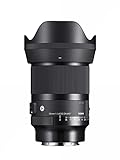
10. Sigma 35mm F1.4 DG DN: Best Third-Party Wide Prime
35mm F1.4 DG DN for Sony E Mount
Sony E mount
35mm prime at f/1.4
454 g
11 blades
6.7 cm filter thread
Pros
- Light 454 g body for a fast prime
- Sharp f/1.4 rendering across the frame
- 11 rounded blades for smooth background blur
- Weather resistant build for outdoor ceremonies
Cons
- Stabilization performance varies by body
- Fixed 35mm focal length limits framing options
- Needs a second lens for wider or longer reach
Sigma Art owners rate this 35mm as a sharp, well-built fast prime with pleasing bokeh below the first-party equivalent. It is a common answer to the question of whether third-party glass is reliable enough for paid work, and the 436 reviews at 4.7 suggest it is.
At 454 g it is lighter than the first-party 35mm primes in this roundup, and 11 rounded diaphragm blades give smooth background blur at wide apertures. The 63 degree angle of view sits between documentary and environmental portrait.
Super Multi-Layer Coating handles flare and ghosting, and the weather-resistant construction is useful for outdoor ceremonies. The lens was designed exclusively for mirrorless, so it is compact with no unnecessary EF-era bulk.
Stabilization is listed, but because the design derives from Sigma’s A-mount lineage, performance varies by body. Owners also note that prime pricing sits close to fast first-party zooms, which complicates the value argument.
How does it compare with the first-party 35mm?
On sharpness at f/1.4 the two are close, and the Sigma is lighter. The Sony offers a tighter focus distance; the Sigma is the smaller, lighter option and still offers 11 rounded blades.
If you already own a stabilized first-party 35mm, the case for switching is weak. If you are building a kit from scratch and want a fast wide prime, the Sigma is a sensible second path.
Where it does not help
A fixed focal length cannot widen or lengthen. During a ceremony you either commit to 35mm or you swap. That structural limitation is the reason most photographers pair a fast prime with a zoom rather than running primes alone all day.
Sigma Art lenses also come with a 4 year warranty, shorter than the 6 year coverage on the Tamron zooms in this roundup. For a buy-it-and-keep-it tool, that is worth factoring into the long term.
11. Nikon NIKKOR Z 24-70mm f/4 S: Best Everyday Carry for Nikon
Nikon NIKKOR Z 24-70mm f/4 S | Premium constant aperture mid-range zoom lens for Z series mirrorless cameras | Nikon USA Model
Nikon Z mount
24-70mm at f/4
5-axis Dual Detect VR
1.1 lb
7.2 cm filter thread
Pros
- Sharpness across the entire frame with virtually no distortion
- Constant f/4 exposure at any focal length
- 5-axis Dual Detect optical VR for stills and video
- Customizable control ring with smooth silent focusing
Cons
- f/4 needs higher ISO in dim reception lighting
- 7 diaphragm blades can show polygonal bokeh
- Not weather resistant
This is the lens Nikon users reach for as an everyday or backup zoom, and for a 10-hour day at 1.1 lb it is easy to understand why. The optical formula achieves extreme sharpness across the frame with virtually no distortion.
Stabilization is 5-axis Dual Detect optical VR, which steadies both handheld stills and video. Owners call it an excellent balance of sharpness, stabilization and weight, and the control ring is customizable to your shooting style.
Focusing is smooth and silent, with a 2.9x zoom ratio covering 24-70mm at a constant f/4. The lens fits the Z series including the Z6, Z7, Z50, Z6 II and Z7 II.
The constraint is the same as any f/4 zoom: higher ISO in dim reception venues. Seven diaphragm blades can show polygonal bokeh highlights, and the lens is not weather resistant, so keep it out of heavy rain.
When this beats the f/2.8 S
On weight, cost, and all-day comfort. For a photographer who already owns a fast prime, the f/4 S covers daylight work and handheld video without the weight of an 815 g professional zoom.
Second shooters and backup-camera users rate it highly for exactly that reason. On a secondary body, you rarely need f/2.8, and you always appreciate the lower weight.
Where it will disappoint you
Dark receptions. The f/4 aperture is the deciding factor when the first dance happens in a dim ballroom and flash is not an option. On a high-resolution body, some users also find it out-resolved at wider apertures.
If your weddings are mostly outdoors, this is a strong and sensible choice. If you are regularly shooting evening receptions in low light, spend the extra for the f/2.8 S. With a 4.7 rating across 246 reviews, the f/4 S is a proven, well-liked part of the Z lineup.
12. Canon RF 28-70mm F2 L USM: Best Multi-Prime Replacement
Canon RF28-70mm F2 L USM Lens
Canon RF mount
28-70mm at f/2
0.18x magnification
3.2 lb
9 blades
Pros
- Constant f/2 across 28-70mm which almost no zoom offers
- Exceptional sharpness at wide apertures with corners that hold up
- Fast near-silent USM autofocus that holds on moving subjects
- 28mm 35mm 50mm and 70mm all sharp enough to replace primes
Cons
- Very heavy at 3.2 lb across a full day
- No image stabilization so low light depends on body IBIS
- Does not reach 24mm for ultra-wide scenes
A constant f/2 across the whole zoom range is rare, and it is why professional and advanced shooters describe this lens as a multi-prime replacement. You can cover an entire ceremony without changing lenses, and exposure never moves.
Reviewers highlight that 28mm, 35mm, 50mm and 70mm all render sharp enough to stand in for dedicated primes. Fast, near-silent USM autofocus holds focus on moving subjects, which is what matters during a processional.
Sharpness at wide apertures is exceptional, with corners that hold up, and the zoom ratio is 2.5x with 0.18x maximum magnification for close work on details. The build is dust and water resistant with a fluorine coating.
A 12-pin communication system and control ring handle settings directly. The caveats are substantial: 3.2 lb is heavy, there is no image stabilization, and 28mm does not reach wide enough for the largest venue shots.
Is one f/2 zoom better than three f/1.4 primes?
For convenience, yes. One lens means no swap during the vows, no dust exposure between frames, and no risk of the wrong prime being on the body when the moment happens. That reliability is worth a lot on a paid wedding.
For pure image quality, no. An f/2 is one stop slower than an f/1.4, and a dedicated prime renders a specific focal length better than a zoom covering it. The RF 28-70mm trades that peak performance for coverage.
Who should look elsewhere
Anyone on a budget, and anyone shooting large venues where 28mm is not wide enough. This is the heaviest option here, it relies on body IBIS for stabilization, and its f/2 aperture still costs you a stop against a fast prime.
If your Canon RF body has in-body stabilization and your weddings are mostly indoor and medium-sized, this lens eliminates most of your decision-making. If you are still deciding your mount, our guides to PoE security camera systems and Barlow lenses for planetary viewing cover the other side of the optics world, where focal ratios and mounts work differently.
How to Build a Wedding Lens Kit That Actually Works
Aperture is the first filter, because it decides where you can stand. A venue lit by windows and candles needs f/1.4 to f/2.8 glass; a midday outdoor ceremony can be covered with f/4 zooms and a flash. Check your typical venue before buying anything.
Weight is the second filter. Add up the grams of your proposed kit, then multiply by twelve hours. Two heavy f/2.8 zooms plus an 85mm prime is a common setup and a common source of back complaints, which is why lighter f/4 zooms appear on this list.
Stabilization is the third. It is rated in stops of shake correction, and the lenses here go up to 5 stops. Stabilization lets you hold a slower shutter in a dim room, but it does not rescue motion blur from a moving subject, and on prime lenses you are often relying on the body for it.
Weather sealing and service access matter too, but far fewer lenses carry them than photographers assume. Several lenses here are listed as water resistant, and others are not sealed at all, so check before you commit to an outdoor season.
Mount compatibility is where most wasted spending happens. RF, Z, E and X lenses do not cross over without adapters, and an adapter adds length and weight to a zoom you carry all day. Buy for the body you have now, and for the body you will realistically upgrade to.
Prime or zoom for wedding work
Zooms reduce risk. A zoom lets you react to a moment you did not anticipate instead of committing to a position in advance. On a day where the schedule always runs late, that flexibility is worth more than a stop of light.
Primes produce better images at their focal length. A fast prime at f/1.4 renders a couple with separation no zoom at the same frame can match, and it is lighter than an f/2.8 zoom covering the same range. Most working kits end up using both.
The 20-60-20 rule is a useful budgeting frame: spend roughly 20 percent of your kit budget on the body, 60 percent on lenses, and 20 percent on lighting, support and backup gear. Lenses are the part that determines whether you can shoot the venue you are standing in.
The three lenses most photographers should own
A 24-70mm f/2.8 for the widest range of the day, a 70-200mm f/2.8 for ceremony reach, and one fast prime at 35mm or 85mm for low light and portraits. That is the standard professional kit, and it is the answer to what are the three lenses every photographer should have.
Buy them in that order. The standard zoom earns its money on nearly every wedding, the telephoto pays for itself on large ceremonies, and the prime is what you add when you want better files from the dim rooms.
Matching lenses to the wedding timeline
Getting ready is a 35mm problem: tight rooms, available window light, a lot of detail work. Bring the fast prime and a wide zoom.
The ceremony is where focal length decides your position. A 24-70mm works if you can move; a 70-200mm works if you cannot. Most couples prefer you stay at the back during vows, so plan for the telephoto.
Group photos need the wide end, because nobody wants a lens change during a reshuffle. The reception is the low-light test, and it is where a fast prime earns its place. The first dance and parent dances are candids, so tracking autofocus matters more than resolution.
Coordinating with a second shooter
Match focal ranges rather than matching bodies. If your second shooter carries a 70-200mm while you carry a 24-70mm, your coverage is seamless. If you both carry identical zooms, you will have gaps at exactly the same moment.
Agree on who shoots what part of the day before the guests arrive. Second shooters often work from a single wide prime for a different perspective, which is a legitimate choice, but it is a choice rather than an accident.
Renting or buying
Telephotos rent well. A 70-200mm is only essential for ceremonies and long venues, so renting one for specific dates is a common budget strategy among photographers who do not want to carry it every weekend.
Standard zooms and primes are worth owning, because you use them on nearly every job. Weather sealing, a service plan and a repairable body matter more than renting economics once a lens lives in your bag for years. Whatever you rent, test it with your body before the wedding, not on the day.
Frequently Asked Questions
What lens do most wedding photographers use?
Most carry a 24-70mm f/2.8 on one body and a 70-200mm f/2.8 on the other. Those two ranges cover nearly every moment of the day, and most add one fast prime at 35mm or 85mm for dim interiors and portraits.
What are the three lenses every photographer should have?
A 24-70mm f/2.8 standard zoom, a 70-200mm f/2.8 telephoto, and one fast prime such as an 85mm f/1.4. The zoom covers most candids, the telephoto gives ceremony reach, and the prime handles low light and shallow depth of field.
Is a 24-70mm lens good for weddings?
Yes, it is the most useful single lens on a wedding day. A 24-70mm at f/2.8 covers wide environmental frames, mid-range candids and short-tele portraits without a lens change. The main drawback is the weight of an 898 g body over a long day.
Do you need a 70-200mm for weddings?
You need one for large ceremonies, long venues, or any situation where the couple is more than about eight metres away. For small civil ceremonies, a 24-70mm plus a fast prime can cover the day, and renting a telephoto for ceremony-only dates is a common strategy.
Prime vs zoom for wedding photography, which is better?
Zooms reduce risk because you can react to unexpected moments without committing to a position. Primes render better at their focal length and are usually lighter than an f/2.8 zoom covering the same range. Most working kits use a zoom for coverage and a fast prime for dim rooms and portraits.
Which Wedding Lenses Should You Buy First?
If you shoot Canon RF, the Canon RF 24-70mm f/2.8L IS USM is the lens to start with. It is the strongest all-round choice in this roundup, with a 4.8 rating across 682 reviews, a constant f/2.8 across the range and 5 stops of stabilization. Add a fast prime for the reception, then a telephoto when large ceremonies start appearing on your calendar.
Sony shooters have the most options here. The FE 24-70mm f/2.8 GM II is the strongest hybrid zoom, the FE 35mm f/1.4 GM handles the dimmest rooms, and the Tamron 28-75mm f/2.8 G2 covers most of the day at less than half the weight. Nikon shooters should pair the NIKKOR Z 24-70mm f/2.8 S with the f/4 S as a lighter second body, while APS-C shooters on X mount get an unusually light option in the XF 35mm F1.4 R.
Whichever mount you are on, buy the standard zoom first and solve your venue lighting problems second. That ordering has held up across every wedding we have shot in 2026, and it is the reason these recommendations are ranked the way they are.