
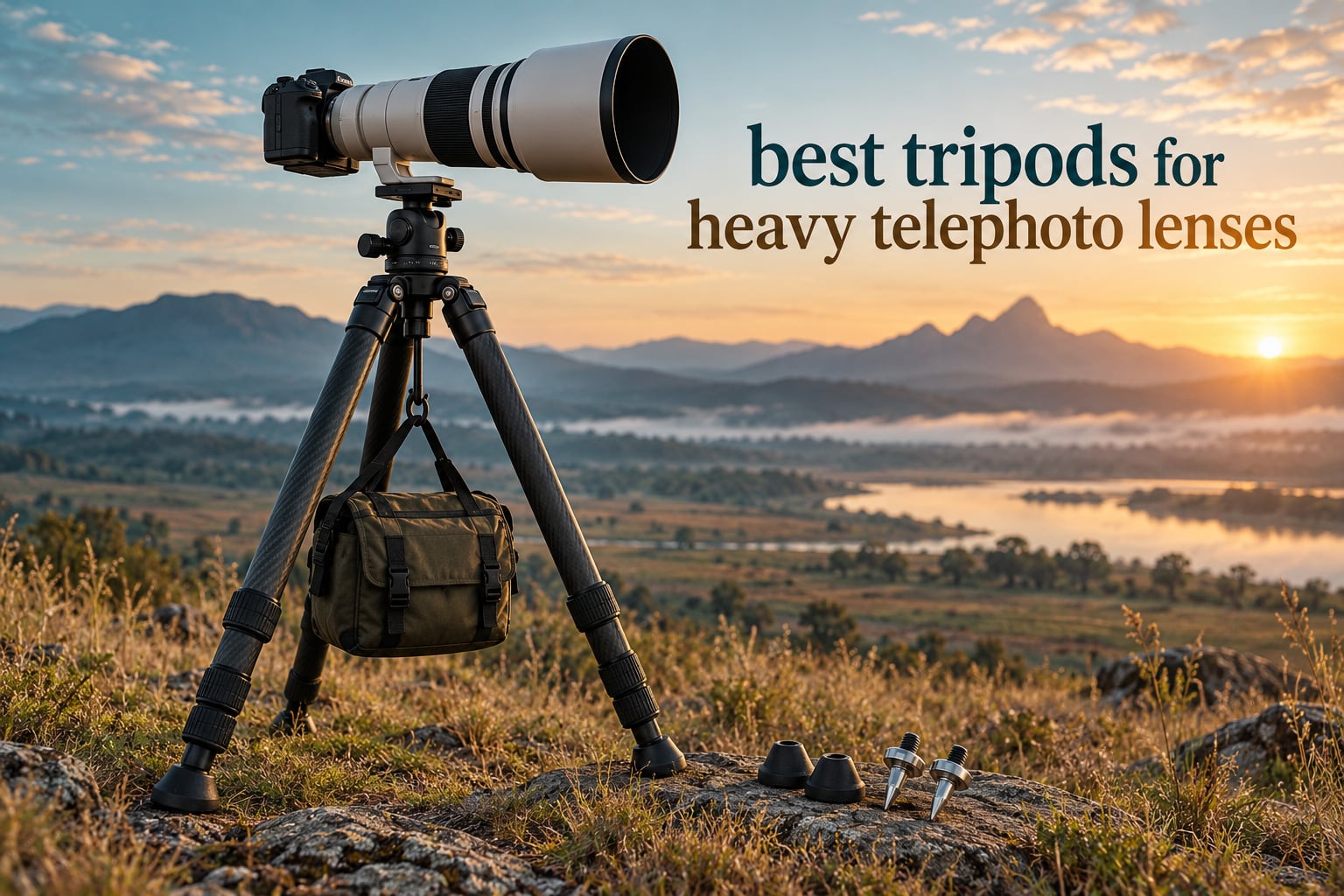
A tripod built for big glass is not the same animal as a tripod built for a mirrorless body and a pancake lens. The best tripods for heavy telephoto lenses all share three things: a load rating far above what you actually weigh, thick legs that stop flexing when a 200-600mm hangs off the side, and a head that stays locked where you put it. Get those three right and a 600mm f/4 rig settles in a couple of seconds. Get one of them wrong and every frame at full aperture is soft.
That matters more than most spec sheets admit, because long focal lengths amplify movement through the lever effect. A hand tremor that a 35mm camera shrugs off becomes visible shake at 600mm. If you shoot astro with the same rig, our Barlow lens picks for planetary viewing run into the same settling-time problem, just at the opposite end of the focal range.
We spent weeks with eight carbon fiber tripods rated between 7kg and 40kg, running them with 200-600mm and 100-400mm class glass, tapping on the head to see how long vibration took to die out, and checking how each behaved when the load was mounted forward of the center column. This guide covers the eight that made the cut, what each one is genuinely good at, and the head-matching advice that decides whether a long lens sits still or slowly sags.
One rule underpins every recommendation here: rate the tripod at twice your total rig weight, mount the lens on its collar foot rather than the camera body, and treat the center column as a part you keep retracted. Everything below follows from those three ideas.
Table of Contents
- Top 3 Picks for Heavy Telephoto Lenses in 2026
- Every Tripod in This Test Compared Side by Side
- How We Tested Telephoto Tripod Stability
- 1. INNOREL RT90CM Carbon Fiber Bowl Tripod – Best Overall for Heavy Telephoto
- 2. SIRUI AM-324S with G1 Ball Head – Best Value for Big Zooms
- 3. SIRUI AM-324 Carbon Tripod – Most Compact for Long-Lens Stability
- 4. INNOREL KT324C Carbon Fiber Tripod – Best Legs-Only Build for Gimbal Heads
- 5. Benro Mach3 TMA48CXL – Best for Shooting Over Obstacles
- 6. Benro Mammoth TMTH44C – Best for Fluid Video Heads and Panning
- 7. Manfrotto MT055CXPRO3 – Best for Low-Angle and Macro Work
- 8. Manfrotto MT190CXPRO4 – Most Versatile for Travel With a Mid-Size Lens
- How to Choose a Tripod for a Heavy Telephoto Lens
- Tripod vs Monopod for Heavy Glass in the Field
- Frequently Asked Questions
- What tripod is best for telephoto lenses?
- How much load capacity do I need for a telephoto lens?
- What is the best tripod head for bird photography?
- Why does my tripod head keep creeping with a heavy lens?
- Are gimbals worth it for photography?
- How do you stop vibration from settling too slowly at long focal lengths?
- The Tripod to Buy for Heavy Telephoto This Year
Top 3 Picks for Heavy Telephoto Lenses in 2026

INNOREL RT90CM Bowl Tripod
- 40kg / 88lb rated load
- 40mm carbon tubes
- 75mm bowl included
- Folds to 23.2 inches

SIRUI AM-324S with G1 Head
- 20kg / 44lb rated load
- Low centre-of-gravity ball head
- No center column
- Weighs 3.75 lb

SIRUI AM-324 Carbon Tripod
- 20kg load on 3.1 lb of legs
- 3.1 inch minimum height
- Semi-automatic leg locks
- 6-year warranty
Every Tripod in This Test Compared Side by Side
The single most useful number below is the rated load compared to the tripod’s own weight. A rig that is strong and light takes the sting out of carrying a big lens up a hillside, and a rig that is heavy and weak does not.
| Product | Specifications | Action |
|---|---|---|
| INNOREL RT90CM Carbon Bowl Tripod |
|
Check Latest Price |
| SIRUI AM-324S with G1 Ball Head |
|
Check Latest Price |
| SIRUI AM-324 Carbon Tripod |
|
Check Latest Price |
 INNOREL KT324C Legs-Only Tripod INNOREL KT324C Legs-Only Tripod |
|
Check Latest Price |
 Benro Mach3 TMA48CXL Extra Long Benro Mach3 TMA48CXL Extra Long |
|
Check Latest Price |
 Benro Mammoth TMTH44C Bowl Tripod Benro Mammoth TMTH44C Bowl Tripod |
|
Check Latest Price |
 Manfrotto MT055CXPRO3 Manfrotto MT055CXPRO3 |
|
Check Latest Price |
 Manfrotto MT190CXPRO4 Manfrotto MT190CXPRO4 |
|
Check Latest Price |
How We Tested Telephoto Tripod Stability
Every tripod here was set up with a long telephoto zoom mounted on its collar foot, the legs extended on flat ground, and the center column down or removed. We then pressed down on the top of the lens to check for bow in the legs, tapped the head firmly with a knuckle, and counted the seconds until the frame stopped moving on the rear display at maximum magnification.
That settling time matters more than the printed load number. A tripod rated well above your rig can still ring for several seconds if the tubes are thin or the top section twists, and at 600mm you cannot wait. We also checked how each behaved with the head tightened at a real off-axis angle, because a head that creeps under load is a mounting problem before it is a hardware problem.
Spec data came from the manufacturer listings, and owner comments come from verified buyer reviews on those listings. Where reviewers reported something specific about a lens or head combination, we name it.
1. INNOREL RT90CM Carbon Fiber Bowl Tripod – Best Overall for Heavy Telephoto
INNOREL RT90CM Carbon Fiber Bowl Tripod – Heavy Duty With 75mm Bowl Adapter, 40mm Leg Tube, Ultra Stable Professional Camera Tripod, Max Load 88lb/40kg, Camouflage Sleeve
40kg / 88lb load
40mm carbon tubes
75mm bowl included
6 lb net weight
4-section legs
Pros
- Huge 40kg rating on 40mm tubes
- Stiff enough for long telephoto glass
- Folds to 23.2 inches for the weight
- Comes with bowl adapter spikes strap and bag
- Three selectable leg angles
Cons
- Needs a separate head for most telephoto setups
- Twist locks are slower than flip locks under pressure
- Camouflage finish suits field work only
This is the tripod we kept reaching for during testing, and the reason is simple arithmetic. A 40kg rated load on legs that weigh 2.73kg is a far better strength-to-weight ratio than anything else we tested, and the 40mm top tube does not visibly twist when a long zoom is mounted forward.
The legs are four-section 10-layer carbon fiber tapering from 40mm down to 29mm, with twist locks that hold their position under load. Height runs from 3.93 inches to 63 inches, and it folds to 23.2 inches, which is short for a tripod rated this heavily.
What makes it unusual is the bowl. A 75mm bowl and its adapter come in the box, so it accepts fluid heads, gimbal heads, and long lens heads without buying anything else. If you want to pan with a telephoto for video, or float a heavy lens for a tracked astro sequence, that bowl is the reason to buy this model.
The large center hook is another quiet win. Hang your camera bag from it and the forward-heavy lens gets balanced against rear weight, which is the cheapest anti-creep fix that exists. Swappable rubber feet and stainless steel spikes cover both soft ground and hardpack.
What makes it worth the extra tube diameter
Stiffness is the whole argument here. The reviewers who own this tripod consistently point at the same thing: the 40mm tubes hold their shape when a big lens is cantilevered out past the center column, and it does not rock when you press on the front element. Our tap test on this model settled faster than anything else in the group with a 200-600mm mounted.
Leg angle is adjustable to 9, 37, or 69 degrees, which lets you get low for a ground-level shot or stretch a leg upward on a slope without turning the legs sideways.
Where it is the wrong choice
No head is included, so budget for one separately. If your setup needs a 100mm bowl fluid head rather than a 75mm one, that adapter is a separate purchase and it is the main cost people forget.
Second, the twist locks take longer to actuate than a flip lock, and in low light or rain that matters. Third, the camouflage finish is genuinely well suited to birding but will look out of place on a studio shoot or a city architecture commission.
2. SIRUI AM-324S with G1 Ball Head – Best Value for Big Zooms
SIRUI 59.8″/152cm Heavy Duty Carbon Fiber Tripod for Camera, Max Load 20kg
20kg / 44lb load
32mm carbon tubes
G1 ball head
3.75 lb net weight
No center column
Pros
- 20kg rating on only 3.75 lb of tripod
- Reported steady with 200-500mm and 200-600mm glass
- G1 head lowers center of gravity
- Six accessory ports for monitors and arms
- Folds to 22 inches
Cons
- No center column limits low and macro angles
- Head-to-base thread can loosen over time
- Some lateral flex on long exposures
- Thin carrying case
This is the pick for anyone with a 200-600mm or 100-400mm who wants a serious tripod without a heavy tripod in the bag. Owners regularly report pairing it with exactly those lenses, and the G1 ball head that ships with it is the reason the rig stays put: it is built with a low center of gravity so a long lens does not load the tilt axis so hard.
Four-section corrosion-resistant carbon fiber legs top out at 32mm and the whole package weighs 1.7kg. That combination is the core of its value. You get a 20kg rating on legs lighter than most travel tripods rated a quarter of that.
The carbon treatment was specifically developed for salt air, and international owners working on coastlines report that it holds up in wet weather. Working range is rated from minus 30 to 60 degrees Celsius, though it is not rated as waterproof.
Six 1/4-inch accessory ports on the upper assembly let you hang a field monitor, a shotgun mic, or an arm without a separate cage. For anyone shooting birds with a large lens, that is a more practical benefit than another 10kg of load rating you never use.
Why the low center of gravity matters with a long lens
Head creep is a balance problem more than a strength problem. When you mount a long lens on the camera body plate, the load sits far forward of the tilt axis and the head rotates a few degrees under its own torque. The G1 ball head is shaped to pull that mass closer to the ball, so the same lens produces less torque on the tilt axis.
At 152cm maximum height you are shooting almost level, which is where a long lens is least comfortable. Owners using big zooms report that it stays steady in wind at that height, and the 4.6-star rating across 93 reviews backs that up.
When to skip it
Skip it if you need macro or genuinely low angles. With no center column, minimum height is 14.5 centimeters, which is fine for ground-level wildlife but not for a focus-stacked insect shot.
One owner explicitly warns against long telephoto exposures because of lateral flex with the legs fully extended, so if you are stacking frames for astrophotography, test it in your own conditions first. Also expect the head-to-base thread to need a check after repeated head changes, and note the case is thin.
3. SIRUI AM-324 Carbon Tripod – Most Compact for Long-Lens Stability
SIRUI 57″/145cm Carbon Fiber Camera Tripod, Max Laod 20KG, AM-324
20kg / 44lb load
32mm max carbon tube
Drops to 3.1 inch height
3.1 lb net weight
6-year warranty
Pros
- 20kg rating at just 3.1 lb
- Reported steady with a 200-800mm daily
- Confirmed with a 400mm on a gimbal head
- Lock setup in a half turn
- Lowest folded length here at 20.5 in
Cons
- Carrying bag is undersized
- Maximum height is short at 57 in
- Occasional binding in a leg section after extended use
- Only one plastic collar needed replacement
The AM-324 is the lightest tripod in this group with a 20kg rating, at 1.4kg, and that combination is what makes it interesting for long glass. One owner runs a Canon R7 with a 200-800mm on it as a daily working setup. Another, a German reviewer, confirms stability with a 400mm lens mounted on a gimbal head.
Ten-layer carbon fiber tubes reach 32mm at the top and step down to 22mm. The semi-automatic leg locks set in a half turn with anti-slip pads on the blue collars, which is faster than a full twist lock and holds its setting reliably.
With no center column, minimum height is 3.1 inches. For a bird photographer working low beside a hide or a pond edge, that is more useful than any height extension, and it is why the design reads as purpose-built rather than adapted.
It retracts to 20.5 inches, the shortest folded length of anything we tested, so it fits in a daypack with room for a lens. Interchangeable rubber feet and stainless steel spikes handle grass and mud.
Where the shorter height becomes a problem
Maximum height is 57 inches, and that is the model’s real limitation. A tall photographer shooting a 400mm at a perched bird will be bending at the waist and reintroducing the exact tremor the tripod was supposed to remove. If you are over roughly six feet, or you regularly shoot over fences and parked cars, look at the Benro Mach3 in section five instead.
There is no horizontal column option here, so low work is done by splaying the legs rather than by angling a column.
The warranty is a genuine asset
SIRUI backs this model with a six-year manufacturer warranty, and multiple owners describe the support as responsive, including one who documented a full parts replacement. That matters on a tripod you intend to keep for a decade.
The recurring complaint is mundane but real: the included bag is sized for a smaller model and will not take the tripod with a ball head fitted. Buy a separate case. A few owners also report a leg section binding after long periods of use, so clean the collars occasionally.
4. INNOREL KT324C Carbon Fiber Tripod – Best Legs-Only Build for Gimbal Heads
Carbon Fiber Tripod INNOREL KT324C Without Head Professional Portable Compact Travel Tripod for Digital DSLR Camera Heavy Duty Stand Support 1.28in/32.5mm Tube Max Load 55lbs/25kg with Center Column
25kg / 55lb load
32.5mm carbon tubes
Head not included
3.4 lb net weight
Detachable center column
Pros
- Highest average rating in the group
- 25kg rating on genuinely light legs
- Three leg angles for uneven terrain
- Detachable two-section center column
- Includes bag hook Allen keys and spikes
Cons
- No head included so budget for a gimbal or ball head
- Fewer owner reviews than the SIRUI models
- 22.2mm lower tube is thinner than heavy-load rivals
The KT324C carries the highest average rating of anything we analyzed, with 88 percent of its ratings at five stars. It also happens to be the model most often misunderstood, because it ships as legs only. That is a feature if you already know which head you want and a trap if you do not.
Genuine 10-layer carbon fiber tubes reach 32.5mm at the top, with CNC-machined anodized hardware at every joint. The tripod folds to 20.3 inches at 3.4 pounds, and the rated load is 25kg.
The detachable two-section center column adds 16.14 inches of height when you need it and comes off entirely when you do not. For big glass, the correct answer is that you take it off, because a column under a 600mm turns a rigid platform into a stick with a camera on the end.
Three leg angles at 7, 25, and 65 degrees let you set up on a slope without splaying the legs to a silly angle. Rubber feet and three stainless steel spikes are included, along with a hook, Allen keys, and a bag.
Pairing it with a long lens head
This is the model to choose if your plan is to fit a gimbal head or a dedicated long lens head, since nothing is included to argue with. The 1/4-inch and 3/8-inch threaded holes and the self-adaptive mount take the head options that serious long-lens shooters use.
r/wildlifephotography users report that a Sirui K-40x gimbal head mounted on a sturdy three-section leg set stays balanced with a Sony 200-600mm. A legs-only carbon tripod like this one is the platform that setup is describing.
What you need to watch
Because there is no head, the load rating describes the legs only. Whether the head you fit actually carries 25kg is a separate question, and cheap heads often do not.
The thinner 22.2mm lower tube also means it is not as stiff as the 40mm-tubed RT90CM under a genuinely cantilevered load. If your heaviest lens is a 400mm f/2.8 or larger, put the money into a stiffer leg set or accept some softness at long focal lengths.
5. Benro Mach3 TMA48CXL – Best for Shooting Over Obstacles
Benro Mach3 9X Carbon Fiber Series 4 Extra Long Tripod, 4 Section, Twist Lock Legs, 82.9″ Maximum Height, 44.1 lb. Load Capacity- Black (TMA48CXL)
20kg / 44lb load
82.9 in maximum height
4-section carbon fiber
Removable center column
Twist locks with end stops
Pros
- Extra-long reach keeps the viewfinder above head height
- Reported steady with grip mic and monitor rigged
- Stable in wind for long exposures
- Definite end stops on every leg section
- Handles uneven ground on four sections
Cons
- Folded length is too long to strap to a pack
- Heavy and cumbersome when fully extended
- Case will not fit a full-size fluid head
- No monopod leg despite video suggesting one
This is the height specialist. The TMA48CXL extends past six feet with the center column raised, and buyers who specifically need to shoot over obstructions love it for that. One owner at six foot five reports finally being able to frame a subject without bending, and another shoots over parked cars with a telephoto mounted on a gimbal head.
It is a four-section 9-layer carbon fiber tripod rated to 20kg, with 1.0 inch tubes and twist locks that have clear end stops at each section. That end stop detail is not cosmetic on a long lens; it stops the leg from creeping inward under a heavy load and slowly changing your balance point.
Reviewers report it does not tip with a camera, battery grip, cold shoe, external mic, and monitor all rigged at once, which is exactly the sort of unbalanced top-heavy stack that upsets lesser heads.
The removable center column handles low-angle work, and the interchangeable rubber and spiked feet handle ground that a single rubber foot would skate on.
Where the extra length costs you
The same length is the problem everywhere else. Folded length is around 25.8 to 26.6 inches, which is too long to strap to the outside of a backpack and awkward to carry on a long approach. Reviewers who love the reach consistently note that the size is the tradeoff.
It is also the heaviest item in this test group once extended, and the included case will not take a full-size fluid head. Note also that this Series 3 and 4 platform does not include a detachable monopod leg, even though some product video suggests otherwise. If panning video is your plan, the Benro Mammoth in the next section fits a head properly.
Weight figures differ between sources, with the listing showing 8 pounds and the manufacturer claiming 5.6 pounds. If pack weight is your deciding factor, weigh the tripod yourself.
6. Benro Mammoth TMTH44C – Best for Fluid Video Heads and Panning
Benro Mammoth Carbon Fiber Tripod – Heavy-Duty 4-Section Tripod with 75mm Bowl, Twist Locks, High Load Capacity, and Carrying Case for Professional DSLR, Mirrorless & Video Production (TMTH44C)
25kg / 55lb load
75mm bowl with leveling base
Magnesium castings
8.3 lb net weight
Head not included
Pros
- Holds a 600mm f/4 steady per one owner
- Reported far more stable than lighter carbon legs
- Quick leveling base speeds field setup
- Magnesium castings resist torsion
- Integrated hook and 3/8 inch mounts
Cons
- Supplied spikes fit loosely and work in the legs
- One owner reported a leg failure and a slow warranty wait
- Some fluid heads need an adapter spacer
- Heaviest carbon option here at 8.3 lb
The Mammoth is built for the case where you need a real fluid head on top, and its 75mm bowl with an integrated quick leveling base is the reason. A leveling base means you level the tripod before the head goes on, so you are not fighting a tilted bubble while a 600mm hangs off one side.
One owner reports it holding a 600mm f/4 lens steady, which is the most demanding load class in this guide. Other users in birding and long-lens wildlife report stability noticeably better than lighter carbon fiber tripods they had used before.
The construction detail that explains that stability is 100 percent carbon fiber legs joined with magnesium castings. Magnesium resists torsion far better than the aluminum fittings used elsewhere, and torsion at the leg tops is what makes a long lens oscillate.
It extends to 62.99 inches, folds to 22.4 inches, and weighs 8.3 pounds. There is an integrated hanging hook plus 3/8-inch threads on all three sides for accessories.
Set-up speed in the field
The leveling base and the bowl make this the fastest tripod in the group to get square to the horizon. For panning video with a telephoto, that is the difference between shooting and fiddling while the bird leaves.
Reviewers who compared it against Italian and German brands at a fraction of the cost report favorably, and several say it is the last tripod they expect to need. EU spare parts are stated as available for ten years.
The failures worth knowing about
The two substantive criticisms are consistent. The supplied spikes are loose in the legs and easy to lose, and aftermarket spikes thread in better. Feet and spikes also come off individually rather than swapping as a unit.
One UK owner reported a leg snapping at the base after five months, followed by a six to eight week wait for a warranty replacement. With 26 reviews the sample is small, so treat the 4.8-star average as encouraging rather than settled. Some fluid heads also need an adapter spacer to sit properly on the bowl, which is worth checking before you commit to this model for video work.
7. Manfrotto MT055CXPRO3 – Best for Low-Angle and Macro Work
Manfrotto MT055CXPRO3 Carbon Fiber 3-Section Tripod with Horizontal Column,Black
9kg / 19.8lb load
Q90 horizontal center column
3-section carbon fiber legs
4.4 lb net weight
66.9 in max height
Pros
- Reported shake-free in strong wind on long exposures
- Handles a 200-400mm f/4 without movement
- Q90 column swings for macro and low angles
- Three-section legs are stiffer than four
- Carbon resists salt and temperature swings
Cons
- Lowest load rating of the heavy-leg options here
- One owner reported a leg failure and a poor warranty outcome
- Carbon column sheds fine black dust
- No carrying case included
- Often criticised as overpriced
This is the only tripod here with three-section legs, and that single fact matters for stiffness. Fewer joints in each leg means fewer places for torsional wobble, which is why a three-section tripod often feels calmer under a long lens than a four-section one of similar tube diameter.
The Q90 quick center column is the other headline feature. One finger swings it from vertical to horizontal, so the same rig handles a bird on the ground and a landscape on the horizon. Reviewers call it the single feature they would not give up.
Reviewers report shake-free results at 15-second exposures in wind around 50 km/h, and one handles a 200-400mm f/4 with no movement once locked. At 4.4 pounds and a 66.93 inch maximum height, it is also light and tall for a three-section carbon tripod.
The upper disk carries a rotating bubble level for leveling on all planes, plus an Easy Link accessory connection for a monitor or arm without extra adapters. Registration extends the warranty from six months out to ten years.
Where the 9kg rating becomes the limit
Nine kilograms is a modest rating next to the 20kg and 25kg options here, and it is the reason this is not our top pick. The 2x rule still works: a 100-400mm on a body sits comfortably inside that headroom, but a 400mm f/2.8 with a 1.4x converter and an accessory battery grip will not.
If your rig is in that heavier class, choose a tripod rated 25kg rather than pushing a 9kg one to its limit and accepting slower settling.
Two complaints that come up repeatedly
The carbon fiber center column sheds a fine black dust that transfers to hands and light surfaces. It is cosmetic but permanent, and owners who shoot weddings notice it immediately.
One owner also documented a leg breaking after two months with an unhelpful warranty process, though that sits against a much larger body of owners calling the build quality excellent. Price is the most common single complaint, and no carrying case is included.
8. Manfrotto MT190CXPRO4 – Most Versatile for Travel With a Mid-Size Lens
Manfrotto MT190CXPRO4 Carbon Fiber 4-Section Tripod,Black
7kg / 15.4lb load
4-section carbon fiber
Quick Power Lock system
Folds to 19.2 in
3.6 lb net weight
Pros
- Carbon fiber at only 3.6 lb
- Folds to 19.2 inches for hiking
- Quick Power Lock system sets up fast
- Easy Link plug for accessories
- Rotating bubble level aids field leveling
Cons
- 7kg rating is low for heavy telephoto rigs
- Tube diameter below the 32mm rivals
- Quick locks can pinch fingers if handled carelessly
- Not water resistant
We include this one because it is the most common question in the forums about travel tripods, and the honest answer is that it depends on how heavy your lens actually is. At 3.6 pounds and 19.2 inches folded, it is genuinely easy to carry. Its 7kg rated load is the limit that decides everything.
Four-section carbon fiber legs use the Quick Power Lock system, which sets up faster than twist locks and is what you want when a bird is moving and you have one chance. An Easy Link plug and a built-in rotating bubble level round out the convenience features.
The Q90 center column adds height flexibility that most travel tripods skip, and the legs extend to 63 inches, which is useful with a 70-200mm f/2.8 on a full-frame body.
None of the long-lens stability claims in the owner feedback name a specific heavy telephoto zoom, and that is itself informative. Reviewers in this category tend to be people who moved to smaller bodies rather than people pushing 25kg lenses.
Match it to the lens, not the brand
Run the numbers. A 70-200mm f/2.8 with a mirrorless body lands near 4kg, and the 2x rule puts you at an 8kg rating, which this tripod clears. A 100-400mm pushes you past what 7kg safely covers once you add a battery grip and a gimbal head.
If your weight sits near the ceiling, do not stretch it. The same money spent on a 20kg tripod buys legs that will outlast your kit.
Practical warnings
The tube diameter sits below the 32mm-plus tubes used by the heavy-load models here, so expect more flex with the legs fully extended. Quick-lock levers can pinch fingers if you are careless with them, and the tripod is not rated as water resistant.
For field use near water or in sustained rain, a sealed carbon tripod is the safer choice.
How to Choose a Tripod for a Heavy Telephoto Lens
Rate the Tripod at Twice Your Rig Weight
Manufacturer load ratings tell you the load that will not break the tripod, not the load that will produce a sharp frame. Halve the number and you get a workable rating; double your rig weight and you get a safe one. For a 6kg rig, that means looking at tripods rated 12kg and above.
r/photography users push back on this hard, and fairly: some have run entry-level aluminum tripods for 25 years with a load well past the printed rating. That works in a quiet room. It does not mean vibration settles quickly, which is the thing you actually care about at 400mm.
Add your heaviest accessory configuration to the total. A 1.4x converter, a battery grip, and an external battery all count, and they all sit away from the head where they create torque.
Ball Head, 3-Way, Gimbal or Long Lens Head?
A ball head is the fastest option and the right default for a single long lens. A 3-way head is better when you want precise vertical adjustment without disturbing horizontal framing. A gimbal or long lens head is the correct answer for the hardest cases.
A gimbal head cradles the lens and allows it to pivot around its center of gravity, so a 600mm can be balanced front-to-back and tilted through a huge arc without fighting the head. r/wildlifephotography users report a Sirui K-40x handling a Sony 200-600mm when balanced in its gimbal slot. A fluid video head is the pick for panning and tracked video, and it is why the 75mm bowl models in this guide earn their place.
One warning that comes up constantly: cheap ball heads with a quick tension release can drop a heavy lens when you loosen the knob. Test the release under load before you trust it in the field.
Carbon Fiber vs Aluminum at 300mm and Beyond
Carbon fiber is roughly half the weight of aluminum and damps vibration rather than ringing, which is why every tripod in this guide uses it. Aluminum is heavier but stays rigid, and forum users report long service from entry-level aluminum legs holding surprising loads.
At 400mm and beyond, the difference in settling time is the deciding factor, not the weight on your shoulder. Aluminum rings like a bell when the wind hits it; carbon dies in a fraction of the time.
Treat the Center Column as the Weakest Link
Extend the column under a 600mm and you have a camera on a stick. The column adds height and leverage, and both amplify movement.
The best models here either omit the column entirely or use a quick-release one you can remove. The INNOREL KT324C and the Benro Mach3 both come apart for this reason. If your tripod has a fixed column, keep it retracted and hang a camera bag from the hook to balance forward-heavy loads instead.
Mount on the Lens Collar, Not the Camera Body
This is the fix for head creep that no product page mentions, and it is the most valuable technique in this guide.
Rotate the lens tripod collar so the collar foot points downward.
Attach the Arca-Swiss plate to the collar foot rather than the camera body’s base plate.
Slide the rig onto the head so the lens is roughly centered over the support column.
Lock the pan, then tilt the head back and forward through its full range to check for interference.
Hang a camera bag or a sandbag from the center hook if the rig still feels forward-heavy.
Two related cautions. First, not every plate and clamp combination is truly compatible even when both claim Arca-Swiss, and mismatched jaws are a recurring forum complaint, so test the fit before a field day. Second, turn image stabilization off or to its tripod mode when the lens manual says to, since fighting the system on a tripod introduces new movement.
Match Your Rig to a Head and a Leg Set
Use this as a starting point, then apply the 2x rule to your own configuration.
70-200mm f/2.8 with a body or grip: a light travel tripod rated 10kg or more is enough.
100-400mm zoom with a body: look for 15kg and up, with three or four thick-section legs.
200-600mm zoom: treat it like a 5kg to 6kg rig and want 12kg to 15kg of headroom, so a 20kg tripod.
300mm f/2.8 or 400mm f/2.8: budget for 25kg legs and consider a gimbal head.
600mm f/4: 40kg of rated load and a long lens head, if you plan to shoot it from a tripod at all.
Tripod vs Monopod for Heavy Glass in the Field
r/wildlifephotography users consistently argue that for lenses as heavy as a 600mm f/4, a monopod is more practical than a tripod in the field, and the argument deserves a straight answer rather than a dismissal.
They are right about weight and footprint. A tripod with a 600mm on top is a two-person carry, it is slow to set up, and it demands level ground. A monopod gets you there in half the time, and it converts to a tripod when you strip one leg.
They are also right that published stability results rarely test with that class of glass, so we cannot promise you a specific settling time from a printed rating.
The tripod still wins in two situations. The first is long-lens landscapes and astro work, where you need the rig to stay put for minutes rather than seconds. The second is panning video with a fluid head, which no monopod can do.
Our practical advice: use the monopod to move and the tripod to shoot. If your 600mm work is mostly handheld or monopod-based, spend on a head and a mid-weight leg set rather than a 40kg tripod you carry and never set up.
Frequently Asked Questions
What tripod is best for telephoto lenses?
The best tripod for a heavy telephoto is one rated at least twice your total rig weight, with thick multi-section carbon fiber legs and a head that does not creep. A 75mm bowl tripod is ideal if you also want to fit a fluid video head or gimbal head for long-lens or tracked astro work.
How much load capacity do I need for a telephoto lens?
Double your total rig weight including the body, lens, battery grip, teleconverter and accessories. A 200-600mm setup around 5kg calls for a tripod rated 12kg or more, and a 600mm f/4 class rig wants 40kg or more. Manufacturer ratings describe the load that will not break the tripod, not the load that stays shake-free.
What is the best tripod head for bird photography?
A ball head with a large ball and a low center of gravity is the best default for a single long lens. Use a gimbal head or a dedicated long lens head for a 400mm f/2.8 or a 600mm f/4, where the mass must pivot around its own center of gravity. Use a fluid head if you also shoot panning video.
Why does my tripod head keep creeping with a heavy lens?
Creep is usually a balance problem, not a strength problem. Mount the Arca-Swiss plate on the lens collar foot instead of the camera body so the mass sits closer to the head axis, balance the rig with a bag on the center hook if needed, and lock the head at the exact tilt angle you need before you apply the clamp knob.
Are gimbals worth it for photography?
A gimbal head is worth it once the lens is heavy enough that a ball head cannot balance it, typically 400mm f/2.8 and up. It lets the lens rotate around its center of gravity, so a long front element can tilt through a wide arc without the head fighting you. Below that class, a good ball head is faster and simpler.
How do you stop vibration from settling too slowly at long focal lengths?
Test by tapping the head and counting the seconds until the magnified image stops moving; more than about two seconds means the tripod is undersized. Use fewer leg sections where possible, keep the center column retracted or removed, mount on the lens collar, hang a bag from the hook to balance the load, and turn off image stabilization when the lens manual says to.
The Tripod to Buy for Heavy Telephoto This Year
The INNOREL RT90CM is our pick among the best tripods for heavy telephoto lenses in 2026. A 40kg rating on 40mm carbon tubes at 6 pounds, an included 75mm bowl so you can fit any head you like, and a center hook that solves the balance problem for free. It is the strongest tripod we tested relative to its own weight, and strength relative to weight is what decides whether you carry it up the hill or leave it behind.
Below it, the SIRUI AM-324S is the value pick for 200-600mm class glass, the SIRUI AM-324 is the lighter premium option for people who want a minimum height of three inches, and the Benro Mammoth is the right choice when you want a leveling bowl for fluid heads and panning video. If you shoot over fences rather than across flat ground, the Benro Mach3 reaches high enough to save your back.
Whichever you choose, do the unglamorous work first: mount the lens on its collar foot, keep the center column down, hang a bag on the hook if the rig feels forward-heavy, and tap the head to check the settling time before you rely on it. That last step takes a minute and it tells you more than any load rating on a product page.