
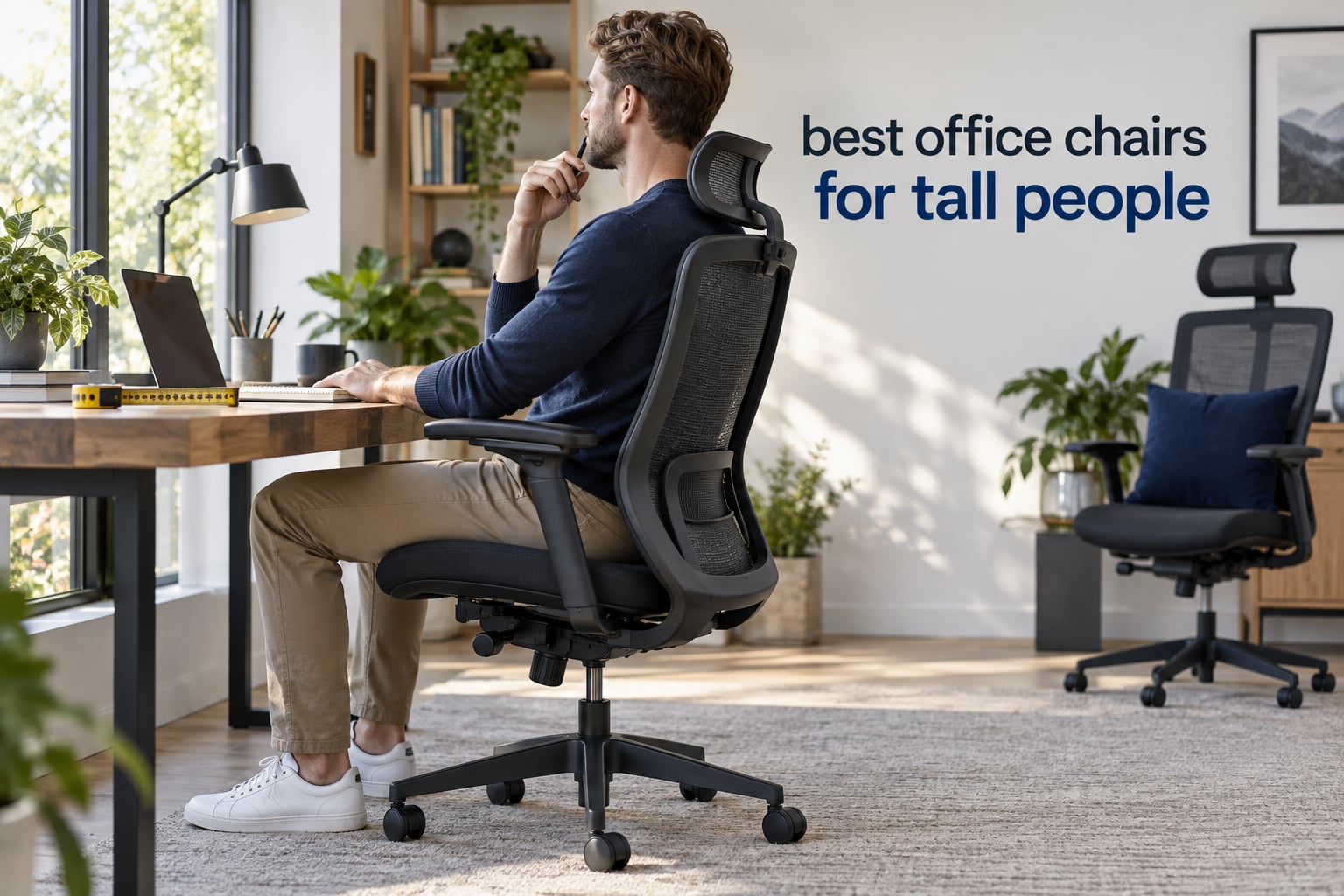
Most office chairs stop making sense at about 6 foot 2. The backrest that was comfortable at 5 foot 9 lands between the shoulder blades, the gas lift runs out of travel with your knees above your hips, and the seat pan that looked generous in the showroom turns out to be four inches short of your femur. Nothing is broken. The chair was simply engineered for a different body.
That is the whole problem behind this guide. After going through the spec sheets, adjustment ranges and owner feedback for the current crop of big-and-tall and tall-specific chairs, the pattern became clear: the best office chairs for tall people are not standard chairs scaled up. They differ in two ways that matter, seat height ceiling and seat depth, and they are sold with two different promises, geometry for height and structure for weight. Confusing those two promises is the single most common reason a tall buyer ends up dissatisfied six months in.
What follows is a fit-first breakdown of eight chairs, from a mesh task chair rated to 300 pounds through to a metal-framed chair rated to 700. Each one is judged on the numbers that decide whether a tall frame actually works: how high the seat travels, how deep the pan is, how tall the backrest runs, how much weight the structure carries, and whether the lumbar support moves to your spine or expects your spine to move to it. We have left out prices throughout, since they move daily; every review block carries a button that shows the current figure.
Two things up front. First, if you are shopping purely on height and sit under 250 pounds, most of the pain in this category comes from seat depth and backrest height rather than capacity, so read the measurement section before the reviews. Second, if you need more than about 350 pounds of capacity, the geometry options narrow sharply, and the chair that is right for you will probably not be the one with the most adjustability. We cover both paths in the buying guide.
Table of Contents
- Top 3 Picks for Tall People in 2026
- Quick Comparison of the 8 Best Office Chairs for Tall People
- Tall Is Not the Same as Big
- The Four Measurements That Decide Your Fit
- 1. GABRYLLY Ergonomic High Back Mesh Chair – Best Overall for Tall Frames
- 2. GTPLAYER L-CH510 Big and Tall Gaming Chair – Best for Tall and Heavy Frames
- 3. HON Sadie Big and Tall Ergonomic Chair – Widest Desk Chair Build
- 4. ELABEST X100 Ergonomic Chair – Best Lumbar Range for Tall Frames
- 5. BOLISS Drafting Tall Office Chair – Tallest Seat Height Range
- 6. HYLONE 400lb Big and Tall Office Chair – Budget Pick at the Entry Tier
- 7. COMHOMA Big and Tall High Back Chair – Best Value
- 8. Petheivun Big and Tall 700lb Office Chair – Best for 400 lb and Up
- How to Choose: Weight First, Then Height Band, Then Depth
- Frequently Asked Questions
- Final Verdict: Which Chair Fits You
Top 3 Picks for Tall People in 2026
These three came out ahead on the combination of published adjustment range, verified owner feedback from tall users, and how much of the frame is actually engineered rather than simply enlarged.

GABRYLLY Big and Tall Mesh Chair
- 22.05 inch seat height
- 20 inch seat depth
- 90 to 120 degree tilt lock with 3 positions
- flip-up armrests and 3D headrest

GTPLAYER L-CH510 400lb Chair
- 400 lb capacity
- 30.31 inch interior backrest height
- 22 inch seat depth
- retractable foot rest

HON Sadie Big and Tall Chair
- 22 inch seat
- 22.8 inch seat height
- 29.25 inch backrest width
- 3-year HON warranty
Quick Comparison of the 8 Best Office Chairs for Tall People
Every chair below appears once, with its published capacity, seat dimensions and the feature that decides fit for a tall frame. Use this as a filter before reading the individual reviews.
| Product | Specifications | Action |
|---|---|---|
| GABRYLLY Ergonomic High Back Mesh Chair |
|
Check Latest Price |
| GTPLAYER Big and Tall Gaming Chair 400lb |
|
Check Latest Price |
| HON Sadie Big and Tall Ergonomic Chair |
|
Check Latest Price |
 ELABEST X100 Ergonomic Mesh Chair with Footrest ELABEST X100 Ergonomic Mesh Chair with Footrest |
|
Check Latest Price |
 BOLISS Drafting Tall Office Chair BOLISS Drafting Tall Office Chair |
|
Check Latest Price |
 HYLONE 400lb Big and Tall Office Chair HYLONE 400lb Big and Tall Office Chair |
|
Check Latest Price |
 COMHOMA Big and Tall High Back Chair COMHOMA Big and Tall High Back Chair |
|
Check Latest Price |
 Petheivun Big and Tall 700lb Office Chair Petheivun Big and Tall 700lb Office Chair |
|
Check Latest Price |
Tall Is Not the Same as Big
Marketing blurs two completely separate problems, and buyers end up paying for the wrong one. Tall is a geometry question. Big is a structure question. A 6 foot 4 person at 175 pounds has a long torso, long femurs and a tall shoulder line, and almost no stress on the frame at all. A 5 foot 8 person at 320 pounds needs exactly the same chair width and the same welded base, but none of the extra seat height.
Geometry problems show up as discomfort. A seat pan that stops six inches short of the back of your knee pushes the back of your thigh against the front edge, which restricts circulation and pushes your pelvis into a posterior tilt. That tilt flattens your lumbar curve, and the pressure that should sit in the thigh bones ends up in the lower back. Long-torso users hit the mirror image: the backrest top edge stops at the shoulder blades, so there is nothing supporting the upper back when you recline.
Structure problems show up as failure, not discomfort. They are about the base casting, the welds in the frame, the class of the gas cylinder and the static load rating. Owner feedback in this category repeatedly describes chairs that felt fine for a year and then developed a wobble or a cylinder that crept downward, almost always in the 290 to 340 pound range where a chair rated at 300 pounds is genuinely at its limit rather than comfortably inside it.
This is also why the phrase big and tall on a product page often means neither. Several chairs in this roundup carry a 400 pound marketing label while listing a manufacturer recommendation of 300 pounds elsewhere in the same listing. One reviewer described a chair in exactly that situation as having a lower backrest noticeably narrower than its seat, which makes the big-and-tall claim misleading. We use the manufacturer maximum weight recommendation from the spec sheet, not the marketing name, in every review that follows.
Our advice is to treat the two problems as separate shopping tasks. Solve geometry first, because no amount of structural capacity fixes a short seat pan. Then confirm the capacity figure has at least 20 percent headroom above your own weight, which is the margin most manufacturers assume is built into their ratings.
The Four Measurements That Decide Your Fit
Before you look at a single chair, take a tape measure and collect four numbers. Every recommendation in this guide follows from these, and they take about five minutes. This method is the same one tall owners on office chair forums use when they post fit questions with their measurements attached.
1. Your knee height while standing. Sit against a wall and measure from the floor to the top of your kneecap. This is the seat height you need to get your feet flat, plus roughly one inch of cushion compression. If a chair’s published maximum seat height is below that number, stop reading. This is the single most common reason standard chairs fail tall users: the lift tops out and the knees drift above the hips, which loads the lower back.
2. Your hip-to-knee length. Sitting down, measure from the back of your hip to the back of your knee where it bends. Your seat pan needs to be within about one inch of that number. Longer femurs are the group most likely to be underserved, because a chair that fits a 6 foot 2 person with a 19 inch pan may leave a 6 foot 2 person with 21 inch femurs pressing against the front edge. A seat depth slider solves this outright, and it remains rare below the premium tier.
3. Your seat-to-shoulder length. Measure from the top of your seat to the top of your shoulder while seated upright. Compare that against the backrest interior height, not the overall chair height, which includes the headrest. Backrest interior height is the number that decides whether anything supports your upper back when you recline. Interior heights in this group run from 18.9 inches on the GABRYLLY to 30.31 inches on the GTPLAYER.
4. Your weight, plus 20 percent. Take the manufacturer maximum weight recommendation and subtract your body weight. If the margin is under 20 percent, look elsewhere, even if the chair fits your dimensions perfectly. A chair run at its rating puts constant stress on the gas cylinder and the base welds, and owners in the 290 to 300 pound range report the most complaints about settling lifts and wobbles.
One practical note on the fourth number: a listed weight capacity is a static rating, not a dynamic one. Rocking back, standing up and leaning sideways all apply far more than your static weight to the base. That is the margin the 20 percent rule protects.
1. GABRYLLY Ergonomic High Back Mesh Chair – Best Overall for Tall Frames
GABRYLLY Ergonomic Office Chair, High Back Home Desk Chair with Headrest, Flip-Up Arms, 90-120° Tilt Lock and Wide Cushion, Big and Tall Mesh Chairs for Man Woman, Black Task Chair
Seat height: 22.05 inch
Side depth: 20 inch
Backrest interior: 18.9 inch
Capacity: 300 lb
Pros
- 22 inch seat height clears the knee-height requirement for most tall users
- 20 inch seat depth suits longer femurs
- Flip-up armrests clear a standard desk
- Mesh back and seat stay cool over long days
- 5-year warranty
Cons
- Lumbar support is fixed rather than independently adjustable
- Armrests do not rise high enough for some forearms to rest
- Only three locked tilt positions with nothing mid-range
The GABRYLLY is the chair we keep coming back to, and the reason is that it attacks geometry rather than just capacity. A 22.05 inch maximum seat height is far above the roughly 20 inch ceiling of a typical task chair, and it is reached with a class-4 gas lift, which is the same class found on commercial drafting and lab seating. For a tall user whose knee height sits in the 21 inch range, that travel is the difference between feet flat on the floor and knees up by the hips.
The 20 inch seat depth is the second reason. That measurement is measured as side depth, so the usable sitting surface is a little under that once the waterfall edge is accounted for, which lands it squarely in the range that works for femurs between 19 and 20 inches. It is wider than most, at 20.5 inches across, which also stops the side edges from pressing into wider hips. The seat edge is a waterfall shape, so the pressure spreads over the underside of the thigh rather than cutting across the front of it.
Owners at 6 foot 1 to 6 foot 3 and 200 to 300 pounds describe it as outperforming chairs they paid several times more for, and one recurring detail stands out: the customer service sends extended gas cylinders, upgraded wheels and replacement parts when something is not right. That matters more than it sounds, because the single most common tall-user complaint in this category is a cylinder that runs out of travel.
Worth flagging honestly: the product listing states a recommended user height of approximately 5 foot 2 to 6 foot 1, which is narrower than the measured dimensions suggest. The seat height and depth numbers are what the chair actually delivers, and those serve taller users. If you are 6 foot 3 or above, check the optional extended cylinder rather than relying on the stated range.
The backrest is where this chair is weakest. Interior height is 18.9 inches with a width of 18.5 inches, which covers a mid-back well for most tall users but stops short of the shoulders. If you plan to recline regularly or you have a long torso, the 3D headrest fills some of that gap by taking the upper back’s share of the load, though it adds height rather than mid-back support. The lumbar support is fixed in position. It is shaped and placed sensibly, but it does not move with you.
Tilt is a three-position lock between 90 and 120 degrees, which is a wide range with nothing in the middle. Users who want to stop at a 105 degree working angle cannot. The flip-up armrests rotate back 45 degrees, and that is the feature that solves the desk clearance problem better than any other chair here, because the arms clear the surface entirely rather than sitting just below it. If you work at a standard 30 inch desk with no drawer, this is worth more than the missing lumbar range.
Who the GABRYLLY suits best
This is the pick for a tall, average-weight user who works at a normal desk and needs seat height above 20 inches. It handles 6 foot 1 to 6 foot 3 comfortably, and the mesh construction keeps it cool through an eight-hour day, which matters more than comfort ratings suggest for anyone in a warm room.
If you are over 300 pounds, this is not your chair, full stop. The rating is a maximum rather than a comfortable working load, and the 20 percent headroom rule pushes the safe number down further. For that weight range, look at the GTPLAYER or the Petheivun instead.
Where it falls short
The armrests are 1D, height only, and owners of longer forearms report they cannot get them low enough to relax the shoulders or high enough to support the elbows properly. There is no width or fore-aft travel, so the fixed lumbar has to do all the shaping work.
Assembly is around 15 to 20 minutes with included tools, and one recurring note is that the supplied Allen wrench did not fit the supplied bolts. Worth having a 4 mm hex key on hand before you start. The chair weighs 41 pounds, so get a second person for the base assembly if you are setting it up alone.
2. GTPLAYER L-CH510 Big and Tall Gaming Chair – Best for Tall and Heavy Frames
GTPLAYER Big and Tall Gaming Chair 400lbs Heavy Duty Office Chair with Foot Rest & Ergonomic Pocket Spring Lumbar Support, High Back 3D Saddle Shaped Cushion for Back Pain Relief, Matte-Black
Capacity: 400 lb
Seat depth: 22 inch
Backrest interior: 30.31 inch
Recline: 90 to 150 degrees
Pros
- 400 lb capacity with roomy wrap-around sides
- 22 inch seat depth suits long femurs
- 30.31 inch interior backrest covers long torsos
- Retractable foot rest extends the session
- Pocket-spring lumbar cushion holds its shape
Cons
- Faux leather runs hot during long sessions
- Seat foam feels board-like until broken in
- Foot rest hardware and brackets look flimsy
This is the most reviewed chair in the group by a wide margin, and the number is deserved rather than inflated. It is a gaming chair scaled up deliberately, with a 22 inch seat depth, a 22.05 inch backrest width and a 30.31 inch interior backrest height. Those three numbers together make it the most accommodating option here for a 6 foot 4 to 6 foot 6 frame with long femurs.
The saddle-shaped seat is a memory foam construction with a 360 degree even-pressure layer, and the backrest carries a pocket-spring lumbar cushion inside dual-layer high-density sponge. The frame is metal rather than nylon, and it sits on a heavy-duty metal base with a three-level gas lift. That structural package is what the 400 pound rating is built on, and owners in the 300 to 375 pound range consistently report that it holds.
Recline runs from 90 to 150 degrees and stays stable when leaned back, which owners pair with the retractable foot rest for breaks and for working through phone calls. The arms can be angled outward or removed entirely, a detail that matters for anyone who finds fixed side bolsters restrictive.
The honest weakness is heat. Faux leather over dense foam does not breathe, and that is the specific complaint raised in tall and large forums about gaming chairs in this class. Anyone running six-hour-plus sessions in a warm room will feel it, and the solution is a clip-on breathable seat and back cover rather than a different chair. The second issue is the foam itself, which several owners describe as board-like for the first few weeks of use before it softens.
The foot rest is a bonus rather than a core feature. The support tubes and their plastic brackets are the least convincing part of an otherwise solid build, and it is best treated as a place to rest bare feet during a break rather than as a load-bearing leg rest. The included lumbar and neck pillows attach with elastic clasps that are awkward to refit, which is a small annoyance every time you reposition them.
One more note on dimensions: a 6 foot 2 user sitting 6 foot 4 finds the chair rides high even at the lowest gas lift setting, because the frame is built for a larger occupant. That is a feature for the people it is designed for and a problem for everyone else.
Who the GTPLAYER suits best
This is the pick for tall and heavy users, particularly anyone between 6 foot 3 and 6 foot 6 carrying 300 pounds or more. The combination of 400 pound capacity, 22 inch seat depth and a 30 inch interior backrest is the best geometry-plus-structure package in this roundup, and it is the only chair here rated to 400 pounds that also offers a foot rest.
If your work involves any gaming or long uninterrupted sessions, the recline range and the foot rest earn their place. The wing sides also give genuine lateral support, which heavier users tend to value more than they expect.
Where it falls short
The one-year warranty is the shortest of any chair here and the reason we would not place it at number one despite the rating and review count. Long-term durability reports are positive, but the cover is thin, and one year of parts coverage on a chair this size is a real limitation.
Heat management is the second limitation, and it is worth solving before a full workday rather than after. A breathable overlay costs little and changes the experience for anyone in a warm room. If heat is a hard constraint for you, the mesh chairs in positions 1, 3 and 4 will serve better.
3. HON Sadie Big and Tall Ergonomic Chair – Widest Desk Chair Build
HON Sadie Big and Tall Ergonomic Office Chair, Heavy Duty Desk Chair, Black
Seat length: 22 inch
Seat height: 22.8 inch
Backrest width: 29.25 inch
Capacity: 400 lb
Pros
- 22 inch seat length avoids hip pinching
- 29.25 inch backrest width is the widest here
- Thick foam seat reported to hold shape after years
- Adjustable lumbar and height-adjustable arms
- 3-year HON warranty
Cons
- No headrest on this configuration
- Plastic lumbar can dig into the mid-lower back when tilted
- Raised arms can strike a standard 30 inch desk
The HON Sadie takes a different approach from everything else here. Where most big-and-tall chairs add height, this one adds width, and the numbers are unusually specific: a 29.25 inch backrest width and a 22 inch seat length on a chair that still reads as a conventional desk chair rather than a gaming chair. For anyone who has pinched hips on a nominally big-and-tall seat, that width is the whole point.
Seat height tops out at 22.8 inches, comfortably above the roughly 20 inch ceiling of a standard task chair, with a 19.8 inch depth. That combination suits tall users with average femurs better than it suits the very long-femur end of the range. If your hip-to-knee measurement is above 20 inches, the depth is going to feel short and you should look at the GTPLAYER instead.
Long-term owners call it the sturdiest big-and-tall chair they have owned, and the most common specific praise is for the thick springy foam seat still holding its shape after six years of daily use. That matters for heavier users, because a compressed foam pan forces a forward lean and the lower back takes the load. The adjustable lumbar and height-adjustable arms are both straightforward and both work.
The trade-offs are honest ones. There is no headrest on this configuration, so a long-torso user who wants upper-back support when reclining does not get it. The lumbar support is a plastic piece rather than a padded or spring-loaded assembly, and owners report it digging into the mid-lower back when the chair is tilted hard, which is a common way to sit in a large-frame chair.
Tilt behaviour is the other recurring complaint. Several owners describe the chair rocking and wobbling at its hardest settings, particularly when the seat is loaded toward one edge. The frame is a plastic and metal construction rather than all-metal, which explains both the weight of 44 pounds and the flex at full tilt.
Check your desk before ordering. Fully raised armrests can strike a standard 30 inch desktop, and because the arm height is listed at 7.6 inches, you want to measure the gap between your desk underside and your thigh before you settle on the tallest position. Owners are split on this one more than almost anything else in the category.
Who the HON Sadie suits best
This is the pick for a wide, taller-than-average user who works at a normal desk and wants a chair that looks like office furniture. The 22 inch seat length and 29.25 inch backrest width are among the most generous proportions in this roundup, and the thick foam seat is a good long-term choice for anyone over 250 pounds who will use the chair daily.
It also suits anyone who wants a 400 pound rating without a wing back or a foot rest. The mesh back keeps it cooler than the faux leather options, and the 3-year HON warranty is the second longest here.
Where it falls short
Long torsos are the weak spot. With a 22.5 inch interior backrest and no headrest, there is nothing above the shoulder blades, and that is a real limitation for anyone who reclines to think or takes calls from the chair.
Supplied casters are the other weak point. Owners describe them rolling poorly out of the box, and replacing a set of casters is an easy fifteen-minute job that materially improves the experience on carpet. A small number of owners also report bolts that did not thread cleanly into their mounting holes, so check the hardware before you start assembly.
4. ELABEST X100 Ergonomic Chair – Best Lumbar Range for Tall Frames
ELABEST X100 Ergonomic Mesh Office Chair with Footrest, Big and Tall Hone Desk Chair with 5D Flip-Up Arms, Adjustable 3D Lumbar Support,Gaming & Executive Computer Chairs
Seat height: 18.3 to 23 inch
Lumbar: 3D with rotation
Capacity: 300 lb
Footrest: 18 inch
Pros
- 3D lumbar adjusts in depth height and rotation
- 5D flip-up arms with four axes of movement
- Customisable backrest position gains effective seat depth
- 18 inch footrest with two angle positions
- Quiet casters and fast proactive support
Cons
- Mesh seat edges are firm and press into the backs of knees
- Footrest is stiff to extend and short for full leg support
- On some versions arms mount to the backrest and limit travel
The X100 carries the highest rating in this group at 4.6 across 1285 reviews, and the reason is a single feature: it is the only chair here whose lumbar adjusts in all three directions. The lumbar pad adjusts in depth, in height and through 15 degrees of rotation, which is the movement your lower back actually performs when you shift position. A fixed lumbar bulge, by contrast, works only in one plane and pushes the spine away from it rather than supporting it.
For tall users this matters more than the seat numbers suggest. A long torso means a lumbar apex higher up, and a lumbar that only moves in height has to be dialled in rather than adapted to. Owners repeatedly describe this as the feature that resolved chronic back and neck pain, and several compare the chair favourably to premium models costing several times as much.
The armrests are 5D, meaning height, width, fore-aft and pad rotation, and they flip up to clear the desk. The backrest position is customisable, and that is the clever part of the design for tall users: moving the backrest forward effectively lengthens your usable seat depth, which is a workaround for the 18 inch nominal pan. One owner at 6 foot 3 and 235 pounds confirms it fits a tall frame without complaint.
The 18 inch extendable footrest with two angle positions is genuinely useful for tall users because it closes the gap that appears when the seat sits at the top of its travel. It is stiff to extend, however, and several owners note it is not long enough to fully support the legs, so treat it as a calf rest rather than a full leg rest. Adding a padded seat cover removes the footrest mechanism, which is a trade-off worth knowing before you buy one.
Two version-dependent issues come up. On some builds the armrests mount to the backrest, which limits vertical travel and pulls the backrest forward when the arms are raised. That directly reduces the effective seat depth, which is the main thing this chair is for, so check the listing carefully. The headrest also runs out of vertical extension before the tallest users are satisfied, though the 3D lumbar makes up a good deal of that gap.
The mesh seat edges are firm and several owners report them pressing into the backs of the knees during long sessions. This is a common trade in mesh task chairs and there is no adjustment for it, so if you are sensitive to that pressure, add a thin seat pad or test before committing.
Who the ELABEST X100 suits best
This is the pick for a tall, lighter user, roughly 180 to 300 pounds, who has a long torso and has had trouble finding a lumbar support that sits where their lower back actually is. If you spend your day shifting position rather than holding one posture, the 3D lumbar plus the customisable backrest is the most capable fit mechanism in this roundup.
It is also the strongest choice for a desk with clearance problems, because the flip-up 5D arms fold back completely. Seat height reaching 23 inches clears almost any tall user’s knee height, and the casters are quiet on hardwood and carpet, which matters if you share a room.
Where it falls short
The 300 pound capacity is the hard limit here, and it is a real one for a tall frame. If you weigh over 280 pounds, the 20 percent headroom rule rules this chair out regardless of how well the adjustability suits you.
It is also the least suitable option for anyone who runs hot, since both the back and the seat are mesh with a firm edge. The footrest helps, but the stiffness of the extension and its length limit how much use you will realistically get out of it. Assembly is tool-free and takes around 15 minutes, the quickest claimed build in this group.
5. BOLISS Drafting Tall Office Chair – Tallest Seat Height Range
BOLISS Drafting Tall Office Chair 400lbs High Back Standing Desk Chair
Seat height: 24.8 to 32.1 inch
Hydraulic range: 7.3 inch
Capacity: 400 lb
Pros
- Tallest published seat height range in this group
- Works with standing desks draft tables and bars
- Large adjustable chrome foot ring
- 400 lb capacity on a balanced five-star base
- Flip-up arms and 4-level headrest
Cons
- Seat pan curves down and can irritate the lower back
- Hydraulic lift can settle under load on some chairs
- Only one recline position with no tilt adjustment
Nothing else in this roundup reaches that range. The BOLISS runs from 24.8 to 32.1 inches, a 7.3 inch hydraulic range, which means a 6 foot 4 user can sit with feet flat and knees below the hips in a way that no task chair allows. Tall reviewers in the 6 foot 2 to 6 foot 6 range describe it as the first chair that let them reach a proper ergonomic height, and several report that neck, shoulder and knee strain resolved once they had it.
That makes it a different category of chair rather than a taller task chair. It is built for standing desks, draft tables, kitchen islands, bars and lab benches, and the chrome foot ring adjusts to your leg length so your feet have somewhere to go when the pan is above foot level. The foot ring is the detail that separates a drafting chair from a task chair on a high cylinder, because it takes the load off the backs of your thighs.
Capacity is 400 pounds on a heavy-duty five-star nylon base with quiet casters, the seat is a 4 inch moulded foam cushion over a nylon and plywood frame, and the 20.1 inch depth is generous. Flip-up padded arms, a freely adjustable lumbar cushion and a 4-level 3D headrest round out the package. Assembly is quick with all tools included.
The dominant complaint, and it appears in a large share of the feedback, is that the seat pan curves downward at the lumbar. For shorter users this feels pleasant. For a tall user sitting at the top of the range with weight distributed forward, the curve presses into the lower back and causes pain when standing up. The fix that most buyers choose is an added seat cushion, which is cheap and resolves it properly, so factor that into your decision rather than treating it as a defect.
There is no tilt adjustment at all, just a single recline position, so this chair cannot rock back and think. That is a fair trade for the height, and it is the price of the drafting format, but it does rule it out for anyone who wants movement through the day. A minority also report the hydraulic lift settling noticeably under load, which is worth checking during the first week and reporting early.
The headrest on the raised position sits well above the shoulders of anyone under 6 foot, which is a non-issue for the intended user and a clear signal that this chair is not adjustable down into a normal task chair range.
Who the BOLISS suits best
This is the pick for a tall user at a standing desk, a counter or a drafting table, and for anyone whose knee height measurement is above 22 inches and who has found that standard task chairs simply top out. Reviewers describe it as resolving the specific problem of knees rising above hip level, which is the most common cause of lower-back fatigue reported by tall sitters.
It also works well for 6 foot 5 and up users who want to be genuinely tall in the chair rather than tall by proportion, since the backrest height, the headrest travel and the foot ring all scale to that. At 400 pounds it covers the taller and heavier end as well.
Where it falls short
It is not a task chair. One recline position, no tilt, no synchro mechanism and a fixed frame mean that if your work involves shifting position, thinking while reclined or working through a long call, you will be sitting rigidly upright the whole time.
The seat pan curve is the second limitation and it is the one most likely to affect you daily. Buy a seat cushion as part of the setup. The warranty is two years with free replacement of defective parts, which is shorter than the HON and the GABRYLLY and considerably shorter than the 5-year coverage on the ELABEST.
6. HYLONE 400lb Big and Tall Office Chair – Budget Pick at the Entry Tier
HYLONE 400lb Office Chair Big and Tall,Desk Chair with Lumbar Support,Black
Seat length: 21.5 inch
Cushion: 5 inch sponge
Capacity: 400 lb
Base: 28 inch five-star
Pros
- 5 inch sponge cushion rated comfortable by users over 210 lb
- 21.5 inch seat length suits bigger frames
- Flip-up arms tuck the chair under a desk
- 28 inch base stays stable at full height
- 24-month parts support
Cons
- Lower backrest is much narrower than the seat
- Curved plastic behind the arms reduces usable width
- Best fit is around 5 foot 5 to 6 foot 2
The HYLONE does one thing extremely well: it puts a genuinely thick cushion under you. The 5 inch streamlined sponge seat is the standout feature in owner feedback, with reviewers above 210 pounds calling it unusually comfortable and several noting it solved problems they had been living with on cheaper chairs. For a heavier user whose complaint is that firm big-and-tall seats press into the tailbone, that cushion is the entire value proposition.
The dimensions back it up on paper. A 21.5 inch seat length with a 19 inch depth and a 400 pound capacity is a roomy package, and the 28 inch five-star base gives real stability at the top of the height range. Flip-up armrests let the chair tuck under a desk, and casters roll smoothly across carpet, tile and wood according to owner reports.
Height adjustment is listed at 19.6 inches at the top of the published figure, and the manufacturer recommends users approximately 5 foot 5 to 6 foot 2. That recommendation matters more here than on any other chair in this roundup, and we come back to it below.
The central issue is the mismatch between the seat and the backrest. The lower backrest is noticeably narrower than the seat, and curved plastic panels behind the armrests reduce the usable width further, so the advertised big-and-tall sizing feels inconsistent once you are sitting in it. One reviewer described the gap between the marketing and the reality as misleading, and that is a fair characterisation of how the chair feels in the first ten minutes.
Backrest height is the second limitation and it follows from the same design. For a 6 foot 2 to 6 foot 3 user with a long torso, the back simply does not run high enough, and there is no headrest to compensate. For 6 foot 4 and above, this chair is not the answer regardless of its 400 pound rating, because the rating describes weight capacity and says nothing about proportions.
Quality control is worth a mention too. A small number of owners report chairs arriving with stained or dented components, which is a packing issue rather than a design flaw, but photograph the chair on arrival in case it happens. Support runs 24 months of free parts with a stated 24-hour response promise.
Who the HYLONE suits best
This is the pick for a big-framed, average-height user between roughly 5 foot 8 and 6 foot 2 who weighs between 210 and 350 pounds and wants a soft seat. The thick cushion is the reason to buy it, and if your previous chairs have left you with tailbone or sciatic discomfort, a 5 inch sponge pan is a genuine change of experience rather than a marginal improvement.
It is also a good second chair for a shared space, a spare for a guest room, or a first ergonomic purchase where you want to spend little and find out how much a thick seat helps before committing to a premium model.
Where it falls short
The narrow lower backrest is the dealbreaker for long-torso users, and no adjustment fixes it. If your seat-to-shoulder measurement is long relative to your height, the HON Sadie is the better shape at a similar class.
Second, the height ceiling is modest for a 400 pound chair, so a tall and heavy user gets the weight capacity without the geometry. That combination is the central trap of this category, and this chair demonstrates it more clearly than most. Flip-up arms are a genuine advantage, but there is no tilt lock, no headrest and no lumbar depth adjustment to compensate.
7. COMHOMA Big and Tall High Back Chair – Best Value
COMHOMA Big and Tall Office Chair, High Back Leather Gaming Chair with Footrest, Executive Ergonomic Office Chair with Pocket Spring Lumbar Support and with Outward Fixed Soft Armrests
Seat depth: 19.7 inch
Base: BIFMA rated 300 lb
Recline: 90 to 135 degrees
Gas lift: SGS-3
Pros
- No restrictive side wings so cross-legged sitting works
- Sturdy all-metal frame and armrest structure
- Recline from 90 to 135 degrees stays stable
- Very clear illustrated instructions with a video
- Footrest stores almost invisibly
Cons
- Armrests are fixed and cannot be adjusted at all
- Lumbar bolster starts stiff and often needs a cushion
- Footrest feels fragile under heavier load
The COMHOMA is one of the most straightforward entries here, and its spec sheet is the most reassuringly well documented. The base is BIFMA-certified to 300 pounds, the gas lift is an SGS-3 unit tested over 120,000 lift cycles, and the recline range is 90 to 135 degrees. That level of third-party testing is rare at this price and it is the reason this chair ranks here rather than lower.
The seat has no restrictive side wings, which is a real ergonomic advantage for a tall user who wants to cross their legs or shift position freely. The back is a 3D wrapping design in dual-layer high-density foam with high-loft fibre, plus an oversized adjustable lumbar pillow, and the frame and armrest structure are metal rather than nylon. Owners of tall frames around 6 foot 4 and 250 pounds confirm it fits and works.
Assembly is genuinely good, with clearly illustrated instructions and a QR code linking to a video, and that sets it apart. The retractable footrest stores almost invisibly under the seat, which matters in a small home office.
The fixed armrests are the defining limitation. They are non-adjustable in height or width, they angle outward, and they cannot be removed. For a tall user this is more serious than it sounds, because fixed arms at the wrong height either push the shoulders up or leave the forearms unsupported, and neither is comfortable for eight hours.
The second issue is the lumbar bolster, which starts stiff out of the box and many owners supplement with a separate cushion. The footrest also feels fragile under heavier load and is realistically a foot rest rather than a leg support. The chrome trim reads as inexpensive next to the all-metal frame it sits on, which is a cosmetic mismatch rather than a structural one.
There is also a small but real cluster of durability complaints about the recline mechanism, including one report of a backrest lock releasing and the chair tipping within a year of normal use. At a 4.2 rating this is the lowest-scored chair in the group, and the 9 percent one-star share is the highest of the eight. That is not disqualifying at this price, but it is the reason this is not the top pick.
Who the COMHOMA suits best
This is the pick for a tall user on a tight budget who wants a recliner with a footrest, values a stable frame over fine adjustment, and can work around fixed arms. The height adjustment range of 10 cm is listed for users between 5 foot 1 and 6 foot 2, so treat this as a chair for the lower end of tall rather than for 6 foot 5 and up.
It works well as a second or occasional chair, or for anyone who spends part of the day reclined with their feet up. The metal frame and BIFMA base give more confidence than the price would suggest, and the light-to-mid weight range is where it performs most consistently.
Where it falls short
Fixed armrests are the dealbreaker for a full-time user. If you type for a living, unsupported forearms and raised shoulders will show up as neck pain within a few weeks, and no setting on this chair fixes it.
Beyond that, the lumbar needs supplementing, the footrest is not a load-bearing leg rest, and the recline lock durability reports are worth weighing against the 4.2 rating. If you need a chair you will sit in for a full working day, spend up a tier for anything with adjustable arms.
8. Petheivun Big and Tall 700lb Office Chair – Best for 400 lb and Up
Big and Tall Office Chair 700lbs, Ergonomic High Back Computer Desk Chair
Capacity: 700 lb
Gas cylinder: SGS Class 4
Lumbar: inflatable airbag
Frame: metal base
Pros
- Extra-wide seat avoids the hip-pinching arm mounts
- Airbag lumbar lets you set your own back pressure
- Headrest stays correctly placed when reclined
- 3D flip-up arms extend forward for long arms
- Upgraded rubber casters will not mark hard floors
Cons
- Armrests slide fore and aft without locking
- Recline has strong self-righting force
- Arms sit too far back for very large users to push up
- Minimum height still suits users around 6 foot and up
The Petheivun is the only chair here rated to 700 pounds, and while no one should treat a 700 pound rating as a comfort target, the engineering behind it is real: a heavy-duty metal base, a metal frame and an SGS-certified class 4 gas cylinder tested over 100,000 cycles. At 63 pounds it is the heaviest chair in this roundup, and that weight is the structure doing its job.
What makes it interesting for tall users is the arm mounting. The extra-wide seat avoids the arm mounts that pinch the hips on most heavy-duty chairs, which is the single most common complaint tall and heavy owners report. The 3D arms extend forward for long-armed users and can be flipped back or removed entirely, and the overall dimensions of 33.8 by 28.7 by 49.2 inches give a genuinely large sitting area.
The inflatable airbag lumbar is unusual and genuinely useful. Instead of sliding a plastic or foam piece up and down, you inflate or deflate the bolster until the pressure matches your lower back, which works for a wide range of body sizes on the same chair. The headrest adjusts up and down and, according to owners, stays correctly placed when the seat reclines, which is not true of most headrests in this class.
The armrests are the problem. They slide forward and back without locking, so they shift under pressure during the day and you end up readjusting them constantly. They also sit too far back and are too short for the largest users to push up from the seat, which is a genuine problem for anyone over 350 pounds using the chair several times a day.
The recline has strong self-righting force, meaning you have to push deliberately to lean back and push again to return upright. It is a rocking seat with multiple positions, which suits reading and relaxing and frustrates anyone who wants a light, easy lean for focused work.
Height is the third limitation. Owners in the 6 foot 4 to 6 foot 6 range at 290 to 400 pounds describe the fit as excellent, but the minimum seat height still leaves the chair too tall for anyone around 6 foot. In other words, this is a chair for a specific intersection of height and weight, and if you are under 6 foot 2 it will not work regardless of your weight.
Assembly instructions use very small pictures and arrows, which owners find frustrating, and a few chairs have arrived with defective arm-mounting screws or transit damage. Budget twenty minutes and check the hardware.
Who the Petheivun suits best
This is the pick for tall and heavy users in the 350 to 500 pound range who have been pinching their hips on every other big-and-tall chair. The arm-free seat width is the differentiator, and several owners in that weight range describe it as the only chair that fit without compressing their hips or legs.
It is also a good choice for anyone who wants to dial in back pressure rather than hunt for a lumbar height, and the adjustable headrest that holds its position when reclined makes it usable for a tall frame that wants upper-back support. The rubber casters that will not mark hardwood, laminate, tile or vinyl are a small detail that matters if you care about the floor.
Where it falls short
The non-locking armrests are the main flaw, and they undercut an otherwise well-proportioned design. For anyone who needs to push up from the seat regularly, the short, rearward arms work against you.
Second, the strong self-righting recline forces effort to use, and there is no gentle tilt for typing. Third, the minimum height rules out anyone under roughly 6 foot, and the 700 pound figure is a structural limit rather than a comfort rating, so the practical comfortable ceiling is nearer 400 pounds. Owners consistently note that it looks far more expensive than it costs, which is a fair summary.
How to Choose: Weight First, Then Height Band, Then Depth
Most buying guides start with style or upholstery. Start with structure instead, then work down. The order matters because the wrong first choice cannot be corrected by any amount of adjustment downstream.
Step one: confirm the weight rating with headroom. Take the manufacturer maximum weight recommendation and check that your body weight sits at least 20 percent below it. A chair rated to 300 pounds is a good chair at 240 pounds and a compromised chair at 290. If nothing in your shortlist clears the margin, that is a signal to look at extended warranty and replacement parts availability, or to accept a firmer frame with a shorter warranty.
Step two: place yourself in a height band against the seat height ceiling. Under 6 foot 2, a standard chair with a 19 to 20 inch seat height may work, though seat depth still decides comfort. Between 6 foot 2 and 6 foot 4, you want a published maximum of 21 inches or more, which is where the GABRYLLY, the HON Sadie and the ELABEST all land. Above 6 foot 4, you want either a drafting chair with a foot ring or a chair with a 25 inch-plus interior backrest height, which is a much shorter list.
Step three: check seat depth against hip-to-knee, then work outward. Seat depth is the most commonly ignored number in this category and the one tall owners complain about most. If your measurement is longer than the pan, the options in ascending order of effort are: reposition the backrest forward if the chair allows it, add a seat pad, or buy a chair with a genuine seat slider. A small number of premium chairs in this category have a depth slider; almost nothing below the premium tier does.
Step four: look at armrests against your desk, not at the chair. Measure the clearance between the underside of your desk and your thigh with your feet flat on the floor. Anything less than about 10 inches means raised armrests will hit the desktop, and this is where flip-up arms earn their place. The GABRYLLY and the HYLONE fold back completely, the ELABEST flips up, and the HON Sadie and the COMHOMA will collide with a standard 30 inch desk if the arms are raised.
Step five: decide on the backrest by how you sit. If you hold one upright posture all day, a fixed lumbar in a well-proportioned chair is fine. If you shift position, recline to think or work through calls, you want lumbar depth adjustment and a headrest that stays put when the back tilts. This is where the ELABEST leads and where the HON Sadie falls short.
If your chair will not adjust in height at all: the most common causes are a cylinder that has been over-extended by someone taller sitting at maximum height for a long period, a control lever or knob that is not fully disengaged, air trapped in the cylinder, or a mechanical failure in the lift itself. A dropped chair that will not rise at all usually indicates a failed cylinder, and replacing the cylinder is a standard fifteen-minute job on most of the chairs here provided you match the class, the stroke and the mounting pattern. A class-4 cylinder is the one to look for on a tall frame, since a class-3 unit tops out sooner. Owners of the GABRYLLY report good results asking the manufacturer for an extended cylinder, which is worth trying before buying a new chair.
On trial periods. Almost every chair in this roundup can only be judged by sitting in it, and the measurements in the spec sheets describe capability rather than comfort. Confirm the return window and whether return shipping is paid before you order, particularly on the larger boxes, and if you can, sit in a showroom equivalent first. A chair that is right for your measurements can still be wrong for your shape, and the reverse is also true.
For people shopping at a heavier weight class rather than purely by height, our big and tall office chair guide goes further into frame construction and base ratings. If your hours are split between work and gaming, the gaming chairs for tall people piece covers the heat and posture trade-offs in more detail, and the executive chairs for big and tall users guide covers higher-back leather builds.
Frequently Asked Questions
What is the best chair for someone who is 6 feet tall?
At 6 feet, most standard task chairs fit you on height but may leave the seat a little short for your femurs. Look for a published maximum seat height of at least 20 inches and a seat depth within an inch of your hip-to-knee measurement. In this group, the GABRYLLY at a 22.05 inch seat height and 20 inch depth is the strongest default choice, while the ELABEST X100 suits long torsos because its lumbar adjusts in depth, height and rotation.
What is the best chair height for tall people?
Aim for a seat height that puts your hips level with or slightly above your knees, with your feet flat on the floor and a small gap behind the backs of your knees. The measurement that decides this is your knee height while standing, measured from the floor to the top of your kneecap. Add about an inch for cushion compression and make sure the chair’s published maximum seat height reaches that number.
What is the maximum seat height for an office chair?
Standard task chairs usually top out around 19 to 20 inches, which is where most tall users run out of gas lift travel. Drafting chairs go far higher: the BOLISS in this roundup is rated from 24.8 to 32.1 inches with a 7.3 inch hydraulic range, and pairs with an adjustable foot ring so your thighs are not taking the load. If your knee height is above 22 inches, a drafting chair is the only category that reliably reaches you.
What is the best office chair for a tall, heavy person?
Tall and heavy means you need both geometry and structure, and the two together are rare. The GTPLAYER L-CH510 combines a 400 pound rating with a 22 inch seat depth and a 30.31 inch interior backrest height, which is the most complete package here. The Petheivun carries a 700 pound rating and an extra-wide seat that avoids the hip-pinching arm mounts found on most heavy-duty chairs, making it the better choice above 350 pounds. The GABRYLLY and ELABEST both cap at 300 pounds and are not appropriate above that.
What are the reasons my office chair will not adjust in height?
The usual causes are a cylinder that has been left fully extended and has crept, a control lever or knob that has not been fully disengaged, air trapped inside the cylinder, or a failed lift. A chair that sinks and will not rise usually points to a failed cylinder, which is a standard replacement job provided you match the class, stroke and mounting pattern. On a tall frame, look for a class-4 cylinder, since class-3 units top out sooner.
Final Verdict: Which Chair Fits You
Start with your numbers, not the photographs. If your knee height is above 20 inches and your hip-to-knee measurement is 19 to 20 inches, the GABRYLLY is the pick: a 22.05 inch seat height, a 20 inch depth, flip-up arms and five years of warranty, held to 4.4 stars across 14200 reviews. It is the best office chair for tall people in the general case because it solves the two geometry problems without asking you to compromise on anything else.
If you are 6 foot 3 or above and over 300 pounds, the GTPLAYER L-CH510 takes it: 400 pounds, a 22 inch pan, a 30 inch backrest and a foot rest, with the largest review base of the group. Above 350 pounds where hip pinching is the recurring problem, the Petheivun is the more considered answer despite its 4.3 rating.
For a long torso and a narrow seat at a normal desk, the HON Sadie is the most proportionate chair here. For a standing desk or a counter, the BOLISS drafting chair is the only one that reaches you. For a tall and light user whose problem is lumbar, the ELABEST X100 is the most adjustable chair in the roundup. The HYLONE and the COMHOMA are the sensible low-commitment entries, each with a specific compromise you should accept deliberately.
Take the four measurements, match them to the numbers above, and you will not be guessing. If the chair still feels wrong after a few weeks, the problem is almost always seat depth, and that is the one thing no amount of adjusting the gas lift will fix.