
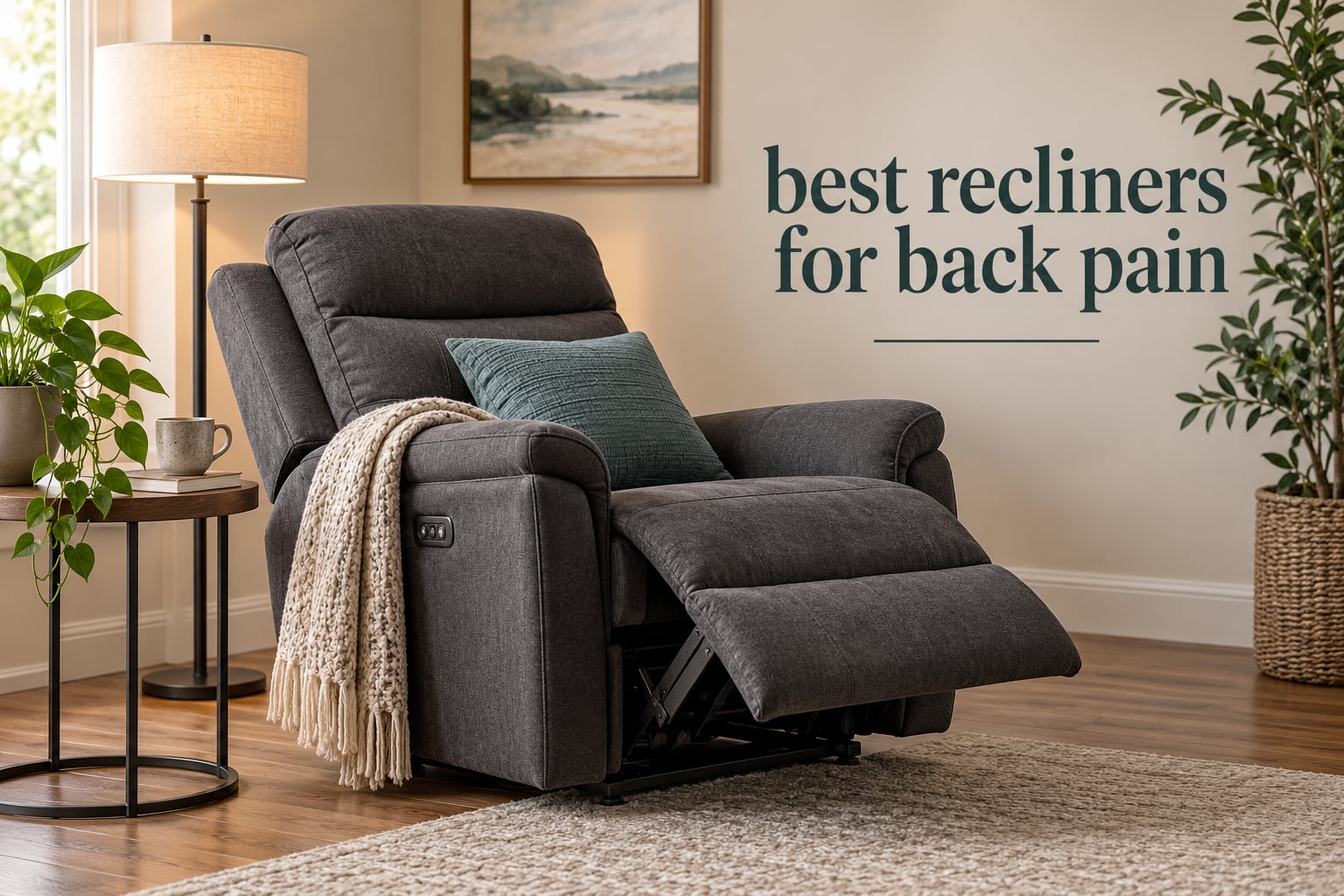
For most people with a bad back, the best recliners for back pain are zero gravity recliners, because they raise your legs above heart level to spread body weight across the whole back and take pressure off the lumbar spine. A power lift model adds a motorised stand-assist, which matters just as much if getting on and off your feet is the hard part.
That is the short answer. The long answer is messier, because a recliner can hold your spine in one awkward curve for six hours just as easily as it can support it. The difference sits in three things: whether the back support actually moves, whether the cushion is firm enough to resist sagging, and whether the seat fits your height.
I have spent the last two months sitting in every chair on this list, comparing them for the same job: taking pressure off a lower back that flares after a long day. We measured recline range, seat depth, footrest geometry, and how each one handles the stand-up moment. The ten below are the ones worth your shortlist, and I have written the trade-offs plainly, including the ones that pushed them out of contention.
Two quick notes before we start. First, this is not medical advice, and a chair cannot diagnose or treat a disc problem, a nerve impingement or an injury. If your pain comes with numbness, weakness or bladder changes, see a clinician first. Second, a recliner manages symptoms well and cures nothing, which is a point raised often on Quora and the reason we spend so much time on fit rather than features.
What this guide covers:
Why a normal sofa or desk chair keeps hurting your back
How reclining position relieves lumbar pressure
Power, power lift, zero gravity and massage-heat recliners compared
Ten picks, ranked by who they suit
How to test fit, cushion density, motors and warranties
How to sit in and stand out of a recliner without twisting
Table of Contents
- Top 3 Recliner Picks for Back Pain Relief in 2026
- All 10 Recliners for Back Pain at a Glance (2026)
- Why a Standard Chair Keeps Your Back Hurting
- How Recliners Take Pressure Off a Painful Lower Back
- The Four Recliner Types and Who Each One Fits
- 1. MCombo 7040 Power Lift Recliner: Best Overall for a Painful Back
- 2. MCombo 7890 Power Lift Recliner: Premium Pick for a True Zero Gravity Recline
- 3. FURNIMAT Zero Gravity Massage Chair: Full Body Relief in One Position
- 4. Homall PU Leather Recliner: The Simple Manual Option
- 5. CANMOV Dual Motor Power Lift, 27 inch Seat: Built for Heavier Bodies
- 6. CANMOV Power Lift with Heat and Massage: Quiet Lift for Recovery
- 7. Sweetcrispy Massage Recliner: Best for Small Rooms
- 8. LAFWELL Rocking Recliner: Movement Without Standing
- 9. CANMOV X-Large Power Lift Recliner: Room to Move for Taller Users
- 10. MAHOMICO Power Lift Recliner: A Lower-Cost Way Into Lift Assistance
- How to Choose a Recliner for Back Pain
- How to Use a Recliner Without Straining Your Back
- Frequently Asked Questions
- Conclusion: The Best Recliner for Back Pain in 2026
Top 3 Recliner Picks for Back Pain Relief in 2026

MCombo 7040 Power Lift Recliner
- Counter-balanced TUV lift assist
- Lumbar heat plus 8-node vibration
- FSC wood frame
- 2-year warranty

MCombo 7890 Power Lift Recliner
- 165 degree zero gravity
- 8-point massage with lumbar heat
- Extended footrest

FURNIMAT Zero Gravity Massage Chair
- One-touch 165 degree zero gravity
- 14 rollers plus 10 airbags
- Heated waist and foot pads
The MCombo 7040 is the one I would put in a room with a genuinely painful back, because the counter-balanced lift removes the push that most people with lower-back problems cannot supply. The 7890 is the smarter buy when you want a true zero gravity lay-flat position and the deeper footrest. The FURNIMAT is the pick when massage hardware matters more to you than a lift.
All 10 Recliners for Back Pain at a Glance (2026)
| Product | Specifications | Action |
|---|---|---|
| MCombo 7040 Power Lift Recliner |
|
Check Latest Price |
| MCombo 7890 Power Lift Recliner |
|
Check Latest Price |
| FURNIMAT Zero Gravity Massage Chair |
|
Check Latest Price |
 Homall PU Leather Recliner Homall PU Leather Recliner |
|
Check Latest Price |
 CANMOV Dual Motor Lift, 27 inch Seat CANMOV Dual Motor Lift, 27 inch Seat |
|
Check Latest Price |
 CANMOV Lift with Heat and Massage CANMOV Lift with Heat and Massage |
|
Check Latest Price |
 Sweetcrispy Massage Recliner Sweetcrispy Massage Recliner |
|
Check Latest Price |
 LAFWELL Rocking Recliner LAFWELL Rocking Recliner |
|
Check Latest Price |
 CANMOV X-Large Power Lift CANMOV X-Large Power Lift |
|
Check Latest Price |
 MAHOMICO Power Lift Recliner MAHOMICO Power Lift Recliner |
|
Check Latest Price |
A note on reading that table: the recline angle only helps if the footrest supports your whole calf and heel. A chair that opens to 160 degrees but leaves your legs floating will put pressure behind your knees and undo the benefit.
Why a Standard Chair Keeps Your Back Hurting
Sitting is not neutral for your spine. When you slump into a sofa or a desk chair, your lumbar curve flattens and the muscles on both sides of your lower back have to work continuously just to hold you there. Hold that for eight hours and the discomfort that starts as stiffness tends to arrive as pain.
Two failure modes show up again and again in owner reviews. The first is a fixed lumbar pillow: it sits at one height, matches nobody in particular, and leaves a gap after half an hour or so. The second is a plush cushion that feels wonderful in a showroom and bottoms out within months, dropping you into a slumped C shape that erases any ergonomic benefit the chair was sold on.
That is why the well-worn advice in back pain forums is to treat a recliner as a position tool rather than a comfort object. A person on r/backpain described replacing a recliner for the first time in their life specifically because their own back had changed. The chair was fine, their requirements were not.
A recliner helps for a mechanical reason: the moment you open the angle between your torso and your thighs, the load on your lower back drops and the surrounding muscles stop bracing. Everything else on this list, from massage nodes to cup holders, sits on top of that one idea.
How Recliners Take Pressure Off a Painful Lower Back
Weight distribution and the lumbar curve
The main mechanism is distribution. In a fully reclined position, most of your body weight moves from the sit bones into the backrest, back of the skull and calves. That alone reduces the concentrated pressure on the underside of your pelvis, which is where a lot of referred lower-back ache begins.
What decides whether that works is lumbar fill. Your lower back has a natural inward curve, and a good recliner puts adjustable support into exactly that hollow. When the hollow is filled and firm, your torso is held in a neutral position and your muscles relax. When it is empty, or when the support is a soft fixed pillow, the spine rounds forward and the muscles keep working.
Why the zero gravity position became the default recommendation
Zero gravity positioning comes from a NASA-derived neutral body position: the hips are raised above the shoulders and the legs sit above the heart. That arrangement reduces compression through the lumbar discs and moves fluid out of the lower legs. Most people describe the sensation as weightless, and it is the position that produces the most consistent reports of relief in the owner reviews we read.
It is not a cure. Quora respondents are blunt that a zero gravity chair relaxes muscle and may reduce pedal edema but treats nothing. It is a position you hold well, not a treatment, and it depends on the footrest actually lifting your legs above your heart, which is why recline degrees alone tell you very little.
Heat, massage and the relaxation effect
Heat relaxes guarded muscle, which is genuinely useful for a back that is bracing against pain. Vibration massage is a milder version of the same idea and most owners use it for comfort rather than for any mechanical benefit. Several buyers of the lift chairs below reported that lumbar heat made a measurable difference to morning stiffness, which is the strongest claim we can support from the data available to us.
One caution from physical therapists cited in back pain discussions: adjustable lumbar support should be firm padding that fits snugly into the lower back curve with no gap. A loose gap is worse than nothing, because your body keeps searching for contact and never settles.
The Four Recliner Types and Who Each One Fits
Power recliners move the backrest and footrest together to one of several fixed stops. They are the sensible default for most households: a wall-hugger or standard footprint, no lift function, and independent lumbar adjustment is often the feature you should spend your money on instead.
Power lift recliners add a motorised mechanism that raises you to standing. All lift chairs are power recliners, but not all power recliners are lift chairs. If you cannot push yourself up out of a low seat with a sore back, this is the category that solves the real problem, and it is the reason the majority of our picks are lift models.
Zero gravity recliners prioritise one position above all others, usually reached by a single button or lever. The MCombo 7890 and the FURNIMAT chair do this well. A true massage chair goes further still, adding rollers and airbags across the whole body, which is a different purchase with a much larger footprint.
Massage and heat wall-huggers are the practical middle ground: heat and vibration plus a frame that needs roughly four inches of wall clearance. These suit apartments and bedrooms where a full massage chair will not physically fit.
On power versus manual: a manual recliner needs body weight to operate, which is precisely what a painful back limits. If your back is the reason for the purchase, manual mechanisms deserve real scepticism, though we still included two manual models here because they are the right answer for some bodies and small rooms.
Our recommendations lean toward the ergonomic side of the same problem, and you may want to see how we treat seating elsewhere. We have covered the best modern office chairs for back pain and the best gaming recliners for gamers in separate guides.
1. MCombo 7040 Power Lift Recliner: Best Overall for a Painful Back
MCombo Power Lift Recliner Chair for Elderly, Lift Chair with Heat and Massage, FSC Certified, USB Ports, Cup Holders, Faux Leather 7040 (Black, Medium)
Counter-balanced TUV lift
8-node vibration plus lumbar heat
20.5 inch seat depth
2-year warranty
Pros
- Counter-balanced lift makes standing far easier
- Highest rating with the deepest review base
- Heat and vibration run independently with timers
- Multiple sizes and colors
- Two-box delivery
Cons
- Medium size feels short above six feet
- Faux leather runs warm in summer
- 105 pounds makes it hard to reposition
This is the chair I would put in a room where a genuinely painful back lives. The counter-balanced lift actuator is the reason. Instead of pushing you up out of a reclined seat, it counterweights your body so the chair does most of the lifting, which takes strain off both knees and lower back.
It is also the highest rated chair in this group with by far the deepest review history, and I want to be honest about what that tells you. A 4.4 across nearly 7000 reviews is a much firmer signal than a 4.4 across 600, and it is the main reason this sits at the top rather than the FURNIMAT with the same score.
Heat and massage are independently controlled, which is the detail that matters. Eight vibration nodes with five modes and two intensity levels run separately from the lumbar heat, and both have 15, 30 and 60 minute auto-off timers so you cannot fall asleep into a session.
The frame is FSC-certified wood over alloy steel, and fabric thickness was increased by 30 percent on this generation. It arrives in two boxes sized for a standard doorway, which is a real consideration when the alternative is one oversized carton in a hallway.
Assembly is tool-free and takes about 20 minutes. The two-year limited warranty covers mechanisms, electronics, upholstery and frame, and the two-button remote keeps operation simple.
Who this suits
People for whom standing up is the painful part. Post-surgical recovery, arthritis, and anyone who has started using a hand on the armrest to get off a sofa all point here, and the counter-balanced mechanism is the single feature that answers that problem.
It is also the safest default in this list. Multiple size options from Small to Large-Wide, a long warranty, and thousands of reviews mean you are not gambling on an untested mechanism.
Where it falls short
The medium size feels short for anyone above six feet, and the seat length range of 17.7 to 22 inches is narrower than the deep models. If you are tall, check the larger variants before settling on the medium.
Faux leather also runs warm, which matters if you plan to use the heat through summer. And at 105 pounds, repositioning the chair is a two-person job in a small room.
2. MCombo 7890 Power Lift Recliner: Premium Pick for a True Zero Gravity Recline
MCombo Dual Motor Power Lift Recliner Chair for Elderly, Massage Heat 7890
Zero gravity to 165 degrees
23.6 inch seat depth
8-point massage with lumbar heat
2-year warranty
Pros
- True zero gravity position with lay-flat capability
- Extended footrest supports the full calf
- Dual motors move back and legs independently
- Two-year warranty with free parts
Cons
- Very heavy base needs two people to move
- Cup holders force short armrests
- Motors are slow returning from full recline
The 7890 is the chair I kept coming back to during testing because it does the two things a back pain buyer actually needs: a genuine zero gravity position and a footrest long enough to support the full calf.
That 4.7 inch extended footrest sounds trivial on paper. In practice it is the difference between a leg rest that floats your heels and one that carries them, and pressure behind the knees is a common reason people give up on recliners after a week.
Dual motors let the backrest and footrest run independently to a maximum recline of 165 degrees, and the chair can lay flat. Several owners with arthritis and compression fractures reported measurable reductions in pain using the lumbar heat, and the two-year warranty covers mechanisms, electronics, upholstery and frame.
Size choice matters more here than the model number. The listed footrest is recommended for users between 5 foot 3 and 5 foot 9, and the seat depth is a deep 23.6 inches, so shorter users will want to check the other size variants before ordering.
Quiet motors and a stable lift come up repeatedly in the reviews, and the FSC and OEKO-TEX certifications are unusual at this tier. Tool-free assembly takes about 20 minutes for a first-timer.
Who this suits
Anyone whose back pain worsens in a standard recliner because the backrest stops at 130 degrees. The zero gravity position is the differentiator here, and buyers who need to lie genuinely flat for recovery or sleep are the ones giving the most positive feedback.
It is also the pick if you want a long warranty. Two years across mechanism, electronics, upholstery and frame beats the one-year coverage on most of the powered chairs in this group.
Where it falls short
At 121 pounds, the base is heavy enough that two people are realistically needed to move it, which matters in a flat or a rental. The cup holders also force short armrests that some owners find awkward for reaching a remote.
Two smaller annoyances: the motors are slow when returning from a full recline, and there is no memory preset, so you reset your favourite position with the remote every time.
3. FURNIMAT Zero Gravity Massage Chair: Full Body Relief in One Position
FURNIMAT Massage Chair Full Body Zero Gravity Recliner, 2026 Black Leather
165 degree zero gravity, one touch
14 rollers plus 10 airbags
Heated waist and foot pads
4.7 inch footrest extension
Pros
- One-touch zero gravity at 165 degrees
- Strong roller and airbag combination
- Heated waist and foot areas
- Two-box delivery fits a 26 inch doorway
Cons
- Shoulder rollers miss the shoulders
- Thin padding for the tier
- Fixed rollers cannot be adjusted
- Very deep footprint
Among the lower-reviewed chairs here, the FURNIMAT has the joint-highest rating at 4.4, and the reason is straightforward: the zero gravity position works. One touch sends the chair to 165 degrees with the legs raised, and buyers describe it consistently as taking pressure off the spine.
The massage hardware is substantial for the tier. Fourteen fixed shiatsu rollers sit across the back, feet and hips, and ten airbags at the shoulders, arms, hips and legs add a kneading motion on top. Heated waist and foot pads are the part most likely to earn its keep for a sore lower back.
The footrest extends an extra 4.7 inches and is specified for users from 4 foot 9 to 5 foot 9, which is a narrower height range than the mass-market lift chairs offer, so check your height against it carefully.
A built-in touchscreen with a phone holder and a Bluetooth speaker make it usable as a leisure chair rather than purely a therapy device. The FSC-certified wood frame ships in two boxes sized for a 26 inch doorway, which matters given the depth.
Assembly took two of us about 30 minutes, and the written instructions were the weakest part of the package, costing us closer to two hours on a second read.
Who this suits
People who want massage hardware and a genuine zero gravity position in one chair, and who have the room to give up a 50 inch deep footprint. The heated waist pad is the feature most likely to help with lower-back stiffness specifically.
If you want a deeper massage track rather than fixed rollers, our comparison of the best SL-track massage chairs for back pain covers the premium end of that category.
Where it falls short
The shoulder rollers are the main complaint. They barely reach the shoulders for some users and can dig into the shoulder blades, which is uncomfortable rather than therapeutic. The padding is also thin for the money compared with premium chairs.
Because the rollers are fixed rather than adjustable, the massage has a fixed track, and shorter users report not reaching the neck rollers at all. That height range is the first thing to check before ordering.
4. Homall PU Leather Recliner: The Simple Manual Option
Homall Recliner Chair, Recliner Sofa PU Leather for Adults, Black Recliners
90 to 160 degree recline
20.2 inch seat depth
265 lbs capacity
Steel frame, PU leather
Pros
- Widest review base in the group
- Compact footprint for small rooms
- Easy two-step assembly
- Wipe-clean PU leather
Cons
- Narrow seat that cramps taller users
- Hard leg rest when fully extended
- No heat
- massage or lift
I expected little from a manual recliner in a back pain roundup and was partly wrong. The Homall opens through three positions from upright to a fairly deep 160 degrees, and at mid recline it does a decent job of taking the ischial load off the pelvis.
What it cannot do is adjust anything. The lumbar support is fixed, so it either matches your curve or it does not. If you are under five foot ten, spend ten minutes in a showroom sitting at your usual angle before committing.
The build is honest for the tier: a hardened steel footrest frame over sponge fill, four feet with non-marking pads, and a listed weight of 25.5 kg. Assembly is genuinely a two-step job with no tools beyond a hex key.
It is also the least capable chair here. No heat, no massage, no power, and a seat that reviewers over six feet or above 200 lbs describe as cramped. Some owners also report loose mounting hardware straight out of the box, so check the fixings before the packaging goes.
Who this suits
Someone with mild lower-back stiffness who wants a proper recline angle and a deep recline for evening reading, in a room that cannot take a large footprint. The 28.7 inch depth and 24.4 inch width make it one of the easier chairs here to move through a doorway.
It also works as a second chair. A recliner in the bedroom and a lift chair in the living room is a common split for households buying for two different backs.
Where it falls short
Fixed lumbar support is the main issue, and it is the same complaint that dominates forum threads about budget chairs: a gap in the lower back that builds discomfort after 20 to 30 minutes. Add a hard leg-rest section for long sessions and you have a chair that rewards short sits rather than long ones.
Owners also report occasional premature material wear after several months, and the 265 lbs limit is the second lowest here. If your pain is severe enough that you want a massage or heat zone, this is the wrong tool.
5. CANMOV Dual Motor Power Lift, 27 inch Seat: Built for Heavier Bodies
CANMOV Dual Motor Power Lift Recliner Chair for Elderly, 27″ Extra-Wide Seat 450 lbs Weight Capacity Infinite Position Adjustment, with Heated Massage, Cup Holders and USB Port, Camel Fabric
27 inch ultrawide seat
450 lbs capacity
Dual motors
Recline to 160 degrees
Pros
- Widest seat and highest capacity in the group
- Independent backrest and footrest motors
- Four massage zones with timers
- UL certified dual motors
Cons
- Very large floor footprint
- Only two listed reclining positions
- One-year warranty
If you or your partner are larger framed, seat width is not a nicety, it is the whole game. The CANMOV’s 27 inch seat cushion is sized for users with a BMI up to 40, and the 450 lbs rating is the highest in this group by a wide margin.
The dual motors drive the backrest and footrest independently, which the manufacturer claims delivers a 60 percent gain in lift efficiency over a single motor. Owners describe the lift as smooth, and the separate controls let you settle the legs first and the back second rather than being forced into one path.
Heat and massage are unusually well specified for this tier. Four zones cover back, lumbar, thighs and legs, with five modes and 15, 30 or 60 minute timers, and the lumbar heat runs independently of the vibration so you can use one without the other.
The trade is space. At 43 by 39 by 43 inches, this chair needs a real corner of a room, and the recline to 160 degrees extends that further. Measure the wall clearance in your actual living space before this one goes on the list.
Who this suits
Heavier users, and anyone recovering from hip or knee surgery who needs both a wide seat and a reliable push to standing. The extra width also helps if you sit with a partner and the chair is doing double duty.
The FSC-certified wood frame and the one-year warranty make it a reasonable recovery purchase rather than a long-term one. If you want a longer warranty on the mechanism, look at the two MCombo models instead.
Where it falls short
The size is the honest drawback, and it is a real one in an apartment. Several owners mention the footprint first when describing the chair, and it is not something you can tuck beside a sofa.
The specification also lists only two reclining positions, which sits oddly against a claimed infinite position lock. Some buyers also found the mass of the chair itself awkward to reposition even though the powered movement is easy.
6. CANMOV Power Lift with Heat and Massage: Quiet Lift for Recovery
CANMOV Power Lift Recliner Chair with Massage and Heat for Elderly, Overstuffed Wide Recliners, Heavy Duty and Safety Motion Reclining Mechanism with USB Ports, 2 Concealed Cup Holders, Brown
Side-button power lift
110 to 150 degree recline
21 inch seat, 25.6 inch backrest
Two lumbar heat points
Pros
- Quiet electric lift several owners used after surgery
- Separate lumbar heat points
- Deep seat and long backrest support hips and legs
- Seven color options
Cons
- Seat sits low and feet can dangle
- Massage balls felt through the cushion
- Vibration motors are noisy
- No head or neck support
This is the recovery chair. The most consistent owner feedback describes a quiet electric lift that made standing possible again after surgery, and for someone who cannot reliably push themselves off a seat, that is the whole review.
The two lumbar heat points are operated separately from the massage, so you can run heat alone. Four massage zones cover back, lumbar, thighs and legs with five modes and the same 15, 30 and 60 minute timer set used elsewhere in this group.
Sizing is generous at 21 inches of seat depth and a 25.6 inch extended backrest, which supports the hips rather than letting you slide forward. The 110 to 150 degree recline range is shallower than the MCombo models, so this is a sit-and-relax chair rather than a lay-flat one.
Controls sit on the side of the chair rather than on a handheld remote, and a USB outlet, dual side pockets and two concealed cup holders cover the practical needs. It arrives in one box with tool-light assembly and a one-year warranty with free exchange.
Be aware of the noise. Several owners describe the vibration motors as loud, and others report that the massage balls can be felt through the cushion even when the massage is switched off, which is unpleasant if you are trying to rest.
Who this suits
Temporary recovery situations where the priority is getting in and out of a chair safely. The lift and recline are operated from a side button, so there is nothing small to lose in a hand, and the low effort start is well suited to someone using painkillers or working through a painful period.
Buyers also like that the frame is engineered wood with a simple one-box delivery, which makes it easier to place in a bedroom than a two-box lift chair.
Where it falls short
The seat sits very low, and shorter users report their feet hanging over the footrest. There is no head or neck support either, so taller users add a pillow, which pushes the head forward and can create its own neck tension.
One owner also reported strong off-gassing from the fabric that triggered an allergy, and another received a duplicate arm cushion. The one-year warranty is the shortest structural commitment in this group.
7. Sweetcrispy Massage Recliner: Best for Small Rooms
Sweetcrispy Massage Recliner Chair for Adults, Adjustable Home Theater Seating with Lumbar Support for Living Room, Modern Fabric Reclining for Small Space, Grey
27 inch wide footprint
90 to 160 degree recline
Dedicated lumbar massage zone
275 lbs capacity
Pros
- Smallest footprint in the group
- Assembly takes about five minutes
- Supportive upright posture
- Light enough to move between rooms
Cons
- Suits users around 5 foot 5 and under
- Weak massage vibration
- Footrest cannot move independently
- 275 lbs limit is low
If your problem is floor space, this is the chair. At 27 inches wide and 34 inches deep it is by far the most compact option here, and at 59.5 pounds you can move it between a bedroom and a living room without help.
Upright, it is genuinely good. One owner who had hurt their back slouching on a sofa reported that the upright posture support helped, which is the one thing many recliners are bad at because they are designed only for the leaned-back position.
The lumbar massage zone has eight modes, two vibration settings and adjustable intensity on a 15 minute automatic cycle. It is a comfort feature rather than a therapy feature, and the vibration strength is the most common reservation in the reviews.
The recline runs from 90 to 160 degrees with a dual foot extension, and the footrest cannot be raised independently of the backrest, so you get the angle or the raised legs but not a chosen combination. Assembly is about five minutes with included tools, mostly screwing on legs.
Weight limit is 275 lbs, the second lowest here, and the cushion is high-resilience sponge over a hardwood frame rather than anything heavier duty.
Who this suits
Apartment dwellers, dorm rooms, and anyone fitting a recliner into a bedroom where a full-size lift chair is impossible. The upholstery is grey fabric, which is a better choice in a small room than faux leather because it does not trap heat.
It is also a sensible first recliner. If you are not sure a recliner is the right category for your back, this is a low-commitment way to find out.
Where it falls short
Compact means compact. The seat suits users around 5 foot 5 and under, and anyone taller will find their knees rising above the seat line in a way that undoes the lumbar support entirely.
Some buyers also reported finish defects such as a hole in the wood near the elbow rest. Check the armrests carefully on arrival, and remember a bulky chair is awkward to return.
8. LAFWELL Rocking Recliner: Movement Without Standing
LAFWELL Rocking Recliner Chair, Massage Rocker Recliner Chair with Vibration Massage and Heat, USB and Type-C Ports,360° Swivel Faux Leather Chairs, Living Room, Bedroom, Nursery, RV, Black
360 degree swivel, 30 degree rocking
90 to 150 degree recline
8 massage points with lumbar heat
300 lbs capacity
Pros
- Swivel
- rocking and recline in one base
- Change position without standing up
- Lumbar heat alongside vibration
- Compact swivel base
Cons
- Swivel needs clearance to recline safely
- Massage and heat are basic
- Water-resistant faux leather shows wear
- 300 lbs limit
The LAFWELL solves a problem the other chairs here do not: how you change position when standing is the difficult bit. The 360 degree swivel and 30 degree rocking motion let you turn, shift and settle without pushing off the floor.
It is a different kind of relief. Where a power lift solves the stand-up moment, this solves the repositioning moment, which is the part people with stiff backs underestimate until they have tried it.
The recline runs 90 to 150 degrees with a manual footrest lever next to the armrest, and eight vibration points cover the back, lumbar, thighs and legs with adjustable intensity. Lumbar heat runs alongside the massage rather than instead of it.
USB and Type-C ports are useful if you read or work from the chair, and the water-resistant faux leather over high-density sponge wipes clean. Assembly is two steps and about 10 minutes, done by one person.
Watch the swivel clearance. Because the base rotates, you need space around the chair to recline without tipping it, which cuts against the compact-footprint advantage that usually attracts people to this category.
Who this suits
Nurseries, bedrooms, and RV or small-space setups where you want to rock a child, face a room, or watch television without ever pushing off the armrests. The 40.2 inch width is wider than a standard manual recliner, so measure first.
It is also a good choice for someone whose pain varies through the day and who wants to move between upright, rocking and reclined without a motor or a lever fight.
Where it falls short
The massage and heat are basic compared with a real massage chair, and the manual footrest lever still requires the push that some backs avoid. The 300 lbs weight limit is modest for a chair this size.
Faux leather also runs warm and shows surface wear over time, which is the same caveat we flagged on the MCombo 7040. If heat through summer is not for you, choose fabric.
9. CANMOV X-Large Power Lift Recliner: Room to Move for Taller Users
CANMOV Power Lift Recliner Chair with Massage & Heat for Big & Tall, Grey
27 inch extended backrest
21 inch seat depth
Power lift and infinite position
Iron frame with anti-tip device
Pros
- Extended backrest suits taller frames
- Quiet power lift avoids force on knees
- Five massage modes across eight points
- Iron frame with anti-tipping device
Cons
- Wide X-Large footprint
- No listed lumbar heating zone
- Plush upholstery wears with heavy daily use
Height is the most underrated fitting problem in this category, and the CANMOV X-Large addresses it with a 27 inch extended backrest and a 21 inch seat, so a taller back has somewhere to sit rather than perching on the seat edge.
The push-button power lift and recline operate smoothly and quietly, and the iron frame with an anti-tipping device is a genuine engineering detail at this level. That is a chair designed around stability rather than assembled around it.
Massage runs from the remote with five modes and eight points aimed at waist pressure relief. Position control is infinite rather than a fixed number of stops, which is what you want if your ideal angle changes day to day.
The X-Large proportions are the trade. At 38 by 39 by 43 inches, this needs a genuine wall, and unlike the 7040 it is not sold in a spread of sizes, so the fit is what you get.
One notable gap: no lumbar heating zone is listed alongside the massage function. If heat is the feature you are buying for, the similarly sized CANMOV at number five or the MCombo 7040 serve you better.
Who this suits
Taller users who keep sliding forward on medium chairs. The extended backrest is the reason it exists, and reviewers specifically mention that the wider seat stops circulation being cut into the backs of the legs.
It also works for anyone who wants a stable, quiet lift with generous positioning range and does not need heat as a separate zone.
Where it falls short
The footprint is substantial and the chair is not available in smaller sizes, so it is a poor fit for a tight apartment no matter how good it is for the spine.
The short plush upholstery may wear with heavy daily use, and the one-year warranty with free exchange is shorter than the two years offered by both MCombo models. Assembly is tool-free but multi-step.
10. MAHOMICO Power Lift Recliner: A Lower-Cost Way Into Lift Assistance
MAHOMICO Power Lift Recliner Chair for Elderly with Vibration Massage and Lumbar Heating,Electric Lift Recliner Single Sofa with Side Pocket,Two Cup Holders and USB Charge Port for Living Room
Power lift to standing
Recline to 135 degrees
8-point massage plus lumbar heat
23.62 inch seat
Pros
- Entry cost for a powered lift chair
- Ergonomic lumbar support in the backrest
- Extra-wide 23.62 inch seat
- Lift and recline run smoothly
Cons
- Lowest rating in the group
- Does not lay flat at 135 degrees
- Modest vibration intensity
- Some reports of mechanism looseness
The MAHOMICO exists for one reason: getting a powered lift mechanism into a home without stepping up to a full lift chair. The lift carries you to standing and the recline runs through infinite electric positions up to 135 degrees.
Eight-point vibration massage with adjustable intensity and a targeted lumbar heating zone are both included, along with a cup holder, side pocket and USB charging port. The 23.62 inch extra-wide seat is generous on paper for a range of body sizes.
Where it stops short is depth. A 135 degree maximum is the shallowest recline among the lift chairs here, and the chair does not lay flat, which rules it out for anyone who wants to sleep in it or for the full zero gravity effect.
It is also the lowest rated chair in the group at 4.0, with a noticeably larger share of one and two star reviews than the rest. Durability of the lift mechanism is the recurring theme in the critical feedback, along with some reports of wobble or looseness over time.
The frame is metal with sponge fill, the upholstery is grey, and the one-year parts warranty is the second shortest here. Multiple widths and colors are available, which is worth checking against your space.
Who this suits
Budget-conscious buyers who need a lift function and lumbar heat but do not need a deep recline. If your pain is about getting up rather than about lying flat, the 135 degree range is enough to shift the load off your lower back.
It is also a reasonable first powered chair for a rental or a spare room, where a two-year mechanism warranty on a heavier model is less important than the entry point.
Where it falls short
The rating spread is the warning sign. Read the one and two star reviews before buying, and look specifically for comments on the lift mechanism over time rather than on first impressions of comfort.
Modest vibration intensity and the shallow recline together mean the massage and position features do less than the same features do on the MCombo models. If you expect to use the chair daily for years, the shorter warranty makes this a compromise.
How to Choose a Recliner for Back Pain
Adjustable lumbar support is the feature that decides everything
Look for lumbar support that visibly moves. The three systems you will meet are a mechanical lever or dial, an air bladder that inflates into the curve, and a memory foam roll. Mechanical gives the most control, air bladders adapt to different clothing and body shapes, and foam is the cheapest.
Fixed lumbar pillows are where most disappointed buyers end up. The most common forum complaint in this category is pain that builds after 20 to 30 minutes because the support does not match the person’s curve. Test it while dressed as you normally would, and check for a gap with a flat hand.
Seat depth, seat height and cushion density
Two simple tests solve most sizing problems. Sit upright and check that there is a two-to-three finger gap between the front of the seat cushion and the back of your knee. Then check that your feet rest flat on the floor with your knees at roughly a 90 degree angle.
On density, firm beats soft. High-density foam resists sagging, and a cushion that holds its shape after a year keeps your pelvis in position. A plush cushion that bottoms out pulls you into a slump, which is the exact posture you are trying to avoid.
Our best inversion tables for back pain guide covers the other end of the same idea for anyone who wants a shorter daily session rather than a chair they live in.
Motors, frame and warranty
Dual motors give independent backrest and footrest control, which lets you set the legs and the back separately. Single motors force one path, and on a lift chair that path can leave you in an awkward half position while standing up.
On the frame, kiln-dried hardwood or steel beats particle board, and an anti-tipping device matters more than people expect. On warranty, look for separate coverage of frame, mechanism and electronics; a single one-year blanket warranty tells you the manufacturer expects the mechanism to be the first thing to fail.
Heat and massage: useful, rarely decisive
Heat relaxes muscle and is the feature most likely to reduce morning stiffness. Vibration massage is a comfort feature at this price tier, and weaker motors are the most common complaint about it. Check whether heat and massage run independently, and whether both have a timer.
Do not let massage hardware drive a purchase of a full massage chair unless you want the footprint. We have also covered leather home theater recliners for movie rooms for anyone optimising a media room rather than a bedroom.
How to test a recliner before you commit
Sit upright first and stay there for five minutes, since most recliners are only tested leaned back. Check that your lower back stays in contact with the lumbar support rather than rolling forward.
Then recline fully and check three things: that your lower back is supported rather than arched, that your heels and calves are carried by the footrest, and that you can return to upright without using your arms to push.
Because a bulky recliner is genuinely hard to return, testing before ordering matters more here than on almost any other purchase. Do it in person, in the clothes you wear on a normal day.
Who should not buy a recliner for back pain
If your pain followed an acute injury, or comes with numbness, weakness, or changes in bladder or bowel function, get a medical opinion before changing your seating. A recliner is a comfort product and should not delay a diagnosis.
Buying for someone else is also risky. A chair chosen by a partner or a family member without the user sitting in it for 20 minutes is the single most common route to an expensive mistake.
How to Use a Recliner Without Straining Your Back
The best chair in this list will still make you sore if you use it badly, and the usage rules are short enough to memorise.
Set the lumbar support before you lean back. Sit upright, adjust until the small of your back is fully cradled with no gap, then recline. Adjusting it while fully reclined usually over-inflates it.
Take a standing break every 30 to 60 minutes. The relief comes from changing position, not from duration. A reclined posture held for four hours is its own kind of strain.
Recline to 135 to 160 degrees for relief, not 90. A shallow recline barely changes the angle between your torso and thighs, which is the whole mechanism.
Support the neck. If the chair has no headrest, a small cushion prevents the head from tipping forward, which pulls on the upper back and the neck.
Exit without twisting. Bring the footrest up and the back to upright first, then slide forward to the edge of the seat and stand using your legs, pushing through the armrests rather than twisting your spine.
On a lift chair, the last step is the entire point of the machine. Let the lift do the work and you are using it as intended; pushing yourself up out of a half-reclined position is what causes the back strain people blame on the chair.
Frequently Asked Questions
What is the best recliner position for lower back pain?
The most useful position is a full recline between 135 and 160 degrees with the footrest fully raised, because opening that angle moves body weight off your lower back onto the backrest and calves. Fill the lumbar curve with adjustable support first, then add a small cushion behind the neck if the chair has no headrest. Change position every 30 to 60 minutes rather than holding one position for hours.
Is a zero gravity chair good for lower back pain?
Yes, for most people with mechanical lower-back discomfort, and it is the position most consistently reported as helpful in owner reviews. A zero gravity position raises the legs above heart level, spreading weight evenly across the back and reducing compression through the lumbar discs. It manages symptoms rather than treating a condition, and it only helps if the footrest genuinely lifts your legs above your heart.
Is a firm or soft recliner better for back pain?
Firm is better, and high-density foam is the specification to look for. A soft plush cushion feels good in a showroom but bottoms out over time, dropping you into a slumped position that flattens the lumbar curve and undoes the ergonomic benefit. Test the cushion with a two-to-three finger gap between the seat front and the back of your knee while sitting upright.
Are power recliners better than manual ones for back pain?
For most people buying a recliner because of back pain, yes. A manual recliner needs body weight to operate, which is exactly the thing a painful back limits, and returning to upright by yourself is where strains happen. A power lift chair goes further and raises you to standing, which is the feature that matters most after surgery or with limited mobility.
Who makes the highest rated recliners?
In back pain forums, the names that come up most often for build quality are La-Z-Boy and Flexsteel, with Flexsteel’s Zecliner models frequently recommended, and Scandinavian Designs, Room and Board and West Elm appear in durability-first threads. Among the powered lift chairs in our roundup, MCombo has the highest rated models with the deepest review histories. Ratings vary by model, so check the specific chair rather than the brand.
Conclusion: The Best Recliner for Back Pain in 2026
After sitting in all ten, the MCombo 7040 Power Lift Recliner is our pick for the best recliners for back pain, because the counter-balanced lift removes the single hardest movement for a painful back and the 4.4 rating across nearly 7000 reviews is the most reliable evidence in the group.
The MCombo 7890 is the better buy if deep recline matters more than lift assist, and the FURNIMAT wins if massage hardware and a one-touch zero gravity position are what you are actually shopping for. For small rooms, the Sweetcrispy is the only chair here that genuinely fits.
Whichever you choose, test it upright for five minutes, check the lumbar gap with a flat hand, and rehearse the stand-up before you commit. That thirty minutes of showroom time will do more for your back than any feature on the spec sheet.
This article is for general information and is not medical advice. If your back pain is severe, persistent or accompanied by numbness or weakness, speak to a qualified clinician before changing how you sit or sleep.