
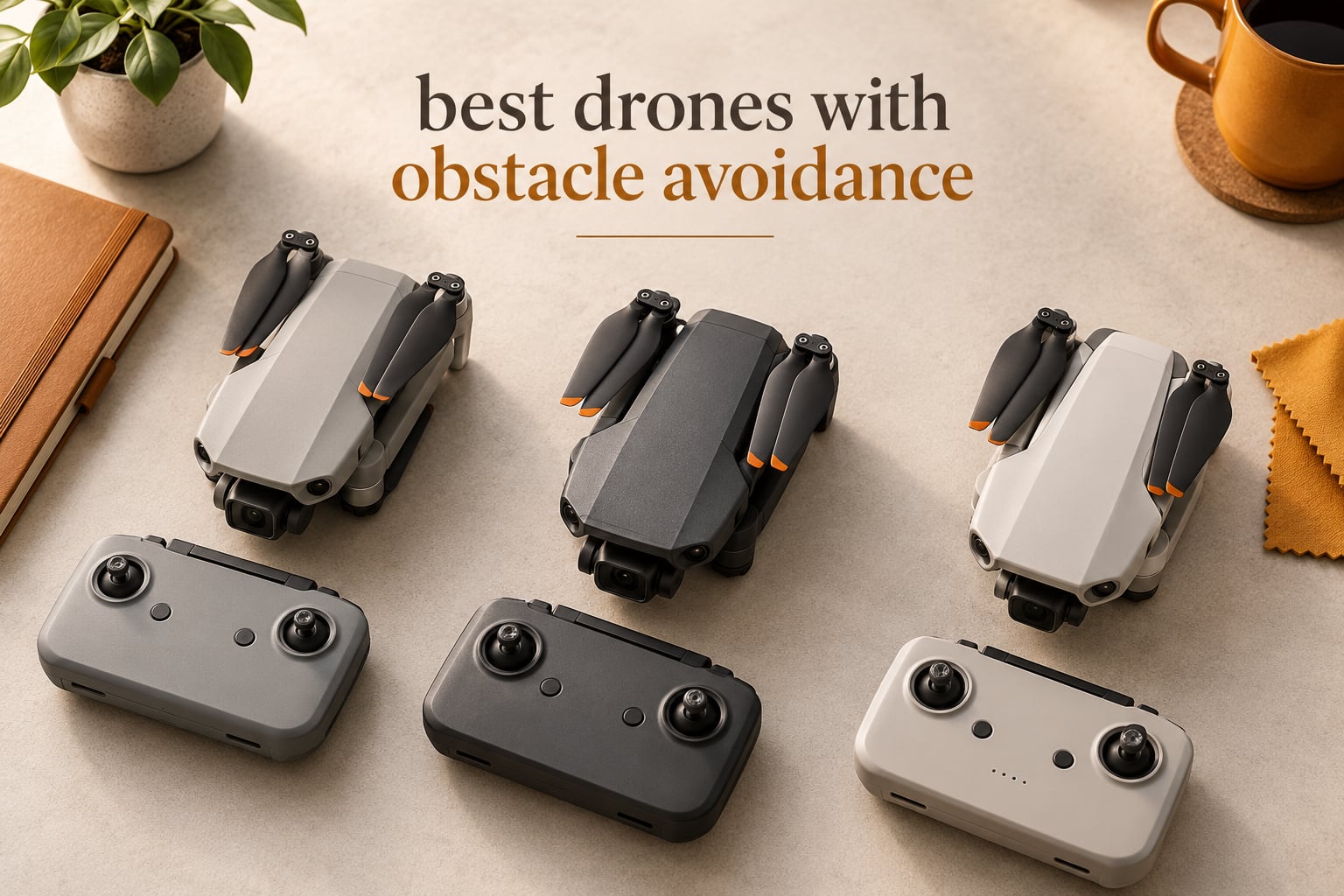
Obstacle avoidance is an onboard sensing system that watches the flight path, brakes or hovers when something appears ahead, and in newer models routes around it. On this list you will find the best drones with obstacle avoidance across every price tier, from a folding sub-250 g travel drone to a 360 capture rig that reframes a shot after landing.
The short answer to the question everyone asks first: yes, drones with obstacle avoidance prevent most crashes, but not all of them. Pilots on r/dji and Mavic Pilots say the same thing in different words, that the system is genuinely useful around trees, buildings and dusk conditions, and still blind to thin branches, wires and low-contrast surfaces. Treat it as a second layer of protection, not a guarantee.
We spent 2026‘s buying cycle comparing ten models on the only criteria that matter for this feature: which directions each one senses, how the sensing performs at dusk, how it behaves when you switch it off, and what the package actually includes. Our verdict is the DJI Mini 5 Pro Fly More Combo, which pairs omnidirectional sensing with forward-facing LiDAR inside a 249 g body.
Coverage direction matters more than sensor count. A drone with two cameras pointing forward is not the same as one that senses in every direction, and buyers who understand that distinction end up with far fewer surprises. We break each model down accordingly, and there is a section further down that lists exactly what avoidance cannot see.
Table of Contents
- Top 3 Drones With Obstacle Avoidance Right Now (October 2026)
- Quick Overview: All 10 Drones at a Glance
- 1. DJI Mini 5 Pro Fly More Combo: Editor’s Choice Overall
- 2. DJI Mini 4 Pro with RC 2: Best All-Rounder Under 250 g
- 3. DJI Avata 360 Fly More Combo: Best for 360 Capture
- 4. SKYROVER X1 Combo: Best for Travel
- 5. DJI Air 3 with RC-N2: Best for Night Flying
- 6. Cyaxzolp AE86ProMax: Best for Endurance
- Cyaxzolp AE86ProMax+Drones with Camera for Adults 4K Video,Touch Screen Tablet Remote and 3-Axis Mechanical Gimbal, 5G Digital Transmission, 360° Laser Obstacle Avoidance, GPS Auto Return,Three 8000mAh 45 Mins Long Endurance, 500g Payload, Smart Follow Waypoint Flight Foldable Quadcopter, Up to 5 Miles Range (Carbon Fiber, 3 Batteries + 64GB TF Card)
- Who the AE86ProMax suits
- Where it disappoints
- 7. DCX EZ Pro: Best for First-Time Flyers
- 8. Tec Wurenju V168 Pro MAX: Most Versatile With a Screen
- V168 Pro MAX GPS Drones with Camera for Adults 4K, RC Drone with 4.5″ HD Screen on Controller, 60 Mins Flight, Long Range Transmission, 360° Obstacle Avoidance, Follow Me, Auto Return, Brushless Motor, QuickShots, Lightweight and Foldable Quadcopter for Beginner Toy Gifts
- Who the V168 Pro MAX suits
- Where it disappoints
- 9. SJsharp TT19LCD: Best for Indoor Practice
- 10. SEKOsamrt TT19LCD: Best Portable FPV Drone
- How We Evaluated These Drones With Obstacle Avoidance
- What Obstacle Avoidance Can and Cannot Detect
- How to Choose a Drone With Obstacle Avoidance
- Flying in the US: Weight, Registration and Remote ID
- Frequently Asked Questions
- Which drone has the best obstacle avoidance?
- What are some good obstacle avoidance drones on a budget?
- What are the cheapest drones with obstacle avoidance capabilities?
- Do drones with obstacle avoidance prevent crashes?
- Which drone has obstacle avoidance and can follow me?
- Is there a good alternative to DJI drones?
- Which drone has the longest range?
- Final Verdict: Which Drone Should You Buy?
Top 3 Drones With Obstacle Avoidance Right Now (October 2026)

DJI Mini 5 Pro Fly More Combo
- Omnidirectional sensing with forward LiDAR
- 1-inch CMOS 4K/60fps HDR
- 249 g
- 36 min per battery

DJI Mini 4 Pro with RC 2
- Omnidirectional obstacle sensing
- 4K/60fps HDR vertical video
- 249 g
- 34 min per battery

DJI Avata 360 Fly More Combo
- 8K/60fps HDR 360 capture
- Nightscape omnidirectional sensing
- Integrated propeller guard
- 455 g
The Mini 5 Pro takes the top slot because it is the only sub-250 g drone here with forward-facing LiDAR added to full omnidirectional sensing, and it arrives with three batteries and a charging hub in the box. The Mini 4 Pro is the value pick for anyone who does not need that extra sensor, and the Avata 360 earns its place for people who shoot reframable 360 footage rather than conventional clips.
Quick Overview: All 10 Drones at a Glance
| Product | Specifications | Action |
|---|---|---|
| DJI Mini 5 Pro Fly More Combo |
|
Check Latest Price |
| DJI Mini 4 Pro with RC 2 |
|
Check Latest Price |
| DJI Avata 360 Fly More Combo |
|
Check Latest Price |
 SKYROVER X1 Combo SKYROVER X1 Combo |
|
Check Latest Price |
 DJI Air 3 with RC-N2 DJI Air 3 with RC-N2 |
|
Check Latest Price |
 Cyaxzolp AE86ProMax Cyaxzolp AE86ProMax |
|
Check Latest Price |
 DCX EZ Pro DCX EZ Pro |
|
Check Latest Price |
 Tec Wurenju V168 Pro MAX Tec Wurenju V168 Pro MAX |
|
Check Latest Price |
 SJsharp TT19LCD SJsharp TT19LCD |
|
Check Latest Price |
 SEKOsamrt TT19LCD SEKOsamrt TT19LCD |
|
Check Latest Price |
Two things jump out of that list. Every drone weighing under 249 g on this list senses in fewer directions than the heavier models, which is the trade you accept for flying without registration paperwork. And the budget tier concentrates its sensing in small front-facing modules, which is fine indoors and far less useful outdoors.
1. DJI Mini 5 Pro Fly More Combo: Editor’s Choice Overall
DJI Mini 5 Pro Fly More Combo With DJI RC 2, 1-Inch CMOS
249 g
1-inch CMOS 4K/60fps HDR
Forward LiDAR plus omnidirectional sensing
36 min per battery
Pros
- 1-inch CMOS delivers sharp 4K/60fps HDR
- Forward LiDAR makes it the only sub-250 g pick here with real low-light sensing
- Three batteries plus charging hub and ND filters in the box
- 42GB internal storage
- Palm-sized foldable body
Cons
- Top of the sub-250 g price class
- 42GB fills quickly with 4K clips
- Many intelligent flight modes mean a learning curve
The Mini 5 Pro is the pick we keep coming back to, and the reason comes down to the sensor stack. Alongside omnidirectional obstacle sensing it adds forward-facing LiDAR, which is the component that holds up after sunset when stereo vision alone starts struggling with contrast.
Owners consistently point at two things in reviews: the 1-inch sensor produces genuinely sharp 4K/60fps HDR footage from a body that folds to palm size, and the sensing has been dependable on night and low-light flights. At 768 reviews and a 4.5 average, that pattern is well established rather than anecdotal.
The Fly More Combo configuration is the version worth having. It bundles three Intelligent Flight Batteries, a spare propeller set, an ND filter set, a two-way charging hub and a shoulder bag, and up to three batteries recharge in about 115 minutes.
True vertical filming through the 225-degree flexible gimbal is the feature that quietly changes how often you pack it. Recording natively in portrait means you no longer crop a landscape clip and lose resolution, which matters when the drone lives in a daypack.
Who the Mini 5 Pro suits
It suits photographers who want a real sensor without carrying a pro body, and anyone flying at dusk around trees where stereo vision alone is a coin flip. ActiveTrack 360 keeps a moving subject framed, and the extra sensing makes that tracking less likely to end against a branch.
Because it sits just under the 249 g threshold, it also suits people who would rather not deal with registration paperwork for a hobby aircraft. That is a real purchasing factor, not a technical footnote.
Where it disappoints
It is the most expensive drone in the sub-250 g class, and 42GB of internal storage disappears quickly if you shoot 4K all afternoon. There is also a lot of new software to absorb, particularly if you have never flown anything with intelligent flight modes.
If your flying is mostly wide open fields with no trees or structures nearby, the sensing premium buys you very little for the money.
2. DJI Mini 4 Pro with RC 2: Best All-Rounder Under 250 g
DJI Mini 4 Pro (DJI RC 2), Drones with Camera for Adults 4K, Under 0.549 lbs/249 g, 34 Mins Flight Time, 20km Max Video Transmission Distance, Omnidirectional Vision Sensing, Mini Drone for Beginners
249 g
Omnidirectional obstacle sensing
4K/60fps HDR with vertical support
34 min per battery,20 km transmission
Pros
- Omnidirectional sensing that genuinely helps first-time flyers
- Bright screen built into the RC 2 remote
- Range and build quality well ahead of earlier Minis
- App and firmware setup is straightforward
Cons
- Base package includes one battery
- Occasional firmware display glitches
- Dual-band Wi-Fi can congest dense urban areas
- Propeller noise is noticeable at low light
With 934 reviews at a 4.4 average, the Mini 4 Pro has the largest owner base on this list, and the consensus is remarkably consistent. Reviewers describe it as the first sub-250 g drone that genuinely justifies its cost, with dependable sensing and a photo step up from everything below it.
The RC 2 controller is part of the appeal. Its integrated screen is bright enough to read in direct sun, which removes the phone-as-controller dance that wrecks a lot of first flights.
A Mini 4 Pro owner on r/dji described upgrading from the previous generation specifically for 360-degree avoidance and called it the single biggest quality-of-life improvement in the whole platform. That reaction shows up over and over in the review summary.
It also runs 20 km of real-time video transmission, and up to 34 minutes per battery. Owners regularly remark that real range far exceeds what earlier consumer drones managed.
Who the Mini 4 Pro suits
It suits beginners who want a drone that will not punish them in week one, and it suits anyone flying near trees, hedges or buildings where forward-only avoidance would leave the sides exposed. At 249 g it stays under the registration threshold too.
People who fly with FPV goggles should note that it works with DJI Goggles 3, Goggles 2 and RC Motion controllers, which are sold separately.
Where it disappoints
The camera hardware is essentially the same sensor as the previous generation, so the upgrade over that model is incremental rather than dramatic. Propeller noise becomes audible in quiet scenes at night.
The base package also includes a single battery, which means one flight session per charge until you add packs. Some owners have reported display artifacts after firmware updates, and DJI’s account and support process is a recurring irritation.
3. DJI Avata 360 Fly More Combo: Best for 360 Capture
DJI Avata 360 Fly More Combo (RC 2), 8K 360° Camera Drone
455 g takeoff weight
8K/60fps HDR 360 capture
Omnidirectional sensing with propeller guard
O4+ transmission up to 20 km
Pros
- Captures a full 360 view in one flight
- 1-inch-equivalent sensors with strong photo and video quality
- Sensing described as very good by owners
- Stable in heavy wind
- Three batteries and charging hub included
Cons
- Battery endurance of roughly 12 minutes per pack
- Not a true FPV drone yet
- 360 footage must be edited and exports slowly
- Heavier than earlier Avata versions
The Avata 360 is not really a conventional camera drone. Its two 1-inch-equivalent sensors capture a full spherical view in a single pass, and the pilot reframes the shot afterwards in software rather than flying a second pass.
That reframing flexibility is the whole appeal. For real estate walkthroughs, indoor showcases and any shot where the subject moves unpredictably, a 360 rig saves enormous amounts of flying time.
Enthusiasts in reviews praise the obstacle sensing as very good and note that the larger airframe holds steady in heavy wind. The integrated propeller guard means you can fly it close to people and objects without the same hesitation you would have with a bare-frame aircraft.
RockSteady and HorizonSteady stabilization handle the horizon lock, and unlimited rotation plus tilt control give the pilot unusual freedom of movement during a shot.
Who the Avata 360 suits
It suits filmmakers who want shots they could not line up conventionally, and reviewers consistently rate it highly as a specialty cinematic drone rather than an all-purpose flyer. Propeller guards also make it a sensible choice near crowds.
The Fly More Combo version is the one to consider, since it includes three batteries, a charging hub, a sling bag and the RC 2 controller.
Where it disappoints
Battery life is the biggest constraint. Owners report roughly 12 minutes per pack, so a single sortie is short and the three-battery bundle matters enormously here.
It is larger and heavier than earlier Avata versions, which limits tight-gap flying. Some buyers also report mushy white balance and output closer to 4K than true 8K, plus slow initial satellite lock that required field calibration.
4. SKYROVER X1 Combo: Best for Travel
SKYROVER X1 Drone with Camera Combo with Screen Controller, 4K/60fps Video, 8K Photo, 360° Obstacle Avoidance, Under 249g, 9.32-Mi Transmission, AI Night Shot, 96-Min Flight Time with 3 Batteries
249 g
360 degree obstacle avoidance
1/1.32-inch CMOS 4K/60fps HDR
96 min total flight time across three batteries
Pros
- 360 degree avoidance in a sub-249 g body
- Bright 5.5-inch 700-nit touchscreen remote
- 96 minutes of aggregate flight time
- 9.32-mile transmission with 1080p/60fps feed
Cons
- Less established brand with a smaller install base
- 48 MP stills and low-light quality trail a 1-inch sensor
- Screen controller adds bulk versus a phone remote
The SKYROVER X1 is the most unusual entry here, and at 4.6 across 309 reviews it holds the highest average rating on this list. What it does better than most is endurance: three batteries add up to 96 minutes of total flight time, which changes how you plan a day out.
The controller is the other headline. A 5.5-inch touchscreen at 700 nits is genuinely readable in direct sunlight, and carrying it means you are not dependent on a phone with a depleted battery.
Full 360 degree obstacle avoidance at 249 g is rare, and it makes the X1 a comfortable travel companion on a woodland path or between buildings. Smart Return to Home uses the sensing rather than flying blind back to you.
The 1/1.32-inch sensor with an f/1.7 aperture records 4K/60fps HDR and 48 MP stills, with a 3-axis gimbal handling stabilisation. SkyBridge transmission runs to 9.32 miles with a 1080p/60fps live feed.
Who the SKYROVER X1 suits
It suits hikers and travellers who want three batteries and a built-in screen without carrying extra gear. AI Auto Track, Smart Spotlight and dual tracking cover the follow-me footage that most people want from a travel drone.
The 4K/100fps slow-motion and timelapse modes add options the cheaper travel drones skip.
Where it disappoints
The sensor class is the honest limit here. Still image quality and low-light performance trail a 1-inch DJI sensor by a visible margin, so this is a video-first pick rather than a photography one.
The screen controller also adds bulk compared with a phone-based remote, and as a less established brand there is a smaller install base for troubleshooting help when something goes wrong.
5. DJI Air 3 with RC-N2: Best for Night Flying
DJI Air 3 (DJI RC-N2), Drone with Medium Tele & Wide-Angle Dual Primary Cameras, 46-Min Max Flight Time, Omnidirectional Obstacle Sensing, 48MP Photos, 4K/60fps HDR, Compliance with FAA Remote ID
720 g
Dual 1-inch wide plus 3x telephoto
Omnidirectional five-direction sensing
46 min flight time
Pros
- Dual wide and 3x telephoto cameras for mid-flight flexibility
- Low-light performance praised as a clear step up
- Heavy airframe stays stable in wind
- 46 minute flight time and reliable 20 km transmission
Cons
- 720 g means registration and Remote ID are required
- Obstacle avoidance does not engage in sport mode
- Base package includes a single battery
- Strict geofencing near controlled airspace
The Air 3 sits at the other end of the weight spectrum from the Minis, and that matters more than most buyers expect. At 720 g it carries a 1-inch sensor, a 3x medium telephoto and up to 46 minutes of flight time, because the airframe can afford the power budget.
Low-light performance is the standout. Reviewers widely describe it as a step up, which pairs well with the omnidirectional sensing that gives new pilots confidence flying around trees and rooftops after dusk.
The dual primary cameras are the creative hook. Switching to the telephoto mid-flight lets you reframe a scene without flying in closer, which is useful on landscapes where you would rather not move position.
Vision Assist and ActiveShots 360 tracking arrive via firmware update, and the six-antenna array holds a 1080p/60fps feed out to 20 km.
Who the Air 3 suits
It suits pilots who will fly in low light and who want a genuine telephoto option. The 720 g weight buys wind stability that the sub-250 g drones cannot match, which matters when you are shooting at dusk in exposed locations.
It is also one of the few models here listed as FAA Remote ID compliant at the point of purchase.
Where it disappoints
Registration and Remote ID are mandatory at this weight, which changes where you can legally fly. Obstacle avoidance does not engage in sport mode, so the protection disappears exactly when the speed makes it most needed.
The base RC-N2 package includes a single battery, strict geofencing can block flying near controlled airspace, and the advanced modes carry a real learning curve. The 4.2 average also reflects an 11 percent share of one-star reviews tied partly to seller issues.
6. Cyaxzolp AE86ProMax: Best for Endurance
Cyaxzolp AE86ProMax+Drones with Camera for Adults 4K Video,Touch Screen Tablet Remote and 3-Axis Mechanical Gimbal, 5G Digital Transmission, 360° Laser Obstacle Avoidance, GPS Auto Return,Three 8000mAh 45 Mins Long Endurance, 500g Payload, Smart Follow Waypoint Flight Foldable Quadcopter, Up to 5 Miles Range (Carbon Fiber, 3 Batteries + 64GB TF Card)
360 degree laser omnidirectional avoidance
7.2-inch touchscreen remote
Three 8000mAh batteries with hot-swap
5G transmission up to 5 miles
Pros
- 360 degree laser obstacle avoidance with several smart return modes
- Large 8000mAh batteries run roughly 28-35 minutes per pack
- 7.2-inch touchscreen remote with 32GB built-in storage
- 500g one-click airdrop payload is genuinely useful
Cons
- Camera quality reported as weak relative to the claims
- Documentation is thin and functions are harder to learn
- Only 18 reviews
- so long-term reliability is unproven
The AE86ProMax is an odd-shaped aircraft with an unusual feature set. It lists 360 degree omnidirectional laser obstacle avoidance, a 3-axis mechanical gimbal and a one-click airdrop payload rated at 500g.
Endurance is its reason to exist. Three 8000mAh packs with a hot-swap design give more than two hours of aggregate flight time, with roughly 28 to 35 minutes per pack even under the 500g payload load.
Return behaviour covers one-key return, low-battery auto return and signal-loss return, which is a more complete safety net than most drones at this level offer. The 7.2-inch HD touchscreen remote carries 32GB of built-in storage and supports app-based control.
5G digital transmission runs up to 5 miles, the lens tilts to 90 degrees, and the listing states FAA certification compliance.
Who the AE86ProMax suits
It suits pilots who work in a fixed pattern and want maximum airtime per charging session, and the airdrop function makes it practical for light delivery tasks in open areas. The 242 g listed weight also keeps it under the registration threshold.
Where it disappoints
The camera is the weak point. Reviewers report image quality falling short of what the listing implies, which is a problem if you bought it for the 4K UHD capture.
Documentation is thin, so functions take longer to learn, and some buyers find it hard to control. With only 18 reviews on record, long-term reliability is genuinely unproven.
7. DCX EZ Pro: Best for First-Time Flyers
DCX EZ Pro Drones with Camera for Adults 4K, Obstacle Avoidance, GPS Auto Return Home, Beginner-friendly, 3-axis Gimbal, Follow Me Mode, Long Flight Time, FAA Remote ID
360 degree avoidance via four LiDAR sensors
4K camera on a 3-axis gimbal
GPS auto Return to Home
3-mile range,30 min flight time
Pros
- Four LiDAR sensors deliver real 360 degree avoidance at a mid-range price
- AI flight modes make it approachable for first-time flyers
- GPS auto Return to Home on signal loss or low battery
- No geofencing or artificial height limits
Cons
- Only 21 reviews
- so long-term reliability is unproven
- Practical range is short compared with premium models
- Direct USB video transmission needs a modern device
The EZ Pro is one of the few mid-range drones on this list that uses LiDAR across four separate sensors for full 360 degree coverage, rather than pairing a binocular pair with a single forward module. For a first drone that is a meaningful difference.
Everything else is aimed at the same buyer. AI-assisted modes including Follow Me, Waypoints, Spiral and Dronie take the manual work out of basic manoeuvres, and the 3-axis gimbal with EIS produces smoother 4K than typical hobby-tier drones.
There is no geofencing and no artificial height limits, which removes a common source of frustration for new pilots who just want to fly. It is also listed as FAA Remote ID compliant and folds down for travel.
Top speed is up to 30 mph with roughly 30 minutes of flight time per battery, and range is listed at 3 miles.
Who the DCX EZ Pro suits
It suits a complete beginner who wants real obstacle avoidance without learning a professional workflow. The AI modes and auto-stabilisation do most of the work while you build confidence on short flights.
Pilots flying where geofencing would be a problem will also appreciate the open approach.
Where it disappoints
The 3-mile range is short against the 9 to 20 mile figures elsewhere on this list, and the direct USB video transmission path needs a reasonably modern device for a smooth live view.
Most importantly, 21 reviews is a small sample. A 9 percent two-star share suggests some buyers felt the value did not land, and there is not enough history here to judge long-term reliability.
8. Tec Wurenju V168 Pro MAX: Most Versatile With a Screen
V168 Pro MAX GPS Drones with Camera for Adults 4K, RC Drone with 4.5″ HD Screen on Controller, 60 Mins Flight, Long Range Transmission, 360° Obstacle Avoidance, Follow Me, Auto Return, Brushless Motor, QuickShots, Lightweight and Foldable Quadcopter for Beginner Toy Gifts
208 g
4-way obstacle avoidance for indoor use
4.5-inch screen controller
60 min total flight time from two packs
Pros
- Screen controller
- GPS and two batteries at a very low cost
- Under 249 g so no registration needed in most regions
- Brushless motors hold altitude in level-4 wind
- 60 minutes of aggregate flight time
Cons
- Obstacle avoidance works only indoors
- 4K is a marketing resolution rather than true 4K
- Entry-level camera and transmission quality
The V168 Pro MAX bundles a screen remote, GPS and two 3000mAh batteries at a price where most competitors ship a bare phone-based remote and one pack. For a gift, a learn-to-fly drone or indoor practice, that combination is hard to argue with.
The catch is stated plainly in the listing and confirmed by buyers: the 4-way obstacle avoidance is functional indoors only. Outdoors it is effectively inert, so do not read it as crash protection in a garden.
Brushless motors with altitude hold manage level-4 wind conditions, and GPS auto return home, Follow Me, waypoint and circle flight cover the basics. Transmission runs to 9,842 feet over 5G WiFi.
At 208 g it stays under 249 g, which means no registration requirement in most regions.
Who the V168 Pro MAX suits
It suits anyone buying a first drone for a child or a relative, and it suits indoor practice in a large space where a screen remote without a phone is much easier to hand over.
Two batteries giving up to 60 minutes total is genuinely useful at this price point.
Where it disappoints
The indoor-only avoidance limitation is the deal-breaker for anyone who wants to fly outdoors near trees. Camera quality also falls short of the 4K claim, and transmission is entry-level.
Buyers treat it as a capable budget gift drone rather than a tool, and it should be bought on that understanding.
9. SJsharp TT19LCD: Best for Indoor Practice
Drone with Camera for Adults LCD Screen FPV Live Video, Brushless Motor 270° Obstacle Avoidance 3D Flips, Foldable RC Mini Drones for Kids Beginners 32G SD Card Max Under 250G Gifts for Boys and Girls
179 g
270 degree obstacle avoidance
2.8-inch screen controller with 32GB
Four propeller guards
Pros
- Very affordable entry point with a built-in screen controller
- 270 degree avoidance helps beginners avoid crashes
- Folds down to coat-pocket size with a carrying case
- Responsive controls in moderate wind
- Propeller guards add real durability
Cons
- Camera resolution far below the implied 4K
- Some units arrived with a dead battery or would not fly on first setup
- Optical-flow hovering suits indoor spaces
The SJsharp TT19LCD is built for one job: learning stick control indoors without breaking anything. The four propeller guards and 270 degree obstacle avoidance do more for a nervous beginner than any amount of GPS sophistication.
It folds small enough for a coat pocket, includes a carrying case, and the 2.8-inch display on the controller takes up to 32GB of expandable storage. No phone pairing required.
A second optical-flow camera handles precise hovering indoors, which is where this drone spends most of its useful life. Brushless motors were tested over 100,000 hours, and route flying, headless mode and three speed levels cover the standard beginner moves.
The 90-degree electrically adjustable remote lens is a nice touch on an aircraft at this level.
Who the SJsharp TT19LCD suits
It suits a child learning to fly, and it suits anyone who wants to practise in a large empty room before taking a bigger drone outdoors. The guards make near-misses almost free.
Buyers largely treat it as a fun, giftable beginner drone, and at 80 reviews the pattern is consistent.
Where it disappoints
Camera quality is the recurring criticism. Reviewers report output that is not even HD, with a narrow field of view, so treat the video as a by-product of learning to fly.
There are also occasional quality control failures, with some units arriving with a dead battery or failing to fly on first setup.
10. SEKOsamrt TT19LCD: Best Portable FPV Drone
FPV Drone with Camera for Adults LCD Screen on RC, Mini Drones for Beginner, Foldable Quadcopter with Brushless Motor Obstacle Avoidance, Support 32G SD Card Under 250 Grams
179 g
270 degree intelligent obstacle sensing
Optical-flow camera for stable hovering
2.8-inch LCD controller,32GB card support
Pros
- 270 degree intelligent obstacle avoidance adds real protection
- Easy to control even for older users
- Screen controller removes the need to pair a phone each flight
- Battery and controller charge fast
- Compact foldable body with a carrying case
Cons
- Some functions are hard to figure out without the manual
- 1080p camera only and not 4K
- One buyer reported a controller screen that would not power on
- Support response times are inconsistent
The SEKOsamrt TT19LCD shares a form factor with the previous pick but is a different listing with different ownership. At 4.6 across 30 reviews, with 87 percent five-star ratings, owners rate it highly for ease of use and manoeuvrability.
The 270 degree sensing covers the front and both sides of the flight path, which is the right shape of coverage for an indoor drone. A built-in optical-flow camera handles stable hovering and accurate positioning.
The 2.8-inch LCD controller takes a rechargeable battery and up to a 32GB TF card, so you can fly and record without a smartphone at all. That is the practical reason this class of drone sells for beginners.
One-key takeoff and landing, headless mode, three speed levels, trajectory flight and 360-degree flips round out a beginner feature set that is easy to live with.
Who the SEKOsamrt TT19LCD suits
It suits anyone who wants a first FPV-style experience indoors without goggles, a phone or a learning curve on the controls. Owners frequently note that even older users find it easy to fly.
Fast charging on both the battery and the controller means less waiting between practice sessions.
Where it disappoints
Several functions are genuinely hard to work out without reading the manual, and the camera is 1080p rather than 4K, so image quality is modest.
There is also an isolated report of a controller screen that would not power on, and support response times are described as inconsistent.
How We Evaluated These Drones With Obstacle Avoidance
We scored each drone on sensing coverage first, then on the sensor technology behind it, low-light behaviour, how Return to Home uses the sensors, what is in the box, and weight class relative to registration rules. Camera quality matters too, but only after the safety systems.
Ratings and review counts come from the customer feedback attached to each product, and we read the recurring complaints rather than the top-line score. Where owners repeatedly mention false braking, single-battery kits or misleading camera claims, that shows up in the verdict.
We also weighted community reports from r/dji, r/drones and Mavic Pilots, because owner pilots document avoidance behaviour in real conditions far better than a spec sheet does.
What Obstacle Avoidance Can and Cannot Detect
Obstacle avoidance works by building a depth map of the surroundings. Stereo vision cameras compare two views to estimate distance, LiDAR measures with laser pulses, and infrared time-of-flight sensors triangulate a position. The flight controller then chooses between braking, hovering and bypassing.
Coverage falls into clear tiers. Partial coverage means forward-facing only. Three-directional adds rear sensing. Omnidirectional means all horizontal planes, and a minority of models add upward sensing for close-quarters indoor work.
Now the honest part. Several obstacle types defeat these systems consistently, and every owner eventually learns this the hard way.
Thin branches and fine foliage. Sparse, twiggy obstacles often produce no return at all, which is why woodland tracking threads still clip branches.
Power lines, guy wires and fence wire. These are the classic killers. Avoid flying near utility infrastructure regardless of what your drone can sense.
Glass windows and clear surfaces. Transparent and reflective surfaces break the assumptions depth sensors rely on.
Low light and direct backlight. Flying toward a low sun blinds a vision-based system. This is where forward-facing LiDAR earns its place.
Fog, mist and heavy rain. Reduced contrast degrades every optical sensor in the air at once.
Objects smaller than the minimum detection size. Small objects at the edge of the stated range are unreliable.
Moving objects at speed. Reaction time is finite. Braking distance is real, and a fast-moving bicycle is not the same problem as a wall.
Sport mode. On several models, including the Air 3 here, avoidance is disabled in sport mode entirely.
Owners also report the opposite failure: the drone halting or climbing when there is nothing there. That false positive behaviour has a long-running thread on Mavic Pilots dating back to 2018, and it is the reason experienced pilots learn to recognise their own aircraft’s braking habits.
How to Choose a Drone With Obstacle Avoidance
Start with direction, not sensor count. Before anything else, work out which directions you will actually fly into. Forest trails and city streets demand omnidirectional coverage. Open fields do not, and you can spend that money on a better camera instead.
Then decide whether you fly at dusk. If you do, prioritise a forward-facing LiDAR module, because stereo vision loses contrast in low light while LiDAR keeps measuring. Only one drone in the sub-250 g class on this list pairs the two.
Third, check the weight class against your local rules. Sub-250 g aircraft avoid registration paperwork in most regions; heavier models require it and increasingly require Remote ID. That changes where you can fly before it changes anything about image quality.
Fourth, count the batteries in the box. Single-battery base kits are common on premium drones and are the most annoying limitation once you own the aircraft. The Fly More style bundles on this list add two extra packs, a charging hub and usually ND filters.
Fifth, learn how to switch avoidance off. Experienced pilots deliberately fly with it disabled for smoother footage through tight spaces, because the system brakes hard and interrupts a smooth line. On models that allow it, braking mode and a bypass setting give you the choice between protection and smoothness.
Sixth, check whether avoidance is forced on in mission and waypoint modes. On several models it cannot be overridden there, which changes how you plan automated routes through anything narrow.
Finally, read Return to Home carefully. A good system plans a collision-free return path using its sensors. A poor one flies a straight line home and treats your line as clear.
Flying in the US: Weight, Registration and Remote ID
Weight is the practical dividing line. Drones under 249 g are exempt from registration in the US, while heavier aircraft require registration and a Remote ID broadcast. Two picks on this list, the Air 3 at 720 g and the Avata 360 at 455 g, fall on the registered side; the other eight do not.
Availability is a separate question. If you are buying in the US, non-DJI brands such as the SKYROVER X1 and the DCX EZ Pro carry no geofencing, which owners on r/drones specifically recommend for that reason.
Whichever you pick, fly away from power lines and coastal areas. No avoidance system substitutes for knowing where you are allowed to be.
Frequently Asked Questions
Which drone has the best obstacle avoidance?
The DJI Mini 5 Pro Fly More Combo has the strongest combination here. It pairs omnidirectional obstacle sensing with forward-facing LiDAR inside a 249 g body, so it keeps measuring after dark where stereo vision alone weakens. The DJI Air 3 has five-direction sensing and a 1-inch sensor for low light, but its 720 g weight brings registration requirements.
What are some good obstacle avoidance drones on a budget?
At the lower end, the DCX EZ Pro uses four LiDAR sensors for full 360 degree avoidance, adds GPS auto Return to Home and ships with no geofencing. The Tec Wurenju V168 Pro MAX is cheaper again with a screen controller and two batteries, though its avoidance works indoors only. The SJsharp and SEKOsamrt 270 degree models are indoor practice drones with guards rather than outdoor protection.
What are the cheapest drones with obstacle avoidance capabilities?
The cheapest real avoidance hardware sits in the sub-250 g toy and hobby class, where 270 degree sensing and optical-flow hovering appear with screen controllers and propeller guards. That tier is built for indoor learning. Genuine 360 degree outdoor avoidance starts to appear in the mid-range, where four LiDAR sensors are the first credible option.
Do drones with obstacle avoidance prevent crashes?
They prevent most shallow, forward crashes into large solid surfaces, which is where new pilots lose aircraft. They do not prevent collisions with thin branches, wires, glass, or fast-moving objects, and vision-based systems degrade in fog, heavy rain and direct backlight. Treat avoidance as a second layer of protection rather than a guarantee.
Which drone has obstacle avoidance and can follow me?
The DJI Mini 5 Pro and DJI Mini 4 Pro both run ActiveTrack 360, and the SKYROVER X1 offers AI Auto Track with Smart Spotlight and dual tracking. The DCX EZ Pro includes Follow Me among its AI modes. Owners report that tracking through woodland paths is where avoidance is most likely to clip a branch, so open paths work far better than dense cover.
Is there a good alternative to DJI drones?
Yes. The SKYROVER X1 delivers 360 degree obstacle avoidance under 249 g with a 5.5-inch 700-nit touchscreen remote and 96 minutes of total flight time across three batteries. The DCX EZ Pro adds four LiDAR sensors for 360 degree coverage with no geofencing, which owners recommend for open flying. Both trade sensor class against price.
Which drone has the longest range?
Among the models here, the DJI Air 3 and DJI Mini 4 Pro list 20 km maximum video transmission, with the DJI Avata 360 also rated to 20 km on its O4+ link. The SKYROVER X1 lists 9.32 miles, the Cyaxzolp AE86ProMax 5 miles on 5G digital transmission, and the DCX EZ Pro 3 miles.
Final Verdict: Which Drone Should You Buy?
For most people reading a best drones with obstacle avoidance guide, the DJI Mini 5 Pro Fly More Combo is the answer. It is the only sub-250 g drone here that combines omnidirectional sensing with forward-facing LiDAR, and the bundle solves the battery problem on day one.
Buy the Mini 4 Pro if you want the same sensing in a proven package without the newest-generation premium. Pick the SKYROVER X1 for maximum airtime and a screen in direct sun, or the DJI Avata 360 if reframable 360 footage is the whole point. If you are buying a first drone mainly to learn indoors, the two 270 degree models with propeller guards will serve you better than anything else at that level.
Whichever you choose, fly it in open space first and learn what your aircraft’s braking feels like in 2026 before you take it near anything you care about.