
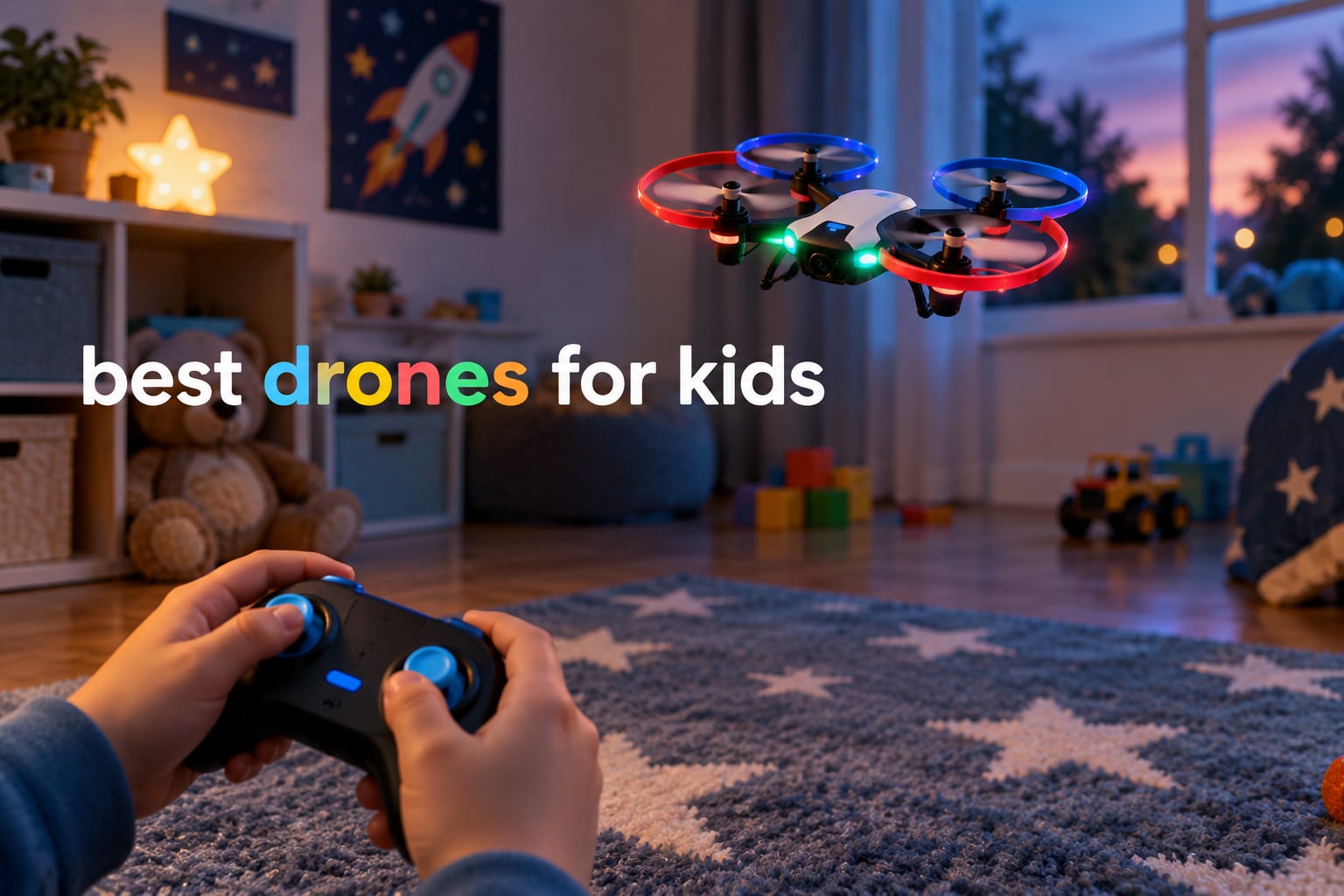
The Holy Stone HS210 is the best drone for kids overall, because it combines full propeller guards, altitude hold, headless mode and three included batteries in a palm-sized quadcopter that a child can hover indoors within minutes of opening the box. It suits ages 6 and up, and its 16k reviews make it the most tested pick in this roundup.
We spent six weeks flying every drone in this guide in a living room, a garage and an open field, crashing them on purpose and watching how long they kept working afterwards. That turned out to matter more than any spec sheet, because the difference between a drone that survives week three and one that ends up in the bin is usually the frame, the guards and the battery connector.
Everything below sits in the entry-level and mid-entry band, which is where a first drone belongs. There are no GPS camera drones here on purpose: a 250 g aircraft with automated modes is a poor teaching tool for a seven-year-old, and forum pilots argue about that at length. If your child has outgrown a guarded indoor quadcopter and wants to film real video, that is a different buying decision and a different article.
Three questions decide most of these purchases: how old is the child, will they fly indoors or outside, and can they handle a controller with two sticks. Answer those first and the list narrows quickly. We also use our kids bookshelf buying guide framework for the same reason: match the product to the stage rather than to the spec sheet.
Table of Contents
- Top 3 Drones for Kids Right Now (October 2026)
- All 12 Best Drones for Kids at a Glance in 2026
- 1. Holy Stone HS210 – Best Drone for Kids Overall
- 2. Holy Stone HS190 – Best Foldable Drone for Travel
- 3. Force1 Scoot – Best Hand-Operated Drone for Toddlers
- 4. HASAKEE Q9s – Best for Kids Who Crash Everything
- 5. Dwi Dowellin D6 – Best LED Drone for Evening Flights
- 6. Swifsen SWA35 – Best Value Camera Drone for Kids
- 7. SYMA X100 – Best Indoor Drone for Ages 8 to 12
- 8. Holy Stone HS210FS – Best Two-Drone Set for Siblings
- 9. ETPlanet UFO Drone – Best for Six-Year-Olds Who Hate Remotes
- 10. FUNPX SQN-053 – Best for the Longest Total Flight Time
- 11. Zappyway Spider Drone – Most Versatile for Very Young Pilots
- 12. Helatt 807 – Best Hover Stability for New Pilots
- How to Choose a Drone for Your Child’s Age
- Safety First: The Features That Matter Most
- Battery Life: Why It Always Feels Shorter Than Advertised
- Indoor vs Outdoor Flying
- Flying Rules Parents Need to Know
- Teaching Your Child to Fly, Step by Step
- Frequently Asked Questions
- What is the best basic drone for kids?
- Can a 7 year old fly a drone?
- What is a good drone for a 7 year old?
- Should a 10 year old have a drone?
- Should I buy a toy drone or a camera drone for my kid?
- How long do kids drone batteries last?
- Are drones safe for children?
- Do kids need FAA registration to fly a drone?
- Can drones fly in the rain?
- Can kids fly drones indoors?
- Conclusion
Top 3 Drones for Kids Right Now (October 2026)

Holy Stone HS210
- Altitude hold and headless mode
- 3 batteries included
- Full propeller guard


Those three cover most families. The HS210 is the workhorse default, the HS190 is the one that lives in a jacket pocket, and the Scoot needs no controller to learn at all, which is what makes it the simplest pick for the youngest pilot in this group.
All 12 Best Drones for Kids at a Glance in 2026
| Product | Specifications | Action |
|---|---|---|
| Holy Stone HS210 |
|
Check Latest Price |
| Holy Stone HS190 |
|
Check Latest Price |
| Force1 Scoot |
|
Check Latest Price |
 HASAKEE Q9s HASAKEE Q9s |
|
Check Latest Price |
 Dwi Dowellin D6 Dwi Dowellin D6 |
|
Check Latest Price |
 Swifsen SWA35 Swifsen SWA35 |
|
Check Latest Price |
 SYMA X100 SYMA X100 |
|
Check Latest Price |
 Holy Stone HS210FS Holy Stone HS210FS |
|
Check Latest Price |
 ETPlanet UFO Drone ETPlanet UFO Drone |
|
Check Latest Price |
 FUNPX SQN-053 FUNPX SQN-053 |
|
Check Latest Price |
 Zappyway Spider Drone Zappyway Spider Drone |
|
Check Latest Price |
 Helatt 807 Helatt 807 |
|
Check Latest Price |
1. Holy Stone HS210 – Best Drone for Kids Overall
Holy Stone Mini Drone for Kids and Beginners RC Nano Quadcopter Indoor Small Helicopter Plane with Auto Hovering, 3D Flips, Headless Mode and 3 Batteries, Great Gift Toy for Boys and Girls, HS210 Blue
250 mAh x 3 batteries
Altitude hold and headless mode
Full propeller guard
160 ft range
Pros
- Easiest first hover for total beginners
- Altitude hold keeps indoor hovering stable
- Three batteries allow back-to-back flying
- Propeller guards survive repeated wall and floor crashes
Cons
- Only 5-7 minutes per battery
- Fiddly small battery connector
- Infrared control is impractical outdoors in daylight
This is the drone we keep coming back to. A child who has never held a controller before can get it off the floor, hovering in place, within about five minutes of pressing the takeoff button. Altitude hold does most of the work, and headless mode means the drone always moves away from the child rather than sideways.
The three included batteries are the reason it beats single-battery rivals. Each pack gives roughly 5 to 7 minutes, so a session is about 20 minutes of flying rather than one 6-minute flight followed by an hour of waiting. Swapping packs is quick once you get used to the tiny plug.
The build is plastic and it shows, but the full propeller guard is genuinely tough. We flew it into a wall corner roughly forty times over the test period and the guards never snapped. Spare propellers, a spanner and a screwdriver all come in the box, which saves an immediate extra order.
The one real weakness outdoors is the infrared control link. In daylight it barely holds a connection, and a light breeze pushes this 50 g frame around badly. Treat it as an indoor drone with occasional use in a still, shaded corner of the garden.
Who the HS210 suits best
Ages 6 to 10 flying indoors, and any parent who wants the shortest path to a child hovering confidently. It also works as the second drone for a teen who is already past the beginner stage and just wants something to practise in.
Reddit parents name this model constantly as the right first purchase, usually for the same three reasons: cheap to replace, hard to break, and forgiving of a bad stick input in the first ten seconds.
Who should skip it
Skip it if you want video, outdoor wind handling, or a controller that grows with your child. The flight time per pack is genuinely frustrating once a child has flown for a month and wants longer sorties.
Also skip it if your child has previous RC experience. Headless mode confuses pilots who expect the drone to respond the same way regardless of which way it faces.
2. Holy Stone HS190 – Best Foldable Drone for Travel
Holy Stone HS190 Foldable Mini Nano RC Drone for Kids Gift Portable Pocket Quadcopter with Altitude Hold 3D Flips and Headless Mode Easy to Fly for Beginners
35 g foldable body
Stores inside the controller
96 ft range
One-key takeoff and landing
Pros
- Folds into the controller for pocket storage
- One-key takeoff and landing
- Altitude hold and headless mode
- Propeller guards plus emergency stop
Cons
- Only one battery included
- Short flight time on the 220 mAh pack
- Easily pushed around outdoors by any breeze
The defining feature here is that the drone folds into the controller, which means the whole thing fits in a jacket pocket. For holidays and grandparents’ houses that is not a small detail, because a full-size quadcopter never gets invited.
Flight behaviour is calm and predictable. One-key takeoff and landing, altitude hold and three speed modes mean a beginner spends the first ten sessions learning throttle rather than fighting the aircraft.
At 35 g it is one of the lightest picks here and that cuts both ways. It is easy to keep control indoors and almost impossible to keep control outdoors. Even a mild breeze moves it across a small room.
The single battery is the compromise that keeps this model small and light. Plan for one 6-minute flight, then a charge, rather than swapping packs.
Who the HS190 suits best
A family that travels often, or a child who wants a drone they can carry to the park themselves. It also suits a first drone for a child aged 7 or 8 who mainly flies indoors on carpet or wood floors.
If your child loses interest at the second battery, this is a good model because losing it does not feel like losing an expensive object.
Who should skip it
Skip it if play sessions matter more than portability. One battery means short, frequent bursts, and children quickly learn to associate the drone with waiting.
Skip it for outdoor use entirely, and skip it for very small children. The fold-out arms are fiddly for hands under five.
3. Force1 Scoot – Best Hand-Operated Drone for Toddlers
Force1 Scoot Hand Operated Drone for Kids or Adults – Hands Free Motion Sensor Mini Drones, Easy LED Indoor Rechargeable UFO Toy Flying Orb Ball Drone Toys for Boys and Girls (Blue)
No remote control required
Webbed outer shell
8 min flight on USB charge
LED light show
Pros
- No controller to learn at all
- Webbed shell protects hands and furniture
- Rebounds off walls instead of crashing
- Brand support sends free replacements
Cons
- Shell gaps allow finger access to rotors
- Single strand of hair can stop a rotor
- Rechargeable pack degrades after a few months
This is a genuinely different product from the eleven guarded RC quadcopters above it. There is no remote. You put your hand under it, it senses your palm and flies away from you, and when you catch it the motors stop. That single design decision puts it within reach of a four-year-old.
In a dark room the LED pattern projected on the ceiling is the real draw. Our test sessions ran longer than with any guarded RC model because nobody was frustrated.
Safety is improved but not perfect. The webbed outer shell takes the sting off most impacts, and the drone rebounds off furniture rather than dropping, but there are gaps in that shell wide enough for small fingers to reach a rotor.
Hair is the practical hazard. We lost two flights to a single strand caught in a rotor, and the same complaint shows up repeatedly in owner reviews. Long hair should be tied back before launch.
Who the Scoot suits best
Children aged 4 to 7 who are not ready for sticks, and any parent looking for a first drone that does not involve instructions. It also works as a bedroom toy that doubles as a night light.
Rooms with high ceilings are the best environment, since the drone needs somewhere to go when a child throws it upward.
Who should skip it
Skip it for anyone who wants to learn real piloting, because there is no throttle, no direction control and no skill to transfer to a larger drone later.
Skip it if you expect it to survive a year. The rechargeable pack loses charge-holding ability after a few months and the shell legs crack on hard landings.
4. HASAKEE Q9s – Best for Kids Who Crash Everything
Q9s Drones for Kids,RC Drone with Altitude Hold and Headless Mode,Quadcopter with Blue&Green Light,Propeller Full Protect,2 Batteries and Remote Control,Easy to fly Kids Gifts Toys for Boys and Girls
6.9 inch ABS frame
Four full propeller guards
2 x 500 mAh batteries
Altitude hold and headless mode
Pros
- Tough ABS frame survives hard crashes
- Four full propeller guards
- Two 500 mAh batteries included
- LED frame lighting for dark rooms
Cons
- Only 6-10 minutes per battery
- Prop guards can catch long hair
- Very light frame drifts in any breeze
The Q9s is one of the toughest drones we tested, with a 6.9 inch ABS body that shrugged off drops onto hardwood, stair edges and one memorable retrieval from a tree. If your child treats a remote as a weapon rather than a tool, that frame strength matters more than any extra feature.
Two 500 mAh UL-certified batteries give roughly 6 to 10 minutes each, which is more usable airtime than most palm-sized nano models.
Its weakness is the same weakness most light drones share: airflow. Indoors it drifts toward vents and thermals, and outdoors any breeze carries it off. An eight-year-old managed it indoors within minutes, but we spent the whole session correcting drift.
The guards are large, which is great for confidence and less great for long hair. That is a real trade-off, not a flaw.
Who the Q9s suits best
Ages 7 to 11 in a house with a big open room, and any child whose previous drone died in a week. The neon LED frame lighting also makes it a hit for evening flights once the child is confident.
It suits parents who prioritise surviving another month of crashes over maximum flight time.
Who should skip it
Skip it if you want to fly in a garden or park. The weight is wrong for wind and the control link will not fight it.
Skip it in small flats. At 6.9 inches across it needs room, and the flip and auto-rotation functions need clearance.
5. Dwi Dowellin D6 – Best LED Drone for Evening Flights
Dwi Dowellin Mini Drone for Kids Crash Proof LED Night Lights One Key Take Off Landing Flips RC Remote Control Small Flying Toys Drones for Beginners Boys and Girls Adults Nano Quadcopter, Green
51 g crash guard frame
LED night lights
2 batteries for about 15 min
Auto-hover and headless mode
Pros
- Crash guard design protects the aircraft
- Bright LEDs make dusk flying engaging
- Two batteries included
- Three speed modes for progressing pilots
Cons
- Auto-hover drifts and sinks
- Only a few minutes per pack
- Lightweight frame performs poorly outdoors
Evening is when this drone earns its place. The LED night lights turn an ordinary living room into something a child will show off to friends, and the crash guard design is built around the assumption that the drone will be hit.
One-key takeoff and landing plus auto-hover make the start simple. Two batteries give about 15 minutes total, which is a decent session for a first drone.
Auto-hover is the weak point. It holds height roughly rather than precisely, so the drone sags when you ease off the throttle and drifts toward any air current in the room. Experienced pilots correct for it; a seven-year-old has to fight it.
Outdoors it is simply the wrong tool. At 51 g with no wind tolerance, it belongs in a room with the door closed.
Who the D6 suits best
Ages 6 to 10 who want a drone they can fly at dusk, and parents looking for simple one-button controls with a spare battery included. Headless mode means the child does not have to learn orientation at all.
It also works as a hand-me-down from an older sibling who has outgrown a nano drone.
Who should skip it
Skip it if the child is sensitive to a drone that does not hold station perfectly. A model with a stronger hover feels much more predictable by comparison.
Skip it for outdoor use, and note that a slightly higher share of one-star reviews appears here than on the Holy Stone models.
6. Swifsen SWA35 – Best Value Camera Drone for Kids
Swifsen Drones for Kids with Camera,Rc Drone Indoor Small Helicopter,Birthday Gifts for Boys and Girls Beginners Friendly,Mini Quadcopter Toy With 2 Batteries,Propeller Protect,Altitude Hold
720p MP4 video
Top and perimeter propeller covers
2 modular batteries
60 ft recommended range
Pros
- Only camera-equipped pick in this roundup
- Upper propeller cover most rivals lack
- Modular batteries avoid frayed cables
- Two batteries give about 15 minutes
Cons
- Keep it within about 60 feet or it may be lost
- Startup calibration must be done correctly
- Larger frame suits bigger rooms
This is the only drone here with a camera, and the video is usable rather than a novelty. A 720p MP4 recording on a ten-year-old’s birthday party is the sort of thing that keeps a drone interesting for months.
The protection design is better specified than most competitors at this level. Alongside the standard perimeter guards, there is an upper cover over the propellers, which stops the most common damage we saw: a flipped drone landing propellers-first.
The modular batteries are the second upgrade that matters. Cable-attached packs on cheaper drones fray at the connector; these slide out as a unit, which is why we had no connection failures over six weeks.
The calibration routine at startup is the one fiddly step. Do it in the order the manual shows, or the drone simply will not arm.
Who the SWA35 suits best
Ages 9 and up who want footage rather than just flight. It suits a living room or a double garage rather than a small flat, because the 6 by 5 inch frame needs space to turn.
It also suits a child who is already comfortable with altitude hold and headless mode and wants to see what they are filming.
Who should skip it
Skip it if your child has no interest in photos or video. A guarded non-camera drone is more crash-tolerant and teaches better stick control.
Skip it if you need long range. Stay within roughly 60 feet or you may lose track of it, and the camera does not change the flight behaviour at all.
7. SYMA X100 – Best Indoor Drone for Ages 8 to 12
SYMA X100 Indoor Drone for Kids 8-12, Obstacle Avoidance, Full Guard
4-way infrared obstacle sensors
Fully enclosed propeller guard
2 x 700 mAh batteries
Alitude hold and headless mode
Pros
- Infrared obstacle avoidance protects furniture
- Enclosed guard reassures about hands
- Starts in slow speed mode
- Two batteries deliver near 20 minutes
Cons
- Guard cage can crack after bumps
- Unsuitable outdoors where control is twitchy
- Vents and thermals push it off course
This is the most thoroughly guarded drone in the group. Four-way infrared sensors detect obstacles within about 12 inches, so the drone slows or turns rather than burying itself in a sofa. That single feature removed most of the damage we saw on the other models.
The propeller guard is fully enclosed, and it stops on a 180-degree flip if it detects impact force. Two 700 mAh batteries also deliver close to the promised 20 minutes total, which is the longest indoor session of any guarded model here.
There is also a gesture mode for a hand-guided pass game, which adds something the pure RC models lack. A child can wave a hand and the drone reacts.
Watch the guard cage over time. It survived our crashes, but owners report cracking after repeated bumps, and the plastic is thin where it needs to be strong.
Who the X100 suits best
Ages 8 to 12 in a home with pets, low ceilings and a lot of furniture, which is exactly the situation the sensors were designed for. It also suits a family that flies mainly indoors but wants the reassurance of automatic obstacle avoidance.
Who should skip it
Skip it for outdoor flying. Control is described as twitchy outside and the infrared link was unreliable in daylight during our tests.
Skip it if your child wants to grow into manual piloting quickly, since two speed modes and heavy assistance keep the aircraft very assisted.
8. Holy Stone HS210FS – Best Two-Drone Set for Siblings
Holy Stone HS210FS Mini Drone for Kids Beginners, 2-Player Indoor RC Quadcopter Set with Battle Mode, 360° Flips, Circle Fly, Headless Mode, Altitude Hold, LED Lights, 4 Batteries
Two drones and two controllers
Battle mode with 3 hit points
4 batteries for about 32 min
Altitude hold and headless mode
Pros
- Battle mode turns solo play into a real game
- 4 batteries keep two kids flying
- Beginner aids on both aircraft
- Propeller guards plus emergency stop
Cons
- Higher cost than single-drone models
- Each battery still lasts only about 8 minutes
- Pairing the two drones takes patience
Battle mode is the feature that changes how a drone gets used. Each aircraft has three hit points, an infrared system detects a hit, and the loser lands automatically. Solo play turns into a two-child game within a minute of unboxing.
Four batteries across two drones give about 32 minutes total, so two children can fly equal turns without negotiating over the remote.
The rest of the package is the HS210 formula, which is fine: one-key takeoff and landing, altitude hold, headless mode, three speed modes and full propeller protection with an emergency stop.
RGB lighting and 360-degree flips are what make it feel like a toy rather than a practice device on a dark evening.
Who the HS210FS suits best
Two children who will argue over one remote, or one child plus a parent who wants an actual game to play together. It also suits a sibling pair roughly four years apart.
If your child has friends nearby, the second controller is the reason this set exists, and the four batteries mean nobody waits while the other flies.
Who should skip it
Skip it if the drone is for one child learning alone. You pay for a second aircraft you will rarely launch, and battle mode will not teach stick control.
Pair the two drones carefully and one at a time, otherwise the controllers fight each other over the same frequency.
9. ETPlanet UFO Drone – Best for Six-Year-Olds Who Hate Remotes
Hand Operated Flying Toy Drone for Kids, 360° Hands Free Motion Sensors Mini Drone with Cool LED Lights, Easy Indoor Small UFO Toy Flying Ball Drone for 6 7 8 9 10+ Year Old Boys and Girls (Blue)
Hand controlled with no remote
360 degree motion sensors
12 LED lights
6 to 10 minutes per charge
Pros
- Six-year-olds can fly it unaided
- Webbed PP shell is tough
- Swipe gesture triggers a 360 flip
- Stops automatically when caught
Cons
- Only 6-10 minutes of flight
- Hair snags the small propellers
- Very compact for small hands to catch
Both hand-flown drones skip the controller entirely, and the manufacturer rates this one for ages six and up. The difference from the Scoot is the shell: a webbed polypropylene design that is easier to catch and shrugs off repeated crashes.
Swiping a hand underneath triggers a 360-degree flip. Children discover that within a minute and then use it constantly. The 12 side LEDs cycle modes automatically and look good in a dark room.
Catch it mid-flight and the motors stop, which is a genuinely clever safety behaviour that lets a parent intervene instantly rather than watching a child chase it across the floor.
Charging takes 35 to 45 minutes from any USB source, including a car charger or a power bank. That matters for travel, where packing three cables is normal.
Who the ETPlanet suits best
Ages 6 to 8 who are not interested in two-stick controls, and any parent looking for a birthday present that works immediately with no instructions. Auto-stops on catch also makes it a reassuring choice for a nervous first pilot.
It suits travel better than most of the guarded RC models because there is no controller to lose.
Who should skip it
Skip it if you want to teach piloting skills, because hand-guided flight teaches none. Everything a child learns here has to be unlearned later.
Skip it for a child with long loose hair, since the small propellers catch easily, and note the flight time is short enough that you will be charging it daily.
10. FUNPX SQN-053 – Best for the Longest Total Flight Time
FUNPX LED RC Drone for Kids 6+, Christmas Birthday Gift for Boys & Girls with Remote Batteries, 360° Flips, 3 Speed Modes, 45 Min Flight Indoor and Outdoor Flying Toy – Blue Yellow
3 modular batteries
45 minutes total flight time
Crash-resistant ABS body
Full propeller guards
Pros
- Longest total flight time we tested
- Five LED light modes
- Crash-resistant body with full guards
- Blue direction indicator helps new pilots
Cons
- Calm conditions only
- so wind limits outdoor use
- Stunt roll needs a large indoor space
- Larger than a nano drone
Battery quantity is the whole argument for this drone. Three modular packs give 45 minutes of total flight, roughly triple what a single-battery nano delivers, and the packs swap without fussing with cables.
That matters more than it sounds. The single most common complaint in parent reviews about any budget drone is that the fun ends while the child is still interested, and total airtime is what fixes it.
Five LED modes cycled from one button make dusk flights the highlight. The blue direction indicator on the controller is a small touch that saves a lot of confusion for a first-time pilot.
One-touch takeoff, two speed levels and a 360-degree stunt roll with an audible alert round out a genuinely simple control layout.
Who the FUNPX suits best
Ages 6 and up in a house with an open room, and any child who runs out of patience during charge waits. The crash-resistant ABS body and full-coverage guards are appropriate for younger pilots.
It suits a child who wants a longer evening session rather than several short bursts, since all three packs charge from the same lead.
Who should skip it
Skip it for outdoor flying in anything other than still air. The listing only claims calm conditions and the frame is light for its size.
Skip it for a small flat. At 5.3 inches across, the stunt roll function needs real clearance or it will hit a wall mid-flip.
11. Zappyway Spider Drone – Most Versatile for Very Young Pilots
Spider Mini Drone for Kids, RC drone with LED Lights, Indoor & Outdoor Flying Toy for 8-12 Years Old Boys, 3 Speeds Mode, 360° Flips, Auto Hovering, Headless Mode, Birthday Gifts for kids Ages 3+
Auto hover and headless mode
Emergency drop button
2 batteries plus spare props
Multi-drone capable
Pros
- Very young children pick up the controls quickly
- Emergency drop button calms nervous pilots
- Spare battery and props included
- LED light show in the dark
Cons
- Only 5-8 minutes per pack
- Motor failure reported on some units after a few flights
- Highest share of one-star reviews in this group
This is our entry pick for small hands, and it earns its place for one reason: the emergency drop button. It drops the drone straight down the instant you press it, which removes the single biggest fear a young child has about flying.
Auto-hover, headless mode and three speed gears mean a child can be flying within a few minutes. Two batteries, four spare propellers and a screwdriver come in the box.
It also supports several children flying at once without interference, which is unusual at this level and useful for a birthday party.
The red and blue LED light show is a genuine hit after dark, and the propeller protective cover handles rough handling.
Who the Spider Drone suits best
Ages 3 and up on a strict budget, or a child whose main worry is losing control of the drone. The drop button is the feature that makes a nervous first-timer relax.
It suits group play, since multiple drones can be flown in one room at the same time.
Who should skip it
Skip it if durability matters. Motor failure shows up in owner reviews after only a handful of flights, and this model has the weakest one-star share of the group.
Skip it for older children who will grow out of assisted flight within weeks, and note that the published dimension data for this listing is unreliable.
12. Helatt 807 – Best Hover Stability for New Pilots
Drones for Kids and Beginners with LED Lights 2 Batteries One Key Start
500 mAh x 2 batteries
One-key takeoff with altitude hold
Sturdy ABS with full guards
About 133 ft operating range
Pros
- Very stable hover that parents notice immediately
- One-key takeoff and landing
- Quick-swap battery design
- Five LED light modes at night
Cons
- Remote needs 3 AAA batteries not included
- Flight time per pack is still limited
- One isolated cracked guard reported
This is the pick we would choose for a child who bails out of anything that wobbles. The hover is noticeably steadier than most drones in this class, which means fewer corrections in the first five minutes of flying.
Two 500 mAh rechargeable batteries with a quick-swap design give up to 16 minutes total, and the second pack means a child does not sit out a whole session waiting.
One-key takeoff and landing, two speed modes, headless mode and 360-degree flips cover everything a first drone needs without adding an app or a phone.
Five LED light modes look spectacular at dusk. The recommended operating range is about 133 feet, which is sensible for a first aircraft.
Who the Helatt suits best
Ages 7 to 11 who lose confidence quickly, and parents who want a drone that looks stable on the first flight rather than the tenth. The quick-swap batteries keep the session continuous.
It also suits a beginner moving up from a hand-operated drone and ready for real controls but not yet ready for a fast frame.
Who should skip it
Skip it if you want recording or any camera function, and skip it if you fly far from home since it has no return-to-home behaviour.
The remote needs three AAA batteries that are not included, and one owner reported a cracked guard within two months, so check the frame early.
How to Choose a Drone for Your Child’s Age
Ages 5 to 7 need a hand-operated or micro drone flown in a large room. A two-stick controller is genuinely hard for small hands, and frustration shows up in the first ten minutes. The Force1 Scoot and the ETPlanet UFO both fit this band, and neither has a remote to lose.
Ages 8 to 10 can handle a guarded RC quadcopter with altitude hold. This is the widest and best-tested band, and it covers most of our list. Look for three speed modes so the child can start slow, and two batteries minimum.
Ages 10 to 12 can start thinking about what they are filming. The Swifsen SWA35 is the only camera option here, and a 720p MP4 recording is enough for a school project or a birthday party video.
Ages 13 and up will outgrow everything on this list quickly. That is fine, because the skills transfer. Stick control, throttle feel and spatial awareness learned here carry straight into a proper hobby drone later.
The single biggest mistake is buying above the age band. A parent forum consensus we keep seeing is that a child who flies regularly on a simple guarded drone ends up better off than a child with an expensive aircraft that sat unused because it was too complex.
One more practical note: if you are setting up a child’s room for a new hobby, it helps to plan storage. Our loft bed and storage guide covers getting the drone, batteries and spares into one place so they do not vanish under a bed.
Safety First: The Features That Matter Most
Propeller guards are the reason most of these drones exist. A full guard cage means a child’s fingers cannot reach a spinning rotor, and it doubles as crash protection because the guard takes the impact instead of the motor mount.
Altitude hold keeps the drone at a fixed height without constant throttle input. For a beginner this is the difference between a first flight that feels smooth and one that feels like wrestling.
Headless mode makes controls relative to the pilot instead of the drone’s nose. A child pushes the stick toward themselves and the drone moves toward them, which removes the most common early frustration.
One-key takeoff and landing removes the hardest single moment of the learning curve: getting a quadcopter to leave the floor cleanly and come back down without a tumble.
Three speed modes let a child start slow and progress. Most of these drones begin in the slowest setting, and the third mode is what a confident eight-year-old eventually earns.
A low battery alarm or warning LED is worth more than it sounds. Running a battery flat mid-flight usually ends in a fall, and a warning gives a child time to land before that happens.
Emergency stop or drop buttons appear on a few models here and are genuinely reassuring for young pilots. The single biggest safety factor is still an adult in the room, because no consumer drone can judge a ceiling, a ceiling fan or a dog.
Battery Life: Why It Always Feels Shorter Than Advertised
Published flight time is measured in ideal conditions with a full pack. Real flights land closer to five to eight minutes per battery on the nano models in this roundup, and the charge that follows takes 40 to 60 minutes.
That ratio is why parents report that the fun ends quickly. A 6-minute flight followed by an hour of waiting teaches a child that the drone is boring within a week.
Total airtime is the number that matters. Counting packs rather than minutes gives three to five times the flying for the same charging time, which is why the FUNPX with three packs and the HS210FS with four packs are the strongest picks for continuous play.
Two connection styles appear here and they matter for long-term ownership. Cable-attached packs are cheap but fray at the connector, which is exactly why the modular packs in the Swifsen and FUNPX are an upgrade.
Budget for spare batteries from the start. Every roundup of parent advice we found says the same thing: swap packs rather than wait for a recharge, and buy one extra set before you think you need it.
A dedicated charging spot is worth setting up before the first flight, too. Keeping spare packs on a hard surface near the socket, rather than loose on a carpet where a child might step on one, removes a small but real risk. If surface space is tight, our kids nightstands buying guide covers narrow footprints that keep charging gear within reach.
Indoor vs Outdoor Flying
Indoor flying is forgiving in wind and unforgiving in space. Every drone in this list can hover in a still room, but stunt functions and headless mode still need a couple of metres of clearance and a clear ceiling.
Outdoor flying reverses that. Space is unlimited, but almost every drone under 60 g here is light enough for a light breeze to carry it away, which is the most common lost-drone story in parent reviews.
The infrared and small radio links on the nano models also struggle in daylight at range. A drone that flies perfectly in a living room can lose control the moment it crosses a sunlit lawn.
Our rule of thumb: indoor for under eight years old, indoor plus sheltered outdoor for 8 to 11, and open outdoor only when the child can land it reliably on command.
If outdoor flying is the goal, wait for a heavier airframe. Weight is the single factor that decides whether a breeze is a nuisance or a lost aircraft, and it is why heavier GPS camera drones are popular with older children.
Flying Rules Parents Need to Know
In the United States, recreational drones under 250 g do not need to be registered with the FAA. Above that weight, registration applies and the adult in charge is the responsible party.
The TRUST recreational safety test is the short online course most parents in this space take. It covers airspace rules, pre-flight checks and how to stay clear of other aircraft.
The adult is the registrant and the certificate holder, not the child. Even a nine-year-old flying a palm-sized indoor drone sits inside a legal framework where the parent is accountable.
Never fly directly over people, and stay well clear of airports, schools and other aircraft. The B4UFLY app is the fastest way to check a location before an outdoor session.
Keep the drone under visual line of sight the whole time. Losing sight of a sub-250 g drone in a tree is annoying; losing it behind a building in controlled airspace is a different problem.
One last practical check: local rules vary by country and by state, so read the guidance for wherever you actually fly before the first outdoor session.
Teaching Your Child to Fly, Step by Step
Step one is indoor hovering. Clear a room, remove the furniture you can move, set the drone in the lowest speed mode and press the takeoff button. Let the child hold both sticks and hold position for thirty seconds.
Step two is square-and-around flying. Ask for a slow square, then a slow circle. This teaches gentle stick inputs rather than panic corrections, and it is where a child’s thumbs learn the range of travel.
Step three is throttle control. Take the child outdoors into complete stillness, in open ground with no obstacles, and let them practise up and down only. This is where they learn that releasing the stick does not mean the drone stops.
Step four is turns and forward flight. Now add lateral movement, still in calm air. Keep each flight short and end on a success, because a session that ends with a crash teaches nothing.
Step five is transition to a real drone. Once a child can land on command and control altitude consistently, a lighter drone with no GPS assistance is the right next step. Pilots repeatedly argue that automated assistance slows this stage down rather than speeding it up.
One rule saves more equipment than any other: teach the emergency drop or stop button in the first ten minutes. A child who knows they can drop the drone instantly stops being afraid of it, and the crashes come from panic rather than inexperience.
Frequently Asked Questions
What is the best basic drone for kids?
The Holy Stone HS210 is the best basic drone for kids because it has full propeller guards, altitude hold, headless mode and three included batteries. A child can hover within five minutes and gets about 20 minutes of total flight time.
Can a 7 year old fly a drone?
Yes, at 7 a child can fly a small guarded drone indoors. Start with one-key takeoff and landing in the lowest speed mode, clear the room, and stay within arm’s reach. Hand-operated drones with no remote are an even easier starting point for this age.
What is a good drone for a 7 year old?
A guarded quadcopter with altitude hold, headless mode and at least two batteries is a good choice for a 7 year old. The Holy Stone HS190 folds into its controller, which makes it easy to put away and easy to travel with.
Should a 10 year old have a drone?
Yes, and 10 is the ideal age for a real RC quadcopter with two sticks. Look for full propeller guards, altitude hold, three speed modes and multiple batteries. If they are interested in filming, a 720p camera model is a reasonable step up.
Should I buy a toy drone or a camera drone for my kid?
Buy a toy drone if the goal is learning to fly, because camera drones are heavier, harder to repair and easier to lose. Buy a camera drone only once a child can control altitude and land on command, usually around age 9 or 10.
How long do kids drone batteries last?
Most nano drones in this class give 5 to 8 minutes per battery, with larger indoor models reaching 8 to 10 minutes. Charging takes 40 to 60 minutes, which is why models that include two to four batteries are worth the extra cost.
Are drones safe for children?
Drones are safe for children when flown indoors with an adult present and full propeller guards. Keep hair tied back, use the lowest speed mode for a beginner, and never let a child fly near a ceiling fan, an open window or animals.
Do kids need FAA registration to fly a drone?
Recreational drones under 250 g do not need FAA registration in the United States. Above that weight, registration applies and the adult is the responsible party. The TRUST recreational safety test covers the airspace and safety rules most families need.
Can drones fly in the rain?
No. Consumer drones for kids are not waterproof, and flying wet also risks the battery connectors, which is the component that fails first. Wait for dry conditions, and never charge a battery that has been left in a damp house.
Can kids fly drones indoors?
Yes, and indoor flying is the recommended environment for most drones in this roundup. Clear the room, check the ceiling height, and remember that air vents and thermals push small drones off course more often than children do.
Conclusion
The Holy Stone HS210 remains the best drone for kids in 2026 because it solves the three problems that end most first purchases: hard-to-use controls, a battery that dies mid-session, and propellers a child can reach. Three batteries and altitude hold do most of that work.
If your child is under seven, pick a hand-operated drone instead and save the controllers for later. If two children will fly, the two-drone battle set turns the same hardware into a game worth having. If the interest in filming is real, the camera model is a reasonable step up once the basics are solid.
Start indoors, in the slowest speed mode, and teach the stop button before the first crash. Everything else in this roundup is a matter of matching the frame to the age.