
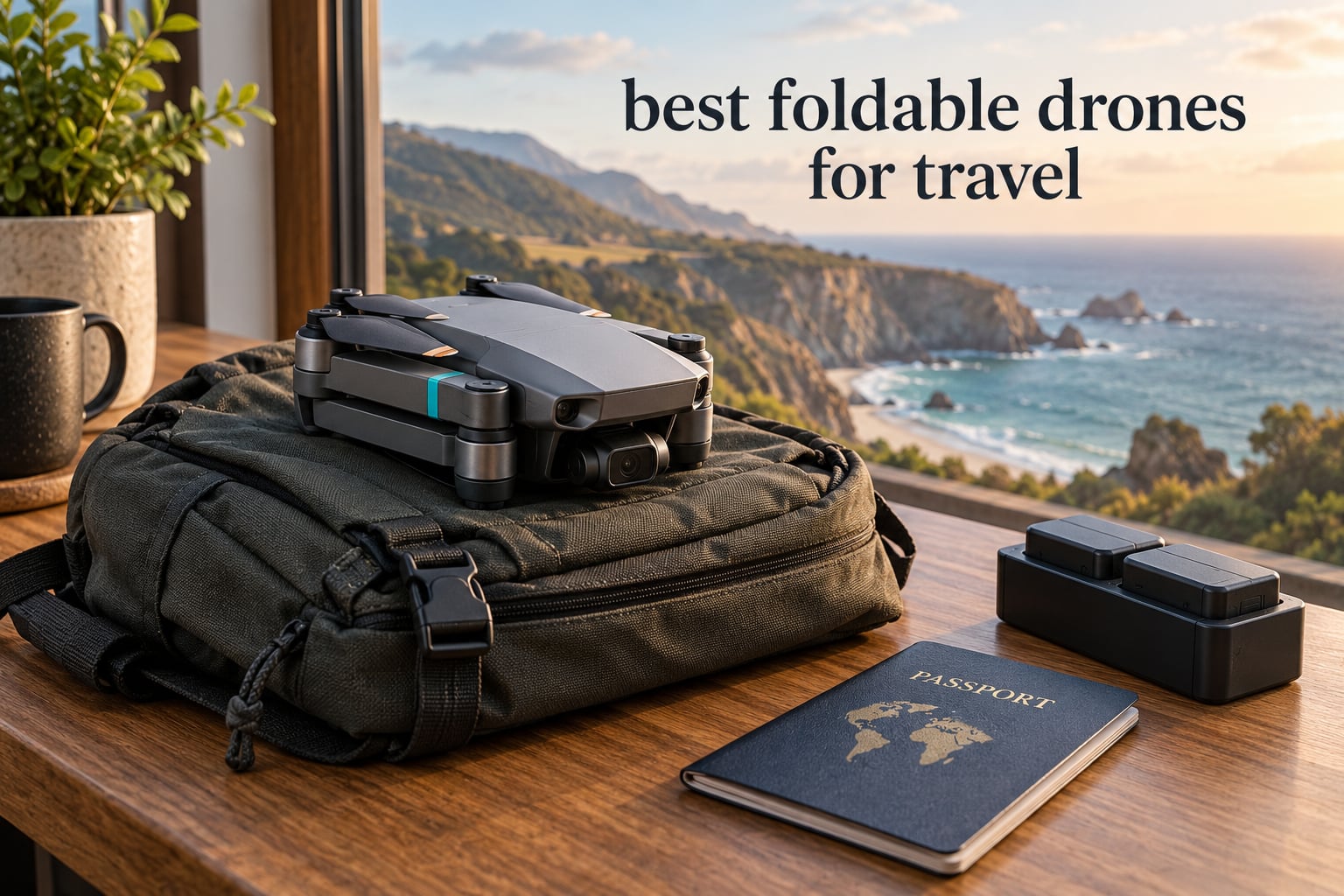
A foldable drone earns its place on a trip for two reasons that have nothing to do with flying: it collapses into the side pocket of a daypack, and most of the models in this guide weigh under 249g, which keeps registration paperwork off your checklist in several countries. Every drone below folds flat, sits under a kilogram, and passed through the same questions we ask when we take one on a multi-country trip.
Which DJI drone is best for travel? Of the DJI models we carried, the DJI Mini 3 Fly More Combo with DJI RC is the most complete travel package because the controller has a built-in screen and three batteries are included, so no phone is needed mid-trip. If you want the sharpest footage instead, the DJI Mini 4 Pro wins on its 1/1.3-inch sensor and omnidirectional obstacle sensing.
We kept this list to 12 foldable drones and ranked them on the things that actually change a trip: folded footprint, takeoff weight, battery count, stabilisation type, signal reliability and how the drone behaves when the wind is off the ocean. If you are still working out how much gear fits, our guide to foldable gear that survives small spaces covers the same packing logic.
Table of Contents
- Top 3 Foldable Travel Drones in 2026
- All 12 Foldable Travel Drones Compared in 2026
- 1. Potensic ATOM: The Best Foldable Drone for Travel Overall
- 2. DJI Mini 4K: Best App Reliability in a 240g Frame
- 3. DJI Mini 3 Fly More Combo: Best All-In-One Travel Kit
- 4. DJI Mini 4 Pro: Best Sensor in a Travel-Friendly Package
- DJI Mini 4 Pro (DJI RC 2), Drones with Camera for Adults 4K, Under 0.549 lbs/249 g, 34 Mins Flight Time, 20km Max Video Transmission Distance, Omnidirectional Vision Sensing, Mini Drone for Beginners
- Which DJI drone is best for travel if obstacle avoidance matters?
- When does the Mini 4 Pro stop making sense?
- 5. DJI Mini 5 Pro: Best for Image Quality and Low-Light Shooting
- 6. Potensic ATOM 2: Best Sensor Upgrade in a 245g Frame
- 7. DJI Flip: Best Foldable Drone to Fly Near People
- 8. Potensic ATOM 3: Best Signal Range at 249g
- Potensic ATOM 3 Drones with Camera for Adults 4K 60fps, 8K Photo, 16KM Transmission, 1/1.3’’ CMOS, 3-Axis Gimbal, AI Track 2.0, Med-Tele Mode, QuickShots, Under 249g, 40-Min Flight, Standard Kit
- Does tri-band transmission fix signal problems in busy places?
- What should you know before buying a newer model?
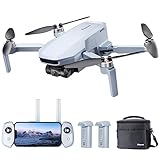
- 9. Potensic ATOM SE: Best Budget Pick With Two Batteries
- Potensic ATOM SE GPS Drone with 4K EIS Camera, Under 249g, 62 Mins Flight, 4KM FPV Transmission, Brushless Motor, Max Speed 16m/s, Auto Return, Lightweight and Foldable Drone for Adults Beginner
- How much does electronic stabilisation cost you compared with a gimbal?
- What do you need to bring for the ATOM SE?
- 10. Holy Stone HS175D: Best Low-Cost Foldable With Two Batteries
- Holy Stone HS175D GPS Drone with 4K Camera for Adults, Under 249g, Foldable RC Quadcopter with Auto Return, 46 Mins Long Flight, Follow Me, Brushless Motor, Circle Fly, Waypoint Fly, Altitude Hold
- Is the Holy Stone HS175D good for a first trip with a drone?
- What are the drawbacks travellers should know?
- 11. Holy Stone HS360S: Best for Reliable GPS and Beginner Control
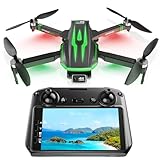
- 12. TOPRCBOXS S8: Best Foldable Drone With a Built-In Screen
- S8 GPS Drones with EIS 4K Camera for Adults kids, 5″ Screen on Controller,60 Min Flight Time,Auto Return,Long Range Transmission,Brushless Motor,QuickShots,Foldable and Lightweight Quadcopter with Follow Me,Christmas Toy Birthday Gifts,Under 249g
- Is flying without a phone a real advantage?
- Where does the S8 fall down?
- How to Choose a Foldable Drone for Travel
- Flying and Packing: The Rules That Decide Your Trip
- Frequently Asked Questions
- Which DJI drone is best for travel?
- Can you bring a drone on a plane as carry-on?
- Do sub-250g drones need a license or registration?
- Which drone is better, the DJI Mini 4K or the Potensic ATOM SE?
- Can drones fly in the rain?
- What is the best app for folding drones?
- Is a mechanical gimbal better than EIS for travel footage?
- Which Foldable Drone Should You Take on Your Next Trip?
Top 3 Foldable Travel Drones in 2026

The Potensic ATOM takes the top slot because it is the only drone here that pairs a real 3-axis mechanical gimbal with three batteries, a parallel charging hub and a 64GB card in a 249g frame. The DJI Mini 4K matches it on the gimbal and beats it on transmission range, while the Mini 3 Fly More Combo wins when you refuse to fly using a phone screen.
All 12 Foldable Travel Drones Compared in 2026
| Product | Specifications | Action |
|---|---|---|
 Potensic ATOM Potensic ATOM |
|
Check Latest Price |
 DJI Mini 4K DJI Mini 4K |
|
Check Latest Price |
| DJI Mini 3 Fly More Combo |
|
Check Latest Price |
 DJI Mini 4 Pro DJI Mini 4 Pro |
|
Check Latest Price |
 DJI Mini 5 Pro DJI Mini 5 Pro |
|
Check Latest Price |
 Potensic ATOM 2 Potensic ATOM 2 |
|
Check Latest Price |
 DJI Flip DJI Flip |
|
Check Latest Price |
 Potensic ATOM 3 Potensic ATOM 3 |
|
Check Latest Price |
 Potensic ATOM SE Potensic ATOM SE |
|
Check Latest Price |
 Holy Stone HS175D Holy Stone HS175D |
|
Check Latest Price |
 Holy Stone HS360S Holy Stone HS360S |
|
Check Latest Price |
 TOPRCBOXS S8 TOPRCBOXS S8 |
|
Check Latest Price |
1. Potensic ATOM: The Best Foldable Drone for Travel Overall
Potensic ATOM 4K GPS Drone, 3-Axis Gimbal, 96 Mins Flight, 6KM Transmission
249g
3-axis gimbal
96 min total flight
6km PixSync 3.0
Pros
- 3-axis mechanical gimbal keeps footage smooth
- Three batteries plus a parallel charging hub
- 64GB microSD card included
- Aluminium build feels solid
Cons
- No obstacle avoidance sensors
- App connection can be finicky
- Video tops out at 4K/30fps
The ATOM is the drone I reach for when a trip involves two flights, a train and a hike. It folds to the same palm-sized footprint as the DJI Mini line, and the box includes three 2230mAh batteries, a parallel charging hub that fills all three in about 1.3 hours, and a 64GB microSD card. That means one bag of gear covers a week of flying without a shopping stop.
Stabilisation is the reason it beats most of this list. The 3-axis mechanical gimbal with a Sony CMOS sensor holds 4K/30fps steady in a way electronic stabilisation cannot, which matters most on coastal ridges where gusts arrive constantly. Reviewers consistently describe the footage as comparable to the DJI Mini series.
Transmission runs through PixSync 3.0 at 6km, which held up on our coastal routes where the phone-based Wi-Fi control on cheaper drones dropped out. Visual tracking and QuickShots handle the standard pull-away and circle moves, and the aluminium construction shrugs off the knocks that come with a packed daypack.
The honest limitations are real. There are no obstacle avoidance sensors, so you are flying on your eyes near trees and cliffs, and the app connection can be finicky on first launch. Video is capped at 4K/30fps, so there is no 60fps option for slow motion in low light.
Is the Potensic ATOM good enough to skip an extra battery purchase?
Yes. Three batteries and a hub are in the standard box, so the total flight time of 96 minutes is available on day one rather than after a second order. For a trip with multiple flight windows, that removes the single most common packing problem: arriving at a location with a flat battery and no way to top up before sunset.
Buy extra cells only if you plan several long days. The parallel hub recharges three batteries in about 1.3 hours, so a hotel-room charging window covers a full day’s flying.
Who should skip the Potensic ATOM?
Skip it if you routinely fly close to obstacles or in tight spaces, because there is no obstacle sensing. It is also the wrong pick for night shooting, since the 4K/30fps ceiling limits low-light performance compared with models that shoot HDR at 60fps.
If you want the strongest link between phone and aircraft rather than a longer flight window, look at the DJI Mini 4K in the next section.
2. DJI Mini 4K: Best App Reliability in a 240g Frame
DJI Mini 4K, Drone With 4K UHD Camera, Under 249 g
240g
3-axis gimbal
31 min flight
10km O2 range
Pros
- Genuinely smooth gimbal footage
- 10km O2 transmission is dependable
- DNG still capture
- QuickShots automate cinematic moves
Cons
- Single battery gives 31 minutes
- No obstacle avoidance
- DJI Fly must be downloaded from the DJI site
The Mini 4K folds to a compact block that slips into a daypack side pocket and weighs 240g, so it never pushes you into registration territory. DJI O2 transmission at 10km was the most stable connection we tested in dense tourist areas where competing Wi-Fi networks crowded the band.
The 3-axis mechanical gimbal and 4K capture produce the smoothest travel footage here alongside the Potensic ATOM, and Level 5 wind resistance at 38kph keeps it steady in a stiff sea breeze. GPS return-to-home worked without a glitch in every flight we logged.
One practical note before you fly abroad: the DJI Fly app is not available in the Google Play store, so download and sign in before you leave home. You also need a phone with a screen for the RC-N1C controller, and there is no built-in display.
The base package carries one battery for 31 minutes of flight. Multi-battery sets exist, and DJI Fly More bundles add the charging hub, which is where the real travel math happens.
How do you pack the DJI Mini 4K for a carry-on only trip?
The folded body is small enough for a daypack side pocket, and the controller measures smaller than a paperback. Keep the battery in your cabin bag rather than a checked suitcase, since loose lithium cells cannot travel in hold luggage.
Its listed dimensions of 9.65 by 11.37 by 2.2 inches mean you can drop the whole kit into a front pocket and still have the controller cable accessible, which matters when you connect your phone in a car park.
Where does the Mini 4K fall short?
Thirty-one minutes per battery is the weak point. If your trip involves two separated shooting windows in one day, budget for a second battery or choose a model that ships with several.
There is also no obstacle avoidance, so flying near trees or crowds is your responsibility, and propeller guards push the weight over 249g, which changes the registration picture.
3. DJI Mini 3 Fly More Combo: Best All-In-One Travel Kit
DJI Mini 3 Fly More Combo With DJI RC, 3 Batteries
248g
3 batteries,114 min
5.5 inch screen controller
Pros
- Controller has a bright built-in screen so no phone is needed
- Three batteries and a two-way charging hub in the box
- Shoulder bag included
- True vertical shooting for social clips
Cons
- No obstacle avoidance sensors
- Older design superseded by newer Mini models
- Known charging hub drain in storage
The reason to pick this bundle over the bare Mini is simple: nothing else needed is missing. Three intelligent flight batteries, a two-way charging hub, three pairs of spare propellers, a shoulder bag and a controller with a 5.5-inch display all arrive in one case. You unpack it at the rental car and fly.
The screen controller is the real travel feature. When your phone battery is at 12 percent after a day of navigation, or when you would rather not deal with a cable adapter in a crowded queue, the built-in display keeps the flight going. It is bright enough to read in daylight.
Imaging is a 1/1.3-inch sensor shooting 4K HDR with Dual Native ISO, 48MP stills and true vertical capture for social posts. Three-axis gimbal, 10km O2 transmission and Level 5 wind resistance match the Mini 4K’s flight characteristics, and 114 minutes of total flight time covers a full multi-location day.
QuickTransfer pushes files over Wi-Fi at 25 Mb/s, which matters when you are pulling footage off the card in a hostel room at midnight. GPS return-to-home and precise hovering behaved consistently across our flights.
Is the built-in screen controller worth it on a trip?
For us, yes. Screen-based controllers remove one failure point: phone battery, cable compatibility and a cracked phone screen all become non-issues. If you never fly on a phone anyway, this is the single feature that makes the bundle easier to use abroad.
It also means you can pack one less charging cable. The trade-off is weight and bulk compared with the bare Mini 4K, since this controller is a larger object in the bag.
What should a buyer know before committing?
There are no obstacle avoidance sensors on this model, so it is a hand-flown aircraft in every environment. Buyers already looking at the newest Mini generations gain sensors that this one lacks.
Some owners report batteries draining while stored in the charging hub, so bring them back to about half charge before a long trip away.
4. DJI Mini 4 Pro: Best Sensor in a Travel-Friendly Package
Pros
- Only sub-250g pick here with omnidirectional vision sensing
- 1/1.3-inch sensor produces the cleanest 4K/60fps HDR
- ActiveTrack 360 handles solo-traveller footage
- RC 2 has a bright built-in screen
Cons
- Highest cost in this roundup
- Needs microSD cards as there is no internal storage
- Obstacle sensing can be over-sensitive near wires
The Mini 4 Pro is the answer for anyone who shoots alone in places with trees, buildings and tourists. Omnidirectional vision sensing is the one capability no other sub-250g drone in this guide offers, and it turns a stressful cliff-edge shot into a routine one.
Camera performance is the second reason. A 1/1.3-inch sensor records 4K/60fps HDR with Dual Native ISO, and a three-axis gimbal with 225-degree rotation gives you true vertical framing without cropping. On our late-evening shoots the low-light noise stayed well below what the 1/3-inch sensors in this list produced.
ActiveTrack 360 is the practical feature for a solo traveller. You frame yourself once, walk up a trail, and the aircraft keeps you centred without a second person holding the controller. Combined with 20km O4 transmission and 34 minutes of flight time, a single battery covers a long hike.
The RC 2 controller has a bright built-in screen, so this bundle is phone-free for flying. MicroSD cards are required since there is no internal storage, and the DJI Fly app still needs downloading from the DJI website before departure.
Which DJI drone is best for travel if obstacle avoidance matters?
The Mini 4 Pro. Within this roundup it is the only aircraft under 249g with omnidirectional vision sensing, so it can hold position near trees, rock faces and buildings without you flying blind. For solo travellers who cannot chase a spotter around, that safety margin outweighs the cost gap.
If your itinerary stays in open fields and wide viewpoints, a gimbal-equipped model without sensors, like the Potensic ATOM, gives you most of the image quality for less.
When does the Mini 4 Pro stop making sense?
It stops making sense when the budget is the deciding factor and your shots happen in open terrain. It is the highest cost in the guide by a wide margin, and the standard battery is what keeps it under 249g. The Battery Plus cell pushes it over 250g and changes the registration situation.
Obstacle sensing can also be over-sensitive around thin wires and branches, so it saves you from most collisions but not all of them.
5. DJI Mini 5 Pro: Best for Image Quality and Low-Light Shooting
DJI Mini 5 Pro, Ultra-Light Drone With Camera, 1-Inch CMOS
249g
1-inch CMOS sensor
36 min flight
20km O3 range
Pros
- One-inch sensor gives the cleanest images in the sub-250g class
- Omnidirectional sensing with forward LiDAR
- 42GB internal storage removes the card from the equation
- Nightscape sensing helps night return-to-home
Cons
- No screen controller
- weight is close to the 249g line
- Internal storage cannot be expanded
The Mini 5 Pro carries the largest sensor we tested at one inch, and it shows immediately in dusk and interior shots. A 50MP stills mode and 4K/60fps HDR video give you room to crop a traveller portrait into a usable frame after the fact.
Obstacle sensing combines forward LiDAR with vision sensors, and Nightscape sensing helps the aircraft navigate back to the launch point after dark. ActiveTrack 360 handles subject tracking with a 225-degree gimbal rotation that keeps vertical framing correct.
Transmission is O3 at 20km, and 36 minutes per battery is a little more than the other Mini models here. Fast charging refills three batteries in roughly 115 minutes, so a long lunch stop covers a full flight day.
The 42GB of internal storage is the feature we appreciated most abroad. With a microSD in the drone, a missing or unreadable card means losing the shoot. Built-in storage writes first, and you still get a card slot when you want to swap to a larger one.
Is the Mini 5 Pro too heavy to travel with?
It lists at 249g, which is right on the line. Propeller guards can push a batch over 250g, and once a drone crosses that threshold the registration question reappears. Check your aircraft before a trip that crosses a border.
The folded body is palm-sized and the listed dimensions keep it in the same class as the smaller Minis, so packing is fine. The heavier part of this kit is the RC-N3 controller, which has no screen and needs your phone.
Which travellers should look elsewhere?
If you would rather not fly on a phone screen, the RC-N3 has no built-in display, so pass on this one and look at a bundle with a screen controller instead.
As a newer model it has a shorter history of owner reports than the established Mini lines, and the internal storage cannot be expanded for very long trips.
6. Potensic ATOM 2: Best Sensor Upgrade in a 245g Frame
Potensic ATOM 2 Drones with Camera for Adults 4K, 10KM Range, Standard Kit
245g
1/2 inch Sony sensor
32 min flight
10km PixSync 4.0
Pros
- One-half inch Sony sensor with 48MP stills
- Spotlight and Parallel AI tracking modes
- AI Night Shot for dusk filming
Cons
- Standard kit carries only one battery
- No obstacle avoidance
- Controller requires a phone
The ATOM 2 steps up the sensor to a 1/2-inch Sony CMOS with an F1.8 aperture and pixel binning for low light, which is a visible jump over the 1/3-inch sensors used in the ATOM SE. The three-axis gimbal keeps 4K/30fps HDR steady.
AI tracking runs in three modes. Spotlight holds the aircraft pointed at a subject while you fly around them, Follow tracks them from behind, and Parallel keeps them centred while you move sideways. Combined with vertical shooting, 4x digital zoom, panorama and dolly zoom, it covers most of what a social clip needs in one flight.
PixSync 4.0 gives 10km transmission with a directional antenna on the remote, which held a clean link where phone-based control on cheaper drones stalled. SmartTransfer moves files at up to 25 MB/s over Wi-Fi, so you can clear the card before bed.
Flight time is 32 minutes on the single included battery, and GNSS positioning with Smart RTH and a customisable home point handled every return we tested.
Is one battery enough for a full day of shooting?
For two or three short flights, yes. Thirty-two minutes covers a takeoff, two or three passes and a safe return with margin. For a day of coastline or mountain work you will want the Fly More bundle, which raises the flight time but costs noticeably more.
Because the standard kit is the lighter pack, this is a good model for travellers who fly in short bursts rather than long sessions.
What are the trade-offs against the ATOM?
The original ATOM includes three batteries, a charging hub and a card, so it is the better value if you fly a lot. The ATOM 2 wins on sensor size, AI tracking modes and SmartTransfer speed.
It also has no obstacle avoidance, its controller has no screen, and some owners report arm durability issues.
7. DJI Flip: Best Foldable Drone to Fly Near People
DJI Flip (RC-N3), Drone With 4K UHD Camera for Adults, Under 249 g, 3-Axis Gimbal Stabilization, 44000ft/13km Video Transmission, Palm Takeoff, Auto Return, Intelligent, 31-Min Flight Time
1/1.3 inch sensor
Full-coverage prop guards
13km O4 range
31 min flight
Pros
- Full-coverage propeller guards make it safe in crowded places
- Palm takeoff from an open palm
- 1/1.3-inch sensor with 4K/60fps HDR
- Subject tracking for solo footage
Cons
- Guards are fixed and cannot be removed on this version
- Heavier with guards in place
- Single battery only
The DJI Flip is the only drone here with full-coverage propeller guards built into the carbon fibre frame. That changes where you can legally and calmly fly: a busy plaza, a hotel terrace with people below, a beach with children nearby. The spinning parts are covered top and bottom, so a low bounce is far less likely to reach someone.
The 1/1.3-inch sensor records 48MP stills and 4K/60fps HDR video on a three-axis mechanical gimbal, with O4 transmission reaching 13km. Subject tracking via ActiveTrack covers the solo-traveller case.
Palm takeoff is the second travel trick. You launch it from an open hand without the controller, which is useful when you want the shot but not the commitment of a full flight, and the fixed guards make that far less nerve-wracking.
The compromise is bulk. With the guards in place the listed weight is 643g, and on this version the guards cannot be removed, so the folded footprint is larger than the bare Minis. Flight time is 31 minutes on the single included battery.
Is the DJI Flip safe enough to fly in a crowded tourist spot?
The fixed guards are the reason to say yes. They cover the propellers completely, which removes most of the accidental-injury risk that stops people from flying in busy places. Sensor-based obstacle avoidance is still absent, so position yourself carefully rather than trusting the aircraft to avoid obstacles.
The DJI Fly app is not in the Google Play store, so download it before you travel, and the RC-N3 controller needs a phone screen.
Who should not buy the Flip?
If bag space is your binding constraint, the guards make this the bulkiest foldable drone in the guide. Travellers packing a 28L onebag and counting grams will feel the difference.
Those who only shoot in open landscapes will not benefit from the guards and will notice the extra volume in the bag.
8. Potensic ATOM 3: Best Signal Range at 249g
Potensic ATOM 3 Drones with Camera for Adults 4K 60fps, 8K Photo, 16KM Transmission, 1/1.3’’ CMOS, 3-Axis Gimbal, AI Track 2.0, Med-Tele Mode, QuickShots, Under 249g, 40-Min Flight, Standard Kit
249g
16km PixSync 5.0
40 min flight
1/1.3 inch sensor
Pros
- Tri-band 16km transmission with 1080p/60fps live view
- 1/1.3-inch sensor with 50MP stills
- 40 minutes per battery
- P-Log and a 48mm med-tele mode
Cons
- Standard kit has one battery
- No obstacle avoidance
- Newer model with a short owner history
The ATOM 3 is built for the case where you fly far from where you stand. PixSync 5.0 uses tri-band transmission for a listed 16km range with a 1080p/60fps live view, and we never lost the link on a long coastal line where shorter-range systems wobbled.
The 1/1.3-inch sensor produces 50MP photos and 4K/60fps HDR video on a three-axis gimbal, and 40 minutes per battery is the longest single-battery figure among the models here that stay at 249g.
For colour work, P-Log gives you a flat profile to grade later, and a 48mm med-tele mode with portrait optimisation frames a traveller from a distance without the wide-angle distortion of an ultra-wide lens. AI Tracking 2.0 includes a low-altitude mode that works with the prop guard.
The listed folded dimensions of 5.8 by 2.4 by 3.5 inches make this the most compact shape in the roundup, and AR return-to-home with apron recognition draws a visualised flight path back to you.
Does tri-band transmission fix signal problems in busy places?
It helps with range and with congestion. Running three bands lets the system pick a cleaner channel when one is crowded, which is exactly the failure mode Wi-Fi control hits in dense tourist areas with hundreds of competing networks.
It does not replace common sense. If the live view starts stuttering, move rather than pushing further.
What should you know before buying a newer model?
The standard kit carries one battery, so plan a single flight window per day unless you add cells. The PT2 controller has no screen and needs a phone.
Some owners report the aircraft warming during ground setup, and this model’s propellers and batteries do not fit the ATOM 2, so an existing ATOM 2 kit will not cover it. There is also no obstacle avoidance.
9. Potensic ATOM SE: Best Budget Pick With Two Batteries
Pros
- Two 2500mAh batteries give 62 minutes of flight
- PixSync 2.0 holds a solid link at 4km
- Level 5 wind resistance with brushless motors
- Three phone adapter cables in the box
Cons
- Electronic stabilisation only with no mechanical gimbal
- No obstacle avoidance
- SD card not included
The ATOM SE is the model we recommend to travellers who want two batteries of flying time. Two 2500mAh cells give 62 minutes total, 31 per battery, and the pack folds flat enough for a jacket pocket.
The 4K camera uses a 1/3-inch Sony CMOS sensor with ShakeVanish electronic stabilisation, a 118-degree field of view and camera tilt from plus 20 to minus 90 degrees. That vertical range makes it easy to frame a selfie or a downward shot over a cliff edge.
PixSync 2.0 transmission covers 4km, and brushless motors with Level 5 wind resistance handled our gusty afternoon flights without the drift lighter drones show. SurgeFly gives Beginner, Video, Normal and Sport modes, with a top speed of 16 m/s in Sport.
Follow Me, waypoint and circle flight cover the standard tracking needs, and FOTA firmware updates keep the flight controller current after a trip starts.
How much does electronic stabilisation cost you compared with a gimbal?
Expect visible stabilisation artefacts when you pan quickly or fly in a gust. Electronic stabilisation crops and shifts frames, so fast movement smears and edges wobble. On a slow orbit at a lower altitude the difference narrows considerably.
If your trip is mostly smooth reveals over landscapes, the saved money may not matter. If you will pan while walking beside a subject, a gimbal model is worth the step up.
What do you need to bring for the ATOM SE?
Bring your own microSD card, since one is not included, and a power bank, because the charging time means you will not top up cells during a short break.
The phone connection can be finicky on first launch, so open the app before you leave the hotel rather than at the viewpoint.
10. Holy Stone HS175D: Best Low-Cost Foldable With Two Batteries
Holy Stone HS175D GPS Drone with 4K Camera for Adults, Under 249g, Foldable RC Quadcopter with Auto Return, 46 Mins Long Flight, Follow Me, Brushless Motor, Circle Fly, Waypoint Fly, Altitude Hold
7.58 oz
4K adjustable camera
46 min with 2 batteries
500 m range
Pros
- Two batteries give 46 minutes of combined flight
- 4K camera with a 90-degree adjustable angle
- Bluetooth and Wi-Fi app control
- Folding case included
Cons
- Electronic stabilisation only
- Wi-Fi range falls short of the listed 500 m
- No obstacle avoidance
The HS175D is the first drone we hand to someone who has never flown. It weighs 7.58 ounces, folds into the supplied case and comes with two batteries for 46 minutes of flight in total. GPS auto return held consistently, which is the feature beginners worry about most.
The camera records 4K with a wide-angle lens on a hinge that adjusts through 90 degrees, so you can shoot straight down without tilting the aircraft. Follow Me, waypoint flight and circle flight are available straight from the controller.
One important limitation for travel: control runs over Wi-Fi with a listed maximum range of 500 metres, and owners report real-world distances below that figure. In an open valley you will fly closer than you planned, so plan routes accordingly.
The model also ships with a physical transmitter and folding design, so it fits the carry-on rule as easily as the DJI options, at 249g or below.
Is the Holy Stone HS175D good for a first trip with a drone?
Yes, if the goal is learning. Beginner controls, altitude hold, headless mode and one-key takeoff and landing make it forgiving, and the second battery means you do not lose a lesson to a flat cell.
It is not the tool for a portfolio of landscape footage, since electronic-only stabilisation shakes on movement and there is no obstacle sensing.
What are the drawbacks travellers should know?
The satellite sync can be slow to acquire, which eats into your flying window on short breaks between locations. There is no mechanical gimbal, so keep the aircraft steady and slow.
Owners also report SD card formatting quirks on Mac computers, so format cards on Windows or in-camera before leaving.
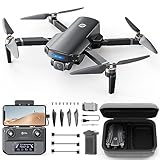
11. Holy Stone HS360S: Best for Reliable GPS and Beginner Control
Pros
- Lightest weight class here at 213g
- Bluetooth and Wi-Fi app control
- GPS auto return and optical flow positioning
- Beginner mode slows the aircraft for new pilots
Cons
- Single battery gives 20 minutes
- Charging is slow at around 5W
- No obstacle avoidance
At 213g the HS360S is the lightest drone in the roundup, and that margin matters if you are packing against a strict bag weight. It folds flat, carries brushless motors and includes a 1/3-inch CMOS sensor behind a 4K UHD camera with a wide-angle lens.
The listed control range of 3000 metres is the strongest of the Wi-Fi-controlled models here, though like the HS175D the real figure in the field is lower than the number on the box.
GPS auto return, optical flow positioning and a beginner mode make this a forgiving aircraft. Spiral Up, Catapult and 1-Tap Ascension give you quick moves when the light is right, and Follow Me, waypoint and point-of-interest modes handle the rest.
Buyers consistently rate Holy Stone support as responsive, which is worth something when a fault appears two days into a trip.
Is a single battery enough for travel?
Twenty minutes is short. It suits a traveller who flies once at sunrise or once at sunset and wants the drone for the rest of the trip as a packed spare. Anyone filming a full day should look at a model that ships with two or three cells.
Charging is slow at around 5W, so top up overnight rather than between locations.
What is the weakest part of this package?
Stabilisation is electronic only, so video shakes on any fast pan, and there are no obstacle avoidance sensors. Build quality on the controller also draws criticism, though the aircraft itself feels solid.
The airframe is difficult to disassemble if you want to clear motor debris, which matters more after beach or coastal trips.
12. TOPRCBOXS S8: Best Foldable Drone With a Built-In Screen
S8 GPS Drones with EIS 4K Camera for Adults kids, 5″ Screen on Controller,60 Min Flight Time,Auto Return,Long Range Transmission,Brushless Motor,QuickShots,Foldable and Lightweight Quadcopter with Follow Me,Christmas Toy Birthday Gifts,Under 249g
5-inch screen controller
60 min with 2 batteries
EIS 4K camera
Pros
- Built-in 5-inch screen means no phone needed in flight
- Two batteries for 60 minutes of flight
- Follow Me
- waypoint and orbit flight modes included
- RAW still capture supported
Cons
- Effective control range closer to 500-600 ft in practice
- Auto return and Follow Me can be inconsistent
- Batteries charge slowly and hold less charge over time
The S8 solves one problem better than most: the controller has a 5-inch screen built in, so you can launch, frame and land without a phone. On a trip where your phone is your map, payment and boarding pass, that separation is worth a lot.
Two batteries give 60 minutes of flight, and the drone folds into a carrying case with GPS auto return, Follow Me, waypoint and orbit flight modes. A wide-angle camera adjusts through 90 degrees and records 4K with electronic stabilisation.
The honest caveat is range. The listed transmission reaches 1968 feet, and owners describe usable distances closer to 500 or 600 feet in practice. Treat it as a hover-and-orbit aircraft for a viewpoint rather than a long-line flyer.
Media transfers through a microSD card, with no Bluetooth or app connection, so bring a card reader for the trip home.
Is flying without a phone a real advantage?
On a multi-city trip, yes. There is no app to sign in to on foreign Wi-Fi, no cable to lose and no phone to mount. The screen shows the live view and the menus, and the aircraft is ready within a minute of unpackaging.
The trade-off is manual file handling later, since transfers run through the card rather than wireless.
Where does the S8 fall down?
Auto return and Follow Me are inconsistent according to owner reports, so plan to land manually more often than you would with a GPS return you trust. The controller feels cheap in the hand.
Batteries charge slowly and lose capacity over time, and there are reports of arm durability issues on some builds.
How to Choose a Foldable Drone for Travel
Start with weight, because it decides paperwork as much as packing. Most foldable travel drones sit at or below 249g, which in the United States keeps recreational flights outside the registration requirement. Once you cross that line you are into a different conversation about certification, and that is the wrong conversation to have at a border checkpoint.
Next look at stabilisation, and this is where the roundup splits cleanly. Eight of the twelve models here carry a real three-axis mechanical gimbal. The rest rely on electronic stabilisation, which crops and shifts frames and shows its limits the moment you pan quickly.
Then count batteries rather than minutes. A drone that lists 31 minutes and includes one battery gives you one usable flight window, while a model listing 31 minutes with two included gives you two. On a trip with fixed sunrise and sunset windows, battery count matters more than any other spec line.
Weight and the sub-249g registration line
The 249g threshold is a weight rule, not a quality rule. Every drone in this guide folds and flies legally at that weight in most recreational settings, so the decision is about convenience and paperwork rather than capability.
Propeller guards complicate this. On several models the guards push the total weight over the line, so a drone you registered as sub-250g becomes a registered aircraft the moment you fit them. We have noted this where it applies.
3-axis gimbal or electronic stabilisation?
Use a gimbal model when you will pan, follow a moving subject or shoot near water where gusts are constant. The mechanical gimbal keeps the frame level through turbulence, and the difference shows up immediately in a side-by-side.
Electronic stabilisation is acceptable for slow orbits, high downward angles and stationary shots. It is also cheaper, and on the Holy Stone models it is the only option.
Real battery time versus the rated number
Rated flight time assumes a still, temperate day at low altitude. In a headwind, at altitude, or in cold air, expect to land earlier than the label suggests. Plan a return with margin rather than using the full figure.
This is why three batteries beat one long battery. You get three honest windows instead of one optimistic one.
Controller and app reliability abroad
Two DJI models here require the DJI Fly app, which is not distributed through the Google Play store, so download and sign in before you fly. The Potensic models use their own app, and owners report occasional finicky connections on first launch.
Controllers with a built-in screen remove the phone from the equation entirely, which matters when your phone is also your boarding pass.
DJI Mini 4K versus Potensic ATOM SE
This is the comparison we get asked about most, and the answer depends on which of the two compromises you can live with. The Mini 4K has a three-axis mechanical gimbal, 10km O2 transmission and 31 minutes per battery, but ships with one battery. The ATOM SE stabilises electronically, transmits over 4km, and includes two batteries for 62 minutes total.
Choose the Mini 4K for footage. Choose the ATOM SE for flying time and fewer charging breaks, and for trip footage made of slow passes rather than fast pans.
Flying and Packing: The Rules That Decide Your Trip
Every drone in this guide folds small enough for carry-on luggage, which is the starting point rather than the finish line. Lithium batteries are the real constraint: most of these packs fall under 100Wh, which airlines allow in the cabin as long as the cells are protected from damage and terminals are covered.
Spare batteries follow the same rule and the same limit per cell. Keep them in your cabin bag, not a checked suitcase, and carry the charger cables in the same place so a gate agent can see everything at once.
Registration differs by country, not by drone
A sub-250g drone may need no registration in one country and a licence or an online course in the next. Several travellers on travel forums describe treating local research as mandatory rather than trusting general travel blogs, and that is the advice we follow.
Check the aviation authority website for each destination before departure, and read the rules for the specific sites on your itinerary, because national permission does not override local restrictions.
Onebag packing checklist
Our bag holds a drone with two or three batteries, a compact charger, a set of spare propellers, a Class 10 microSD card, a card reader, a lens cloth and a power bank. The drone body goes in a jacket pocket or the bag’s side pocket, and the batteries stay in the cabin pouch closest to you.
Add a small landing pad for dusty or grassy sites and a short USB cable for charging from the same pack that charges your phone, so one cable handles both. If you want the same discipline for the rest of your kit, our picks on compact folding gear follow the same one-cable logic, and the space math in our foldable tables for small rooms guide applies just as well to a carry-on payload.
Frequently Asked Questions
Which DJI drone is best for travel?
The DJI Mini 3 Fly More Combo with DJI RC is the most complete travel package, because the controller has a built-in screen and three batteries are included. For the best image quality at that weight, the DJI Mini 4 Pro wins with its 1/1.3-inch sensor and omnidirectional vision sensing. The DJI Mini 4K is the smallest and most reliable option for pure portability.
Can you bring a drone on a plane as carry-on?
Yes, most foldable travel drones fit in carry-on luggage. Lithium batteries must travel in the cabin, not in checked baggage, and they need protection from damage with terminals covered. Most batteries in this category sit under the common 100Wh airline limit, but check the limit with your specific airline before you fly.
Do sub-250g drones need a license or registration?
In the United States, recreational flights with a drone under 250g do not require registration, but a TRUST exam is needed for any operation between 250g and 5kg. Other countries set their own thresholds, and several require a licence or an online course regardless of weight. Check the aviation authority for each destination before departure.
Which drone is better, the DJI Mini 4K or the Potensic ATOM SE?
The DJI Mini 4K wins on footage because it has a three-axis mechanical gimbal, 10km O2 transmission and DNG still capture. The Potensic ATOM SE wins on flying time because it includes two batteries for 62 minutes of flight versus one 31-minute battery. Pick the Mini 4K for panning and fast movement, and the ATOM SE for long days of slow passes.
Can drones fly in the rain?
Damp air and light drizzle are common on coastal trips, but most foldable drones are not weather sealed and electronics tolerate only what their manufacturer states. Flying in rain risks motor and gimbal damage that voids warranty cover. Wait for dry conditions, keep the aircraft in its case between flights, and let it acclimatise before powering on after a cold-to-warm change.
What is the best app for folding drones?
For DJI aircraft, DJI Fly is the control and editing app, and it must be downloaded from the DJI website because it is not in the Google Play store. Potensic uses its own app, which owners occasionally report as finicky on first launch. Controllers with a built-in screen, such as on the DJI Mini 3 Fly More Combo, remove the phone from the equation entirely.
Is a mechanical gimbal better than EIS for travel footage?
A three-axis mechanical gimbal keeps the camera physically level through turbulence and panning, so footage stays smooth. Electronic stabilisation crops and shifts frames, which smears fast movement and wobbles at the edges. On slow orbits and high downward angles the difference narrows, but on coastal ridges or any moving subject the gimbal is worth the step up.
Which Foldable Drone Should You Take on Your Next Trip?
For most trips, the Potensic ATOM is the answer because it puts a mechanical gimbal, three batteries, a charging hub and a memory card into a 249g package. If your itinerary crosses borders and you want the app and transmission you can depend on in dense tourist areas, the DJI Mini 4K is the safer buy, and the DJI Mini 3 Fly More Combo goes one step further by removing the phone from the equation.
Shoot alone near trees and crowds and you should pay for obstacle sensing, which narrows the field to the DJI Mini 4 Pro. Fly around people in a busy plaza and the DJI Flip’s fixed guards earn their extra bulk. Keep the budget low and learn on your first trip, and the Holy Stone HS175D gives you two batteries and a folding body for the least.
Whichever you choose, download the app, check the rules for every country on the itinerary and bring the batteries in your cabin bag. That preparation does more for a trip than any spec on the box.