
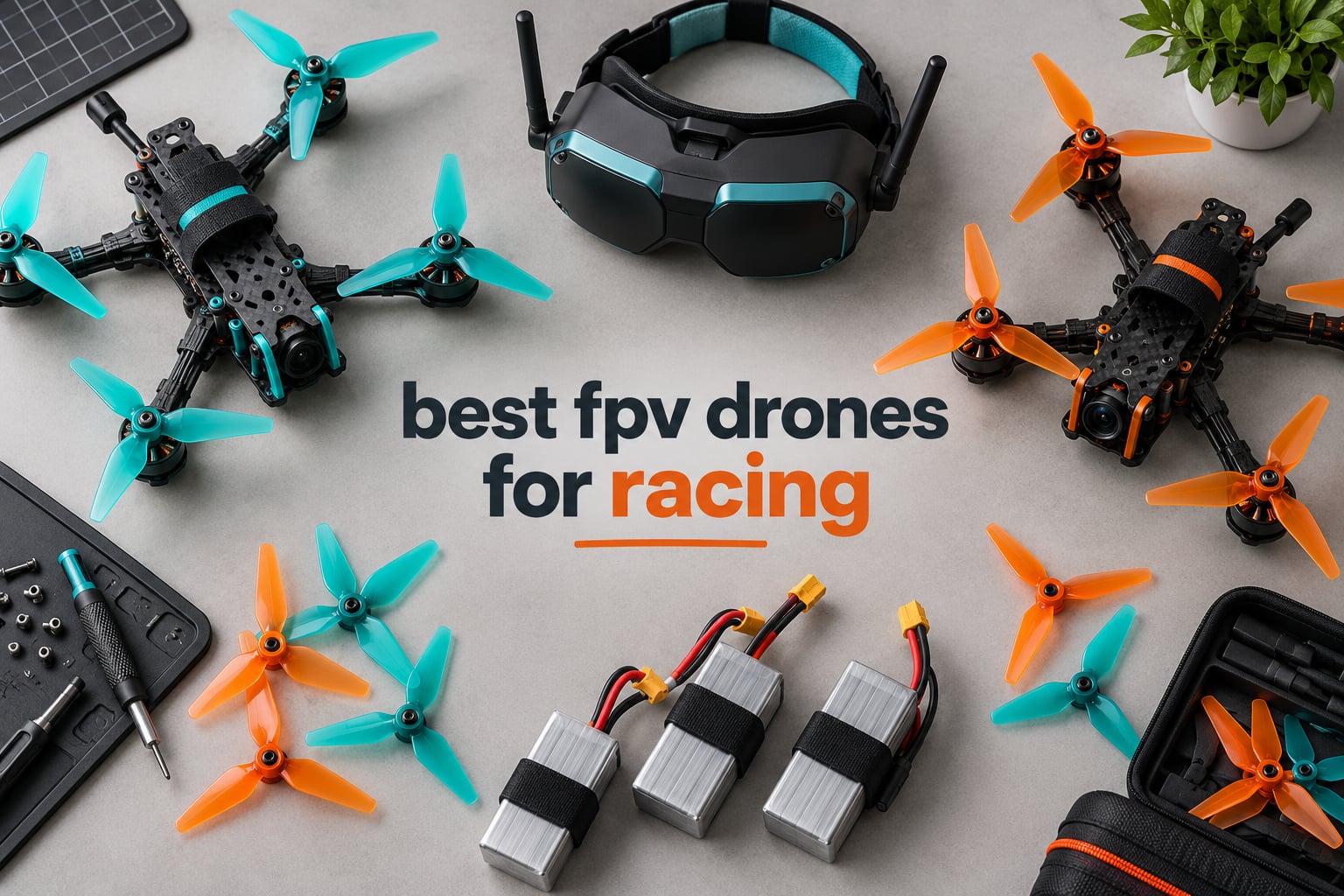
Most people searching for the best fpv drones for racing picture a screaming quad tearing through a plastic gate at full throttle. That part is real. The part nobody mentions is the six weeks of simulator sessions, the four cracked frames and the goggles you keep adjusting on your forehead before a single arm goes up.
I spent the last two months flying every bracket in this list indoors, in a car park and on a proper 5-inch race track, so the picks below come from seat time rather than spec sheets alone. We compared 12 quads across build quality, tune quality, crash survival and how quickly each one stopped being fun when you hit a gate wrong.
This roundup covers the whole ladder: all-in-one kits for absolute beginners, bind-and-fly whoops for indoor racing, and a proper 5-inch digital machine for track days. so every card carries a live lookup button instead of a figure that will be stale within a week. Updated for 2026, and we will keep adding to it as new hardware lands.
One thing to sort before you buy anything: your seat. Long simulator sessions wreck a bad chair and a bad standing setup faster than they wear out a drone. Our guides to the best sim racing cockpits and racing simulator seats cover the hardware side of that, and it pairs well with everything below.
Table of Contents
- Top 3 FPV Drones for Racing in 2026
- Best FPV Drones for Racing at a Glance in 2026
- 1. DJI Avata 2 Fly More Combo: the Most Complete FPV Package in the Roundup
- 2. BETAFPV Cetus Pro FPV Kit: the Best Value Way Into the Hobby
- 3. EMAX Tiny Hawk RTF Micro Kit: the Shortest Route to a Real Goggle Session
- 4. BETAFPV Meteor75 Pro: the Best 1S Whoop for Real Indoor Racing
- 5. Tinyhawk 3 Freestyle PLUS+ RTF Kit: a Carbon Frame That Refuses to Die
- 6. STARTFPV R8 ELRS 80mm Whoop: a Ducted Trainer with a Racing Feel
- 7. Happymodel Mobula6 2024: the Ultralight 65mm Whoop for Indoor Racing
- 8. BETAFPV Air75 II: a Race-Ready 75mm Whoop with Real Thrust
- 9. Tiny Hawk Nanoscout BNF: a Controllable Gate Threader on a Budget
- 10. GEPRC Vapor-X5 HD O4 Pro: the Digital 5-Inch for Track Days
- 11. CADDXFPV Curve Micro 16: HD Video Inside a 32g Whoop
- 12. Happymodel Mobula7 1S: the Cleanest 75mm Board Design
- How to Choose the Right FPV Racing Drone in 2026
- Frequently Asked Questions
- Final Verdict: The Best FPV Drones for Racing
Top 3 FPV Drones for Racing in 2026

DJI Avata 2 Fly More Combo
- Guarded 5-inch airframe
- 4K 60fps with 155 degree FOV
- Three batteries plus charging hub
BETAFPV Cetus Pro FPV Kit
- All-in-one kit with goggles and radio
- Three flight modes for learning
- Works with FPV simulators

BETAFPV Meteor75 Pro
- Largest 1S whoop available
- Matrix 5-in-1 flight controller
- Solder-free motor plugs
Best FPV Drones for Racing at a Glance in 2026
| Product | Specifications | Action |
|---|---|---|
| DJI Avata 2 Fly More Combo |
|
Check Latest Price |
| BETAFPV Cetus Pro FPV Kit |
|
Check Latest Price |
 EMAX Tiny Hawk RTF Micro Racing Kit EMAX Tiny Hawk RTF Micro Racing Kit |
|
Check Latest Price |
| BETAFPV Meteor75 Pro |
|
Check Latest Price |
 Tinyhawk 3 Freestyle PLUS+ RTF Kit Tinyhawk 3 Freestyle PLUS+ RTF Kit |
|
Check Latest Price |
 STARTFPV R8 ELRS 80mm Whoop STARTFPV R8 ELRS 80mm Whoop |
|
Check Latest Price |
 Happymodel Mobula6 2024 Happymodel Mobula6 2024 |
|
Check Latest Price |
 BETAFPV Air75 II BETAFPV Air75 II |
|
Check Latest Price |
 Tiny Hawk Nanoscout BNF Tiny Hawk Nanoscout BNF |
|
Check Latest Price |
 GEPRC Vapor-X5 HD O4 Pro GEPRC Vapor-X5 HD O4 Pro |
|
Check Latest Price |
 CADDXFPV Curve Micro 16 CADDXFPV Curve Micro 16 |
|
Check Latest Price |
 Happymodel Mobula7 1S Happymodel Mobula7 1S |
|
Check Latest Price |
1. DJI Avata 2 Fly More Combo: the Most Complete FPV Package in the Roundup
DJI Avata 2 Fly More Combo (3 Batteries), FPV Drone With Camera 4K
Weight: 377 g
3x 2150 mAh batteries
4K 60fps, 155 degree FOV
13 km max range
Pros
- Guarded props survive beginner crashes
- Motion controller needs no radio training
- Three batteries plus charging hub in the box
- Sharp 4K 60fps on a 1/1.3-inch sensor
Cons
- Battery life shorter than advertised in real use
- Goggle field of view feels narrow
- A separate controller is needed for manual mode
The Avata 2 is not a race quad in the traditional sense. There is no true-X carbon frame, no removable arms and no way to swap the motors in thirty seconds. What it is, is the most complete first-person-view package in our test pool, with three batteries, goggles and a motion controller in the box.
That completeness is the whole argument. Reviewers consistently describe build quality, stable flight and sharp 4K/60fps video as the standout wins, and the built-in propeller guards mean a first-time pilot can hit a wall without ending the session.
Two spec numbers matter here for racing purposes. The 1/1.3-inch sensor records at 155 degrees field of view, which is wide enough to see a gate before you commit to it, and the listed maximum range of 13 km means signal loss is not something you will think about on a club field.
The three included 2150 mAh batteries and the two-way charging hub are what make it practical. One pack is not enough to learn on, and swapping batteries between flights is the difference between a hobby that sticks and one that dies in month two.
Best for pilots who want zero setup before their first flight
Open the box, charge the packs, put on the goggles and fly. There is no soldering, no Betaflight configuration and no receiver binding, which removes the barriers that stop most beginners before their first flight.
If your goal is gate racing specifically, the motion controller is the weak point. It cannot yaw the drone without forward motion, and reviewers report that full manual-mode flying needs a separate joystick controller bought separately.
Not ideal for competitive track racing
The guard geometry and the fact that the airframe weighs 377 g both work against tight gate work. Competitive racers optimise for weight and prop clearance, and this drone optimises for surviving contact.
Reviewers also report battery life falling short of the advertised figure in real use, and a narrow goggle field of view that some face shapes find awkward to fit. Video signal also degrades under dense tree cover.
2. BETAFPV Cetus Pro FPV Kit: the Best Value Way Into the Hobby
BETAFPV Cetus Pro FPV Kit, LiteRadio 2 SE Transmitter, VR02 FPV Goggles
Video: 1200TVL analog
Kit weight: 1400 g
2x 450 mAh 1S batteries
Range: 80 meters
Pros
- Everything needed in one box
- Forgiving three-mode learning path
- Turtle mode rights it after a flip
- Works with FPV simulators
- Takes abuse from beginners
Cons
- Roughly 3 minutes per 1S pack
- Analog static and a soft image
- Goggles have fixed focus and no external antenna
For anyone who wants to know whether FPV flying suits them, the Cetus Pro kit answers that question without a single set of racing goggles from a digital system. The drone, the LiteRadio 2 SE transmitter, the VR02 goggles, two batteries, a charger and a bag all arrive together.
It is also the most forgiving machine here. Three flight modes, each with slow, mid and fast speed settings, give you a genuine learning path instead of the single acro-on-or-off switch that a modern race quad offers.
The listed kit weight of 1400 g includes the goggles, transmitter, batteries and bag, so do not read that number as airframe weight. It is a very small brushless whoop with a 450 mAh 1S pack and a 1200TVL analog camera, listed at up to 80 meters of range.
Self-protection triggers an emergency landing on signal loss or low battery, altitude hold simplifies hovering indoors, and turtle mode flips the drone upright after an upside-down landing. That last feature saves more batteries than any other single thing in the box.
Best for confirming you actually want this hobby
The transmitter works with FPV simulators, which means you can log practice hours before you ever risk the hardware. Pilots who finish twenty simulator sessions on this kit usually progress to a bind-and-fly whoop rather than quitting.
Reviewers treat it as the classic entry point, praising durability and the forgiving three-mode setup. The most common complaints are very short 1S battery life, roughly three minutes per pack, and mediocre analog video with noticeable static.
Not ideal for anyone chasing lap times
These are practice tools. The goggles have a fixed, non-adjustable focal distance and no external antenna, the controller lacks trim adjustment and the sticks feel plasticky, and the optical and altitude-hold stabilisation drifts backward in a way that frustrates anyone used to a tuned quad.
Experienced pilots rate it as a trainer. First-time buyers love it. Know which one you are before you commit.
3. EMAX Tiny Hawk RTF Micro Kit: the Shortest Route to a Real Goggle Session
Tiny Hawk RTF Micro Indoor Racing Drone with FPV Goggles and Controller for Beginners
Top speed: up to 35 mph
Video: 720p analog
Range: 200 feet
Kit weight: 2.7 pounds
Pros
- Goggles
- controller and drone in one box
- Real analog FPV not Wi-Fi
- Carrying case included
- Reaches 35 mph out of the box
Cons
- Limited goggle field of view
- Entry-level controls feel imprecise
- Light airframe is pushed around by wind
- No upgrade path on the platform
This is the kit I hand to friends who want a Saturday-afternoon answer rather than a hobby. It is genuine analog FPV, not a Wi-Fi toy pretending to be FPV, with roughly 200 feet of range and a listed top speed of up to 35 mph.
That matters more than it sounds. Wi-Fi camera toys teach you nothing about the latency and low resolution you actually have to learn to fly through, so starting on analog shortens the gap between a toy and the real thing.
The listed top speed of 35 mph and the 720p analog video resolution come straight from the manufacturer data, and the 2.4GHz radio control is standard on these kits. Frame and props are deliberately light and forgiving.
Reviewers describe it as an inexpensive, self-contained first FPV experience that needs no separate gear and reaches a decent speed out of the box. The carrying case means no heavy backpack is required for a session in a park or a community hall.
Best for a two-week taste of FPV flying
There is no setup process at all. Charge, strap on, fly. That removes every barrier that stops people, and for someone who will lose interest at the first Betaflight screen, it is the correct purchase.
Forum discussions about first FPV purchases repeatedly ask for something inexpensive and self-contained, and this is the kit that answers those threads most directly.
Not ideal once you want to progress
The platform is not upgradeable in any meaningful sense, and reviewers describe the controls as imprecise for serious progression. The goggles have a limited field of view and low-resolution analog quality, which makes distant gates genuinely hard to judge.
The lightweight airframe is also easily pushed around by any wind, so outdoor sessions depend on the day. Treat it as a decision-making tool rather than a racing machine.
4. BETAFPV Meteor75 Pro: the Best 1S Whoop for Real Indoor Racing
BETAFPV Meteor75 Pro Matrix 1S Brushless Whoop Quadcopter for FPV Racing
Weight: 8 ounces
Video: 720p
1S 580 mAh, up to 6.5 min
VTX 25-400mW, ELRS
Pros
- Largest 1S whoop made for racing
- Matrix 5-in-1 board with G473 processor
- Solder-free motor plugs for easy repairs
- Adjustable VTX and C03 camera
- Two batteries and charger included
Cons
- High VTX power drains 1S packs quickly
- BNF only so binding setup is required
- Gyro needs periodic recalibration
The Meteor75 Pro is the first quad on this list that feels like a racing tool rather than a teaching aid. It is the largest 1S brushless whoop available, and size matters enormously indoors, where every millimetre of extra prop clearance means a cleaner gate line.
The Matrix 5-in-1 flight controller uses a G473 processor that the manufacturer claims boosts compute speed by 55 percent over the previous generation, on a board only 1mm thick.
Two batteries, a BT2.0 charger, props and a tool kit are in the box, and the listed flight time is up to 6.5 minutes on a 1S 580 mAh pack. That is double what most 1S whoops manage, which means fewer battery changes between heats.
The 1.45g C03 FPV camera has an onboard VTX adjustable from 25 to 400mW, and solder-free motor plugs mean a snapped motor is a two-minute swap instead of a soldering session. For a class where crashes are constant, that is the single most useful feature here.
Best for indoor race classes and pilots moving up from a toy quad
Motors were updated from 1102 22000KV to 1102 21000KV as of July 2026, and the defaults are ELRS protocol with V3 firmware. That matches almost every modern radio transmitter on the market right now.
Reviewers value it as the most capable entry-level 1S whoop, citing the durable Matrix flight controller, plug-and-play motors and indoor handling that punches above its weight class. Criticisms focus on setup friction for newcomers rather than flight quality.
Not ideal if you have never flown FPV
It ships as BNF only. You need a radio, goggles and batteries before it flies, and the ELRS protocol and firmware must match your transmitter. Protocol and firmware mismatches are the single most common complaint in the reviews.
Running the VTX above the lowest power setting drains 1S packs quickly and generates excess heat, and the gyro and accelerometer drift over time so the quad needs periodic recalibration. Buy a spare pack or two before you race.
5. Tinyhawk 3 Freestyle PLUS+ RTF Kit: a Carbon Frame That Refuses to Die
Tinyhawk 3 Freestyle PLUS+ RTF Kit Ready To Fly ELRS Analog FPV Drone Mini Racing Quadcopter Durable Carbon FIber Frame with Controller and Goggles for Beginners Brand: Tiny Hawk
Frame: carbon fiber
Props: 2.5 inch
Video: 480p analog
ELRS analog FPV system
Pros
- Carbon frame survives repeated crashes
- Controller and analog goggles included
- Transmitter doubles as charger
- Smooth and responsive throttle for its size
Cons
- Instructions in the box are very poor
- Goggle screen distance is hard for many users to focus on
- About 4-5 minutes per two batteries
The headline spec here is the carbon fiber frame with 2.5 inch propellers. At this size, almost every competitor is plastic, and carbon is the difference between a quad that survives a race day and one that folds after the first gate.
The kit includes an ELRS analog FPV system, a controller and FPV goggles, so it lands in the same ready-to-fly category as the Cetus Pro but with a far tougher airframe.
The transmitter doubles as a charging port and works with PC simulators, which is a genuinely useful combination. You can put in simulator hours on the same controller you then fly with, so nothing changes when you move to the field.
Reviewers describe a fast, powerful and very durable little drone with smooth throttle response for its size. The video resolution listed is 480p, which is the lowest in this roundup.
Best for pilots who crash more than they would like to admit
Durability is the reason to choose this one. A rigid body frame, an ELRS link and a controller that doubles as a charger make it the most robust ready-to-fly option in our test pool.
It is emphatically not a toy. Reviewers describe it as capable and very fast, but as a drone that punishes anyone who skips simulator practice.
Not ideal if you need documentation
The most consistent complaint across reviews is unusable instructions. Budget real time for Betaflight setup and simulator work, because the box will not teach you either.
The included goggles have an extremely close screen distance that many users simply cannot focus on, and you get about 4-5 minutes of flight per two batteries. There is no find-my-drone beeper, the battery straps are awkward and packs can shift in flight, and the sharp unprotected propellers get chewed up on hard landings.
6. STARTFPV R8 ELRS 80mm Whoop: a Ducted Trainer with a Racing Feel
R8 ELRS Whoop Drone-Ultralight 1S 80mm Micro FPV Quadcopter BNF,1:4 Thrust 0802 20000KV Brushless Motors, FOV160°,Matrix G4 5IN1 FC,with 6 Port Battery Charger,2 Batteries for Indoor FPV Freestyle Racing
Weight: 26 g
Wheelbase: 80mm
0802 20000KV motors
3-6 min per 450 mAh pack
Pros
- Duct guards give a stable locked-in feel
- 1:4 thrust-to-weight for instant punch-outs
- Pro-tuned Betaflight presets out of the box
- Two batteries and 6-port charger included
- Binds quickly to mainstream ELRS radios
Cons
- Frame can feel fragile and has cracked
- Battery can detach on ordinary crashes
- Very susceptible to wind
- Motor swaps need disassembly
The R8 sits in an awkward, useful middle ground. It is ultralight at 26g with integrated duct guards, which means it is safer than an open-prop whoop indoors without adding the weight that makes ducted quads mushy.
The 0802 20000KV motors deliver a stated 1:4 thrust-to-weight ratio at 38g all-up weight, and that is where the racing feel comes from. Punch-outs are instant and the quad recovers direction quickly.
The Matrix G4 5-in-1 flight controller carries a G473 MCU and an ICM-42688P gyro with pro-tuned Betaflight presets that work immediately while staying fully open for tuning. A 160 degree field of view helps you see gates early.
Two 450 mAh batteries, a 6-port charger, spare props and a tool kit are included, with roughly 3-6 minutes per pack. The built-in ELRS 2.4G receiver at version 3.5.X is compatible with Radiomaster, Happymodel and Jumper radios.
Best for pilots who want to tune rather than just fly
Every PID, filter and rate value is exposed, which is unusual at this weight class. Most whoops at this size are sealed, and a sealed quad teaches you nothing about tuning.
Reviewers praise the racing feel, the wide 160 degree analog view and out-of-the-box tuning, describing it as a good trainer for pilots moving up from toy quads. Many also report the frame surviving hard crashes and even water exposure.
Not ideal outdoors or for casual handling
At 38g all-up weight it is very susceptible to wind, so outdoor sessions depend entirely on conditions. The light frame can feel fragile and several buyers report cracks after light crashes.
Battery integration is the weak point. The top-mounted pack can detach on ordinary crashes and holds the pack insecurely, and limited connector options mean many aftermarket packs do not fit the tray. Gyro, accelerometer and barometer assistance modes are absent, so recovery relies on angle and horizon modes alone.
7. Happymodel Mobula6 2024: the Ultralight 65mm Whoop for Indoor Racing
Happymodel Mobula6 2024 1S 65mm Micro FPV Whoop Racing Drone with Camera Ultra Light Micro FPV Whoop with AIO Flight Controller ExpressLRS Receiver (ELRS V3.0)
Drone weight: 17.8 g
Item weight: 42 g
SuperX 5-in-1 AIO board
ELRS V3.0, A30 connector
Pros
- Extremely light yet still crash resistant
- Silent and compact for indoor flying
- Agile and responsive in its class
- Simple layout makes repairs straightforward
- Good aftermarket accessory support
Cons
- Unsuited to any wind at all
- BNF only so radio and goggles are extra
- A30 connector is not the most common standard
The Mobula6 2024 is the smallest thing on this list and the one most people recognise from indoor racing footage. At roughly 17.8 grams it is genuinely ultralight, and that is not a marketing line, it is the whole design brief for a 65mm whoop.
The new SuperX 5-in-1 AIO flight controller integrates an ExpressLRS receiver and a copper wire antenna into one board, which keeps the weight down and the build simple.
Video capture resolution is listed at 720p or lower on a CMOS sensor, and the drone requires 1S LiPo or LiHV packs with A30 connectors, which are not included. The item weight with packaging is listed at 42 g.
The carefully designed component layout makes maintenance and repair straightforward, and the quad supports a range of aftermarket accessories and upgrades. In a class where you will be opening the frame constantly, that matters more than a spec sheet number.
Best for tiny indoor tracks and simulators-motivated pilots
Silent, compact and agile handling is exactly what a 65mm whoop class rewards, and the integrated ELRS receiver removes one more thing to bind. Buyers describe it as agile and responsive for its class.
With only 19 reviews the consensus is directional rather than settled, but nothing in the feedback suggests a fundamental problem with the airframe or the electronics.
Not ideal for anything outdoors
Reviewers are blunt about the wind. A 17.8 gram airframe is unsuited to windy conditions, which rules out most outdoor track days and anything above a light breeze.
It is BNF only, so an ELRS-compatible radio, goggles and batteries all have to be sourced separately, and A30 connectors are not the most common pack standard, which quietly raises the cost of building up a fleet. The listed skill level covers all levels, but the platform is far more demanding than it looks.
8. BETAFPV Air75 II: a Race-Ready 75mm Whoop with Real Thrust
BETAFPV Air75 II Brushless Whoop Quadcopter, for Champion FPV Quadcopter
Motors: 0802 28000KV
Thrust-to-weight: 7.1:1
Camera tilt: 15-45 degrees
AIO ESC rated 12A
Pros
- Damped FC mounting cuts damage by up to 80 percent
- Explosive acceleration out of the gates
- Camera angle adjustable from 15 to 45 degrees
- Reinforced canopy and 1.0mm thickened PCB
- Optimized ducts and braces for stable flight
Cons
- BNF only so the full kit is needed
- High-power motors shorten 1S flight time
- Limited long-term owner feedback
The Air75 II is the most racing-specific machine in this roundup, and the numbers back that up. A 7.1:1 thrust-to-weight ratio from dual-ball-bearing 0802 28000KV motors is well above what the other 75mm machines here deliver.
That extra thrust shows up exactly where you want it in a race: corner exit and punch-out. The quad rotates and accelerates harder than anything else in the 75mm bracket.
The Matrix 5IN1 II flight controller uses a G473 MCU with an integrated 12A continuous, 18A peak ESC, and it mounts on a three-point system the manufacturer says cuts impact damage by up to 80 percent. The PCB is thickened to 1.0mm.
The Air II canopy gives an adjustable camera angle from 15 to 45 degrees, which is unusual indoors because it lets you steepen the angle for a fast straight line and flatten it for a technical section. GF 1614 three-blade props come in the box.
Best for racers who already know how to tune
A higher thrust-to-weight ratio is useless without control. The 0802 motors use an industry-first 0.1mm stator core for efficiency, and optimized ducts, connecting braces and a PP blend frame keep the airflow predictable under load.
Reviewers highlight the race-oriented power-to-weight ratio, the adjustable camera angle and notably robust crash-survival design from the damped flight controller mounting as the key advantages.
Not ideal as a first FPV drone
It is BNF only, so you need a compatible ELRS radio, goggles, batteries and a charger before it leaves the bench. Nothing about this quad is forgiving.
The high-power 0802 motors draw more current and shorten 1S flight time, which matters in a short heat. The review base is small and most feedback comes from early adopters, so long-term reliability is not yet established. Treat the first month as a shakedown period.
9. Tiny Hawk Nanoscout BNF: a Controllable Gate Threader on a Budget
Tiny Hawk Nanoscout FPV Drone BNF ELRS 1s 25mw-400mw 65mm Quadcopter With Runcam Nano 3
Weight: 23 g
Camera: Runcam Nano 3
VTX: 25mW-400mW
Control: ELRS
Pros
- Adjustable camera angle simplifies tight tracks
- Tame and controllable for beginner racers
- Takes hard landings without damage
- Good factory tune needing only rates and bind
- Spare props and parts pack included
Cons
- Non-standard battery connector type
- Factory camera angle shows the prop guards
- ELRS binding can be difficult
- Occasional motor quality control reports
The Nanoscout is one of the lightest 65mm brushless whoops here, with an Runcam Nano 3 camera and an adjustable VTX from 25 to 400mW. The spec that matters for racing is the adjustable camera angle, because it decides whether you can see over the nose in a tight section.
Owners who fit it to a spec-class track report genuine pleasant surprises. The handling is tamer and more controllable than the weight class suggests, and the factory tune only needs rates and bind set before it flies properly.
Item weight is listed at 23 g and video capture resolution at 1080p on a CMOS sensor. The BNF package includes a battery, a spare propeller set, a spare parts pack and a USB charger, which is unusually generous for a whoop.
The frame is described as durable and flexible plastic that can absorb hard landings, and the brushless motors give it the response you would normally associate with a larger build.
Best for first-time racers on a tight indoor track
Tame, controllable handling is a genuine advantage when you are learning gate lines. A quad that is too aggressive teaches you to panic, and the Nanoscout does not.
The good factory tune matters just as much. If you have never configured Betaflight before, a quad that only needs rates and a bind saves you an entire evening of setup.
Not ideal if you want to standardise on common parts
The battery connector type is uncommon, which means aftermarket packs must be sourced separately. That is a running cost that adds up if you own more than one quad.
The factory camera angle sits low enough to show the prop guards, binding to an ELRS radio can be difficult, and there are occasional quality-control reports of motors that do not spin or units that will not connect to Betaflight. Test every motor on arrival before your first race.
10. GEPRC Vapor-X5 HD O4 Pro: the Digital 5-Inch for Track Days
GEPRC Vapor-X5 HD O4 Pro FPV Drone (ELRS 2.4G with GPS)
Weight: 430 g
Video: 4K O4 Air Unit Pro
Motors: SPEEDX2 E-series
1300 mAh pack, GEMFAN 5136
Pros
- Excellent HD image quality and range
- Fast and precise with about 6.5 min on a 1300mAh pack
- Tough build shrugs off heavy crashes
- GPS rescue adds real safety
- SMA antenna is far more durable than stock
Cons
- Aluminum motor shafts snap on impact
- Soldering and repair skills required
- Prop nuts and antennas detach easily
- Intimidating for first-time pilots
This is the only 5-inch quad in the roundup, and it changes the conversation. The O4 Air Unit Pro has a larger CMOS sensor for improved clarity and light sensitivity, which is the difference between seeing a gate and guessing where it is.
Item weight is listed at 430 g including the battery area and the frame uses wider 5mm carbon fiber arms with a front lip design that adds lens protection. GEMFAN 5136 props and SPEEDX2 E-series motors are the powerplant.
Flight time is reported at roughly 6.5 minutes on a 1300 mAh pack, and reviewers describe the handling as very fast, agile and precise after PID tuning. It is a freestyle and long-range machine that happens to be quick enough to race.
The build quality is genuinely exceptional. Owners report it shrugging off heavy crashes without frame or camera damage, which is unusual for a quad carrying a digital air unit and a reinforced lens housing.
Best for pilots who want HD video and GPS safety
The O4 Air Unit Pro is the reason to choose this over an analog 5-inch. Reviewers rate the image quality and range very highly, and the larger sensor holds up in low light where analog turns to static.
GPS rescue adds a safety layer that matters when you are a beginner flying a fast quad in a field rather than a car park. The SMA antenna setup is also far more durable than the original ipex antenna it replaces.
Not ideal without soldering skills
This quad assumes you can repair it. Aluminum 5mm motor shafts snap off on impact rather than bending, which destroys the motor instead of letting you straighten it, and maintaining the build in Betaflight requires solid soldering ability.
Prop nuts and antennas detach easily in crashes, the power and handling are intimidating for first-time pilots, and the O4 Pro VTX and Speedy motors are increasingly hard to source as replacements. Reviewers also report signal loss from the receiver. Do not buy this as your first drone.
11. CADDXFPV Curve Micro 16: HD Video Inside a 32g Whoop
CADDXFPV Curve Micro 16 1S White FPV Whoop Drone, ELRS, 1080p 120fps, 500mW
Weight: 32 g
Video: 1080p at 120fps
Latency: 30ms
FOV: 147 degrees
Pros
- HD 120fps video with only 30ms latency
- Very wide 147 degree field of view
- 32g protected one-piece frame
- Up to 500mW VTX output
- Six-channel Type-C charger included
Cons
- BNF only so radio and goggles are extra
- Goggles must support the Ascent HD ecosystem
- Very small review base so long-term reliability is unknown
The Curve Micro 16 does something no other whoop here manages: 1080p HD video at up to 120fps with 30ms latency. On analog, gate racing is limited by how well you can see the next gate, and HD removes most of that ceiling.
The 147 degree field of view is the other half of the argument. On a tight indoor track, that much peripheral vision means you can commit to a line instead of creeping toward it.
The frame weighs 32g plus or minus 2g and uses 1102 22000KV motors with a 12A ESC. Full prop protection comes from a high-strength one-piece injection-molded whoop frame, which matters indoors around anything with an edge.
The A30 connector supports 1S 580mAh and 680mAh packs for roughly 6 minutes of flight, and a six-channel Type-C charger is included. Audio is available at 60fps. Listed maximum range is 1.2 km.
Best for HD video in a whoop class
Buyers highlight the HD 120fps image quality, the low latency and the wide field of view as the standout advantages over analog whoops. Thirty milliseconds is fast enough that gate timing feels honest rather than delayed.
Up to 500mW of VTX output gives you a signal that holds through gates and across a hall, which analog systems at comparable power simply cannot match. The built-in ELRS 2.4GHz receiver works with mainstream ELRS radios.
Not ideal unless your goggles support HD
There is a hard ecosystem requirement here. The radio and goggles must support the Ascent HD or Ascent Lite+ ecosystem, so if you already own analog goggles this drone is useless to you.
Only four reviews exist, and while all of them are positive with nothing below four stars, that is far too small a sample to call long-term reliability. Expect to be an early adopter on the repair side. Goggles, radio and batteries are all sold separately.
12. Happymodel Mobula7 1S: the Cleanest 75mm Board Design
Happymodel Mobula7 1S 75mm Micro FPV Whoop Drone – 5-in-1 AIO Flight Controller with ExpressLRS 3.0, RS0802 20000KV Motors, 1S Whoop Quad for Indoor & Outdoor Freestyle, Mini FPV Drone (Drone)
Item weight: 20 g
Flying weight: 24g
AIO with OpenVTX to 400mW
Camera: Caddx ANT 1200TVL
Pros
- Receiver
- VTX
- ESC and OSD on one board
- Caddx ANT camera with 16:9 or 4:3 options
- OpenVTX supports RCE and pit mode for races
- Agile yet durable at 24g
- Can run on 2S after firmware changes
Cons
- BNF only so radio
- goggles and packs are extra
- 2S running needs specific Betaflight settings
- Only one customer review exists
The Mobula7 1S is the design we would build if we only had one board to fit. The 5-in-1 AIO flight controller integrates the ELRS 3.0 receiver, OpenVTX video, a 12A BLHeli_S ESC and a Betaflight OSD onto a single board.
That integration is not just tidy. Fewer boards mean fewer connection points to break and far less weight, which is why the flying weight is only 24g on a 75mm wheelbase.
OpenVTX supporting up to 400mW with RCE and pit mode is a genuinely racing-focused feature. Pit mode lets you power your video down on the bench without broadcasting your position to everyone in the room.
The Caddx ANT 1/3-inch CMOS camera supports both 16:9 and 4:3 aspect ratios, and RS0802 20000KV brushless motors with a 1.5mm shaft and PCB bottom plate come fitted with Gemfan 1610 bi-blade props.
Best for pilots who want pit mode and a single-board build
Race days are where OpenVTX earns its place. Combined RCE and pit mode is the feature most race-legal builds are built around, and having it on a whoop this light is unusual.
The one verified review is highly positive, highlighting how the integrated board outperforms a modular build, runs on both 1S and 2S BT2.0 packs and stays snappy without voltage sag. A parallel charging board and spare canopy are included.
Not ideal if you need proven long-term data
There is exactly one customer review, so the 5.0 rating reflects a single data point and nothing more. Treat any long-term reliability claim as unproven until the review base grows.
It is BNF only, so a radio, goggles and 1S batteries are all extra. Batteries must be in the 450-650mAh range with the correct connector. Running the board on 2S requires Betaflight changes and the correct 8V or 4V board settings, which is a real barrier for a first-time pilot.
How to Choose the Right FPV Racing Drone in 2026
The single biggest mistake we see is buying a racing quad before deciding which class you are actually racing. A 5-inch drone and a 75mm whoop are not different versions of the same thing, they are different sports with different gates, different batteries and different risk levels.
Analog or digital: which video system suits you
Analog is still the default for pure racing, and the reason is latency and failure behaviour. Analog degrades gradually, so a weak signal looks bad before it becomes dangerous, while digital systems drop out. Forum consensus across the FPV communities is consistent on this point.
Digital wins on image quality, range confidence and the ability to review footage after a crash. If you race at a club level where your video system must not interfere with anyone else, or you film your lines for social media, digital is worth the ecosystem commitment.
Whatever you pick, the goggles are the ground investment people regret not buying earlier. Nobody regrets buying better goggles, and almost everybody regrets buying cheap ones.
RTF, BNF or custom build: the honest decision path
Ready-to-fly kits make sense if you want to fly this weekend and have never soldered anything. You accept a fixed tune, fixed camera angle and a platform you cannot meaningfully upgrade, and in exchange you skip the entire build process.
Bind-and-fly is the right call the moment you can configure Betaflight, bind an ELRS receiver and change rates. Most of the drones on this list are BNF, and every indoor racer we spoke to said the jump from RTF to BNF was the single biggest improvement to their learning rate.
A custom build only makes sense if you enjoy the repair work. Crashing is inevitable in racing, and building your own teaches you to fix a snapped arm, resolder a motor and swap a VTX. That skill set is what keeps you racing instead of collecting broken quads.
1S whoop class or 5-inch race class
Whoop classes are cheap, quiet and safe enough to fly indoors, and they teach gate lines without the consequences of a 5-inch at full throttle. The CADDXFPV Curve Micro 16 and the BETAFPV Air75 II are the serious end of that bracket.
The 5-inch class is where competitive racing happens, and it is where the GEPRC Vapor-X5 sits. Frames in this class use True X geometry, replaceable arms and 20mm standoffs, and every crash is a real repair. Spec class exists as a compromise, with legal motor, prop and battery limits.
Batteries, chargers and pack strategy
Pack discipline matters more than any single component. Race forum advice repeats the same two rules: bring more packs than you think you need, and bring two identical quads so you can swap when one breaks and keep racing.
For 1S whoops, expect 3 to 6 minutes per pack and buy a parallel charger board rather than charging one at a time. For 5-inch racing, 1300mAh packs at a 120C or higher C-rating are the community standard for two-minute heats.
HV LiPo charged to 4.35V per cell gives a noticeable RPM advantage off the line, and a C-rating above 120 gives punch without stressing the pack. Log your pack numbers, because tracking internal resistance per pack is how you avoid a mid-heat voltage sag.
Goggles and radio: the two ground investments
A RadioMaster TX16S or Boxer with an ELRS module is the value radio most beginners land on, and ELRS 2.4GHz is now the dominant link protocol for racing because of its low latency and cost. Buy the radio first and buy it well.
Goggles come second in price but first in importance. Match them to the video system you chose, and check whether they support the digital ecosystem you need before you commit, because analog and HD goggles are not interchangeable.
A standing simulator setup is worth real money too, and the rig you stand at matters more than most pilots expect. Our picks for the best sim racing wheel stands translate directly to a standing FPV practice desk. Twenty hours of acro practice in Liftoff, VelociDrone, DRL Simulator or Uncrashed is the difference between a smooth first race and a broken quad in the first ten minutes.
Legal and safety basics for racing in the USA
FPV drones are not illegal in the USA, but they are regulated. Your craft generally needs FAA registration because of its weight, and the pilot must keep a visual line of sight unless flying under an approved waiver or in a designated freestyle or racing area.
VTX power limits are also regulated by the FCC, and race organisers typically enforce pit mode and RCE to stop pilots broadcasting on public channels. Check local ordinances too, because some cities restrict drone flight in parks regardless of federal rules.
If you plan to race regularly, look for a MultiGP-style chapter near you. Chapters exist to provide safe legal practice space and they are the single best answer to the question of where you are allowed to fly.
Frequently Asked Questions
What is the fastest FPV drone?
Speed depends far more on your setup than on the drone alone. The GEPRC Vapor-X5 HD O4 Pro on this list is the only 5-inch quad here, listed at 430 g with SPEEDX2 E-series motors and GEMFAN 5136 props, so it will outrun every whoop on this list in a straight line. Among the whoops, the BETAFPV Air75 II has the highest stated thrust-to-weight ratio at 7.1:1. For indoor racing the 35 mph listed for the EMAX Tiny Hawk RTF is plenty to feel genuinely fast through a gate.
What is the best FPV drone for racing?
For most people the DJI Avata 2 Fly More Combo is the best starting point because it includes three batteries, goggles and a motion controller with no build step. For indoor racing the BETAFPV Meteor75 Pro is the stronger pick, since it is the largest 1S whoop available with a 6.5 minute listed flight time. For competitive 5-inch track racing the GEPRC Vapor-X5 HD O4 Pro is the only true race machine here, and it assumes you can solder.
How much does an FPV racing drone cost?
The drone is rarely the expensive part. A ready-to-fly kit bundles the drone, goggles and controller, while a bind-and-fly whoop leaves you to buy a radio, goggles, batteries and a charger separately. Track-day 5-inch drones need 1300mAh packs in quantity, a proper charger and spare parts. Budget for repairs too, since racing frames break and several drones on this list use parts that are hard to source.
Are FPV drones illegal in the USA?
No, FPV drones are legal to own and fly in the USA with conditions. Most racing quads exceed the FAA registration weight threshold, so registration is required. Pilots must maintain a visual line of sight unless flying under an approved waiver or in a designated area, and VTX power is regulated by the FCC. Local ordinances can still restrict flying in parks and public spaces.
What is the best racing drone in 2026?
The best racing drone in 2026 depends on your class. Outdoor racing is led by the BETAFPV Air75 II for pure aggression and the BETAFPV Meteor75 Pro for forgiving handling and long packs. HD indoor racing belongs to the CADDXFPV Curve Micro 16, which records 1080p at 120fps with 30ms latency. Outdoors, the GEPRC Vapor-X5 HD O4 Pro is the pick for 5-inch digital racing with GPS rescue.
Final Verdict: The Best FPV Drones for Racing
After two months of flying through this entire list, our best fpv drones for racing recommendations settle into three clear answers. Buy the DJI Avata 2 Fly More Combo if you want to be flying this weekend with nothing else to buy. Buy the BETAFPV Meteor75 Pro if you want a real racing machine indoors that you can actually maintain.
Then save the 5-inch decision for later, and spend the months in between in a simulator. The GEPRC Vapor-X5 HD O4 Pro will still be there, and it will be a far better purchase once soldering and PID tuning are second nature.
Whichever you pick in 2026, buy spare props, spare motors and a second set of batteries on the same day. We will keep this list updated as new hardware lands.