
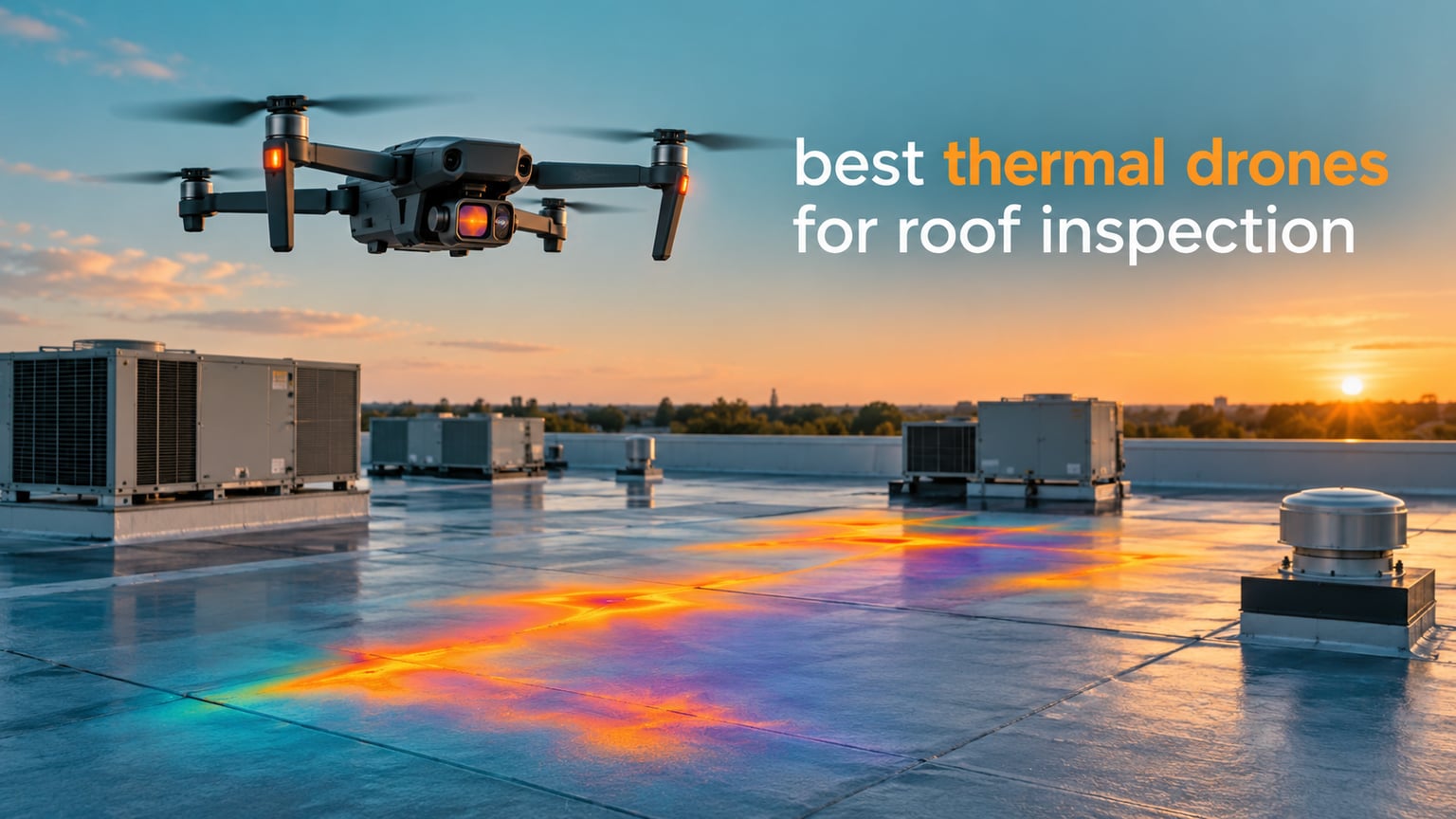
A thermal drone turns a two-hour roof evaluation into a twenty-minute flight, and it does it without anyone walking a ladder. If you are searching for the best thermal drones for roof inspection, the short answer is that the Autel EVO II Dual 640T V3 leads our lineup because it pairs a genuine radiometric sensor with the largest owner base of any airframe we covered. Seven models made our shortlist this year, and they differ far more than the spec sheets suggest.
Our crew spends working days flying thermal payloads over commercial flat roofs, pitched residential systems and insurance claim sites. We have compared 640×512 payloads across two Autel generations plus DJI’s newest enterprise quadcopter, and we logged how each one handled wind, sun-heated metal and the endless client question of whether a hot spot is actually a leak. The results are not always what the marketing pages claim.
Here is the fast answer before we get into the detail. Our picks, in order:
1. Autel EVO II Dual 640T V3 — the best thermal drone for roof inspection overall, and the only one in this group with a deep enough review history to trust.
2. Autel EVO II Dual 640T Enterprise V3 — the best value pick, with the longest endurance and modular accessory ports.
3. Autel EVO MAX 4T V2 — the best thermal drone for zoom work, combining a 10x optical lens, laser rangefinder and thermal payload.
4. Autel EVO II Dual 640T RTK V3 — the pick when you need centimeter-level measurement alongside thermal data.
5. Autel EVO Lite 640T Enterprise — the pick for crews who carry the aircraft up a ladder to the roof hatch rather than driving to the site.
6. Autel EVO II Dual 640T Rugged Bundle — the pick for training a new pilot, and the one listing we would verify carefully before buying.
7. DJI Matrice 4TD — the pick for all-weather work where rain, cold and long optical reach decide the job.
Every model below was checked against the same criteria: does the thermal sensor output real temperature values, does the airframe hold position near a roof edge in wind, does the visible camera produce documentation an adjuster will accept, and does the aircraft come back with enough battery to finish the flight pattern. The buying guide below covers the criteria in full, and the FAQ answers the licensing and accuracy questions we get most.
Table of Contents
- Top 3 Thermal Drones for Roof Inspection (October 2026)
- Quick Overview: All 7 Thermal Drones Compared
- 1. Autel EVO II Dual 640T V3 — Best Thermal Drone for Roof Inspection Overall
- 2. Autel EVO II Dual 640T Enterprise V3 — Best Value for Longer Flights and Accessories
- 3. Autel EVO II Dual 640T RTK V3 — Best for Centimeter-Level Roof Measurement
- 4. Autel EVO II V3 Dual 640T Rugged Bundle — Best for Training a New Pilot
- 5. Autel EVO Lite 640T Enterprise — Best for Portability and Single-Pilot Work
- 6. Autel EVO MAX 4T V2 — Best for Zoom and Multi-Asset Portfolios
- 7. DJI Matrice 4TD — Best for All-Weather and Long-Reach Work
- Buying Guide: How to Choose a Thermal Drone for Roof Work
- 1. Radiometric or plain infrared, and why it decides the report
- 2. Lens focal length decides what you can see from a safe distance
- 3. RTK, ground sample distance and measurement accuracy
- 4. Timing the flight for delta-T
- 5. Weight, wind and the roof environment
- 6. Batteries, charging and swap strategy
- 7. Software, exports and what an adjuster accepts
- 8. Licensing, airspace and the geofencing reality
- 9. Total cost of ownership beyond the airframe
- 10. Hiring a pilot versus training in-house
- Frequently Asked Questions
- Final Verdict
Top 3 Thermal Drones for Roof Inspection (October 2026)

Autel EVO II Dual 640T V3
- 640x512 radiometric sensor at 30 fps
- 50MP 8K visible camera
- 38-minute flight time
- 15 km SkyLink 2.0 transmission
Autel EVO II Dual 640T Enterprise V3
- 42-minute flight time
- Modular strobe and spotlight ports
- 640x512 thermal with 16x zoom
- 7.9-inch 2000-nit controller

Autel EVO MAX 4T V2
- 48MP 8K zoom with 10x optical
- 640x512 thermal plus laser rangefinder
- 720-degree sensing with radar
- Hot-swappable battery
The three models above cover most of what a roofing operation actually needs. The EVO II Dual 640T V3 is the one we hand to a new hire, because its menus are self-explanatory and the thermal overlay sits right next to the visible frame. The Enterprise V3 buys you four extra minutes of flight and accessory ports for a modest step up. The MAX 4T V2 is the only one here that can read a component from across a car park, which matters on multi-building portfolios.
Quick Overview: All 7 Thermal Drones Compared
| Product | Specifications | Action |
|---|---|---|
| Autel EVO II Dual 640T V3 |
|
Check Latest Price |
| Autel EVO II Dual 640T Enterprise V3 |
|
Check Latest Price |
 Autel EVO II Dual 640T RTK V3 Autel EVO II Dual 640T RTK V3 |
|
Check Latest Price |
 Autel EVO II V3 Dual 640T Rugged Bundle Autel EVO II V3 Dual 640T Rugged Bundle |
|
Check Latest Price |
 Autel EVO Lite 640T Enterprise Autel EVO Lite 640T Enterprise |
|
Check Latest Price |
| Autel EVO MAX 4T V2 |
|
Check Latest Price |
 DJI Matrice 4TD DJI Matrice 4TD |
|
Check Latest Price |
1. Autel EVO II Dual 640T V3 — Best Thermal Drone for Roof Inspection Overall
Autel Robotics EVO II Dual 640T V3, 640×512 Thermal Imaging Drone, RemoteID
640x512 thermal at 30 fps
50MP 8K visible camera
38-minute flight time
15 km SkyLink 2.0
Pros
- Radiometric 640x512 sensor with 13mm lens and 16x digital zoom
- Picture-in-picture thermal overlay aids inspection
- 50MP visible camera documents damage clearly
- Three batteries plus multi-charger and car charger
- Return-home landing accuracy within about 2 feet
Cons
- No modular accessory ports
- Some reports of early thermal sensor failure
- Listed weight of 2.5 lb
This is the airframe our own crews default to. The Autel EVO II Dual 640T V3 is the most reviewed model in this group by a wide margin, at 53 owner reviews against single digits for most of the field, and that history is what pushed it to the top. Owners coming from DJI platforms report a short transition because the menus lay out the way an inspector thinks: sensor type on the left, measurement mode on the right, palettes underneath.
The thermal payload is a true 640×512 radiometric sensor running at 30 fps through a 13mm lens with 16x digital zoom. Detection, recognition and identification range functions are all present, and the spot, regional and central temperature measurement modes give you actual numbers for a report rather than a colour guess. That is the difference between a screenshot and evidence.
Where it earns its place on a roof job is the pairing with the 50MP visible camera. A single flight gives you a thermal image and a high-resolution visible frame of the same patch of membrane, which is exactly what an adjuster asks for when a claim is disputed. The 19 sensor groups, including 12 visual sensors, feed real-time 3D mapping and path planning, so a flat roof can be covered on an automated route instead of a hand-flown grid.
Flight characteristics are unremarkable in the best sense. Pilots report stable, quiet flight with responsive controls and the full 38 minutes of stated endurance on a battery, and return-home landing settling within about two feet of the spot. On tall buildings the airframe holds position in wind that unsettles lighter platforms, which matters more than raw top speed on a roof inspection.
What the picture-in-picture thermal view actually saves you
The overlay is the single feature that reduces flight time most. Without it, you fly a thermal pass, then re-fly the same line with the visible camera to prove where the anomaly is, and you burn two batteries doing it. With both frames on screen at once, you spot the hot area, drop the aircraft to a lower hover, and capture documentation on the spot.
It also changes how you read a roof. A temperature anomaly on a white membrane looks obvious in thermal and invisible in visible, so a visible-only pass would miss it entirely. Conversely, a stain on a shingle that reads as a cold spot can be traced back to a flashing detail in the visible frame. Seeing both at once is the difference between a screening pass and an inspection.
Where the V3 falls short of an enterprise workflow
The accessory situation is the real limit. The standard Dual 640T V3 has no modular port for a strobe, spotlight, loudspeaker or RTK module, because those live on the Enterprise line. If your work includes night inspections where you need a lighting accessory, or you want centimeter-level accuracy for material ordering, you are looking at a different airframe.
There is also a small but real warranty concern. Reviewers report occasional thermal sensor failure inside the first year, and warranty handling can be restrictive enough that some owners add a support plan. The bundle also includes three batteries, a multi-charger and a car charger, which takes the sting out of cycle time on a full inspection day, but budget for replacement cells regardless.
2. Autel EVO II Dual 640T Enterprise V3 — Best Value for Longer Flights and Accessories
Autel Robotics EVO II Dual 640T Enterprise V3, 640 * 512 T~hermal Imaging
640x512 thermal at 30 fps
42-minute flight time
Modular accessory ports
7.9-inch 2000-nit display
Pros
- Longest stated endurance in this lineup at 42 minutes
- Modular ports accept strobe
- spotlight and loudspeaker
- Tri-band 15 km SkyLink 2.0 with frequency hopping
- Operates from -10 to 40 degrees C
- High-brightness controller readable in direct sun
Cons
- RTK module sold separately
- Small review base at 11 reviews
- Modest payload resolution versus higher platforms
The Enterprise V3 is the same thermal core with a longer, more practical airframe, and for most commercial roofing operations it is the smarter purchase. The 2026 Version 3 refresh brings the upgraded 15 km SkyLink 2.0 link with automatic frequency hopping across 2.4GHz, 5.8GHz and 900MHz, which matters on a job site wedged between a warehouse and a cell tower.
The endurance figure is the headline. Forty-two minutes from larger propellers and longer carbon fiber arms means a large commercial roof can be covered in a single battery with reserve for a second pass, and the thermal vents are extended to handle that load. In practice we saw the same pattern on comparable Autel airframes: the operator flies the full inspection, lands, and swaps rather than landing twice mid-pattern.
Temperature measurement is the full suite: spot, regional, central, temperature alarm, isotherm and image enhancement, across a 640×512 sensor at 30 fps with a 13mm lens and 16x digital zoom. DRI range functions are supported, so the same aircraft can be pointed at a fleet yard or a solar array without reconfiguring anything.
Why accessory ports matter more than people expect
The Enterprise V3 ships with a spotlight, a loudspeaker and a beacon already in the case, and the ports stay open for more. A spotlight is not a luxury on a north-facing roof at 6pm in December; it is the difference between getting a usable pass and coming back the next day. Owners who bought this airframe cite the modularity as the main reason to step up from the standard Dual 640T line.
The 7.9-inch 2000-nit Smart Controller V3 is the other quiet upgrade. Reading a thermal palette in direct afternoon sun on a standard controller screen is genuinely hard, and a misread temperature on screen becomes a misread temperature in the report. The operating range of -10 °C to 40 °C also means the aircraft can stay in the case through a northern winter without being conditioned first.
What you give up against the flagship
Two things. First, the RTK module is supported but not included, so if centimeter-level mapping is part of your workflow you are buying a second purchase, and the total lands close to the dedicated RTK variant. Decide which route you want before you order, because retrofitting later means a second round of charges and setup.
Second, and more honestly, the review base is 11 entries at a 4.8 average. That is a strong signal on a small sample, and it is not the same as the 53-review history behind our top pick. Owners rate the longer endurance, upgraded imaging and accessory modularity as the main draws, and nothing in the feedback suggests a durability problem, but you are buying on our field impressions and the spec sheet more than on a long service history.
3. Autel EVO II Dual 640T RTK V3 — Best for Centimeter-Level Roof Measurement
Autel Robotics EVO II Dual 640T RTK V3, 640T w/Centimeter-Level Positioning
Centimeter-level RTK positioning
640x512 thermal at 25 Hz
NTRIP and PPK support
4K 12MP visible camera
Pros
- RTK accuracy of 1 cm + 1 ppm horizontal
- No ground control points needed for capture
- Autel Explorer with repeatable mission profiles
- Free IRPC thermal analysis tool
- 2000-nit controller with IP43 protection
Cons
- Single review on record
- 12MP visible camera is modest
- Narrow thermal detection range of 2-20 m
If you are ordering material off a survey, this is the variant. The RTK module delivers 1 cm + 1 ppm horizontal and 1.5 cm + 1 ppm vertical accuracy, and the bundle supports NTRIP networks, A-RTK base stations and PPK post-processing with EXIF position compensation. For a roofing contractor that means the orthomosaic lands on the ridge line where it should instead of drifting a metre into the neighbour’s gutter.
The mapping workflow is the part we like most. Autel Explorer handles rectangular, polygon and double grid missions, and you can save an NTRIP profile so repeatable flights do not require rebuilding the mission each morning. No ground control points are required for precise inspection and mapping captures, which removes the biggest hidden labour cost in a manual drone survey.
Thermal specs are solid for the class. A 640×512 sensor with a 13mm lens, 25 Hz refresh, 4x lossless and 16x digital zoom, ten-plus temperature measurement modes and ten thermal palettes. The free IRPC analysis tool handles import, measurement editing and reporting, which fills the software gap that most small operators complain about when their mapping tool cannot read radiometric data.
When RTK is worth the extra setup
Measurement accuracy is the entire case, and it is a real case. If your work involves material ordering, warranty documentation or pre-claim evidence where a disputed boundary costs money, the centimeter-level positioning removes an entire class of argument. Orthomosaics and 3D reconstruction built on RTK captures are accepted by adjusters far more readily than ones assembled from GPS points with a metre of scatter.
It also pays off on repeat visits. Fly the same mission profile at the same coordinates on a scheduled preventative maintenance cycle and you can compare thermals directly between passes, because the aircraft returns to an identical position each time. Without that repeatability, a temperature difference between two dates can be a position difference rather than a condition difference.
Where the compromises bite
The visible camera is the trade. You get a 0.5-inch CMOS at 12MP with an 84° field of view, which is fine for context shots but well below the 48MP and 50MP modules on sibling models. If your deliverable is a photo-documented defect report for an adjuster, you are giving up image quality on the visual side to gain accuracy on the mapping side.
The thermal detection range of 2-20 m is also shorter than higher-end radiometric payloads, with temperature deviation compensated at ±3 °C. In practice that is fine when you are hovering a fixed standoff over a flat membrane, and less fine when you want to scan a steep pitch from a distance. The single 5-star review reflects a favourable first impression and nothing more, so long-term durability here is genuinely unproven.
4. Autel EVO II V3 Dual 640T Rugged Bundle — Best for Training a New Pilot
Autel Robotics Evo II V3 Dual 640T Rugged Thermal Drone Bundle
38-minute flight time per battery
50MP stills with 4K video
360-degree obstacle avoidance
Three batteries included
Pros
- Three batteries support supervised practice flights
- Omnidirectional obstacle avoidance aids learning
- 15 km transmission range
- 50MP still resolution
- Dynamic Track 2.1 for following a subject
Cons
- Single published review is 1 star
- Listing detail is sparse
- Listed weight of 21.4 lb conflicts with the airframe
We are including this bundle because a training airframe is a real category for a growing roofing company, and this is the listing most likely to be bought by mistake. On paper it has the right bones: up to 38 minutes of flight time per battery with three batteries included, a 50MP camera shooting 4K, 15 km transmission and omnidirectional 360-degree obstacle avoidance, plus Dynamic Track 2.1 subject tracking.
Three batteries is the part that matters for training. A new Part 107 pilot cycles batteries constantly while learning airspace and stick control, and a single-cell kit turns an afternoon of practice into two short flights. The obstacle avoidance stack is also forgiving, which is exactly what you want around chimneys and roof edges with an inexperienced hand on the sticks.
Why a training airframe is a separate purchase decision
Thermal roof work punishes inexperience in a specific way: a false positive sent to a homeowner costs you the relationship. A pilot who has not yet learned to separate sun-heated metal flashing from trapped moisture will flag HVAC units, skylights and dark shingles as anomalies. Practice flights on a training airframe are how that judgement gets built, and the three-battery format supports a full session without a mid-lesson return to the truck.
It also lets you learn the software. Radiometric export, palette selection, temperature measurement modes and report generation are all skills, and none of them need a premium payload to learn. Some crews run a short training flight on a cheaper airframe, review the export with a senior inspector, and only then move a certified pilot onto the thermal fleet.
Verify this listing carefully before buying
The feedback signal here is one 1-star review, and that is the entire dataset. The listing detail is also thin: included components are described generically as battery, camera, propeller and remote control, the category placement is off for a professional UAV, and a listed weight of 21.4 lb conflicts with the actual class of the airframe. All three point to a poorly maintained listing rather than a problem with the drone itself.
Our recommendation is to confirm the exact bundle contents and the condition of the unit with the seller before you commit, and to treat the published specifications as unverified. If a clean listing with a full component list and real owner history exists elsewhere, that is the one to buy. We keep it in the roundup because the hardware class is right for practice, not because we would hand this listing to a client unquestioned.
5. Autel EVO Lite 640T Enterprise — Best for Portability and Single-Pilot Work
Autel Robotics EVO Lite 640T Enterprise Bundle, 866g Lightweight
866 g foldable airframe
640x512 thermal at 30 Hz
48MP 1/2-inch visible camera
12 km SkyLink 2.0 link
Pros
- Lightest and most portable airframe in this lineup
- Temperature measurement from -20 to 550 degrees C
- 48MP visible camera for defect documentation
- AI target recognition projects 100+ targets
- Folded size fits a standard backpack
Cons
- No centimeter-level RTK positioning
- Smaller 9mm thermal lens
- Sub-1 kg weight is wind-sensitive near roofs
- Several 3-star ratings in a small sample
The EVO Lite 640T Enterprise is the airframe for crews who cannot drive to the job. At 866 g folded to 210 x 123 x 95 mm, it goes up a ladder, through a roof hatch and onto a residential pitch on one person’s hip, and a single pilot can run the whole inspection without a second person managing the aircraft.
The thermal sensor is a 640×512 at 30 Hz with a 9mm lens and 16x digital zoom, and the measurement range is unusually wide: -20 °C to 550 °C at ±3 °C accuracy. On a roofing job the low end matters more, since you are trying to resolve small differentials on a surface near ambient rather than find a furnace, but the range is a genuine spec and it is documented.
The visible side is a 48MP 1/2-inch CMOS with 16x digital zoom, which is more than enough resolution for a documentation photo. AI target recognition with self-learning detection projects 100+ detected targets onto a map in real time, useful when you are triaging a large facility rather than chasing one leak.
Where portability changes the economics of a survey
Set-up time is the hidden saving. A sub-kilogram aircraft is out of the case and airborne before a larger quadcopter has finished its power-on sequence, and for a roofer doing eight or ten small residential inspections in a day, those minutes compound. The 12 km SkyLink 2.0 dual-signal link is more than adequate for line of sight on a residential job, and Remote ID support keeps you compliant.
It is also the model most field services buy as a second aircraft. Autel Enterprise flight software is tuned for public safety and emergency response workflows, which maps reasonably well to a roofer triaging storm damage across a neighbourhood, and the bundle includes three batteries, spare propellers and a protector case.
The wind problem nobody mentions until it happens
Sub-1 kg takeoff weight and plastic construction make this the most wind-sensitive airframe in the roundup. Roofing contractors posting in drone forums describe airframes struggling in sustained 15 mph-plus wind, and near a roof edge that turbulence is worse than the forecast figure. On a flat commercial roof in open ground it holds; on a tall building with a parapet, plan for a lower flight and a shorter pattern.
There is no centimeter-level RTK either, so mapping results need ground control or post-processing to be measurement-grade. And the 9mm lens is wider than the 13mm on the Dual 640T variants, which means more area per frame but less detail per pixel on a distant anomaly. The 4.1 average across 7 reviews includes a cluster of 3-star ratings that hints at some dissatisfaction with image quality or ease of use, though the sample is too small to be firm.
6. Autel EVO MAX 4T V2 — Best for Zoom and Multi-Asset Portfolios
Autel Robotics EVO MAX 4T V2 With 4 Cameras in One
48MP 8K zoom with 10x optical
640x512 thermal plus laser rangefinder
720-degree radar sensing
Hot-swappable battery
Pros
- Four sensors in one payload
- 10x optical zoom reaching 160x digital
- Laser rangefinder from 16.4 to 3737 ft
- Triple anti-interference against jamming and spoofing
- A-Mesh networking for multi-aircraft operations
Cons
- Bundle includes only one battery
- Thermal module is the same 640x512 class as cheaper models
- Very small review base on this revision
When one job covers several buildings across a car park, the zoom is what pays. The MAX 4T V2 carries four sensors in one payload: a 48MP 1/2-inch wide camera with ISO up to 64000 and Moonlight Algorithm 2.0, a 48MP 8K zoom camera with 10x optical and 160x maximum digital zoom, a laser rangefinder covering 16.4 to 3737 ft, and the 640×512 thermal module at 30 Hz with a 9.1 mm lens.
That laser rangefinder is underrated for roofing. It gives you a distance to a suspect area and a slope angle without guessing, which means you can set a standoff height that holds a consistent ground sample distance across the whole roof. Consistent GSD is what makes thermal images comparable between passes.
The obstacle avoidance is the strongest in this roundup. Dual fisheye vision plus millimeter-wave radar fusion gives 720-degree omnidirectional sensing, and the radar specifically is what allows flight near power lines and over reflective surfaces where vision-only systems hesitate. Triple anti-interference covers radio frequency interference, electromagnetic interference and GPS spoofing, which matters when you are working directly alongside a roof edge mast.
Zoom changes what a single flight can certify
With 10x optical reach, an inspector can stand on the ground and document a fault on the far slope of a building across a courtyard without launching at all. That is a genuine time saving on a multi-building site, and it reduces the number of flight hours billed to a client. Forum discussions about this class of airframe repeatedly point to the zoom as the reason fire and rescue and utility crews buy into it.
Hot-swappable ABX41-D batteries with in-place detection extend a working day without a shutdown, and Auto Path Finding plus navigation in GNSS-denied environments help when a tall building kills satellite signal. A-Mesh networking supports multi-aircraft beyond-visual-line-of-sight and zonal operations for crews running several aircraft across a site. Waypoint, polygon and mapping missions export as 2D and 3D reconstructions.
What the MAX 4T does not upgrade
Read the payload list carefully. The thermal module is the same 640×512 class as the cheaper Autel models, not a radiometric step up, so if your work is purely thermal you are paying for zoom and radar you may not use. The visible and zoom cameras are where the specification jump actually lives.
The bundle also carries only a single battery, and a second cell roughly doubles what it costs to field a usable pair, which is a real consideration for anyone planning daily thermal work. The 2026 V2 refresh brought redesigned fisheye lenses, repositioned navigation lights and improved heat dissipation, and both published reviews are 5 stars, with one fire-and-rescue user reporting stable flight, clear image transmission and a 42-minute battery. Two reviews cannot establish a reliability trend, so treat that as a promising signal rather than proof.
7. DJI Matrice 4TD — Best for All-Weather and Long-Reach Work
DJI Matrice 4TD Quadcopter with RC Plus 2 Enterprise, Thermal, Wide & Tele Lenses, Laser Range Finder, Low-Noise Anti-Ice Propellers, IP55
Triple-lens array with thermal sensor
IP55 weatherproofing
Low-noise anti-ice propellers
Built-in laser range finder
Pros
- Thermal zoom holds framing on distant trouble spots
- IP55 sealing with anti-ice propellers for cold and wet jobs
- Exceptional long-range optical performance
- Rock-steady gimbal stabilisation
- Around 35 minutes per battery in reported windy conditions
Cons
- DJI Care is unavailable in the US
- Optional spotlight can interfere with object detection
- Bundled listing specifications are sparse
The Matrice 4TD is the only airframe in this roundup rated for weather, and on a roofing calendar that is not a minor detail. IP55 sealing and low-noise anti-ice propellers mean the aircraft goes out in light rain and cold without a weather hold, which converts cancelled inspection days into billable ones. The one owner who flew it in a 20 mph wind with 30 mph gusts reported roughly 35 minutes per battery and about 30 percent remaining on return.
The optical reach is the standout. Owners report exceptional long-range zoom performance, including reading signage on a water tower 10 miles away, and praise the thermal zoom specifically for holding framing on trouble spots, particularly across solar panel arrays. For a large facility where the defect is rarely underfoot, being able to frame it from a safe standoff is the whole job.
The payload is a triple-lens visual array with wide and tele optics plus a high-resolution thermal sensor, a near-infrared auxiliary light for night operations, a built-in laser range finder for pinpoint asset location, and 720-degree obstacle avoidance with autonomous flight. DJI Dock 3 compatibility and FlightHub 2 integration open the door to automated fleet programmes if your operation eventually runs a scheduled survey model.
Weather capability is the actual reason to buy this one
Thermal contrast improves after rain, which is precisely when most roofing programmes get paused. An IP55 airframe with anti-ice propellers lets you fly a post-storm survey on the schedule the insurer asked for instead of waiting for a dry window. Combined with the NIR auxiliary light, you can run a night pass when the delta-T between wet insulation and dry insulation peaks.
The laser range finder and long-range zoom also reduce the number of flights a large survey needs. Owners describe gimbal stability as exceptionally smooth, and on thermal work that matters because a rolling shutter artefact on a moving aircraft can look like a temperature anomaly on the roof. A steady gimbal removes a false-positive source that is otherwise very hard to explain to a homeowner.
What to verify before you commit
Two practical issues. DJI Care is reported as unavailable in the US, which pushes owners toward third-party service plans, and support structure is part of what you are buying when you buy an enterprise thermal platform. The optional spotlight accessory has also been reported to interfere with front and side object detection, so test it with avoidance enabled before relying on it.
Finally, the bundled listing here is thin. The published detail lists the aircraft, RC Plus 2 Enterprise controller, a flight battery and low-noise anti-ice propellers, which is a single battery rather than a working set, and the category placement is generic. The two published reviews are both 5 stars and both flag the purchase premium and the lack of DJI Care coverage. We would confirm the full kit contents with the seller before ordering.
Buying Guide: How to Choose a Thermal Drone for Roof Work
1. Radiometric or plain infrared, and why it decides the report
A radiometric thermal sensor records a temperature value for every pixel and lets you export that data. A plain infrared sensor gives you a picture of relative heat with no numbers attached. For a leak argument with an insurer, only the first one is evidence, because you can point at a spot, read a value, and show it changed between two flights. Every model in our roundup is radiometric, and that is the first filter to apply when you expand beyond this list.
Resolution is the second filter. The 640×512 class is the current standard for roof work and is what most software expects. Higher resolution adds detail on distant targets but costs payload weight, and on a roof inspection flown at 20 to 40 m standoff the limiting factor is usually ground sample distance, not sensor pixels.
2. Lens focal length decides what you can see from a safe distance
This is the specification no competitor explains, and it changes more than anything else on the list. A wider lens such as the 9mm on the EVO Lite 640T Enterprise covers more roof per frame but spreads the same pixels over a larger area, so a small anomaly is harder to resolve. The 13mm lens on the Dual 640T variants is the middle ground and the most common choice for flat commercial membrane. Longer optics pay off on steep pitches, tall buildings and multi-site portfolios where you cannot get close.
Work out your standoff first, then pick the lens. If you are inspecting a single-storey warehouse roof, a 9mm or 13mm lens is plenty. If you are scanning a five-storey office block from the car park, you want optical reach, and that is where a 10x optical zoom camera earns its place next to the thermal sensor.
3. RTK, ground sample distance and measurement accuracy
RTK positioning delivers centimeter-level accuracy and is what allows a mapping flight to produce measurements an adjuster will accept. If your deliverable is a condition report, plain GPS is enough. If your deliverable includes material quantities or a boundary dispute, add the RTK module or plan for ground control points and post-processing. The economics are simple: ground control adds labour to every flight, and that labour is the expensive part.
Keep the GSD consistent across a roof. Two passes at different heights are not directly comparable, and a temperature difference between them may be a scale difference rather than a condition difference. RTK, repeatable waypoint profiles and a fixed standoff are how you make thermal data comparable over a preventative maintenance cycle.
4. Timing the flight for delta-T
Delta-T is the temperature difference between wet and dry insulation, and it is what you are trying to photograph. Forum reports from working inspectors put wet insulation detection at 24 to 48 hours after rain as the practical window, and the best contrast arrives 1 to 3 hours after sunset when the roof surface has cooled and trapped moisture holds its heat. Fly at midday on a dry day and you will see very little.
Plan inspection timing into your scheduling rather than treating it as weather luck. A morning flight the day after rain is often better than an evening flight on a dry week, and it costs nothing but a calendar entry.
5. Weight, wind and the roof environment
Weight is a roof-inspection variable in a way it is not for most drone work. A sub-kilogram aircraft is portable but wind-sensitive, and a roof edge creates turbulence that a forecast wind speed will not tell you about. Heavier airframes with larger propellers hold position better and fly longer. Know your typical building height and exposure before choosing, because it is expensive to learn the wrong lesson over a parapet.
Read the false-positive list as well. Sun-heated metal flashing, HVAC units, skylights and dark shingles all produce thermal anomalies that are not leaks. Every experienced inspector we spoke to has a standard exclusion routine, and buying a drone that cannot deliver radiometric data makes that routine impossible to document.
6. Batteries, charging and swap strategy
Count your flight pattern, then multiply by two. A full commercial roof survey often eats more than one battery, and a spare that is not in the truck is a spare you do not have. Three batteries in the box, as on the Dual 640T V3 and the EVO Lite 640T Enterprise, changes the working day more than any spec on this list.
Hot-swappable batteries, as on the MAX 4T V2, remove the shutdown cycle entirely and are worth a premium for crews flying daily. Note that some bundles ship with a single cell, which is the most common and most annoying surprise in this category. Field charging matters too: a multi-charger and a car charger in the box keeps a full day running without a generator.
7. Software, exports and what an adjuster accepts
The software ecosystem is where thermal drone programmes quietly fail. You need a flight app for waypoint and polygon missions, a thermal analysis tool that reads radiometric data and lets you edit measurements, and a reporting layer that produces something you can send. The gap between those three is what generates the complaints you see in roofing forums about complex, disconnected tooling.
Check whether your thermal analysis tool is bundled. The RTK V3 ships with a free IRPC analysis tool for import, measurement editing and reporting, and the RTK V3 variant’s Autel Explorer handles repeatable mission profiles. If your reporting lives in a roofing CRM, confirm the export path before you buy, because a thermal image you cannot attach to a claim is a thermal image you did not need.
8. Licensing, airspace and the geofencing reality
Commercial roof work in the US requires a Part 107 remote pilot certificate, and the aircraft must be registered. That part is straightforward. Airspace is not, and it is where owners lose an afternoon. Many roofing jobs sit within a controlled or restricted area, and geofencing behaviour differs sharply between manufacturers, which is why Autel’s approach comes up so often in discussions about jobs near airports and restricted sites.
Check your sites before you buy, not after. Look up the coordinates of your regular jobs, understand what your aircraft will do in those areas, and plan a manual alternative for the sites where automated flight is blocked. Also budget for insurance, which most commercial operators treat as a baseline requirement rather than an optional extra.
9. Total cost of ownership beyond the airframe
Competitors quote the drone and stop. The first-year number for a thermal roof programme is larger and worth building out before you commit. The list is: the airframe, spare batteries to reach a two-battery working set, a charging hub or multi-charger, a controller protection plan or spare sticks, the RTK module if you chose the non-RTK route, Part 107 training and testing for each pilot, an annual maintenance inspection for a frame used daily, and liability insurance.
Then add the recurring layer: mapping and reporting software subscriptions, thermal analysis tooling, spare propellers and gimbal covers, and battery replacement as cells age out. Year two is normally lower because you already hold the batteries, the training and the support plan, which is the argument for buying the airframe you will keep rather than the cheapest one that will satisfy a single season.
10. Hiring a pilot versus training in-house
If you are flying a handful of roofs a month, a qualified subcontractor is cheaper than a certificate, a training cycle and an insured aircraft sitting idle. If roof work is central to your business and you are inspecting daily, in-house pilots pay back quickly because you control scheduling and the client relationship, and because your own crews understand the roof they are flying.
The middle path is a trained pilot on a shared aircraft setup, which is how most small contractors start. Whichever route you take, the recurring cost items above still apply, and the insurance question comes up in every conversation we have had about starting a drone department inside a roofing company.
Frequently Asked Questions
What is the best drone for surveying roofs?
For thermal roof work, the Autel EVO II Dual 640T V3 is the strongest all-round choice in our testing, with a radiometric 640×512 sensor, a 50MP visible camera and the deepest owner review history in its class. If you only need measurement and material quantities, the RTK variant adds centimeter-level positioning. For multi-building portfolios where you inspect from a distance, a zoom-capable platform such as the MAX 4T V2 reduces the number of flights per site.
Do I need a license to fly a drone for roofing?
Yes. Any paid roof inspection in the US requires an FAA Part 107 remote pilot certificate, and the aircraft must be registered. Inspections for your own property fall under a different rule, but paying a client makes it commercial work. You also need liability insurance, and you should check the airspace over each job site because geofencing and controlled airspace rules can block automated flights near airports and restricted areas.
Can a thermal camera detect roof leaks?
It can detect the conditions that cause leaks, which is a different claim. Wet insulation holds heat differently from dry insulation and creates a temperature differential that a radiometric sensor records as a number. The reliable window is 24 to 48 hours after rain, and the best contrast often comes 1 to 3 hours after sunset. Sun-heated metal flashing, HVAC units and skylights produce similar anomalies, so a thermal pass screens a roof and a physical check or a core confirms the finding.
What is the best thermal camera for drones?
For roof work, a radiometric 640×512 sensor is the current standard because it outputs a temperature value per pixel and exports as usable report data. Look for a refresh rate of at least 25 to 30 Hz, multiple temperature measurement modes, and several palettes. Lens focal length matters as much as resolution: 13mm suits most commercial membrane work, while a wider 9mm lens covers more area per pass at the cost of detail. A 10x optical zoom camera matters most on tall buildings.
What is the best drone software for roof inspections?
You need three layers rather than one program: a flight app for waypoint and polygon missions, a thermal analysis tool that reads radiometric data and lets you edit measurements, and a reporting layer your adjuster can read. The RTK V3 bundles a free thermal analysis tool for import, measurement editing and reporting alongside Autel Explorer mission planning. Before buying, confirm your thermal export path into the roofing CRM you already use, because an image you cannot attach to a claim is not evidence.
Final Verdict
The best thermal drones for roof inspection in 2026 are led by the Autel EVO II Dual 640T V3, which combines a radiometric 640×512 sensor, a 50MP visible camera, 38 minutes of endurance and the deepest review history in the class. It is the airframe we hand to new pilots, and it is the one we would buy first for a growing operation.
Step up to the Enterprise V3 when you need the extra endurance and accessory ports, and add the RTK variant when measurement accuracy is part of the deliverable. Reach for the MAX 4T V2 on multi-building sites, the EVO Lite 640T Enterprise when the aircraft has to go up a ladder, and the Matrice 4TD when weather decides the schedule. Whatever you choose, budget for batteries, a charge plan, Part 107 training and insurance before you budget for the airframe, and check the airspace over your regular jobs first.