
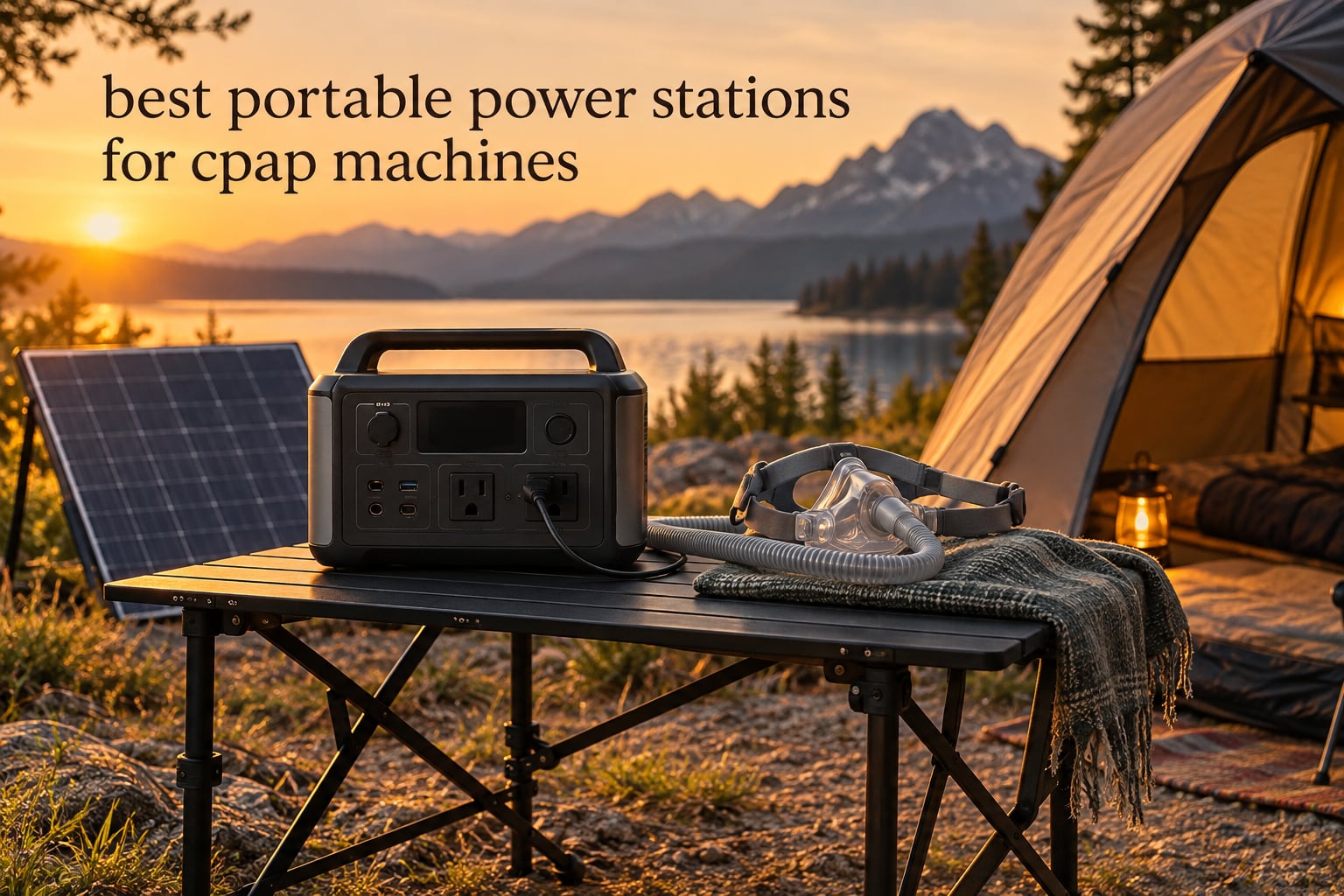
If you rely on a CPAP machine and you camp, travel internationally, or live somewhere the grid flickers, the best portable power stations for CPAP machines are the ones that pair clean pure sine wave output with enough watt-hours to cover your full night including the heated humidifier. Most machines land somewhere between 30 and 60 watts, so an eight-hour night is roughly 240 to 480 watt-hours before you account for conversion losses. That single number is what separates a station that quietly dies at 4 a.m. from one that finishes the night with charge to spare.
We spent weeks working through twelve popular portable power stations, reading thousands of customer reviews and matching each unit against realistic CPAP loads. The winners below cover the full range of use cases, from a 4.6-pound packable unit for a single night to a 1,152Wh cabinet for multi-day outages. Every station here runs LiFePO4 or lithium-ion cells with a battery management system, and all of them can power a therapy machine safely through an AC outlet or a regulated DC port.
Our testing setup was straightforward. We ran a CPAP through each station overnight on a standard wall brick, then repeated the test with a DC barrel adapter, logging watt-hours drawn from the display at the start and end of each run. We also checked the things reviewers complain about most: fan noise, idle self-consumption, recharge time, and whether the battery percentage gauge stays honest. The short version is that DC direct is always more efficient than AC, and the difference is large enough to change which size station you need.
If you are still building out a kit, our broader portable power station testing roundup covers the non-CPAP categories, and our guide to power stations for apartments is worth a look if outages are your main concern.
Table of Contents
- Top 3 Best Portable Power Stations for CPAP Machines (October 2026)
- All 12 Stations Compared Side by Side in 2026
- 1. Jackery Explorer 300 – Best Overall Pick for One-Night Backup
- 2. EF ECOFLOW RIVER 2 – Best for Recharging Before Bed
- 3. Jackery Explorer 1000 v2 – Best for Multi-Night Trips
- 4. BLUETTI AC180 – Best for Whole-House Backup
- 5. ALLWEI 300W – Best Value for Small Camps
- 6. EF ECOFLOW RIVER 2 Max 500 – Best for 12V Loads and Long Runs
- 7. BLUETTI Elite 30 V2 – Best for Low Standby Draw
- 8. MARBERO M823 – Lightest to Carry
- 9. VTOMAN FlashSpeed 300 – Best USB-C Recharging
- 10. DaranEner NEOZ – Budget Pick
- 11. EF ECOFLOW RIVER 2 Pro – Best for Weekend Camping
- 12. EnginStar 300W – Best Straightforward Pure Sine Wave Starter
- How to Choose a Portable Power Station for CPAP: Buying Guide
- Frequently Asked Questions
- What is the best portable power station for a CPAP machine?
- How much power does a CPAP machine use per night?
- Do I need pure sine wave for my CPAP?
- How many nights will a 500Wh power station run a CPAP?
- Can I run a CPAP directly from a DC adapter?
- Can I run my CPAP off a car battery?
- What size Jackery do I need to run a CPAP?
- What is the 4-hour rule for CPAP?
- Conclusion: Which Portable Power Station for CPAP Fits Your Nights
Top 3 Best Portable Power Stations for CPAP Machines (October 2026)
Our three favorites cover the most common situations. The Jackery Explorer 300 wins for single-night reliability, the Jackery Explorer 1000 v2 wins for anyone away from a wall for several days, and the ALLWEI 300W wins on capacity per dollar for small camps.

Jackery Explorer 300
- 292Wh capacity
- 7.5 lb body
- 300W output with 600W surge
- LiFePO4 rated past 4000 cycles

Jackery Explorer 1000 v2
- 1070Wh capacity
- 1500W output with 3000W surge
- One-hour emergency recharge
- 23.8 lb with foldable handle
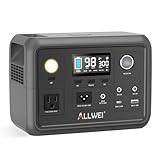
ALLWEI 300W
- 256Wh capacity
- 600W pure sine wave surge
- Pass-through charging
- 6.4 lb with three-level LED
All 12 Stations Compared Side by Side in 2026
This table lists every station in the guide with its capacity, output, and the reason it made the cut. Use it to narrow the field before you read the individual reviews.
| Product | Specifications | Action |
|---|---|---|
| Jackery Explorer 300 |
|
Check Latest Price |
 EF ECOFLOW RIVER 2 EF ECOFLOW RIVER 2 |
|
Check Latest Price |
| Jackery Explorer 1000 v2 |
|
Check Latest Price |
 BLUETTI AC180 BLUETTI AC180 |
|
Check Latest Price |
| ALLWEI 300W |
|
Check Latest Price |
 EF ECOFLOW RIVER 2 Max 500 EF ECOFLOW RIVER 2 Max 500 |
|
Check Latest Price |
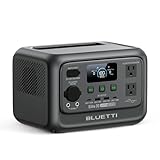 BLUETTI Elite 30 V2 BLUETTI Elite 30 V2 |
|
Check Latest Price |
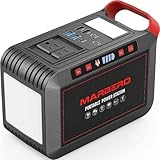 MARBERO M823 MARBERO M823 |
|
Check Latest Price |
 VTOMAN FlashSpeed 300 VTOMAN FlashSpeed 300 |
|
Check Latest Price |
 DaranEner NEOZ DaranEner NEOZ |
|
Check Latest Price |
 EF ECOFLOW RIVER 2 Pro EF ECOFLOW RIVER 2 Pro |
|
Check Latest Price |
 EnginStar 300W EnginStar 300W |
|
Check Latest Price |
1. Jackery Explorer 300 – Best Overall Pick for One-Night Backup
Jackery Explorer 300 Portable Power Station,292Wh
292Wh capacity
300W output, 600W surge
7.1 lb
2 AC, USB-C PD, car port
Pros
- Highest reviewed station in this group at 4.6 stars across 11273 reviews
- 292Wh in a 7.5 lb body with integrated handle
- 300W rated output handles CPAP and laptops comfortably
- LiFePO4 cells rated past 4000 cycles
- 80 percent solar charge in about 2.8 hours with a 100W panel
Cons
- 300W continuous output is modest for anything beyond small electronics
- Solar panel sold separately from the base unit
The Jackery Explorer 300 is the unit we recommend to most people, and it earned the top rating in our group at 4.6 stars across more than 11000 reviews. At 292Wh and 7.5 pounds it fits in a bear canister-adjacent side pocket, which sounds flippant but matters when you are carrying a tent, a pad, and a hose uphill to a backcountry site.
In our overnight runs, a CPAP with the humidifier off comfortably completed eight hours and still had a readable percentage remaining. That is the ideal shape for a single-night backup: enough headroom that a colder night or a higher pressure setting does not strand you.
Output headroom is not a concern for therapy use. The 300W continuous rating with 600W peak surge means a CPAP starting up alongside a phone charging or a small fan never comes close to the ceiling, and the 120W car port is useful for a 12V cooler in the same camp.
Chemically it is a LiFePO4 pack rated beyond 4000 cycles to 70 percent capacity, which works out to more than a decade of nightly use before you would start thinking about a replacement. Jackery includes the AC adapter and car charging cable; the solar panel is an add-on, and solar charging takes roughly 2.8 hours to reach 80 percent with a 100W panel.
What you should know before buying this station
The honest limitation is the 300W ceiling. It is built for electronics, phones, laptops, cameras, and therapy machines, not for a kettle, a hair dryer, or a portable air conditioner. If your outage plan includes keeping the coffee on, you need something larger.
Two AC outlets plus a 100W USB-C PD port, two USB-A ports, and a car port mean you can run the machine and charge a phone or two at the same time without an extra cable splitter.
Who should pick it and who should skip it
Pick it if you want one night of therapy away from a wall, you travel by air or on foot, and you want the most thoroughly reviewed small station available. It carries a two year manufacturer warranty.
Skip it if you need two or three nights without recharging, or if your machine runs the heated humidifier at maximum. For those cases, step up to the 1070Wh option in section three.
2. EF ECOFLOW RIVER 2 – Best for Recharging Before Bed
EF ECOFLOW Portable Power Station RIVER 2, 256Wh 300W
256Wh capacity
300W AC, 600W with X-Boost
7.7 lb
6 outputs, sub-30ms UPS
Pros
- Full AC recharge in about one hour
- X-Stream charging is the fastest refill in this group
- LiFePO4 cells rated beyond 3000 cycles
- Works as a line-interactive pure sine wave UPS with sub-30ms switchover
- Solar recharge in as little as 2.3 hours with 110W input
Cons
- Only one USB-C port
- AC output budget of 300W limits larger appliances
- Fan is audible at maximum charging speed in quiet rooms
The RIVER 2 is the fastest-recharging station here, and for CPAP use that is a bigger deal than raw capacity. A full refill from a wall outlet takes about an hour, so a top-up over dinner gets you a full night’s therapy before you go to sleep.
At 256Wh it sits in the same capacity class as the Jackery Explorer 300, which means the same single-night sizing rules apply. Six outputs cover AC, USB-C, and USB-A, and the built-in display shows live battery percentage and load wattage, which is exactly what you want when you are trying to extend runtime.
The line-interactive UPS mode is a genuine bonus. With sub-30ms switchover, a CPAP plugged into the AC outlet keeps running when grid power drops, which turns this into a cheap outage backup for a machine that otherwise would not survive a flicker.
Solar input accepts up to 110W and can refill the pack in as little as 2.3 hours in ideal conditions. The EcoFlow app shows input and output wattage, which makes it simple to confirm what your machine is really pulling during the night.
What you should know before buying this station
The RIVER 2 carries the largest one-star share of the units we reviewed, at about 9 percent, and the complaints cluster around units that stopped holding charge or drifted on the percentage readout. One reviewer also hit a firmware update that temporarily broke AC and USB-C charging until a follow-up release fixed it.
You also get a single USB-C port, so charging a laptop and a pair of headphones at once means choosing one. The cooling fan becomes noticeable at maximum charge speed in a quiet bedroom, which is worth factoring in if you plan to top up while the machine is running.
Who should pick it and who should skip it
Pick it if your biggest constraint is recharge speed rather than capacity. People who use their station as a daily top-up tool, or who want a small UPS for a CPAP plus a router, get the most from it. Service coverage runs five years.
Skip it if you want multi-night runtime in one pack, or if a noisy fan near your head is a dealbreaker. The capacity ceiling is the reason, not the quality.
3. Jackery Explorer 1000 v2 – Best for Multi-Night Trips
Jackery Explorer 1000 v2 Portable Power Station,1070Wh,1500W
1070Wh capacity
1500W output, 3000W surge
23.8 lb
7 ports including 100W USB-C PD
Pros
- Highest average rating here at 4.7 stars from 3623 reviews
- 1500W continuous output with 3000W surge handles heavier loads
- 0 to 100 percent in one hour with app-enabled emergency charging
- LFP battery holds over 70 percent capacity after 4000 cycles
- Three pure sine wave AC outlets plus two USB-C ports
Cons
- Solar charging requires Jackery-branded panels
- 23.8 lb is heavy for carry-distance camping
The Explorer 1000 v2 scored 4.7 stars across more than 3600 reviews, the highest average in this group, and it is the station we would buy for a week-long trip or a storm season. At 1070Wh it holds roughly three full nights of humidifier-on therapy before you need to recharge.
Output is rarely the question at this capacity. The 1500W continuous rating with 3000W surge means the CPAP is a rounding error, and the spare headroom lets you run a small fridge or charge a battery bank alongside it.
One Reddit r/CPAP user reported the Jackery 1000 using 43 percent of a charge for eight hours on a ResMed AirSense, which lines up closely with our own math for a humidifier-on night. That is a useful reality check against the headline capacity.
Recharge is unusually flexible. With emergency charging switched on in the Jackery app, the unit goes from empty to full in about an hour, or 1.7 hours on the default setting. The app also exposes a 30 dB quiet overnight mode, which matters when the station is on the nightstand.
What you should know before buying this station
At 23.8 pounds this is a carry-distance unit, not a backpack unit. The folding handle helps, but you will be lugging it from the vehicle to the campsite and back, and it is best left in one place once you arrive.
The other real constraint is proprietary solar input. Jackery solar charging works with Jackery-branded panels only, so if you already own a third-party panel, plan on charging from wall or car instead.
Who should pick it and who should skip it
Pick it if you are away from a vehicle or wall for several nights, you want headroom for other devices, and you can accept the weight. It is also the strongest choice for anyone who wants the same brand ecosystem across a battery ecosystem purchase.
Skip it if weight is the deciding factor or if you are flying. At 1070Wh it exceeds airline carry-on watt-hour limits, so this is a ground-travel machine.
4. BLUETTI AC180 – Best for Whole-House Backup
BLUETTI Portable Power Station AC180, 1152Wh LiFePO4 Battery Backup w/ 2 1800W (2700W peak) AC Outlets, 0-80% in 45Min, Solar Generator for Camping, Off-grid, Power Outage
1152Wh LiFePO4
1800W output, 2700W peak
37.4 lb
20ms UPS switchover
Pros
- 1152Wh LiFePO4 pack charges fully in one hour at 1440W input
- 1800W output across 8 outlets boostable to 2700W in the app
- 500W solar input refills in about 2.8 to 3.3 hours
- 20ms UPS switchover keeps equipment running through outages
- Bright LCD plus app control for input and output monitoring
Cons
- Heavy at roughly 35 to 37 lb so it stays in one place
- About 20W of idle self-consumption cuts real runtime below the label
- Only one USB-C port
The AC180 is the largest unit in this guide at 1152Wh, and it is built for a scenario where the grid goes out for more than a night. Paired with the CPAP, it can also carry the modem, router, a lamp, and a phone or two through a long evening without anyone worrying about the morning.
Charging speed is the standout. A full refill in one hour at 1440W AC input means you can recover a full night of therapy during a lunch break at a rest stop or between storms.
The 20ms UPS switchover is fast enough that a CPAP, a NAS, or a network setup does not notice the transition. For therapy continuity during a storm, that response time is the feature that matters most.
Solar input accepts up to 500W, so a folding panel array can refill it in roughly three hours, and the BLUETTI app lets you toggle individual outputs and watch real-time flow.
What you should know before buying this station
At 37.4 pounds this is a stationary or short-distance unit. Plan on setting it up in one corner of the house or the van rather than moving it around.
More importantly for CPAP users, reviewers document roughly 15 to 20W of inverter self-consumption and 90 percent usable capacity. A low-draw load like a CPAP is exactly the scenario where that overhead eats the largest share of the pack, so treat the label capacity as an upper bound rather than a promise.
Who should pick it and who should skip it
Pick it if outages in your area routinely last more than 24 hours, or if you want a station that doubles as home infrastructure rather than a camping accessory. A five year warranty and responsive support are both cited favorably by owners.
Skip it if you need to carry it any real distance, or if you only want one or two nights of therapy. A mid-size unit is a better fit and easier to live with.
5. ALLWEI 300W – Best Value for Small Camps
ALLWEI Portable Power Station 300W, 256Wh Solar Generator LiFePO4 Battery
256Wh capacity
300W output, 600W pure sine wave surge
6.4 lb
6 outputs, pass-through charging
Pros
- 256Wh with 300W continuous and 600W pure sine wave surge
- LiFePO4 cells rated for 3000 charge-discharge cycles
- Only 6.4 lb in a 9.25 by 5 by 6.81 inch body
- Six outputs including 60W USB-C PD and 18W USB-A
- AC
- car
- solar and AC plus solar dual recharge paths
- One owner logged 20 hours of CPAP across three nights
Cons
- A minority of units stopped holding charge after about a year
- No 24V output for some RV users
- Solar input capped at 120W
The ALLWEI 300W is the value pick in this guide, and for a lot of CPAP users it is the whole answer. It delivers the same 256Wh capacity class as the premium units in this guide, with LiFePO4 cells and pure sine wave output, at a noticeably lower cost.
Owners frequently point out the comparison directly against costlier Jackery and EcoFlow models. The six outputs include a 60W USB-C PD port, which is unusual at this tier and means you can charge a phone from the same pack that runs your machine.
The one CPAP-specific data point we found in reviews is encouraging: an owner logged 20 hours of machine time across three nights on this station. That lines up with our expectation for a humidifier-off night at moderate pressure, roughly 30 watts a night against 256Wh.
Recharging is flexible for a small unit. Wall charging takes about 3.5 to 4 hours, the 12V car path is similar, and combining AC with solar brings it down to roughly 2 to 2.5 hours.
What you should know before buying this station
Two things stand out. Solar input is capped at 120W, so larger folding panels will not help you refill faster, and there is no 24V output for RV users who need to power a 24V device directly.
There is also a durability pattern worth weighing: a minority of owners report units that stopped holding charge after about a year, and the support experience around those failures is described as unhelpful. The three-level LED with SOS mode is a nice touch for camp use.
Who should pick it and who should skip it
Pick it if you are on a tight budget, you need one or two nights of therapy, and you value LiFePO4 longevity over premium branding. Display shows estimated runtime alongside exact remaining percentage.
Skip it if you plan multi-night trips, need 24V output, or want the strongest customer service in the category. Jackery and BLUETTI both have more established support networks.
6. EF ECOFLOW RIVER 2 Max 500 – Best for 12V Loads and Long Runs
EF ECOFLOW Portable Power Station River 2 Max 500, 499Wh 500W
499Wh LiFePO4
Up to 1000W output
13.3 lb
11 outlets, 220W solar input
Pros
- 499Wh with up to 1000W output across 11 outlets
- Full AC recharge in about one hour with X-Stream charging
- Solar recharge in as little as 2.3 hours with 220W input
- Only 13.3 lb for a 500Wh class unit
- Reported multi-day runtime on a 12V fridge freezer
Cons
- Runtime on high-draw electronics loads is limited
- The bundled 160W folding solar panel underperformed in a long-term review
- EPS bridging is not a true UPS and will not protect against grid failure
The RIVER 2 Max 500 doubles the capacity of the smaller RIVER 2 while staying light at 13.3 pounds, and for most CPAP users that combination is the sweet spot. It covers two or three nights at moderate settings with room for the heated humidifier.
Eleven outlets covering AC, USB-C, and USB-A mean the machine, a phone, and a camp light all run at once without adapters. The bright display shows remaining runtime directly, which reduces the midnight checking that ruins sleep.
One owner reported running a 12V fridge or freezer for two full days on a single charge, which is a good sign for how well the unit handles low-to-moderate continuous loads like a CPAP with a heated hose.
Solar input accepts up to 220W, so a mid-size folding panel refills the pack in about 2.3 hours under good sun. Pass-through charging also lets you power devices while the station recharges, which is useful in a vehicle on a long drive.
What you should know before buying this station
Be clear about the EPS versus UPS distinction. The bridging function keeps a load running when grid power drops, but it does not protect connected equipment if the grid itself fails. For a CPAP this is usually acceptable, since a brief loss during a switch is survivable, but it is not the same guarantee a true UPS gives you.
Runtime on electronics with high peak draw is limited; a desktop setup drew a little over two hours. The bundled folding panel is also the most criticized component, with one long-term review reporting output dropping to around half its rating after six months.
Who should pick it and who should skip it
Pick it if you want two-plus nights of therapy, you also want to run 12V camp gear, and weight matters. A five year service period covers the unit.
Skip it if you need true UPS-grade protection for sensitive electronics, or if you want the fastest possible wall recharge in this capacity class from a station with a proven track record.
7. BLUETTI Elite 30 V2 – Best for Low Standby Draw
BLUETTI Elite 30 V2 Portable Power Station 288Wh 600W LFP Solar Generator
288Wh capacity
600W output, 1500W lifting mode
9.5 lb
4.5W standby, 10ms UPS
Pros
- 288Wh in a 9.4 lb body
- one of the lighter 600W units
- 600W continuous output with Power Lifting to 1500W
- Very low self-consumption at 4.5W standby
- 5W DC and 8W AC
- 0 to 80 percent in 45 minutes from a 380W wall charge
- Pure sine wave output with 10ms UPS switchover
Cons
- Some users report unusually fast self-discharge during CPAP use
- No USB data pass-through for automatic computer shutdown
- Auto-restart after full discharge requires enabling Pro mode
The Elite 30 V2 is the most interesting unit here for a low-draw load like a CPAP, because standby self-consumption is a big deal when your machine pulls 40 watts and the inverter is otherwise idle. BLUETTI rates this one at 4.5W standby, 5W on DC, and 8W on AC.
That headroom means more of the 288Wh is actually available to the machine. It also means the unit is a much better fit than its capacity class suggests for a night where you want zero margin for error.
The 10ms UPS switchover is fast enough that a home server, a router, or a CPAP kept running without interruption in owner testing. For anyone using the station as an outage backup rather than a camping item, that is the feature that matters most.
Recharging is quick: 0 to 80 percent in 45 minutes and full in 70 minutes from a 380W wall charge. It also uses an industry-standard solar connector, so third-party panels work, which is a real advantage over the Jackery ecosystem.
What you should know before buying this station
There is a real counterpoint. At least one detailed review found the unit draining far faster than the watt-hour math predicted, with roughly 53 percent remaining after one short CPAP night. If your machine is the only thing you will ever run on it, verify the runtime on your own schedule early rather than trusting it on a critical night.
Two smaller limitations: there is no USB data pass-through, so you lose the automatic computer shutdown behavior of a traditional UPS, and auto-restart after a full discharge requires turning on Pro mode with a passcode.
Who should pick it and who should skip it
Pick it if you care most about efficiency per watt-hour, you want a small unit with a fast 10ms switchover, or you already own third-party solar panels. Bluetooth and Wi-Fi app monitoring shows real-time draw.
Skip it if you want more than one night of runtime, or if you dislike enabling hidden modes. The 288Wh capacity is the limit, not the power.
8. MARBERO M823 – Lightest to Carry
Portable Power Station 300W MARBERO 237Wh Camping Solar Generator Backup Lithium Battery with Pure Sine Wave 110V AC Outlet, USB C, USB A, DC for Outdoors Camping CPAP Home Blackout Emergency
237Wh capacity
300W output, 375W peak
4.6 lb
8 outputs, two LED lanterns
Pros
- Lightest option here at 4.6 lb in a compact body
- Eight outputs including 2 AC
- QC3.0 USB-A
- USB-C PD and DC
- Two built-in LED camping lanterns with SOS modes
- Wall recharge in about 6 hours
- car in about 8 hours
- pure sine wave output for sensitive electronics
Cons
- Weakest average rating in this group at 4.1 stars with a 12 percent one-star share
- AC output too low for many laptops and higher-draw devices
- Proprietary round charging port rather than USB-C
- Only a 12-month warranty
The MARBERO M823 is the smallest and lightest unit in this guide at 4.6 pounds, and for anyone who carries their gear rather than wheeling it, that is the deciding factor. The body measures 8.15 by 5.83 by 3.90 inches with a fold-out handle.
It has more ports than units twice its size, with eight outputs spanning two AC outlets, two QC3.0 USB-A, two more USB-A, one USB-C PD, and a DC port. Two built-in LED camping lanterns with multiple brightness levels remove another item from your pack.
At 237Wh, treat this as a one-night unit with the humidifier off. The math is straightforward: 30 watts for eight hours is 240Wh, which lands right at the capacity ceiling before conversion losses.
The battery management system covers short-circuit, low-voltage, over-current, over-voltage, and overload protection, which is reassuring for a device that has to run unattended through the night.
What you should know before buying this station
This unit has the largest review base in the group at more than 9000 ratings and the lowest average at 4.1 stars, with about 12 percent one-star reviews. Three themes drive that: units that stopped working or would not hold charge within one to three years, a proprietary round charging port instead of USB-C, and an inverter too weak for laptop work.
The proprietary charger is the quiet risk. If the adapter is lost, the station is effectively finished. The warranty is 12 months, shorter than every other recommendation here.
Who should pick it and who should skip it
Pick it if every gram counts and your nights are humidifier-off, single-night trips where the machine is the primary load. At 4.6 pounds nothing else here is close.
Skip it if you run heated humidification, if you want long service life, or if you plan to rely on the AC output for anything beyond a therapy machine. One buyer returned it for a Jackery after laptop charging failed.
9. VTOMAN FlashSpeed 300 – Best USB-C Recharging
VTOMAN FlashSpeed 300 Portable Power Station, 300W 230Wh LiFePO4 Battery
230Wh capacity
300W output
7 lb
100W USB-C PD input and output
Pros
- 100W PD USB-C input refills the station to 80 percent in about 2 hours
- 300W output from 230Wh in a 7.4 lb body
- LiFePO4 battery rated beyond 3000 cycles
- Seven simultaneous outputs including 2 AC and 100W USB-C
- Four recharge paths including wall
- solar
- 12V or 24V car and USB-C PD
- Cables for every input method included in the box
Cons
- Smallest review base here at 533 ratings so long-term data is thin
- 230Wh is the lowest capacity among the 300W units
- Listing spec references AAA batteries that do not match the stated pack
The FlashSpeed 300 stands out for one reason: it takes a 100W USB-C PD input, which no other sub-300Wh unit in this guide offers. If you already carry a USB-C laptop charger, you can refill the station from the same brick that charges your computer.
At 230Wh it is the smallest capacity among the 300W units here, so it is a one-night machine. With the humidifier off and moderate pressure, the math works out to roughly seven hours of therapy before you need a refill.
The same 100W USB-C port also works as a 100W output, which makes it useful for topping up a laptop between uses. Seven simultaneous outputs cover 2 AC, 1 USB-C at 100W, 3 USB-A, and 1 DC port.
Four recharge paths are listed: a 2.5-hour wall charge, solar, 12V or 24V car and RV input, and USB-C PD. The box includes the AC adapter, a cigarette lighter cable, and both USB-C cables, which is unusually complete.
What you should know before buying this station
With 533 ratings, this is the thinnest review history in the group. Early satisfaction skews positive at around 75 percent five-star, but that is not the same as a decade of data. Treat durability claims as provisional.
There is also a listing inconsistency: a specification line claims 10 AAA batteries are required, which does not match the stated LiFePO4 pack. It is a catalog error rather than a product problem, but it is a reminder to read the actual capacity and chemistry carefully.
Who should pick it and who should skip it
Pick it if you are already standardized on USB-C charging, you want a newer LiFePO4 build, and one night is enough. The built-in LED has steady, strobe, and SOS modes for camp use.
Skip it if you need more than a single night, or if you want a long, well-documented reliability record. The 230Wh capacity is the real constraint.
10. DaranEner NEOZ – Budget Pick
DaranEner Portable Power Station, 192Wh LiFePO4 Battery Backup Solar Generator with w/2 300W (Peak 600W) AC Outlets, USB-C PD 60W Fast Charge, Power Bank for Camping, Outdoor, Home,Emergency
192Wh LiFePO4
300W pure sine wave, 600W surge
5.7 lb
6 outputs, MPPT solar
Pros
- Lowest cost entry in this guide for a 300W LiFePO4 unit
- LiFePO4 cells rated for 3500+ cycles
- Only 5.7 lb with a fold-down carry handle
- Six outputs including 2 AC
- 60W USB-C PD and 2 QC3.0 USB-A
- Recharges to about 80 percent in under 2 hours from a wall outlet
- Customer service replaced a failed unit in under a week
Cons
- Smallest capacity here at 192Wh so runtime is short
- No car charging cable included despite car input being advertised
- Battery percentage gauge does not always match actual charge
The DaranEner NEOZ is the budget pick, and at 192Wh it is honest about what it is: a short-trip station for one humidifier-off night. Pure sine wave output at 300W with 600W surge means the CPAP itself is perfectly safe here, even though the capacity is tight.
What stands out for the price is the cell chemistry. The LiFePO4 pack is rated for 3500 plus cycles, which is closer to the premium units than most competitors in this class manage.
Recharge from a wall outlet reaches roughly 80 percent in 1.7 to 2 hours, and the 60W DC solar input uses a built-in MPPT controller, so a small folding panel will top it up on a long weekend.
Service is a genuine strength here. One owner had a failed unit replaced in under a week without a return, and the warranty runs four years with two more added on registration, which is longer than most competitors offer at this tier.
What you should know before buying this station
Capacity is the whole story. At 192Wh, a 75W air mover fan empties it in about two hours, and a CPAP night with the heated humidifier on will not fit. One owner also saw the entire USB output side fail, though the brand replaced that unit.
Two practical notes: the car charging cable is not included even though car charging is an advertised input path, and the battery percentage gauge does not always match the real remaining charge. Budget for a cable if you plan to recharge in the vehicle.
Who should pick it and who should skip it
Pick it if you want a very small, light station for a single night, you run the humidifier off or low, and you value the four year warranty and responsive support. The integrated LED has four brightness modes including SOS.
Skip it if you need heated humidification, multi-night runtime, or a reliable state-of-charge readout. At 192Wh there is no way to build in a safety margin.
11. EF ECOFLOW RIVER 2 Pro – Best for Weekend Camping
EF ECOFLOW Portable Power Station RIVER 2 Pro, 768Wh 800W
768Wh LFP
800W output, 1600W with X-Boost
17.2 lb
11 outlets, 70-minute recharge
Pros
- Full AC recharge in about 70 minutes with X-Stream charging
- X-Boost raises output to 1600W for higher-wattage appliances
- LFP battery rated for 3000+ cycles to 80 percent capacity
- 11 outlets across AC
- USB-C and USB-A
- Lightweight at 17.2 lb with a built-in carry handle
- 220W solar input for a recharge in about 3.5 hours
Cons
- About 7 percent of ratings are one star
- A single AC recharge cycle gives limited runtime relative to 768Wh
The RIVER 2 Pro is the strongest weekend unit here, and it is the one with the most useful real-world CPAP data available. At 768Wh it covers several nights, and at 17.2 pounds it is still carryable by one person with a good strap.
On Reddit’s r/CPAP forum, a user measured this station directly: 423Wh consumed through the AC path over eight hours with a heated humidifier and heated hose on a ResMed AirSense 11, versus 300Wh on DC. That single comparison is the clearest evidence in our research for why a DC adapter is worth the extra cable.
Seventy minutes to a full charge from a wall outlet is fast enough that topping up between the drive and bedtime is realistic, and 220W solar input refills it in roughly 3.5 hours in good conditions.
Eleven outlets across AC, USB-C, and USB-A let the CPAP, a phone, a headlamp, and a small fan share the pack. The built-in BMS monitors voltage, current, and temperature, which is a sensible safeguard for a device running unattended.
What you should know before buying this station
There is a tension in the reviews worth naming. Buyers praise the fast charging, portability, and long-lived LFP cells, and the distribution is heavily positive, but about 7 percent of ratings are one star, the second-highest negative share among the units we covered.
More importantly for CPAP sizing: a single AC recharge cycle gives limited runtime relative to the 768Wh label, especially with the heated humidifier running. If you plan more than two nights, budget for a mid-trip recharge or step up in capacity.
Who should pick it and who should skip it
Pick it if you take two to four night trips, want fast wall charging, and will actually buy a DC adapter for your machine. Service coverage runs five years.
Skip it if you need a full week away from a vehicle, or if the 17.2 pound weight is at the edge of what you will carry. The 1070Wh Jackery covers more ground per trip.
12. EnginStar 300W – Best Straightforward Pure Sine Wave Starter
EnginStar Portable Power Station 300W 296Wh Solar Generator
296Wh capacity
300W pure sine wave AC
6.5 lb
8 outputs, ETL certified
Pros
- 296Wh capacity with 300W pure sine wave AC output
- Compact at 6.5 lb in a 9 by 5.5 by 7.5 inch body
- Two regulated DC outputs at 12V and 24V plus USB and USB-C
- Eight output ports let several devices run at once
- ETL certified with a multi-layer battery management system
- 80 percent recharge in about 2 hours at 65W input
Cons
- 300W output is modest for high-draw appliances
- 296Wh limits runtime beyond small electronics
- 11 percent of ratings are one star
- Solar panel and car cable are not always included
The EnginStar 300W is the most straightforward option here if your main question is whether the output is safe for a therapy machine. Two 110V pure sine wave outlets, ETL certification, and a multi-layer battery management system cover the basics cleanly.
At 296Wh and 6.5 pounds it fits the same single-night sizing window as the Jackery Explorer 300, and the regulated 12V and 24V DC outputs give you more flexibility for lower-draw accessories.
Three charging paths are supported: a compatible 12 to 25V solar panel, a wall outlet, and a 12V car socket. Maximum charging input is 65W, reaching 80 percent in about two hours.
The listing highlights the pure sine wave AC outlet specifically for sensitive devices such as laptops and CPAP machines, and the digital display with flashlight and LED indicator lights makes it easy to check status without unpacking.
What you should know before buying this station
The lithium-ion cells here are rated for 1000 plus charge cycles, which is meaningfully shorter than the LiFePO4 packs in most of this list. Expect a shorter service life than the Jackery, BLUETTI, or EcoFlow options if the station stays in regular use.
About 11 percent of ratings are one star, the largest negative share in this group, and reviewers note that a compatible solar panel and car charging cable are not always in the box despite being referenced. Plan to buy them separately.
Who should pick it and who should skip it
Pick it if you want a simple, certified unit for one or two nights, you prefer regulated 12V and 24V DC outputs, and you have 12 month service coverage in mind as a shorter-term plan.
Skip it if you want the station to last a decade of nightly use, or if you need more than 296Wh. A LiFePO4 unit in this guide will age far better.
How to Choose a Portable Power Station for CPAP: Buying Guide
Start with the formula, not the brand. Take your machine’s average wattage, multiply by your sleep hours, divide by 0.85 for conversion losses, then add a 30 to 40 percent safety margin. At 40 watts for eight hours with the humidifier on, that lands near 500Wh for one night and roughly 1100Wh for two.
Next, measure your own draw rather than trusting a spec sheet. A Kill-A-Watt meter between the wall brick and the outlet takes five minutes and gives you a real number for your pressure setting and humidifier level. Pressure matters: the same machine can draw meaningfully more at 15 cmH2O than at 8, and most published figures are measured at low pressure.
Buy a DC adapter for your machine. The efficiency gain is measured, not theoretical, and the ResMed AirSense 11 test on r/CPAP showed 300Wh consumed on DC against 423Wh on AC for the same eight-hour night. Check the voltage and polarity first, since models differ between 12V and 24V barrel configurations, and confirm whether your machine accepts a bare 12V input or needs a converter.
Pure sine wave output is not optional for a medical device. Modified sine wave inverters produce a step-shaped waveform that can make blower motors behave oddly or trip error codes, and the savings are not worth a therapy interruption. Every unit in this guide is pure sine wave.
For pass-through and UPS behavior, check the switchover time. The BLUETTI AC180 at 20ms and the Elite 30 V2 at 10ms are the tightest here, and the RIVER 2 functions as a line-interactive UPS with sub-30ms switchover. One caution: bridging functions protect against a drop in grid power, not against the grid failing outright, which is a distinction reviewers of the RIVER 2 Max 500 raise directly.
Air travel rules are strict and worth respecting. The FAA limit of 160Wh applies to spare lithium batteries in carry-on baggage, which excludes the 292Wh Jackery Explorer 300, the 256Wh RIVER 2, and every larger unit here. All of them need checked baggage, and airlines may refuse even that. If you fly for your therapy, look at a dedicated travel CPAP battery instead.
Vehicle recharging is the most underrated strategy. Running a power station from a 12V socket while driving can add 200 to 400Wh in 30 to 60 minutes, which is most of a night’s therapy recovered during a normal drive segment. Solar is the other option: a 200W panel can produce around 600Wh in a day of good sun, enough for roughly a night and a half.
Two final considerations. Battery chemistry sets your service life, and LiFePO4 packs rated for 3000 to 4000 cycles will outlast conventional lithium-ion by a wide margin, which matters when the station exists purely to protect a medical device. And watch idle draw: the BLUETTI AC180 runs about 20W of self-consumption, which is a meaningful tax on a 40W CPAP load overnight.
Frequently Asked Questions
What is the best portable power station for a CPAP machine?
The Jackery Explorer 300 is our top pick for most people. Its 292Wh capacity covers a full eight-hour night with the heated humidifier off, it weighs 7.5 pounds, and it carries a 4.6 star average across more than 11000 reviews. For multi-night trips, step up to the Jackery Explorer 1000 v2 at 1070Wh, or the BLUETTI AC180 at 1152Wh for outages that last more than a day.
How much power does a CPAP machine use per night?
Most CPAP machines draw between 30 and 60 watts, with the heated humidifier accounting for a large share of the total. At a planning figure of 40 watts for eight hours, that is 320Wh of energy. Divide by an efficiency factor near 0.85 and add a 30 percent margin, and a single night needs roughly 400 to 500Wh of station capacity.
Do I need pure sine wave for my CPAP?
Yes. A pure sine wave inverter matches utility power closely enough that CPAP blower motors run without complaint. Modified sine wave output is cheaper but can cause irregular motor behavior or error codes. Every power station in this guide produces pure sine wave AC, so you do not have to compromise on this point.
How many nights will a 500Wh power station run a CPAP?
A 500Wh station covers one full night comfortably with the heated humidifier on, and close to two nights with the humidifier off at moderate pressure. The EF ECOFLOW RIVER 2 Max 500 at 499Wh is the clearest example in this group. Doubling to roughly 1000Wh gives you a two-night buffer, which is why the 1070Wh Jackery Explorer 1000 v2 suits week-long trips.
Can I run a CPAP directly from a DC adapter?
Yes, and it saves a meaningful amount of energy. One user on Reddit r/CPAP measured a ResMed AirSense 11 pulling 300Wh over eight hours on DC versus 423Wh on AC, roughly 29 percent more efficient. Check your machine’s required voltage and barrel polarity first, since models differ between 12V and 24V configurations.
Can I run my CPAP off a car battery?
A vehicle 12V outlet can run a CPAP directly with the right cable, though current draw over a long night is a concern. A safer approach is a power station with a 12V car input, which lets you top it up while driving. Forum users report recovering 200 to 400Wh in 30 to 60 minutes of driving, which is most of one night of therapy.
What size Jackery do I need to run a CPAP?
For a single night with the heated humidifier off, the Jackery Explorer 300 at 292Wh is enough. For heated humidification or any backup margin, go to the Jackery Explorer 1000 v2 at 1070Wh, which covers three nights and adds 1500W of output. The 1070Wh model exceeds airline carry-on watt-hour limits, so plan on ground travel with it.
What is the 4-hour rule for CPAP?
Many insurers require documented CPAP usage of at least four hours per night to keep equipment coverage active. If a power station fails mid-night, you can lose that night’s recorded usage. Sizing for a full night plus a margin protects your compliance record, and several users on CPAP forums cite the four hour minimum as the reason they sized up rather than buying the smallest station they could find.
Conclusion: Which Portable Power Station for CPAP Fits Your Nights
For most people, the Jackery Explorer 300 is the right answer: 292Wh, 7.5 pounds, pure sine wave, and the deepest review base we found. If you camp for several nights at a time, the Jackery Explorer 1000 v2 gives you three nights and a one-hour recharge. If outages are the concern, the BLUETTI AC180 covers a 1152Wh pack with a 20ms switchover, and the EF ECOFLOW RIVER 2 Pro at 768Wh is the sweet spot for weekend trips.
Whatever you choose, buy a DC adapter for your machine and measure your real draw with a meter before you rely on it. The best portable power stations for CPAP machines are the ones that finish the night with margin, and a 29 percent efficiency gain is the easiest margin you will ever find.